


Course progress and additional readings
Progress records the five module exercises on this browser. Additional reading is not tracked.
Design the return each reader needs
L-18 needs feedback they can act on. The facilitator needs to see which teaching elements participants found difficult. Client A needs its agreed cohort findings. These are different views drawn from an appropriately governed record.
A learner report can connect the starting goal, reviewed practice evidence and next action. A client report might summarize coverage, demonstrated skills and later application with limitations. Do not assume the client should receive raw individual coaching notes because it paid for the program.
Before inviting raters, explain how their responses will be used and shown. Configure reporting for the agreed confidentiality promise. Avoid claims of anonymity when role, wording or small-group context could identify a contributor.
Test the underlying access, not just the report layout
Define who can submit, read, correct, analyze and approve each record type. Include uploaded documents, source citations, exported files and shared links. Hiding a note in the visible report does not help if its citation opens an unrestricted source.
Test that Client A cannot retrieve Client B’s records through the report, a search or an export. Use fictional data first. Confirm the configured platform behavior rather than treating an instruction in an AI prompt as the access control.
Assign responsibility for staff changes, withdrawn sharing permissions, corrections and recurring report approval. Revoking a link does not retrieve a copy already downloaded. Document those practical limits and keep the relevant owner involved.
Complete one evaluation cycle before expanding
Build a small pilot containing L-18, a missing follow-up, an ambiguous assignment and an unrelated client record. Produce a learner feedback view and a client summary. Ask different reviewers to trace the claims and challenge an unsupported interpretation.
Check that a correction reaches the next report without erasing the original source. Confirm that the next collection invitation uses the right person, episode and timing. A polished dashboard is not a substitute for this complete workflow test.
Your finished workbook is a specification the team can use to configure and evaluate its process. Sopact’s connected collection and analysis approach is relevant where repeated forms, files and reviews must remain associated over time. The practical test is whether your team can maintain that process and return useful findings without rebuilding the evidence each cycle.
Work through the Bridge example
This is a fictional teaching example. Adapt the fields and rules to the question your own training program needs to answer.
| Reader | Useful return | Boundary |
|---|---|---|
| Learner | Reviewed feedback and next practice action | Appropriate disclosure of other contributors |
| Facilitator | Teaching patterns and authorized evidence | Private coaching restrictions still apply |
| Client A | Agreed cohort results and limitations | No Client B data or unrestricted private notes |
| Course owner | Coverage, correction and next-cycle plan | Named responsibility for approval and access |
A completed client report for a leadership provider
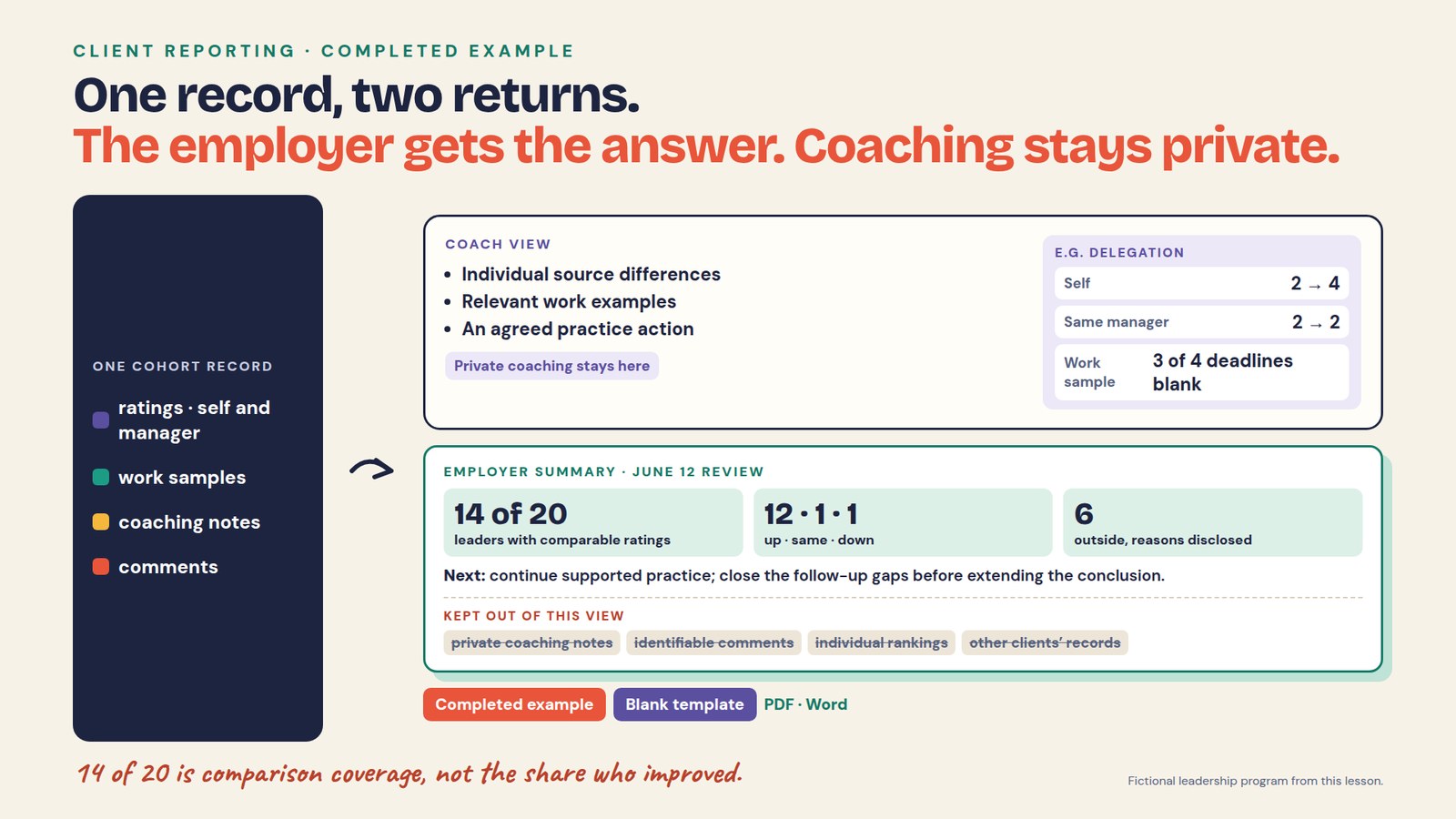
An employer sponsor often needs to decide whether to continue a cohort, change support or request better follow-up. Give that reader a bounded answer with the evidence coverage and next actions. The example below is a separate fictional leadership program, not a measured customer result or an extension of the Bridge dataset.
View the completed client report (PDF) · Edit the example (Word). Start your own report with the Download the blank report (PDF) or Edit the report template (Word).
Example executive summary
“At the June 12 review, 14 of 20 enrolled leaders had comparable delegation ratings from themselves and the same manager at baseline and follow-up. Within that matched group, 12 manager ratings increased, one was unchanged and one decreased. Six leaders remain outside this comparison for disclosed evidence or comparability reasons. Continue supported practice and resolve the relevant follow-up gaps before extending the conclusion to the full cohort.”
The 14/20 figure measures comparison coverage. It is not the share who improved. A higher rating describes change in the available observations; it does not establish the program’s causal effect or financial ROI.
| Reader | Useful evidence | Keep outside the routine view |
|---|---|---|
| Authorized coach | Individual source differences, relevant work examples and an agreed practice action | Another client’s records and evidence outside the coach’s authorization |
| Employer sponsor | Agreed cohort findings, coverage, limitations, program actions and report version | Private coaching notes, identifiable comments not cleared for sharing and individual rankings |
Make the report reproducible and useful
The completed example includes the cohort, dates, inclusion rule, missingness categories, next actions and limits. The editable blank adds fields for source-register references, approval and correction ownership. Before sharing a real report, verify that the counts reconcile and that every linked source follows the same access decision.
When a valid late response changes the matched group from 14 to 15, issue a new report version with the new cutoff and denominator. Preserve the earlier version. The worked calculation explains which measures change and which remain untouched.
For the first provider pilot, agree on one employer cohort, two observable behaviors, one coach review format and one sponsor report. Identify who actually sends follow-ups and reviews overdue responses. An owner or due-date field does not itself implement reminders. Test the configured process before collecting sensitive material.
Running leadership cohorts for employer clients? Explore Training & Programs and discuss one cohort with Sopact. Bring your current assessment and the client report you need to produce.
Build this part of your plan in more detail
These lessons address the next practical questions in this module. Choose the detail your workflow needs, then return to complete the exercise.
- How to Keep Impact Reporting Numbers Consistent
Freeze the evidence and calculation behind a shared result.
- How to Write a Donor Report: Format, Evidence and Example
For a funded program, define the report decision, evidence and financial scope before drafting.
More practical questions in this module (15)
- How Do You Evaluate Mentoring Relationship Quality?
For mentoring or coaching, review the arrangement separately from participant progress and follow up an agreed adjustment.
- How to Write an Evidence-Based Impact Narrative
Write a bounded finding from a claim-and-source table, with accurate quotations and coverage.
- How to Build a Training Metrics Dashboard
Build a recurring decision view with visible denominators, coverage and next actions.
- When Is a Monetary Value on Social Impact Credible?
Optional valuation: first decide whether a monetary estimate would improve the decision and whether evidence is sufficient.
- How Do You Build an SROI Value Map?
Optional valuation: map stakeholders, outcomes, sources and unresolved assumptions before choosing monetary values.
- How Do You Pick a Financial Proxy for SROI?
Optional valuation: compare sources for one outcome; preserve units, context and overlap limits.
- How Do You Estimate Deadweight and Attribution?
Optional valuation: document evidence, uncertainty and calculation bases before adjusting outcome value.
- How Do You Calculate the SROI Ratio?
Optional valuation: reproduce the full worked calculation and test assumptions after the evidence review.
- How to Calculate SROI as New Evidence Arrives
After building a valuation model, practice reviewing new evidence and preserving issued calculation versions.
- How to Report a Job-Training Program to Grant Funders
For grant-funded employment training, assemble the full cohort, target, coverage and expenditure report.
- How to Report Job Placements to Impact Investors
For a placement enterprise reporting to investors, keep participant outcomes, fees, cash and capital scenarios distinct.
- What Is Connected Data Intelligence?
Before repeating the workflow, test identity, source context, shared definitions, access and reproducibility.
- What Are AI Skills?
For a recurring analysis task, define reusable instructions, evidence rules, evaluation examples and review ownership.
- How to Write a Funder Report with AI—and Check It
Once the evidence pack is approved, draft and check the narrative without changing denominators, scope or uncertainty.
- How to Measure Training ROI
When a financial decision requires it, distinguish ROI, benefit-cost ratio and payback with explicit evidence and assumptions.
Add this part to your plan
On workbook pages 6 and 7, sketch the learner and client views. Test allowed access, denied cross-client access, a correction and a source citation.
Download workbook (fillable PDF)Compare with a suggested answer
L-18 receives useful feedback. Client A receives its reviewed cohort findings with missingness stated. Private coaching and unrelated client records stay restricted. The team records test results and assigns an owner to each gap.
Self-check: Can each reader get useful evidence while the agreed boundaries hold?
Questions you may have
Should client reports contain raw coaching notes?
Only when an appropriate purpose and agreement authorize that use. Keep private coaching material separate from routine evaluation reporting by default in this exercise.
Does marking the course complete implement the workflow?
No. It records that you marked a module exercise complete on this browser. The workbook and pilot checks help the team plan and test an implementation.
Apply the method to your work
Use the five-part plan to assess the sources, analysis and permissions your team needs. The solution page shows where a connected platform can support that workflow.
Explore the training and programs solution →