play icon for videos

SROI: Social Return on Investment Explained

Plain-language guide to Social Return On Investment SROI. The seven principles, four adjustments, the formula, and a worked example.

US
Pioneering the best AI-native application & portfolio intelligence platform
Updated
May 3, 2026
360 feedback training evaluation
Use Case
SROI in plain language

SROI puts a dollar value on the change a program creates.

Compare that value to what the program cost and you get a ratio: every $1 invested produced $X of social value. The ratio is the headline. The inputs are the work.

This guide walks through the seven principles SROI follows, the four adjustments that separate a defensible ratio from a marketing number, and how to set up the data once so the ratio recomputes whenever fresh evidence arrives. Worked example comes from a workforce training program. No prior background needed.

  • 01 What SROI is and what it produces
  • 02 The six stages of an SROI calculation
  • 03 The seven principles, in plain words
  • 04 A worked workforce-training example
  • 05 Where SROI fits with theory of change
  • 06 FAQ on calculation, ratios, and tools
The SROI calculation, end to end

Six stages, four adjustments, one ratio

An SROI calculation has the same shape every time. Six stages produce the ratio. Four adjustments make the ratio defensible. Skip a stage and the ratio is incomplete. Skip an adjustment and reviewers discount the result. The SROI methodology earns its credibility from this discipline, not from the size of the final number.

The calculation pathway
01
Scope & stakeholders
What is in the analysis. Who experiences the change. Narrow scope, defended.
02
Map outcomes
For each stakeholder, the changes that actually happened. Not activities. Not outputs.
03
Evidence & value
Proof each outcome occurred. A financial proxy for what the outcome is worth to the stakeholder.
04
Apply adjustments
Subtract the four discounts that separate gross outcome value from net social value.
05
Calculate ratio
Sum the present value of adjusted outcomes. Divide by total investment. Read the ratio.
06
Report & embed
Document assumptions. Share with stakeholders. Wire the data to recompute on fresh evidence.
Four adjustments band
Deadweight
The share of the outcome that would have happened anyway, without the program.
Attribution
The share other actors or programs caused alongside this one.
Displacement
Effects pushed to other groups (a job filled is a job not available to someone else).
Drop-off
How fast the outcome value fades in years two and three after the program.

The adjustments are where most SROI studies are won or lost. A ratio of 1:30 with weak adjustments is less defensible than a ratio of 1:3 with full evidence.

Source: SROI methodology as published by Social Value International in A Guide to Social Return on Investment. The seven SROI principles cover the conduct of the calculation; the four adjustments are the technical discounts applied at stage 04.

Definitions

SROI in plain language

Four definitions cover most of what readers want when they search the term. Each definition is paired with the question form people actually type. Below the definitions, a four-card grid distinguishes SROI from terms it gets confused with: ROI, cost-benefit analysis, theory of change, and the forecast vs. evaluative split.

What does SROI mean?

SROI stands for social return on investment. It is a framework for putting a dollar value on the changes a program produces for the people it serves and others affected. You collect evidence of what changed, assign each change a financial proxy that reflects what it is worth to the person who experienced it, subtract the share that would have happened anyway, then divide by what the program cost.

The result is a ratio: every $1 invested produced $X of social value. The number itself is less interesting than what it summarizes: a defended chain of evidence linking program cost to changes in stakeholders' lives. Two SROI ratios are not directly comparable unless the studies behind them used the same scope, the same stakeholder definitions, and the same adjustment rules.

What does SROI stand for?

SROI stands for Social Return on Investment. The full form is most often written that way, sometimes as Social Return on Investments or Social ROI. The framework was developed by the Roberts Enterprise Development Fund (REDF) in the late 1990s, refined by the New Economics Foundation, and now sits with Social Value International, which publishes the seven-principle methodology and a guide to applying it.

What is the SROI framework?

The SROI framework is a set of seven principles published by Social Value International that govern how the calculation is done. Involve stakeholders. Understand what changes. Value the things that matter. Only include what is material. Do not over-claim. Be transparent. Verify the result.

The principles answer the questions a calculation alone cannot answer: which stakeholders count, which outcomes belong in the ratio, which proxies are appropriate, when the analysis is honest about its limits. A ratio without the principles behind it is a marketing number, not an SROI. Most SROI failures in external review trace back to violating one of these seven, not to arithmetic errors.

What is the SROI formula?

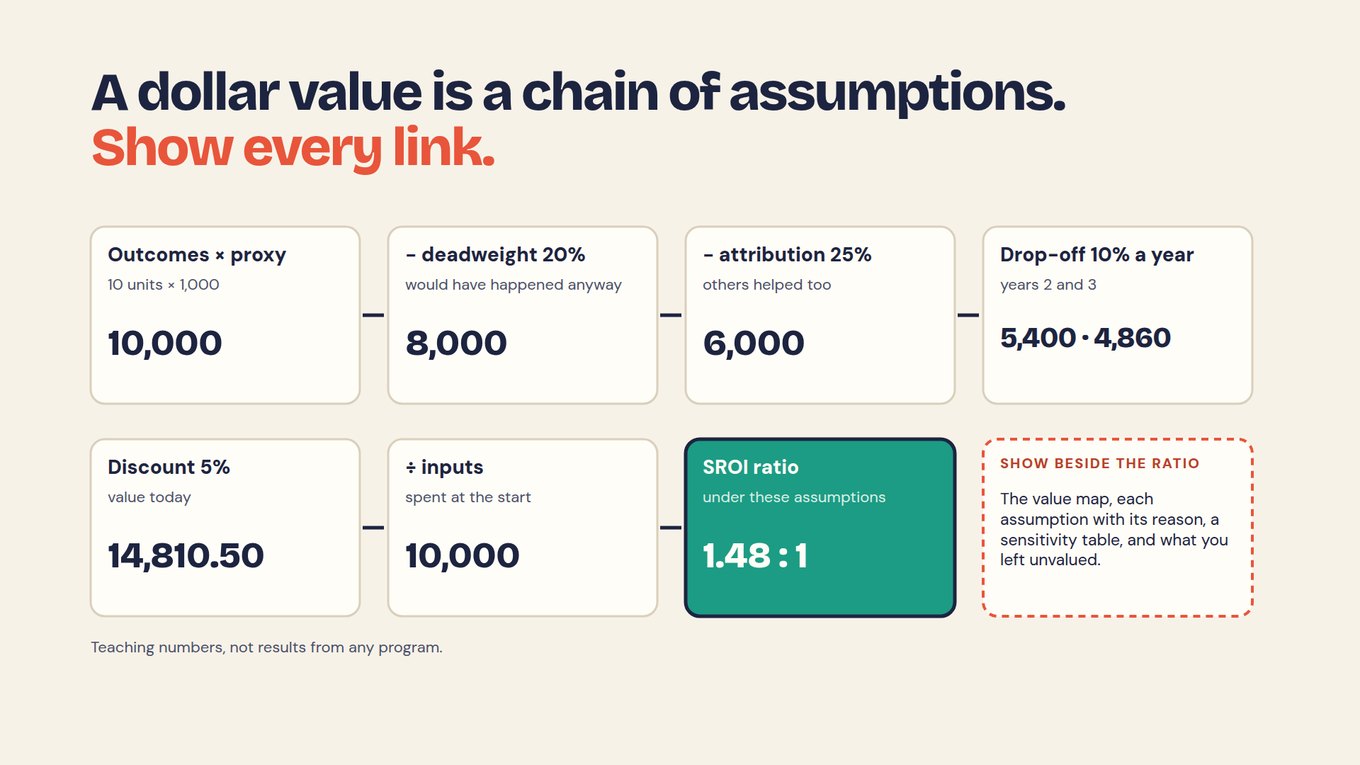
The SROI formula is the present value of net social benefits divided by the value of inputs. In practice: add up the dollar value of every outcome the program produced, subtract the share that would have happened anyway (deadweight) and the share other actors caused (attribution), apply displacement and drop-off adjustments, then divide by the total cost of the program.

Multi-year studies discount future outcomes to present value so a dollar of value next year counts a little less than a dollar today. The arithmetic is straightforward. The credibility of the ratio comes from the evidence behind each outcome and the discipline of the four adjustments, not from the formula itself.

SROI vs related terms

SROI is often confused with four related concepts. The distinctions matter because choosing the wrong framework wastes months of work.

SROI vs ROI

ROI compares financial return to financial investment. SROI extends that to outcomes that have no market price (improved health, increased confidence, justice contact avoided) by assigning each a financial proxy. The challenge SROI takes on is putting a credible dollar value on those outcomes. The challenge ROI does not have.

SROI vs cost-benefit analysis

Cost-benefit analysis (CBA) and SROI both monetize benefits and compare them to cost. The difference: SROI requires beneficiaries to help define what counts as an outcome and which proxies are appropriate. Standard CBA does not. SROI is essentially CBA with stakeholder-driven outcome selection.

SROI vs theory of change

A theory of change explains how a program produces outcomes. SROI takes a validated outcome chain and adds monetary values plus the four adjustments, producing a ratio. SROI builds on theory of change rather than replacing it. The cleanest workflow: write the theory of change first, then run an SROI on the validated outcomes.

Forecast vs evaluative SROI

A forecast SROI predicts the value a program will create using planned outcomes and proxy values from prior research. An evaluative SROI measures the value a program created using evidence from the cohort itself. Forecasts inform funding decisions. Evaluations are stronger evidence and the preferred form for public reporting.

The seven principles, in six commitments

Six principles SROI requires

Social Value International publishes seven SROI principles. Five are listed below as written; the seventh and the closing principle are combined into a single commitment about external scrutiny. Each card names the principle, says it in plain words, and tells you what the failure mode looks like in practice.

01 · STAKEHOLDERS

Involve the people the program changes

Ask the people the program changes which outcomes matter, and how much.

Stakeholders are the people whose lives the program changes. Their judgment about which outcomes matter, and how much, is the input the whole calculation rests on. Beneficiary involvement is what separates SROI from a top-down cost-benefit analysis run from a spreadsheet.

Why it matters: without stakeholder input you end up measuring what is convenient to measure, not what actually changed.

02 · OUTCOMES

Understand what changes

Outcomes are what changed in people's lives, not what the program did.

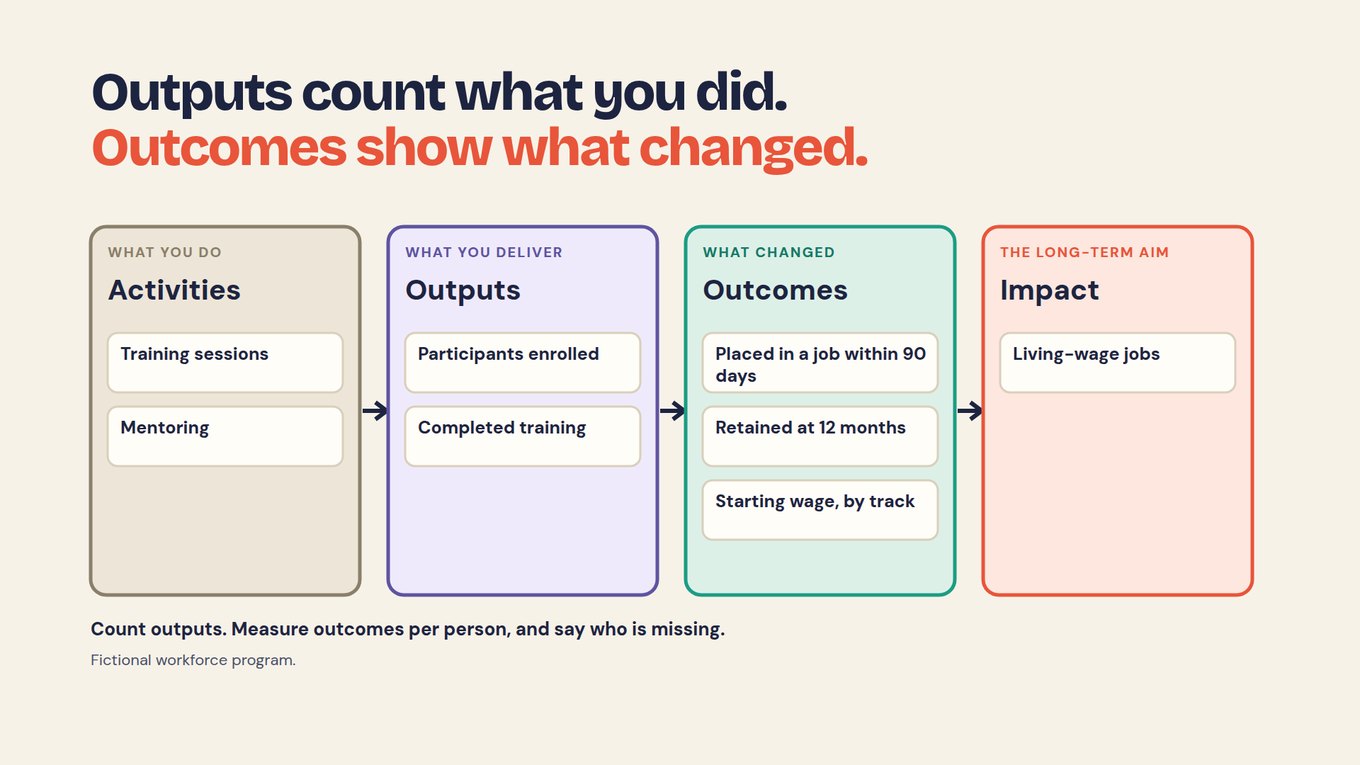
Activities are what the program did. Outputs are what it produced. Outcomes are what changed in stakeholders' lives. SROI counts outcomes only. Confusing one for another inflates the ratio with effort that did not produce change in any stakeholder.

Why it matters: most failed SROIs count training hours instead of skills gained, sessions delivered instead of behavior shifted.

03 · VALUATION

Value the things that matter

Assign each outcome a financial proxy. Cite the source.

Most outcomes have no market price. SROI assigns each one a financial proxy: the wage earned by a person who got a job, the avoided cost of a hospital admission, the value of an additional year of education. Proxies are sourced from prior research and named in the report so reviewers can challenge them.

Why it matters: a proxy without a citation is a guess, and external reviewers will treat it that way.

04 · MATERIALITY

Only include what is material

Material in. Trivial out. Apply the test before the math.

Materiality means the outcome is large enough to change the decision the report informs, and important enough to the stakeholder to count. Tiny outcomes inflate the ratio with noise. The materiality test is applied at outcome selection, not after the calculation is done.

Why it matters: padded ratios fail external review faster than honest small ratios do.

05 · ADJUSTMENTS

Do not over-claim

Subtract the share you did not cause.

Some of the change would have happened anyway (deadweight). Some was caused by other actors or programs (attribution). Some was pushed onto other groups (displacement). Some fades in years two and three (drop-off). SROI requires you to estimate each and subtract before reporting the ratio.

Why it matters: skipping any of the four is the most common reason a published SROI ratio fails an external audit.

06 · VERIFICATION

Verify the result and stay transparent

Show your work. Invite challenge. Document everything.

An SROI is not finished when the ratio is calculated. It is finished when the report names every assumption, every proxy source, every adjustment rate, and a third party has reviewed the calculation end to end. Transparency is a precondition for verification, and verification is what gives the ratio standing.

Why it matters: a ratio with no audit trail is a data point, not evidence a funder can act on.

SROI calculation choices

Six choices that decide whether the ratio holds

Every SROI calculation involves the same six choices. Each has a broken default and a working alternative. The first choice (stakeholder scope) controls the next five. Most SROI rebuilds start by narrowing scope and watching the rest of the calculation get cleaner.

The choice
Broken way
Working way
What this decides
Stakeholder scope
Who counts as someone the program changes
BROKEN
Cast wide. Survey everyone the program touched, including staff, partners, even the office landlord. Pad the outcome list with weak signals.
WORKING
Cast narrow. Identify the groups the program is designed to change, and stop there. Defend the boundary in writing using the materiality test.
Sets the entire outcome map for the rest of the study. Wide scope with thin evidence is the most common reason an SROI fails external review.
Outcomes or outputs
What gets counted toward the ratio
BROKEN
Count training hours, sessions delivered, materials distributed. The numbers are bigger, the data is easier to collect, and the math feels productive.
WORKING
Count what changed in stakeholders' lives. Skills gained, behavior shifted, condition improved. Verify each outcome with evidence from the cohort.
Determines whether the ratio reflects change in lives or only program effort. Funders and reviewers spot the difference within minutes.
Financial proxy choice
How a dollar value gets attached to each outcome
BROKEN
Pick the highest plausible value. Cite a single distant study. Hope no reviewer asks for sensitivity analysis or alternative proxy ranges.
WORKING
Pick a defensible value range. Cite the source. Show how the ratio changes when the proxy is varied. Lower the proxy if the source is weak.
Drives the final ratio more than any other input. Aggressive proxies with weak sources read as marketing, not as evidence, no matter how the ratio looks.
The four adjustments
Deadweight, attribution, displacement, drop-off
BROKEN
Skip them entirely. Or apply a flat 10% across the board to all four so the headline ratio is barely affected and the report can claim "adjustments applied."
WORKING
Estimate each adjustment separately. Cite the basis for each rate. Show the ratio pre-adjustment and post-adjustment so the reader sees the discount.
Half of an SROI's credibility lives in this row. A 1:3 ratio with full adjustments outperforms a 1:30 with weak ones in every audit.
Forecast or evaluative
When in the program cycle the calculation runs
BROKEN
Run a forecast at proposal stage. Publish the projected ratio. Never revisit it with actual cohort data once the program is delivering outcomes.
WORKING
Forecast at proposal. Run an evaluation at end of cycle using the same outcome map. Compare predicted to actual and explain the gap in the report.
Determines whether the SROI becomes a planning artifact or a learning artifact. Funders now expect both, with the gap analysis between them.
Reporting standard
What you publish alongside the ratio
BROKEN
Publish the ratio in a one-pager. Stop. Bury the assumptions in an appendix that no one reads or in a spreadsheet that lives on a consultant's hard drive.
WORKING
Publish the ratio with the seven-principle methodology disclosure, every proxy source, every adjustment rate, and a link to the underlying outcome data.
Determines whether the ratio is defensible or merely published. Verification by an external party requires the full audit trail.
Compounding effect

The first row decides the next five. A wide stakeholder scope inflates the outcome map (row 2), which inflates the proxy work (row 3), which makes the four adjustments harder to defend (row 4), which makes the gap between forecast and evaluation impossible to explain (row 5), which makes the report indefensible to external review (row 6). Narrowing scope at the start is the cheapest way to make every other choice easier.

SROI calculation example

Worked example: a workforce training program

One cohort, 240 participants, three months of data prep before the math. This is what the inputs look like in practice and where they break in survey-only tools. The example is a workforce training program because the outcomes are well-documented and the proxies are credible, but the same pattern applies to financial coaching, youth mentorship, or community health programs.

We trained 240 people in the last cohort. 170 finished the program. 142 got jobs in the next 90 days. The funder is asking for an SROI ratio. Here is where it falls apart. I have wages from payroll, but I do not know what these participants would have earned without us, so I cannot estimate deadweight without a comparison group. I have confidence scores from intake and exit, but the survey tool cannot link the same person across two waves because half the email addresses changed. My consultant is going to spend three months matching CSV exports by hand. The math will take her one afternoon. The data prep will take her a quarter.

Workforce training program lead, mid-cohort review
Quantitative axis

Wages earned from payroll records

Employment status 30 / 90 / 180 days post-program

Job retention in months across the first year

Public benefit reduction compared to pre-program baseline

Tax contribution from new employment income

Qualitative axis

Confidence in interview from open-text intake and exit surveys

Agency over career from mid-program reflection prompts

Mentor relationships sustained beyond program end

Family stability reported by participants and corroborating contacts

Sense of belonging in workplace, tracked at 90 and 180 days

What Sopact Sense produces
A persistent participant ID
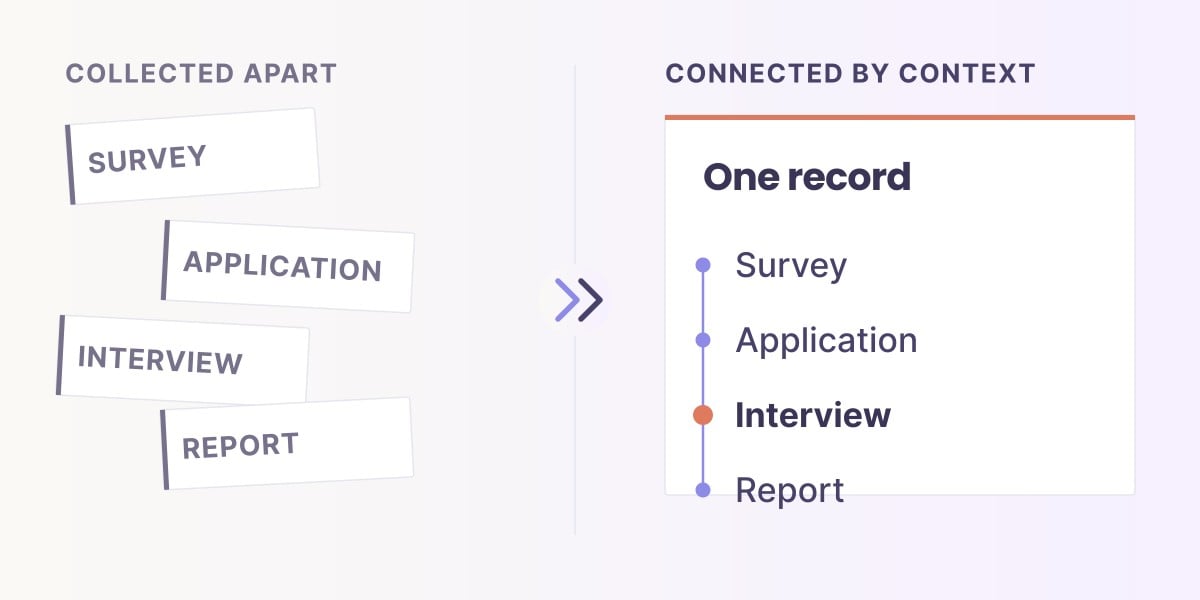
Same identifier across intake, mid-cycle, exit, and 90 / 180-day follow-up surveys, even when names and emails change between waves.
Outcome chain reconciled at source
Self-reported employment cross-checked to payroll feed at the participant level. Discrepancies surfaced for review, not silently averaged.
Open-text confidence extracted
Free-form intake and exit answers parsed into structured confidence and agency variables ready for proxy assignment.
Adjustments parameterized
Deadweight, attribution, displacement, and drop-off rates stored as named parameters. When the underlying source updates, the ratio recomputes for every cohort.
Why traditional tools fail
Email-as-key matching breaks
Half the emails change between intake and follow-up. Manual reconciliation by name plus partial DOB consumes weeks per cohort and never reaches 100%.
CSVs do not connect to payroll
Survey tool exports rows. Payroll exports rows. Stitching them is a separate ETL project that the consultant rebuilds for every cohort.
Open text stays narrative
Confidence is recorded as paragraphs the consultant reads but never extracts into variables. The qualitative outcomes never reach the SROI calculation.
Each cohort restarts from zero
Proxy library and adjustment rates live in a consultant's spreadsheet. When the consultant rotates, the institutional learning leaves with them.

In Sopact Sense, the SROI calculation is not a separate study. It is a view over data already collected, linked, valued, and adjusted in the system. When a fresh cohort completes, the ratio recomputes. When a proxy source updates or a new adjustment rate is published, every prior cohort recomputes alongside it. The structural integration is what makes annual SROI reporting feasible without a new consultant engagement every cycle.

SROI in three program contexts

Three program shapes, three different SROI failure modes

The SROI methodology is the same across sectors. The hard parts are different. Health programs struggle with the data join to claims. Financial inclusion programs struggle with drop-off across multi-year cohorts. Education programs struggle with the gap between proximate outcomes (graduation) and ultimate outcomes (lifetime earnings) that take a decade to verify.

01

Health and wellbeing programs

Outcomes valued through avoided cost

A community health program runs a 12-month intervention for chronic-condition self-management. Participants log weight, blood pressure, medication adherence, and self-rated wellbeing each month. Outcomes are documented in two registers: the program's own intake and exit forms, and the regional health system's claims data. Both registers are needed to estimate avoided cost.

Most SROI attempts in this sector stall at the data join. The survey tool collects self-report. The claims system holds avoided hospital admissions and emergency department visits, the largest dollar values in the calculation. Without a persistent participant ID linking the two, the consultant cannot match the cohort to the claims. The avoided-cost proxy gets dropped or estimated from population averages, which reviewers heavily discount.

Programs that succeed here build the data join into enrollment, not into the SROI study. Each participant's program ID is registered with the health system at intake, with appropriate consent. The avoided-cost proxy is computed against actual claims for the cohort, not against population averages. The ratio is defensible because the largest input is sourced, not estimated.

A specific shape
A community health program in an integrated care system runs SROI annually because each participant's outcomes flow from claims data into the SROI calculation by participant ID, with consent renewed each year.
02

Financial inclusion and microcredit

Outcomes valued through business performance

A financial inclusion program offers small loans plus business training to participants who launch micro-enterprises. Outcomes are measured in business income, household income lift, and savings retained. The proxy library draws on national household income surveys and small-business survival rates. The cohort is followed for at least 36 months because most failure shows up in years two and three, not year one.

Drop-off is the dominant adjustment in this sector. A program reporting 1:8 in year one routinely reports 1:2 by year three because business survival rates and income volatility erode the headline outcomes. Short-cycle SROIs that report only year-one ratios overstate the effect by a factor of two to four. Reviewers with sector experience know to ask for the multi-year drop-off curve, and a missing curve is read as a missing argument.

Programs that report well here treat the SROI as longitudinal from the start. Persistent participant ID across 12, 24, and 36-month surveys makes the drop-off curve calculable directly from cohort data instead of from sector averages. The ratio reported each year is the cumulative ratio with all available adjustments, not the year-one peak. Funders see the honest curve and trust the rest of the report.

A specific shape
A microcredit program in West Africa ships an SROI report each January with year-one, year-two, and year-three ratios for the 2023, 2024, and 2025 cohorts side by side.
03

Education and youth development

Outcomes valued through lifetime earnings differential

An education or youth development program produces outcomes that often do not appear for years. A high school completion program for at-risk students produces immediate outcomes (graduation, college enrollment) and downstream outcomes (lifetime earnings, criminal justice contact avoided) that take a decade to verify. The largest dollar values in the calculation are in the downstream outcomes, the ones the program cannot yet observe.

Most SROI studies in this sector either report only immediate outcomes (understating the program's value) or use national-average lifetime earnings differentials, which reviewers discount because they are not cohort-specific. Cohort tracking ten years out is rare, expensive, and often lost when the program changes administrative systems mid-decade or when staff turn over.

Programs that succeed here pair a forecast SROI at year one with evaluative SROIs at years three, five, and ten as cohort data accumulates. Each successive evaluation tightens the proxy estimates and replaces forecast assumptions with cohort evidence. The persistent ID system has to last longer than the average tenure of the program director, which is the institutional design challenge SROI rarely names but always demands.

A specific shape
A youth development program in Chicago publishes a forecast SROI at end of program plus an evaluative update on the 2018 cohort each year, with the proxy library refreshed as new lifetime-earnings research is published.
SROI tooling

Where Sopact Sense fits in the SROI tool landscape

Sopact Sense SROI Network calculator Social Value UK templates REDF spreadsheet Generic survey tools

Most SROI tools handle one piece of the calculation well. Free calculators and spreadsheet templates from Social Value International, Social Value UK, and REDF teach the structure and work for a one-time forecast. Generic survey tools collect the underlying data. The architectural gap they share is keeping the cohort linked across survey waves, keeping the proxy library current with citations, and keeping the four adjustments parameterized so the ratio recomputes when a source updates.

Sopact Sense holds the whole calculation in one place: a persistent participant ID across pre, mid, and post surveys, a stored proxy library with citations, parameterized adjustment rates, and the SROI ratio computed as a live view over the underlying data rather than a static spreadsheet. The first SROI study still takes the same care as anywhere else. The second one takes hours instead of months.

FAQ

SROI questions, answered in plain language

What is SROI?

SROI (social return on investment) is a framework for putting a dollar value on the changes a program produces for the people it serves and others affected. You collect evidence of what changed, assign each change a financial proxy that reflects what it is worth to the person who experienced it, subtract the share that would have happened anyway, then divide by what the program cost. The result is a ratio: every $1 invested produced $X of social value.

What does SROI stand for?

SROI stands for Social Return on Investment. The full form is most often written that way, sometimes as Social Return on Investments. The concept extends financial return-on-investment thinking by giving social and environmental outcomes a monetary value so they can be compared with program cost.

What is the SROI formula?

The SROI formula is the present value of net social benefits divided by the value of inputs. In practice: add up the dollar value of every outcome the program produced, subtract the share that would have happened anyway and the share other actors caused, then divide by the total cost of the program. Multi-year studies discount future outcomes to present value so a dollar of value next year counts a little less than a dollar of value today.

How do you calculate SROI?

Calculating SROI takes six stages. Define scope and the stakeholders affected. Map the outcomes each group experienced. Collect evidence that each outcome happened and assign a financial proxy. Apply four adjustments: deadweight, attribution, displacement, and drop-off. Sum the adjusted outcome values and divide by total investment. Document assumptions in a report so others can audit the ratio. Most studies take three to five months end to end.

What is the SROI framework?

The SROI framework is a set of seven principles published by Social Value International. Involve stakeholders. Understand what changes. Value the things that matter. Only include what is material. Do not over-claim. Be transparent. Verify the result. The principles guide every choice in the calculation, from who counts as a stakeholder to which outcomes belong in the ratio. A ratio without the principles behind it is a marketing number, not an SROI.

What does SROI mean?

SROI means the social value a program creates for every dollar invested in it, expressed as a ratio. A 1:3 ratio means every $1 of investment produced $3 of value for the people the program serves and others affected. The number itself is less interesting than what it summarizes: a defended chain of evidence linking program cost to changes in stakeholders' lives.

What are the four SROI adjustments?

The four adjustments are deadweight, attribution, displacement, and drop-off. Deadweight is the portion of the outcome that would have happened without the program. Attribution is the share other actors or factors caused. Displacement is the effect pushed onto other groups (a job filled by one person is a job not available to another). Drop-off is how the outcome fades in years two and three. Skipping any of the four is the most common reason an SROI ratio fails an external review.

What is a good SROI ratio?

There is no universal benchmark. SROI ratios vary by sector, scope, and how aggressively the four adjustments were applied. Reported ratios for nonprofit programs commonly land between 1:2 and 1:10. A ratio of 1:30 with weak adjustments is less defensible than a ratio of 1:3 with full evidence. Comparing two SROI ratios requires that the studies used the same scope, stakeholder definitions, and adjustment rules. They rarely do.

What is the difference between forecast and evaluative SROI?

A forecast SROI predicts the value a program will create using planned outcomes and proxy values from prior research. An evaluative SROI measures the value a program created using collected evidence from the cohort. Forecasts are useful for design and funding decisions. Evaluations are stronger evidence and are the preferred form for public reporting. Many organizations run a forecast at proposal stage, then convert it to an evaluation at the end of the cycle using the same outcome map.

How is SROI different from ROI?

ROI compares financial return to financial investment. SROI extends that comparison to outcomes that do not have a market price: improved health, increased confidence, time saved, criminal justice contact avoided. The challenge SROI takes on is putting a credible dollar value on those outcomes using financial proxies. The challenge ROI does not have. The framework also requires that beneficiaries help define what counts as an outcome, which is unusual for financial analysis.

How is SROI different from a theory of change or a logic model?

A theory of change explains how a program produces outcomes. A logic model lays out the same chain in a grid. An SROI takes that chain and adds a monetary value to each outcome plus four adjustments, producing a ratio. SROI builds on theory of change rather than replacing it. The clearest workflow is to write the theory of change first, validate the outcome chain with stakeholders, then run an SROI on the validated outcomes.

How long does an SROI study take?

A first SROI study for a single program typically takes three to five months. Stakeholder mapping and outcome identification take four to six weeks. Evidence collection and proxy research take six to ten weeks. Calculation, write-up, and review take three to five weeks. Repeat studies on the same program are faster because the outcome map and proxy library carry over. Programs with persistent participant tracking can recompute the ratio in days, not months.

Can I use a free SROI calculator or template?

Free calculators and spreadsheet templates from Social Value International, REDF, and others can teach the structure of the calculation, and they work for a one-time forecast. They tend to fall apart when the same study is repeated next year because they have no place to store stakeholder evidence or to track the outcome chain over time. The math is straightforward. The hard part is keeping the inputs current and audit-ready.

Can I use Google Forms or SurveyMonkey for SROI data collection?

Google Forms and SurveyMonkey can collect the survey data behind an SROI. They cannot link a respondent's pre-program survey to the same person's post-program survey to the financial proxy library to the calculation engine. Most SROI studies done in those tools end with a consultant rebuilding the link by hand from CSV exports. The data collection is fine. The integration is not.

Run an SROI on your program

Bring a program. See the SROI ratio.

A working session walks through your program's outcome map, identifies which adjustments will be hardest to defend, and shows where the data join breaks if it is left for the consultant to fix at the end. Most sessions surface one fixable scope problem and one hidden proxy assumption inside the first thirty minutes.

What we cover
Stakeholder scope, outcome chain, the four adjustments, the data join from your existing tools to a defensible ratio.
What you bring
A program, a recent funder report or proposal, and any survey or outcome data you already collect from participants.
What you leave with
A defensible scope statement, an honest read on where the calculation will be challenged, and a sketch of the data join.

AI-Powered SROI Calculator

🎯 AI-Powered SROI Calculator

Calculate your Social Return on Investment with intelligent analysis and real-time insights

✨ Powered by Sopact Intelligence
1:0.00
Current SROI Ratio
$0
Total Investment
$0
Social Value Created
$0
Net Social Return
💰

Investment Details

?
$
%
👥

Stakeholder Groups

?
🎯

Outcomes & Impacts

?
⚖️

Adjustment Factors

?
%
%
%
Your SROI Ratio
1:0.00
Enter your data to calculate
Total Investment $0
Gross Social Value $0
Adjusted Value $0
Net Present Value $0
Net Social Return $0
💡
Enter your investment and outcome data to see your SROI ratio and interpretation.

Sopact Sense Free Course
Free Course

Data Collection for AI Course

Master clean data collection, AI-powered analysis, and instant reporting with Sopact Sense.

Subscribe
0 of 9 completed
Data Collection for AI Course
Now Playing Lesson 1: Data Strategy for AI Readiness

Course Content

9 lessons • 1 hr 12 min