

Build an impact report readers can use: define outcomes, connect evidence, compare results fairly and choose the right reporting tools.
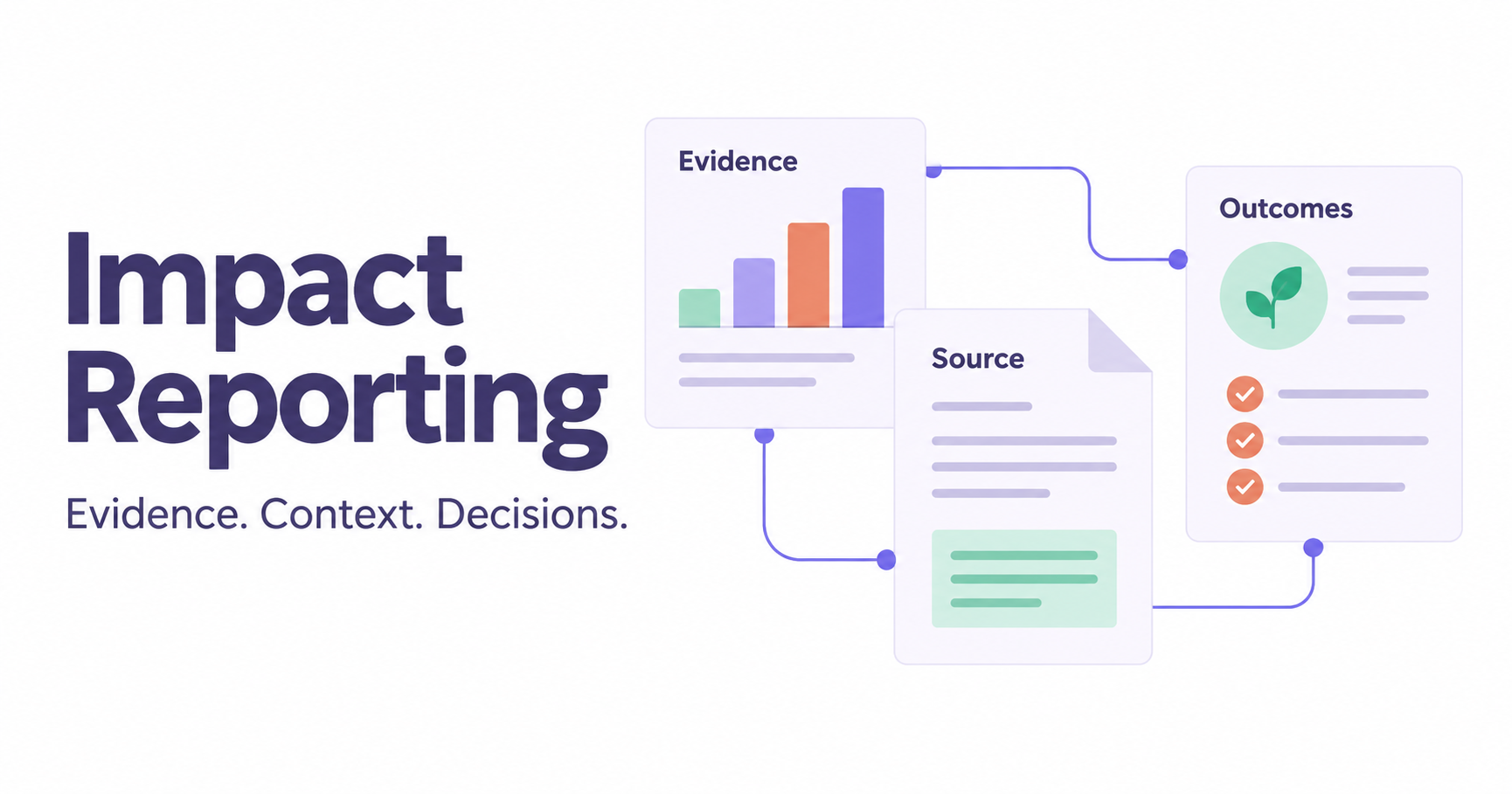
Impact reporting explains what changed, for whom, how you know, and what you will do next. It combines measures of results with the experience of the people affected, the evidence behind each claim and the limits of what can be concluded.
An impact report is the document or presentation that communicates those findings. Impact reporting is the ongoing process behind it: defining measures, collecting evidence, checking results and explaining their implications. A well-designed report gives a reader enough information to assess the claim and make a decision.
For a fund manager, that decision might concern support for an investee. For a foundation, it might be a grant renewal. For a business, it might concern a supplier program or an employee initiative. Social impact reporting focuses on changes in people's lives; broader impact reports may also cover environmental outcomes.
Counts alone are insufficient. Delivering 200 training sessions describes activity. Participants finding and keeping work describes an outcome. Establishing how much of that change resulted from the program requires further evidence about what would likely have happened otherwise.
Use a structure that lets a busy reader find the finding first and inspect the method when needed. The following seven sections are a practical starting point, not a universal reporting standard. Adapt them to the audience's requirements and the maturity of your evidence.
| Section | What the reader needs | Check before publishing |
|---|---|---|
| Executive summary | The main finding, its significance and the decision requested. | Does the headline match the evidence and its limits? |
| Purpose and scope | Who and what is covered, the reporting period and intended outcomes. | Are exclusions and organizational boundaries clear? |
| Methodology | Sources, definitions, sample, collection timing and analysis. | Could another reviewer understand how you reached the result? |
| Quantitative outcomes | Baseline, current result, target where appropriate and denominator. | Are periods, definitions and populations comparable? |
| Qualitative evidence | Experiences that explain the numbers, including conflicting accounts. | Are quotations permitted and themes supported beyond one anecdote? |
| Visual summary | Charts or tables showing the important patterns. | Are units, missing data and uncertainty visible? |
| Learning and next steps | What will change, who owns it and when it will be reviewed. | Is the action connected to a finding? |
Keep detailed definitions and calculations in an accessible appendix or linked evidence record. A public report should not expose private participant records: offer an appropriately anonymized explanation, with controlled access for authorized reviewers.
Get the free guide: How to Write an Impact Report →
Explore impact report examples and dashboards →
For a reusable outline, use the impact report template. The guide explains the writing process; the examples help you assess how evidence is presented.
A report can be calculated correctly yet leave its reader uncertain about what to do. Four useful checks are accuracy, comparability, relevance and credibility. They overlap, but checking them separately exposes different problems.
| Check | Question | Evidence to retain |
|---|---|---|
| Accuracy | Is the result correct? | Validated source values, calculation and review. |
| Comparability | Does it mean the same thing as the result beside it? | Agreed definitions, population, timing and measurement method. |
| Relevance | Does it answer this reader's question? | The decision, requested scope and level of detail. |
| Credibility | Can the reader understand and check the claim? | Source trail, assumptions, limitations and approval. |
A data dictionary defines a measure: its meaning, unit, allowed values, calculation, owner and collection schedule. It can also document stage, source requirements and framework mappings. Shared definitions support consistent collection and comparison. They do not, by themselves, prove that an entered value is accurate or that an outcome was caused by an intervention.
For example, a valid confidence score of 3 does not tell you whether it is someone's first response or a decline from 5. The reporting record needs the observation date, stage and an appropriate way to connect repeated responses. Define those fields alongside the score.
Agree the dictionary with the teams supplying the data, test it on sample records and version changes. A definition that only the reporting team uses will not make partner submissions comparable. The Academy guide on giving every number one definition develops this step.
A practical way to organize reporting context is to distinguish data, framework, audience and expression. This is a working method for preparing reports; it is not an external reporting standard. The layers can live in linked records and controlled documentation rather than being repeated in every file.
Record the source, observation date, reporting period, stage and reason for collection. Keep the distinction between a participant's account, a staff assessment and an administrative record. Each can be useful, but they support different claims. Retain the original document or response so a reviewer can inspect an extraction or interpretation.
Map the measure to the intended outcome, the relevant reporting requirement and any chosen metric definition. A theory of change explains the expected path from activity to outcome. A metric catalog supplies measurement definitions. Neither substitutes for the evidence that the result actually occurred.
Impact Frontiers' Five Dimensions distinguish what changed, who experienced it, how much change occurred, contribution and risk. The GIIN's IRIS+ catalog includes qualitative and quantitative performance metrics. Select measures appropriate to the objective, record their versions and retain any local adaptations. Mapping a field to a framework does not certify a report or establish causality.
A committee reviewing a funding commitment, a program officer adjusting delivery and a board considering strategy need different views of the same evidence. Write down their questions before choosing the charts. Distinguish a documented reporting requirement from a preference or an assumption about what a reader wants.
Agree how the organization names groups, stages and measures. Use consistent units and explain technical terms. Set rules for describing uncertainty: “participants reported” and “the program caused” are different claims. Clear language should make the evidence easier to understand without making it sound stronger than it is.
Keep definitions stable while adapting the selection, time horizon and explanation. This avoids creating separate spreadsheets that gradually disagree. It also lets the reader move from a headline to the relevant detail.
| Reader | Decision | Useful view |
|---|---|---|
| Funder or investment committee | Review the next commitment or release. | Agreed milestones, results, missing evidence and material risks. |
| Program or portfolio team | Change support during the current cycle. | Progress by cohort or partner, emerging issues and explanatory feedback. |
| Board | Assess direction and allocation over time. | Comparable trends, strategic outcomes, costs and limitations. |
| Participants or community | Understand findings and respond. | Accessible results, what was heard, what will change and how to challenge an interpretation. |
A quarterly donor report may need a fixed approved snapshot. The operational dashboard may continue changing as new records arrive. Label both with a reporting date and explain revisions, so the same figure is not presented as two unexplained answers.
Illustrative example: two investees each report 40 jobs. One counts roles filled during the year, including seasonal and replacement hires. The other counts net new full-time positions held at year end. Adding them produces 80, but that is not a defensible total under either definition.
Retain the two results separately. Agree a common definition for future collection, and check whether historical records can be recalculated on that basis. If they cannot, disclose the break rather than constructing a comparable trend. Software can flag an incompatible definition when the checks are configured; someone still needs to resolve it.
On a five-point confidence scale, two participants answer 3. One is at baseline. The other previously answered 5. Their current values are identical, while their trajectories differ. An average alone conceals that distinction.
For individual change, link observations through an appropriate stable identifier and retain stage and date. For anonymous surveys, compare groups with care and describe the limits: group trends do not establish how each individual changed. Never reconstruct identity merely to produce a stronger-looking report.
A team changes the completion threshold, excludes a group or alters a denominator. The new calculation may be reasonable, yet an unmarked year-on-year chart becomes misleading. Give each definition an owner, effective date and version. Record whether earlier results were restated, and explain any break in the series.
Missing, not applicable, not asked and zero also need separate treatment. If sources conflict, retain both, identify the question to resolve and assign a reviewer. A missing financial document should create a visible gap, not be treated as evidence of zero expenditure.
Keep the source attached at every step. The next reporting cycle adds to the same history.
Start with the reader's decision, intended outcomes and reporting obligations. Map each question to a measure or qualitative source. Specify the owner, timing, acceptable evidence and treatment of missing information. Keep a small shared core across partners while allowing justified partner-specific measures.
A quarterly partner update may contain metrics, narrative responses, a financial report and a social audit. Other evidence may sit in a CRM, a file store or an interview transcript. Record what each source describes and which organization, period and activity it belongs to. Confirm access and import arrangements before depending on an integration.
Use clear collection instructions and validation at entry. Ask for clarification while the person who supplied the record can explain it. A mandatory upload field verifies that a file exists; it does not establish that the document covers the right period or supports the claim.
Review completeness, units, time periods, duplicate records and contradictory answers. Apply a documented rubric to narrative evidence where useful. Separate an automated flag from a confirmed finding, and keep the review decision. Investigate a large change before presenting it as success or failure.
Combine the quantitative pattern with relevant qualitative evidence. State the denominator and missing responses. Explain plausible interpretations, including conflicting evidence. Connect important claims to their source and calculation. Keep sensitive information out of public versions.
Have an accountable reviewer check claims, sources, definitions and the requested action. Confirm permission for identifiable stories and quotations. Publish an approved version, record decisions and set a date to review progress. The next cycle should show what happened after the previous recommendation.
Continue in the Academy: turn reporting requirements into collectable evidence →
AI can help extract information from documents, organize open responses, apply a supplied rubric and draft an explanation from selected evidence. It can also miss context, misread a document or create a fluent claim that the source does not support. More context improves the conditions for analysis; it does not guarantee correctness.
Give the analysis a defined scope: source records, approved metric definitions, reporting period, audience and rules for uncertainty. Require source references and a visible treatment of missing or conflicting evidence. Test the output against known examples, including a deliberately incompatible pair of metrics.
Check calculations independently where possible. Review whether a qualitative theme reflects several records or one vivid statement. Inspect a sample of document extractions against the originals, especially tables, units and reporting dates. Keep the original evidence available to authorized reviewers.
The video below explores why context matters when a report is already clean. Read its distinction between dictionary and context alongside the guidance above: a well-designed dictionary can carry contextual definitions, while actual source records and review are still necessary.
The right tool depends on the work behind the report. For a small, occasional report with stable definitions, a spreadsheet and document editor may be sufficient. Recurring reporting across partners, periods and document types creates a different requirement: keeping evidence connected and reviewable without rebuilding the dataset each cycle.
| Capability to test | Ask for a demonstration |
|---|---|
| Collection beyond a survey | Submit metrics, narrative, a financial file and an audit under one partner and period. |
| Analysis of new evidence | Show how a newly uploaded document is processed, checked and reviewed. |
| History across cycles | Compare a partner's last two periods and open the sources explaining the change. |
| Shared definitions | Change a metric version and show what happens to existing reports. |
| Review and permissions | Separate contributor, reviewer and public access; demonstrate correction history. |
| Reproducible reporting | Reopen an approved report and reproduce a headline figure from its snapshot. |
Estimate total implementation cost: defining measures, setting up collection, cleaning imports, reviewing outputs, training contributors and maintaining the process. A low subscription price can still require substantial staff time. Conversely, a more capable platform is not worthwhile if the process is too small to need it.
Sopact's portfolio intelligence solution is relevant when teams need recurring partner submissions, documents and qualitative evidence connected over time. Evaluate the exact workflow, integrations and review controls you need in a demonstration. For a separate selection guide, see impact reporting software.
Kuramo Foundation had developed an internal impact framework for its gender-lens investing initiative and wanted to use it from launch. Its published customer story describes Sopact bringing manual data together, mapping indicators and operationalizing the framework across collection and analytics.
The useful reporting lesson is the sequence: make the framework operational before the first reporting deadline. The story demonstrates a working data foundation; it does not establish a quantified improvement in investment outcomes or prove that every reporting task was automated.
A formal report may be annual or quarterly. Review decision-critical evidence at a pace that allows action: a delivery issue might need attention this week, while an employment outcome needs a later follow-up. Choose the cadence deliberately instead of treating the publication deadline as the only moment to examine evidence.
Work through these related Academy lessons in order:
Get the free impact report writing guide →
Browse impact report examples and dashboards →
Use the guide to plan the structure and the examples to discuss what your readers need to see.
Impact measurement defines and assesses change. Impact reporting communicates the findings, methods, limitations and implications to an audience. Reporting draws on measurement; a polished report cannot replace missing evidence.
Choose a framework appropriate to the intended outcomes and audience requirements. A theory of change explains the expected pathway. Impact Frontiers provides dimensions for understanding impact, while IRIS+ supplies metric definitions. Document the version, mapping and any adaptations rather than treating a framework name as proof.
Only when their definitions, units, periods and populations support aggregation and duplicate counting is addressed. Otherwise present them separately or recalculate from adequate source data. Do not silently combine incompatible measures.
Match formal publication to commitments and reader needs, often quarterly or annually. Review operational evidence more frequently where action is possible. Keep approved reporting snapshots distinct from dashboards that continue to update.
AI can assist with extraction, organization and drafting from supplied evidence. Check source references, calculations, missing information and interpretations. Shared definitions and connected records support analysis, but they do not remove the need for review.
State what is missing, how it limits the finding and what would resolve the gap. Keep zero, not applicable and not collected separate. Preserve conflicting sources and narrow the claim until a reviewer resolves the issue.
Sopact provides an impact report template, a free guide called How to Write an Impact Report, and a library of report examples and dashboards. The links in this article lead to each resource.


