


A member satisfaction survey helps an association understand how members experience its services, which needs remain unmet and what should change. Useful questions connect to decisions: which benefit to improve, which barrier to remove or which group needs a different way to participate. A satisfaction score alone cannot explain why a member stays or leaves.
This guide is for professional associations, trade bodies, chambers and member networks. It includes questions you can adapt, a way to separate individual and organizational responses, and a worked example of reporting results without overstating what they show.
Choose the decision before the questions
Start with the decision your team will make when the answers arrive. “We want to know what members think” leaves too much room for a long survey that nobody uses. “We need to decide which two benefits to improve next year” provides a clearer boundary.
List the decisions, who can answer each question and what other evidence you already have. Your membership system may hold renewal dates and event registrations. Asking members to re-enter that information creates unnecessary work and may introduce conflicting records. Confirm changing details when needed; explain any planned linkage between answers and existing records.
| Decision | Ask members | Check alongside answers |
|---|---|---|
| Improve a benefit | Whether they used it, their experience and what would help | Use records, accessibility issues and delivery costs |
| Reach less active members | Barriers, relevant topics and preferred participation options | Who received the invitation and which groups responded |
| Understand renewal concerns | Perceived value, unmet needs and reasons for uncertainty | Actual renewal outcomes when linkage is disclosed and appropriate |
| Plan network support | Local priorities and the support a member organization needs | Its size, circumstances and relevant reporting period |
Member survey questions you can adapt
The questions below are starting points, not a validated scale or a requirement to ask everything. Select a short set for your decision. Keep a consistent reference period, test the wording with members and include “not used,” “not applicable” or “don’t know” where those answers are meaningful.
Overall experience and value
- Thinking about the past 12 months, how satisfied are you with your membership? Use a balanced scale from very dissatisfied to very satisfied.
- How well has membership helped you meet the professional or business goals you joined to pursue? Include an option for people who have not yet had enough experience.
- What has been the most useful part of your membership during this period?
- What is one thing we could change to make membership more useful to you?
Keep experience and value separate. A member can enjoy events but find the overall package poorly suited to their needs. Combining both into “How satisfied are you with the quality and value of membership?” makes that distinction difficult to interpret.
Benefits and unmet needs
- Which of these benefits have you used in the past 12 months? List the relevant benefits and include “none of these.”
- For each benefit you used, how useful was it for your work? Show this question only for benefits the respondent selected.
- Which topics or challenges would you most like the association to help you address? Ask for up to three priorities.
- What support do you need that the association does not currently provide?
Do not treat non-use as dissatisfaction. Someone may not know a benefit exists, may not need it this year or may be unable to access it. Those situations call for different actions.
Participation and access
- What, if anything, made it difficult for you to participate? Offer relevant options such as timing, cost, location, accessibility, language, relevance and lack of information, plus an open response.
- Which participation options would make it easier for you to take part?
- How easy was it to find the information or support you needed?
- If you contacted the association for help, what happened and what could have worked better?
Renewal and follow-up
- At present, how likely are you to renew your membership when it is next due? Include “not my decision” and “not sure.”
- What is the main reason for that answer?
- May we contact you about the issue you raised? Explain how contact details will be used and whether they are stored separately from the survey answers.
For organizational memberships, ask whether the respondent makes or informs the renewal decision. One employee’s satisfaction is useful evidence, but it is not automatically the organization’s renewal intention.
Separate members, representatives and participants
An association may have member organizations, nominated representatives and many people who use its services. Define who a response represents before inviting people. An annual organization return can come from one authorized representative; an event experience survey may collect individual views from several employees of that organization.
Keep those reporting units separate. Five employees responding to an event survey do not count as five member organizations. Record the organization and individual relationship only when necessary and permitted. Where anonymity is promised, do not quietly use membership details to identify a respondent.
Let local groups ask useful questions without losing comparison
Federated networks do not always need one identical survey. Chapters may work in different languages, industries or local conditions. Agree the few common questions needed for the network decision, then allow local questions that serve local work.
Write down the shared question’s meaning, response options, period and eligible population. If a chapter changes those elements, review whether its result still belongs in the same comparison. A question about event satisfaction and a question about the value of annual membership measure different experiences even when both use a five-point scale.
Use a small data dictionary to distinguish common measures from local ones. Preserve the original wording and version. Mapping field names helps organize answers; it cannot make incompatible questions equivalent.
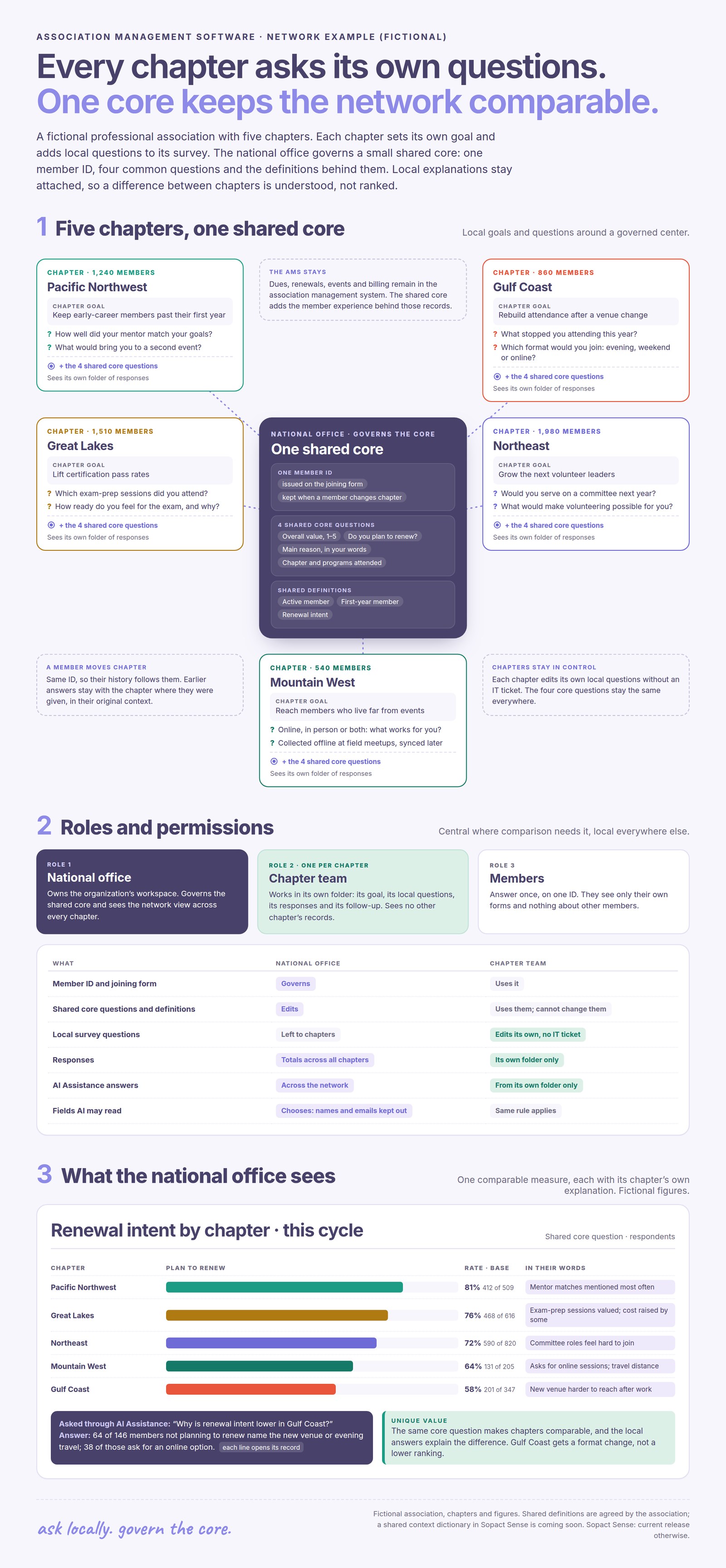
Here is how that can look across a whole network, in a fictional association with five chapters. Each chapter adds its own questions to four shared ones, and the national office compares renewal intent with each chapter’s reasons beside it rather than ranking the chapters.
Collect answers from the people you need to hear
Choose the invitation list from the reporting unit and decision. Explain why you are asking, how long the survey is expected to take after testing it, who will see the answers and what members will receive back. Make the survey usable on a phone and offer an appropriate alternative for people who cannot use the main channel.
Plan reminders without making members feel that participation is compulsory. For an anonymous survey, decide how reminders can be sent without connecting answers to individuals. Test translated versions for meaning, not just grammatical accuracy.
Record who was eligible and invited. Compare respondent coverage across relevant groups such as membership type, tenure or region, where collecting and reporting those details is appropriate. A large number of responses can still leave an important group unheard.
Analyze satisfaction, coverage and reasons together
Report the response base for each finding. The number answering the satisfaction question may differ from the number completing the survey. Separate missing answers from explicit neutral or “don’t know” answers. Decide which categories constitute “satisfied” before calculating a percentage.
Read comments alongside the relevant question, response and period. Group repeated concerns while retaining the original text and exceptions. AI can help propose themes, but a reviewer should check ambiguous comments, translation issues and whether the summary represents the evidence. Remove identifying details from quotations when needed.
A worked example
In this fictional example, an association invites 200 eligible individual members. Eighty respond, and 72 answer the overall satisfaction question. Fifty-four of those 72 select “satisfied” or “very satisfied.”
- Survey participation is 80 ÷ 200 = 40% of invited members.
- Satisfaction is 54 ÷ 72 = 75% of members who answered that question.
- Eight respondents skipped the satisfaction question. They are not automatically dissatisfied.
The association should not announce “75% of our members are satisfied” without qualification. It can report that 75% of respondents to that question were satisfied, state the response base and examine who did not respond. Comments may suggest an improvement to test; the survey does not prove that improvement will raise renewal.
Return findings members can use
Close the survey with a clear commitment about when members will hear back. The returned summary should explain what you heard, whose answers it represents, what you will change and what you cannot resolve yet. Give each action an owner and a review date.
A local chapter should receive useful findings about its own context, subject to confidentiality limits. Avoid ranking chapters with small or incomparable response bases. A qualified finding with a practical next step is more useful than a league table that rewards different definitions or participation patterns.
Use the editable question-to-decision worksheet to connect each survey question to a decision. Adapt the returned-findings template for your contributors, then choose the individual-member or independent-organization example to check coverage, missing answers and corrections before sharing a conclusion.
When the survey becomes a recurring workflow
A single survey can be manageable in the tools you already use. The work changes when you repeat it across chapters, link it to events and member history, receive documents from different contributors and need permissions that follow those relationships.
That is the workflow to evaluate with Sopact: collection, analysis, continuing context, shared definitions and governed use. Test whether your team can revise a local question, preserve prior answers, review the supporting evidence and return an appropriate result. Keeping your existing membership administration system may be the right starting point.
Build your member collection plan in the Academy →
See which membership analytics requirements to test →
Common questions
How often should we survey members?
Match the cadence to the decision and the member’s experience. An annual survey can inform planning, while a short event or service check-in can address a recent interaction. Coordinate requests so the same member is not repeatedly asked for information the association already holds.
Should a member satisfaction survey be anonymous?
Choose this before collection. Anonymous feedback may be appropriate when identification could discourage candor. Identified follow-up may help resolve a service issue when the member understands and accepts that use. Do not promise both anonymity and individual follow-up from the same linked answers.
What is a good member satisfaction score?
There is no universal threshold that makes unlike surveys comparable. Interpret the score using the question wording, scale, respondent mix and period. A trend using compatible questions and a clear response base is more informative than an unexplained external benchmark.
Sources and review
The sample questions and numerical example are original teaching material. General question-design guidance is supported by Pew Research Center’s guide to writing survey questions, including clear wording, response options and question-order effects. These sample questions are not a validated research instrument.
Put the plan to work
Bring one recurring member reporting cycle, the sources it uses and the decision it needs to support.
Explore the membership workflow →