


Related solution
Applications & Grants
Connect application evidence, human review and the next program stage.
Explore the solution →


Live webinar: Wednesday, October 7, 2026 | 9:00 AM PT
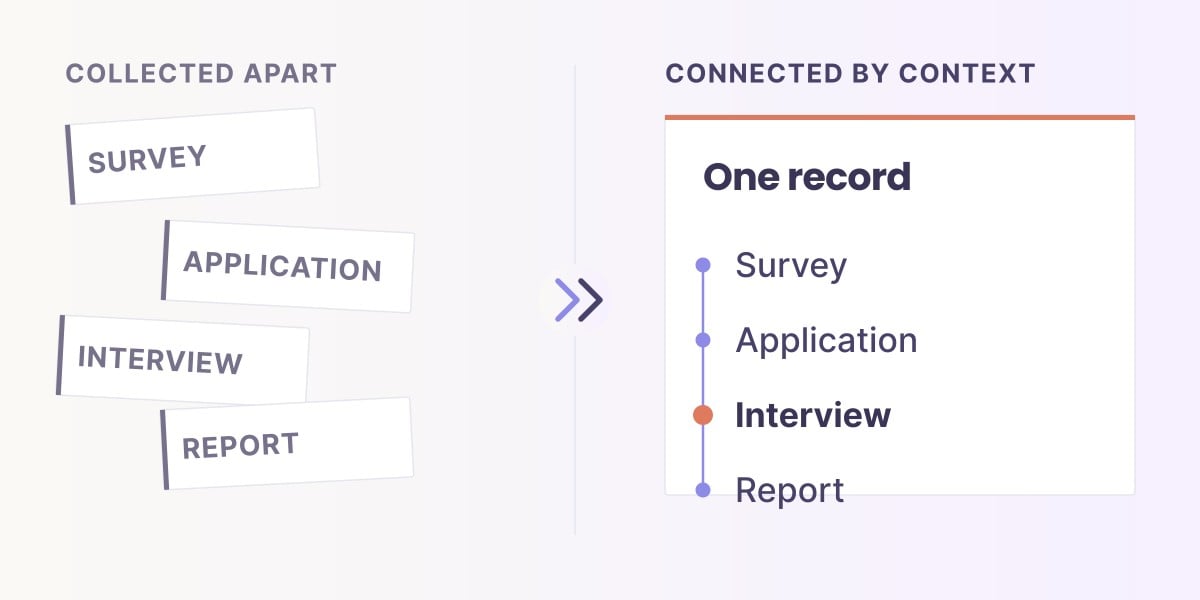
Building context across your data. In 30 minutes, see how to connect data and definitions across teams, with the right permissions and governance, so scattered data points become intelligence your teams and AI can actually use.
Save your spot (free)USE CASE / SOFTWARE GUIDE
Award management software helps organizers collect entries or nominations, coordinate judges, evaluate submissions and communicate decisions. Good software gives entrants a clear process, helps judges apply the right criteria and leaves organizers able to explain how the final selection was reached.
The problems usually appear between submission and decision: incomplete evidence, judges reading the same material repeatedly, inconsistent interpretations of a rubric and last-minute reconciliation of scores. A public-voting contest also needs different controls from a confidential expert panel. The right platform must fit the way the award is actually decided.
AI can now assist parts of awards administration and review, including preparing summaries and identifying relevant evidence. The useful distinction is whether it reduces preparation while keeping the judges’ reasoning visible. Sopact focuses on evidence-based assessment for human decisions; specialist awards platforms offer important strengths in voting, program presentation and judging administration.
Bring the material needed for the award criteria together.
Make relevant evidence and unanswered questions easier to see.
Keep human judgment connected to the basis for selection.
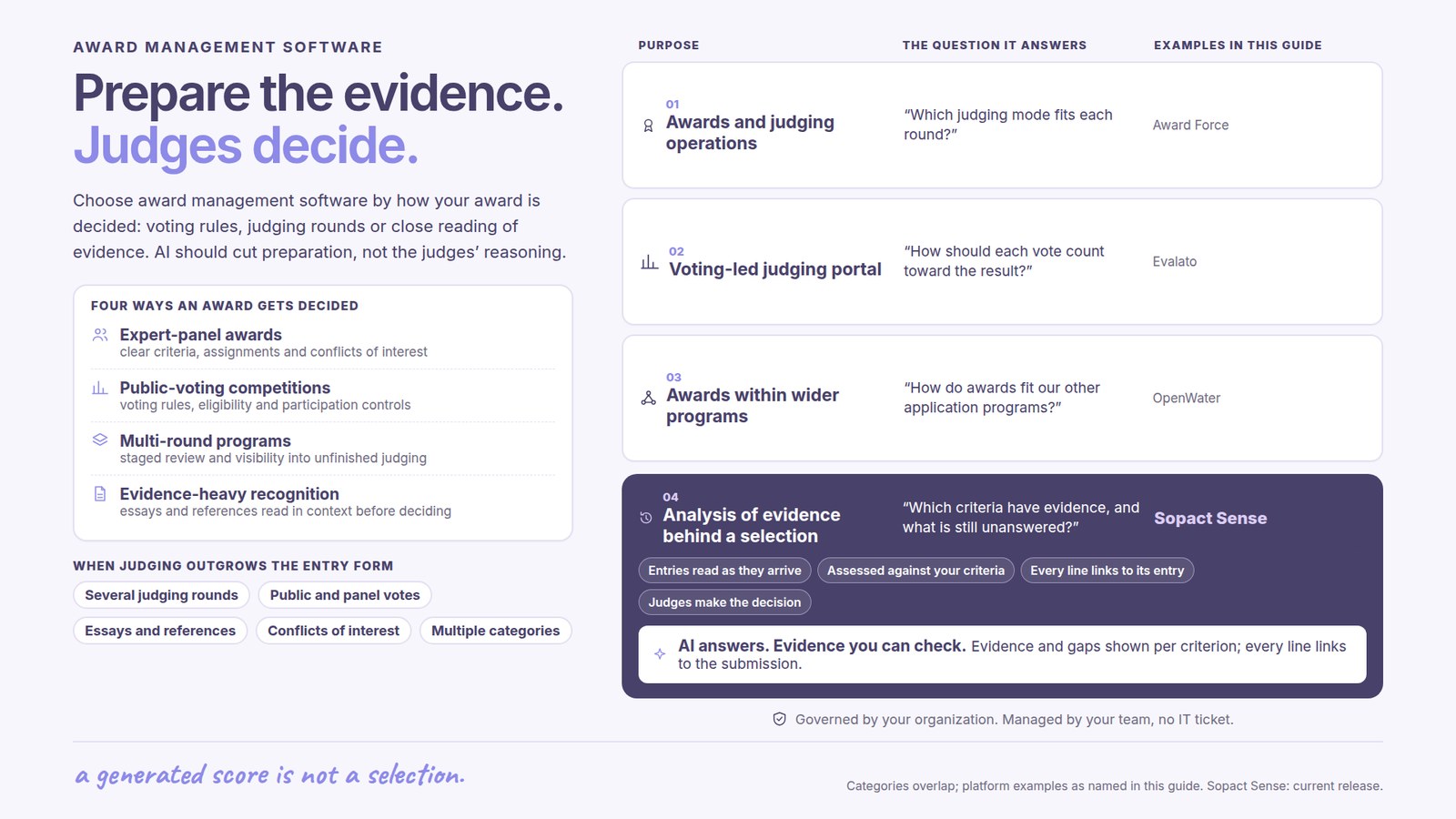
| Award format | What matters most |
|---|---|
| Expert-panel awards | Clear criteria, manageable review assignments, conflicts of interest and evidence behind the recommendation. |
| Public-voting competitions | Voting rules, eligibility, participation controls and the relationship between public and panel results. |
| Multi-category or multi-round programs | Different criteria where needed, staged review and visibility into unfinished judging. |
| Evidence-heavy recognition | Reading essays, supporting documents and references in context, with clarification before a final decision. |
These formats can overlap. Begin with the actual rules for selection, then consider entry fees, branded presentation, communication and integrations. An AI assessment feature does not replace the operational requirements of a public competition.
Award Force documents qualifying, scoring, preference-based selection and public voting that can be combined across rounds. This is relevant for awards with varied judging formats and a substantial program-administration workload.
Its AI guidance also discusses summaries and other awards tasks. The buying question is how the chosen judging mode, review controls and entrant experience fit the program—not whether the platform has AI at all.
Evalato’s judging documentation describes assignments by round and category, six voting types, comments and progress tracking. Its voting options include scoring, popularity, points, positional voting and single transferable vote.
It is a relevant option when the structure of voting and the experience of judges are central. Decide how each round contributes to the final outcome before choosing a voting method simply because it is available.
OpenWater supports awards alongside grants, scholarships, fellowships and other application programs. It emphasizes configurable submission and review processes and connections with association-management and CRM systems.
That fit matters for associations or institutions running several program types. Evaluate the effort to maintain different processes and the integration with existing member or applicant records, rather than treating every program as an isolated award form.
Sopact is relevant when reading and interpreting submissions is the major constraint. It analyzes incoming application evidence against the program’s context and makes the analysis available for questions through AI Assistance. Reviewers can inspect the basis of an assessment, identify gaps and decide where closer reading or an interview is needed.
This purpose differs from buying a full public-voting or awards-promotion system. Confirm those specialist requirements separately. For a selection-only award, the immediate value is better preparation and a defensible human decision; there is no need to impose a long post-award participant journey.
Judges often spend valuable time orienting themselves: finding the relevant section of an essay, checking a supporting document and working out whether a requirement has been addressed. Useful AI assistance reduces that preparation and makes omissions visible. It should help a judge focus attention rather than replace an independent assessment with a persuasive paragraph.
An application may describe a strong result without explaining the nominee’s contribution. Another may meet the eligibility requirements but lack evidence for a particular criterion. These require different follow-up. A source-linked assessment is useful because the reviewer can understand the distinction and decide whether clarification is appropriate.
Treat a score, a supporting explanation and a final decision as separate things. Program rules for eligibility, conflicts and human deliberation still govern the award. AI participation alone does not establish consistency or fairness.
Sopact’s AI-native approach makes incoming analysis available as applications arrive. Reviewers can use AI Assistance to ask about the submitted evidence and the program criteria, with the relevant material available for inspection. A new question does not need to begin with another manually assembled packet.
For an expert-panel award, the benefit is a clearer starting point for judgment: which criteria have evidence, what remains unanswered and which entries need closer consideration. Reviewers can spend more of their time examining differences that affect the decision.
The program team retains control over the selection criteria and decision. Sopact’s role is personalized evidence preparation and analysis, with ongoing support as the program changes. See AI application review software for the broader approach.
Sopact’s typical setup estimate is two days to two weeks for an agreed scope. Once the configured workflow is running, analysis becomes available as data arrives. Final decisions still depend on the submission deadline, interviews, judges’ availability and committee deliberation.
The Project Olympus customer story describes a five-day application launch and overnight assessment against a custom rubric before a human committee made its decisions. In that entrepreneurship program, the analysis prepared the committee for closer review. The committee still decided who should advance.
When comparing options, separate launch preparation, reviewer preparation and final judging time. A faster summary is useful only if it reduces meaningful work in the actual selection process.
If public voting and multi-round awards administration dominate the work, start with dedicated awards platforms. If the organization already runs several application programs, integration and shared administration may matter most. If substantial essays and supporting files create a review backlog, include Sopact’s evidence-analysis approach.
Before committing, agree how reviewers will reach the supporting material, handle unanswered questions and record the basis for the decision. Include the support needed for a new award cycle. Those choices determine whether the software helps the panel concentrate on judgment or merely moves the same workload into a new interface.
It organizes entries or nominations, judging assignments, evaluation and decisions. Depending on the product, it may also support public voting, entry fees, branded program pages and multiple rounds.
AI can help prepare evidence and assessments, but the award’s rules and human decision process remain essential. A generated score should not be confused with a justified final selection.
Sopact fits programs where understanding substantial written submissions and supporting evidence is the main review burden. Specialist voting, promotion and event requirements should be assessed separately.
Not always. For a selection-only award, focus on entry quality, review effort and explainable decisions. Continuing program tracking matters only if the award includes later support or reporting.
Continue with a purpose
Related solution
Connect application evidence, human review and the next program stage.
Explore the solution →Continue learning
Explore how program criteria guide evidence review.
Start learning →
Customer story
An entrepreneurship-program example of rubric-based preparation for human selection.
Read the story →See how Sopact can prepare your award evidence for closer human review, questions and final decisions.
See it with your workflow →