play icon for videos

Impact Reporting Software: 10 Platforms Compared (2026)

Compare the 10 best impact reporting software platforms for nonprofits, foundations, and funders — and which turn program data into funder-ready reports.

Updated
June 10, 2026
360 feedback training evaluation
Use Case
Software Comparison · 2026

Impact Reporting Software: 10 Platforms Compared for Funders & Nonprofits

Impact reporting is longitudinal work — the same people, tracked across intake, exit, and follow-up, reported cycle after cycle to the funders and investors who decide on renewal. This comparison covers the ten platforms that turn that data into compliance, reporting, storytelling, and evidence — and is honest about when a chat window like ChatGPT or Claude is all you need.

3 tools · no shared ID
pre-survey post-survey interviews PDFs · docs case notes
ONE PERSON
id_482 · every form
Evidence funders trust
71%
earned the credential · n = 184
mentor 38% · interview prep 27%
↳ response #482, in her words
Scattered data → one person, one ID → a report funders renew
Scope

This page compares software for reporting impact — turning collected data into reports and dashboards. For defining what to measure and how to collect it, see impact measurement software.

Definition

What is impact reporting software

Direct answer

Impact reporting software turns program data collected over time — pre and post surveys, interviews, outcome metrics, documents — into the reports funders, impact investors, donors, and boards use to make decisions. It is longitudinal by nature: the same participant tracked across intake, exit, and follow-up, cycle after cycle, with every reported number traceable to a source response. One evidence base serves four jobs at once: compliance, reporting, storytelling, and evidence.

Those four jobs are why the category exists. A report that does only compliance is the eighty-page checkbox, filed and forgotten. Only storytelling is the gala video nobody who funds at scale quite trusts. Only evidence is the methodology appendix nobody finishes. The reports that earn grant renewals and investor confidence do all four from one source — the number carries the story, the story cites the number, and the compliance field was captured at collection.

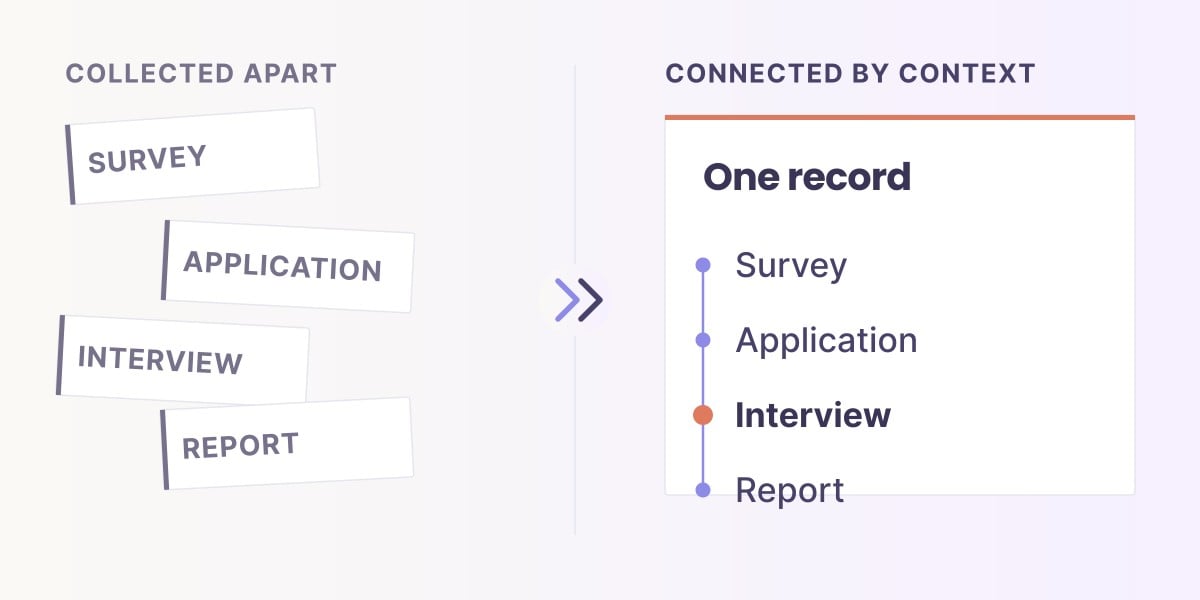
The structural problem is longitudinal identity. A typical workforce training nonprofit collects intake forms in one tool, mid-program surveys in another, exit interviews as documents, and outcome metrics in a spreadsheet. By report time, the same participant appears under three name spellings, so every pre-to-post claim — skill gained, confidence shifted, wages changed — rests on weeks of hand matching. And the open-ended responses, the part of the evidence funders actually quote, sit unread against the deadline.

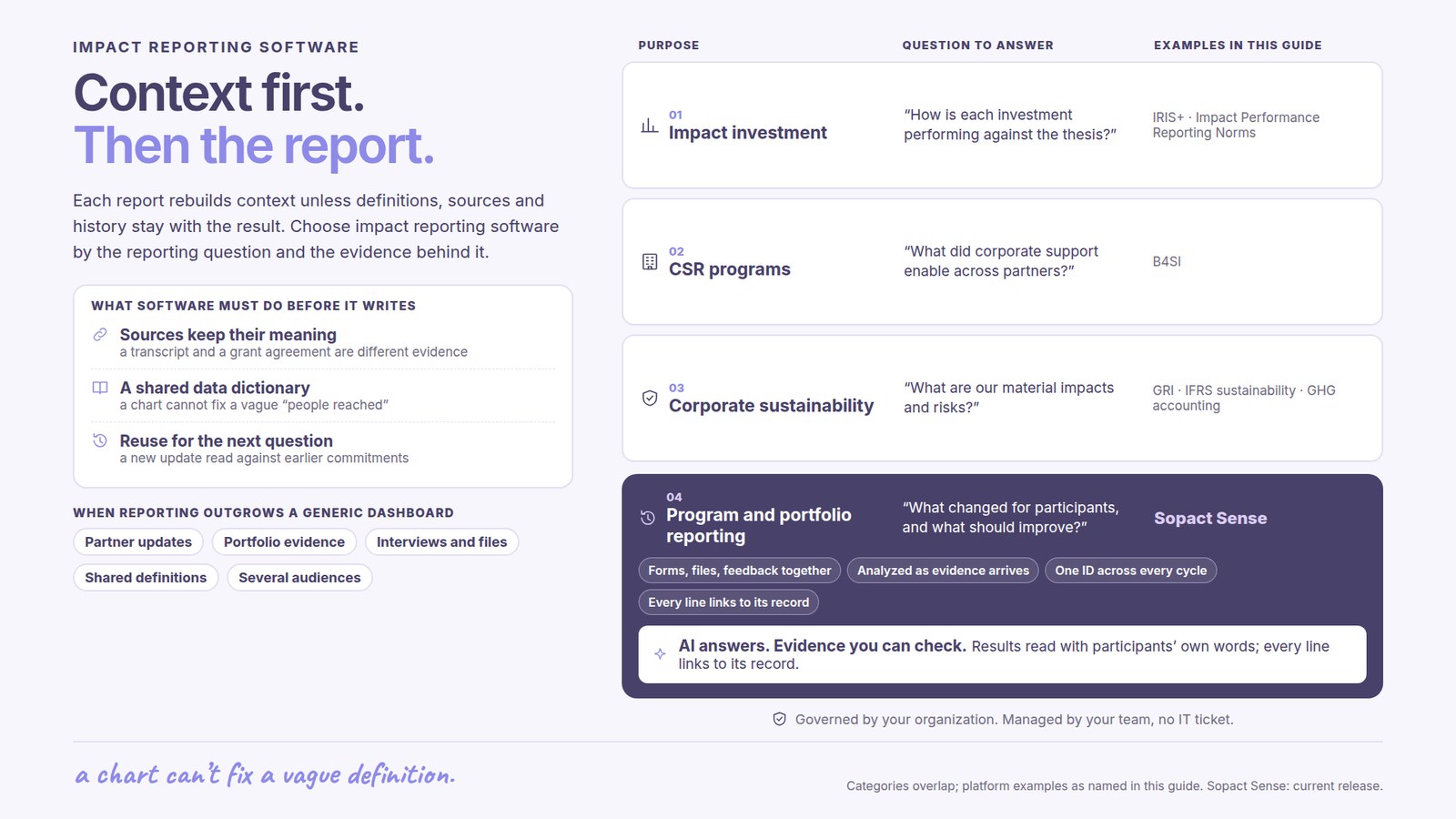
Reporting software earns its place when it solves that pipeline, not when it adds another dashboard on top of it. The platforms below differ most on one axis: whether they treat reporting as a layout exercise on already-clean numbers, or as a data problem that starts at collection — one ID per person, carried across every form and every year. For the reporting practice itself, see the impact reporting guide. This page is about choosing the software.

Buyer Criteria

How to choose impact reporting software

Feature lists converge; data models do not. These six criteria separate platforms that produce a report from platforms that produce a report you can defend.

01 · Data model

Does every record carry a stable identity

The pre-survey, the exit interview, and the six-month follow-up must resolve to the same participant without manual matching. If the platform cannot bind records to a unique ID at intake, every longitudinal claim in the report — skill gained, confidence shifted, income changed — rests on hand reconciliation.

02 · Qualitative handling

What happens to open-ended responses

Most tools accept text and ignore it. Ask the vendor to show an open-ended response becoming a theme code or rubric score, and that code rolling up across the cohort. If the answer is "export to Excel and code it yourself," the platform reports on a fraction of your evidence.

03 · Traceability

Can a reader click from finding to source

Funders and auditors increasingly ask where a number came from. A report where "68 percent reported increased confidence" links back to the actual responses survives scrutiny. A report where the number arrived by copy-paste does not.

04 · Freshness

Does the report update or rebuild

If new responses require re-exporting, re-cleaning, and re-charting, the report is a snapshot that ages immediately. Continuous reporting — where the document reflects data as it arrives — turns the reporting cycle from a six-week project into a review step.

05 · Audience outputs

One dataset, several documents

The board wants a one-page summary, the funder wants outcomes against targets, the program team wants the open feedback verbatim. Check whether the platform produces audience-specific outputs from the same underlying data, or whether each audience means another manual build.

06 · Total cost of operation

License price vs. staff time

A small foundation rarely fails on subscription cost — it fails on the analyst-weeks each cycle consumes. Price the workflow: hours from "data collected" to "report shipped," per cycle, per program. The cheapest license attached to a manual pipeline is the most expensive option on this page.

The Comparison

The 10 platforms compared

Ordered by how completely each platform covers the path from raw data to shipped report. "Data model" describes what kinds of evidence the platform can analyze, not merely store.

Platform Best for Reporting outputs Data model Pricing posture
1 · Sopact Longitudinal programs where qualitative + quantitative evidence must roll into continuous, traceable reports Live report links, dashboards, funder/donor/board variants from one dataset Clean-at-source collection; automated theming and rubric scoring of text; every finding cites its source Flat program-based; no per-record scaling
2 · UpMetrics Funders and sports/youth philanthropy aggregating grantee metrics Portfolio dashboards, impact frameworks, shareable reports Structured metrics with framework mapping; qualitative as attachments Quote-based, funder-oriented
3 · Clear Impact Government and agencies running Results-Based Accountability scorecards Public scorecards, performance dashboards Indicator and performance-measure data; narrative fields untyped Per-scorecard tiers
4 · ImpactMapper Foundations coding grantee narratives and tracking trends in documents Trend visualizations, SDG mapping, exportable charts Document and survey coding with manual + assisted tagging Subscription tiers
5 · SureImpact Human-services nonprofits and collaboratives tracking case-level outcomes Outcome dashboards, partner network rollups Case management records; structured outcomes Per-organization quote
6 · Bonterra Impact Management Large nonprofits already in the Bonterra/Social Solutions stack Program dashboards, funder reports from case data Structured case and service data; deep CRM ties Enterprise contract
7 · True Impact Corporate CSR teams estimating and reporting program ROI Standardized social ROI reports, benchmark comparisons Predefined outcome models; survey-fed estimates Per-program pricing
8 · Blackbaud Institutions wanting reporting inside the fundraising system of record Donor-facing reports, financial + outcome blends Fundraising CRM data; outcomes via add-on modules Enterprise contract
9 · Submittable Grantmakers reporting on application and grantee pipelines Grant cycle dashboards, applicant funnel reports Application and form data; review workflows Per-seat + volume tiers
10 · Salesforce Nonprofit Cloud Organizations with Salesforce admins building custom reporting Fully custom dashboards and report builder Anything — if you build the object model yourself Per-seat + implementation cost

Pricing postures reflect publicly stated models as of June 2026; confirm current terms with each vendor.

Platform Breakdowns

Each platform, in depth

01

Sopact

Best for: programs where the evidence is mixed — open-ended responses, interviews, documents, and metrics — and the report has to ship continuously, not once a year

Sopact treats reporting as the last step of a clean pipeline rather than a layout problem. Data collection runs through forms where every response binds to a unique participant ID at intake, so the pre-survey, mid-program check, and exit interview resolve to the same person without reconciliation. Open-ended responses are themed and rubric-scored on arrival — a 400-word reflection from a job-training participant becomes a confidence score and two theme codes the moment it is submitted, and those codes roll up across the cohort as the program runs.

The practical result: most of the data work that normally happens after collection — deduplication, matching, coding, charting — happens during it. A grantee writing a quarterly funder report, a scholarship team summarizing 500 applicant essays, or an accelerator tracking founder confidence across cohorts reviews findings instead of producing them. Reports publish as live links where every percentage and theme count clicks back to the source response, which is the traceability standard funders and auditors now ask for.

Data source
Intake form + exit interview, each response bound to participant_id and timestamp
Transformation
Automated theming + rubric scoring on arrival; scores roll up per participant, themes distribute across the cohort
Report
Live funder report — "72% gained job-search confidence" — each figure citing its source responses
Qualitative + quantitative Continuous reporting Source-cited findings Clean-at-source IDs Longitudinal tracking

See Sopact Sense for the product, or the impact report guide for the method.

02

UpMetrics

Best for: funders aggregating structured metrics across a grantee portfolio

UpMetrics is funder-first: grantees submit metrics against shared frameworks, and the platform rolls them into portfolio dashboards and shareable impact reports. It is strong on framework alignment and visual polish. Qualitative grantee evidence travels as attachments rather than analyzed data, so narrative reporting still depends on staff reading and summarizing by hand.

Portfolio rollupsFramework mappingStructured metrics
03

Clear Impact

Best for: government agencies and coalitions running Results-Based Accountability

Clear Impact's Scorecard is the standard tool for RBA practitioners — public-facing scorecards that track indicators and performance measures with turn-the-curve narratives. If your reporting requirement is an RBA scorecard, it is the direct fit. Outside that methodology, the data model is rigid, and open-ended stakeholder evidence has no analytical home.

RBA scorecardsPublic dashboardsIndicator tracking
04

ImpactMapper

Best for: foundations coding trends across grantee reports and documents

ImpactMapper focuses on the document side of funder work: upload grantee reports, code them against SDGs or custom taxonomies, and visualize trends across the portfolio. The coding workflow is researcher-friendly and assisted, though it remains a post-collection exercise — the analysis happens after documents arrive rather than as data is gathered, which suits annual cycles better than continuous learning.

Document codingSDG mappingTrend visuals
05

SureImpact

Best for: human-services nonprofits and funder collaboratives tracking case-level outcomes

SureImpact connects case management to outcome reporting — a housing-services network, for example, can track individual client milestones and roll them up across partner organizations into a shared dashboard. The model is structured and case-centric; it reports well on service delivery and outcome counts, less so on the qualitative texture of why outcomes moved.

Case-level outcomesNetwork rollupsHuman services
06

Bonterra Impact Management

Best for: large nonprofits already operating in the Bonterra / Social Solutions ecosystem

Bonterra (the merged Social Solutions, EveryAction, and CyberGrants stack) offers impact reporting as part of an enterprise case management and fundraising suite. If your organization already runs intake and services through Apricot or ETO, the reporting layer reads from data you have. Adoption outside that ecosystem means an enterprise implementation, and qualitative analysis is not the suite's center of gravity.

Enterprise suiteCase dataCRM-integrated
07

True Impact

Best for: corporate CSR and employee-volunteering teams reporting social ROI to leadership

True Impact standardizes corporate social program reporting: predefined outcome models estimate the value of volunteering, giving, and program investments, and the outputs benchmark against peers. For a CSR director who needs a defensible ROI figure for the leadership deck, it is purpose-built. It is an estimation framework more than a primary-data pipeline — the numbers model outcomes rather than trace them to stakeholder evidence.

Social ROICSR benchmarksCorporate reporting
08

Blackbaud

Best for: institutions that want donor-facing reporting inside the fundraising system of record

For universities, hospitals, and large nonprofits running Raiser's Edge NXT, Blackbaud's reporting blends financial and engagement data into donor-facing outputs without leaving the CRM. Program outcome reporting arrives through add-on modules and configuration; organizations whose evidence is primarily stakeholder voice rather than transaction history will find the model fundraising-shaped.

Donor reportingFundraising CRMEnterprise
09

Submittable

Best for: grantmakers reporting on application pipelines and grant cycles

Submittable's reporting strength sits where its data lives: applications, reviews, and awards. A community foundation can report on funnel volume, review progress, and disbursement by program area directly from cycle data. Post-award outcome reporting — what the funded work achieved — depends on follow-up forms whose narrative content still requires manual synthesis.

Grant cyclesApplication dataReview workflows
10

Salesforce Nonprofit Cloud

Best for: organizations with admin capacity that want fully custom reporting on a CRM backbone

Salesforce can report on anything — once someone builds the object model, the flows, and the dashboards. Nonprofit Cloud provides program and outcome objects to start from, and the ceiling is the highest on this list. So is the cost of reaching it: implementation partners, admin time, and ongoing maintenance. It is a platform decision, not a reporting tool purchase.

Fully customCRM backboneAdmin-dependent
The Question Everyone Asks First

Can ChatGPT or Claude do impact reporting?

Honestly: sometimes. Before buying anything on this page, run the test below. For a small, clean, one-time report, a general-purpose chat tool is a fine way to build — and there is no reason to buy a platform for it.

A chat window is enough when all five are true
  • One survey, one moment — no pre/post matching across forms
  • Under roughly 200 responses — few enough to eyeball
  • A one-off — you will not have to reproduce it next quarter
  • Low stakes — no funder or auditor will ask how a number was computed
  • Mostly numbers — only a handful of open-text answers

If all five hold, paste your spreadsheet into the chat and save real hours. One rule even then: verify every number against the sheet before publishing — a chat model will compute a percentage on the wrong denominator without telling you.

Impact reporting, though, is rarely a one-off. Grant funding and impact investment run on longitudinal evidence — the same participants tracked from intake through follow-up, reported quarter after quarter, year after year, in a form that survives a renewal meeting or an audit. At that point five problems arrive, usually together, and better prompting fixes none of them, because they are data problems wearing an analysis costume.

Break 1 · Repeatability

Can you get the same answer twice?

Paste the same spreadsheet next month and the themes, counts, even the tone come back different. When a funder asks "how did you calculate this," there is no durable answer. A report you cannot reproduce is a report you cannot defend.

Break 2 · Scale

Past a few hundred rows, rows get dropped

Hundreds of responses, multiple forms, attachments — long inputs get cut off and the model quietly drops rows without saying which. You cannot audit a sample the tool picked for you.

Break 3 · The join

The score and the story must be the same person's

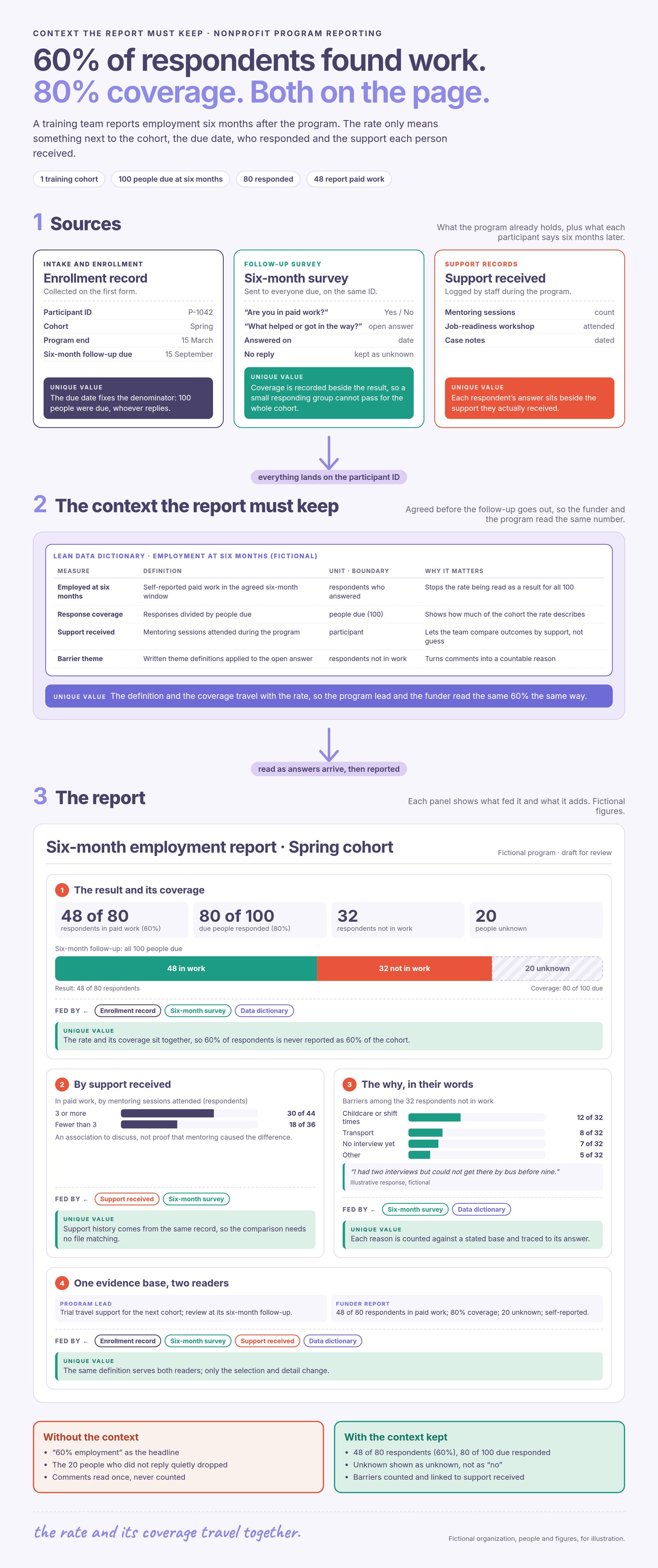
A "71%" that carries a quote from response #482 needs one record and the right denominator. A chat window has no persistent participant ID, so it cannot reliably match score to story across pre, post, and follow-up. The output will look joined and not be.

Break 4 · The rule set

This year must compute like last year

Year-over-year trends only mean something if the rules held still — same indicators, same denominator, same theme codebook. A new prompt is a new rule, and a fake trend.

Break 5 · Your taxonomy

Your program's own language cannot live in a prompt

A disability-employment program is not one ladder — visual impairment, hearing impairment, and autism each take a different path to a job, and severity changes the support each person needs. Mapping hundreds of mixed records to indicators and outcomes in that taxonomy, then re-mapping to each funder's framework, is how your work becomes legible to the people who fund it. A chat window re-learns your language from zero every session.

All five share one shape: the intelligence lives inside one conversation, and longitudinal reporting needs it to live between conversations — identity that persists, rules written once and re-run, evidence that traces. That is the line between a drafting tool and reporting software. Below the line, the chat window wins. Above it, the cost is not the hours — it is the renewal meeting where a number falls apart. The free impact report guide walks through this decision in full, including a signal checklist for knowing when you have crossed.

Disambiguation

Impact reporting software vs. impact measurement software

Vendors use the terms interchangeably; buyers should not. Measurement decides what counts as evidence. Reporting turns the collected evidence into something an audience reads. Evaluate each platform against the job you are hiring it for.

This page · Reporting

Impact reporting software

  • Transforms collected data into reports, dashboards, and report links
  • Answers: what happened, for whom, with what evidence
  • Audiences: funders, donors, boards, program teams
  • Core test: can a reader trace any finding back to its source response
  • Failure mode: beautiful documents built on unreconciled data
Sibling page · Measurement

Impact measurement software

  • Defines frameworks, indicators, and collection instruments
  • Answers: what should we measure, and how
  • Audiences: program designers, evaluators, MEL teams
  • Core test: do the indicators connect to a theory of change
  • Failure mode: rigorous frameworks no one collects against

The strongest setups close the loop: clean primary data collected against a deliberate framework, reported continuously, with secondary data from existing systems layered in where it strengthens compliance or context. If you are earlier in that journey — still deciding what to measure — start with the impact measurement software comparison and return here when the data exists.

By Audience

For nonprofits, foundations & impact investors

The same category serves three buyers with different reporting jobs. The platform that fits depends on which one you are.

Nonprofits & NGOs

Report up, learn in real time

The job is two reports from one dataset: the outcomes report the funder requires, and the live view the program team uses to adjust mid-cohort. A youth services organization running programs across five schools needs attendance and outcome metrics rolled up per site — and the open feedback from students analyzed while there is still time to act on it.

Decisive criterion: qualitative analysis at collection, not after
Foundations & Funders

Aggregate without flattening

Grantee reports arrive as PDFs; portfolio reporting usually means re-keying them into a spreadsheet. The better pattern reads grantee evidence at source level — narrative reports themed automatically, metrics bound to grantee IDs — so the portfolio view keeps its citation chain. Small foundations on a budget should weight staff-time cost over license cost.

Decisive criterion: grantee narratives become data, not attachments
Impact Investors & CSR

Portfolio evidence that survives diligence

An impact fund reporting to LPs, or a corporate team reporting program outcomes to leadership, needs standardized metrics across portfolio companies plus the qualitative evidence that explains them. The same need shows up outside the social sector — a customer-experience team reporting churn-driver themes to executives faces the identical pipeline problem.

Decisive criterion: standardization across entities with traceability intact

Writing the report itself?

The free guide covers structure, evidence selection, and examples — how to write an impact report your funder actually reads.

Get the Guide
The Real Alternative

Beyond spreadsheet-based reporting

For most teams evaluating this category, the incumbent is not another platform — it is Excel plus a survey tool plus a long weekend. The spreadsheet workflow fails at three predictable points, and any platform worth buying has to fix all three.

Identity breaks first. The intake sheet says "Maria G.," the exit survey says "Maria Gonzales," the follow-up says "M. Gonzalez." Every longitudinal claim now requires a human to decide whether three rows are one person. Across a 200-participant cohort, that decision repeats thousands of times — and it is wrong often enough to make the pre/post deltas unreliable.

Qualitative data goes unread second. The open-ended column holds the reasons behind every number, and it is the column the deadline forces the team to skip. Closed-form responses alone tell a small fraction of the story; the context lives in the text. When the text is themed and scored on arrival instead of coded by hand at quarter-end, that context makes it into the report — and into mid-program decisions.

Freshness dies third. The exported report is stale the day after export. When a funder asks a follow-up question in March about a January report, the analysis starts over. Continuous reporting ends the rebuild cycle: the report is a living document, and the reporting deadline becomes a review, not a production sprint.

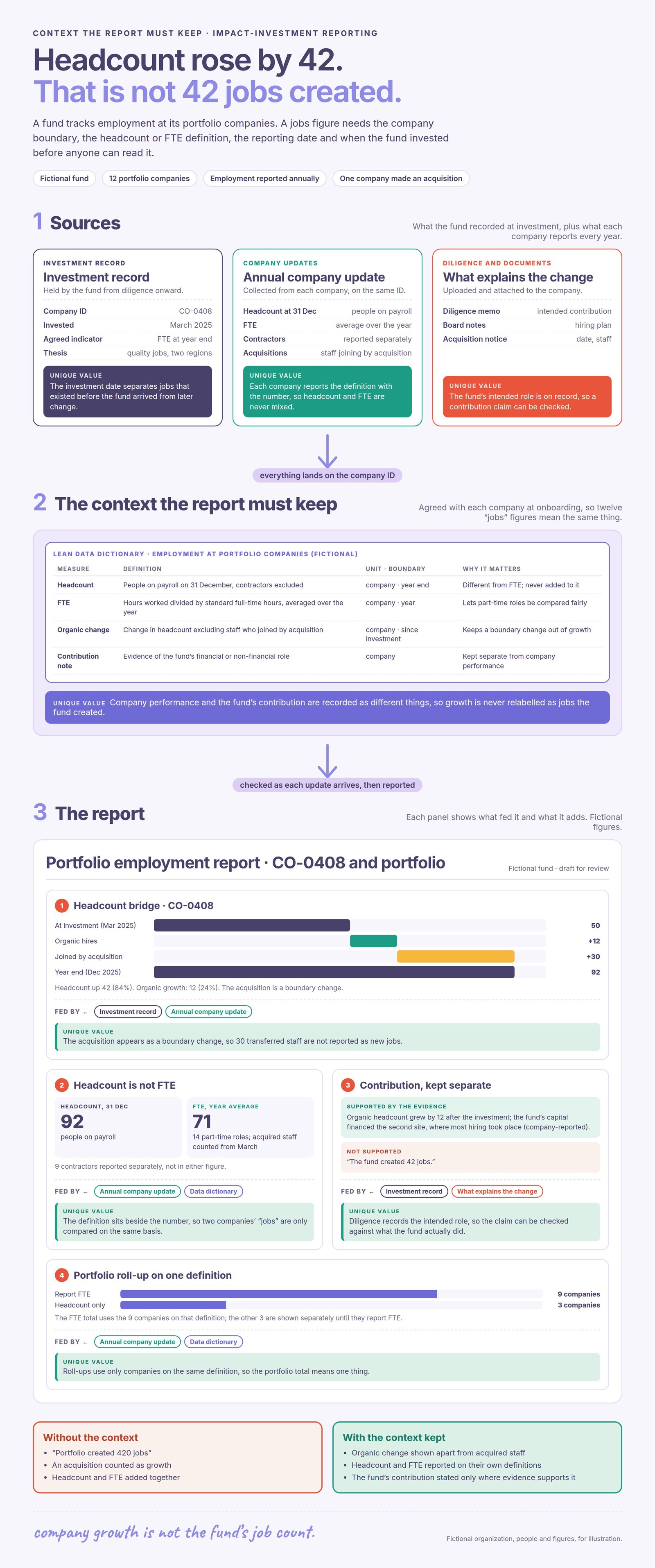
There is also a pattern beyond the platform itself worth naming. Clean primary data — collected at source, bound to IDs, analyzed on arrival — pairs with secondary data already sitting in your CRM, finance system, or grant records. Primary plus secondary is what produces reporting that holds up everywhere it is used: compliance documents that cite evidence, donor stories grounded in real stakeholder voice, board dashboards that reconcile with finance. And where a recurring finding should trigger a recurring action — a low-confidence flag routing to a coach, a risk theme opening a review task — the analyzed data can feed automated workflows downstream, so the learning loop closes without a person re-running the analysis.

Primary data
Stakeholder surveys, interviews, documents — clean at source, ID-bound
+
Secondary data
CRM, finance, grant systems — context the stakeholders did not provide
Output
Compliance, reporting, storytelling, and evidence from one traceable pipeline
FAQ

Frequently asked questions

What is impact reporting software?

Impact reporting software turns collected program data — survey responses, interviews, outcome metrics, documents — into reports and dashboards that funders, donors, and boards can read. It sits downstream of data collection: the collection layer captures the evidence, and the reporting layer transforms it into distributions, comparisons, narratives, and citations that support funding and program decisions.

Can I use ChatGPT or Claude to write an impact report?

For a small, one-time report — one survey, under roughly 200 responses, low stakes, mostly numbers — yes, a general-purpose chat tool works well and a platform would be overkill. It breaks down when reporting becomes longitudinal: results must be reproducible across cycles, scores and quotes must join on the same person via a persistent ID, the computation rules must hold steady year over year, and the analysis must run in your program's own taxonomy. Those are data problems a prompt cannot fix, which is the line between a drafting tool and impact reporting software.

What is the difference between impact reporting software and impact measurement software?

Impact measurement software defines what to measure — frameworks, indicators, data collection design. Impact reporting software turns the collected data into the outputs an audience reads — funder reports, donor updates, board dashboards. Many platforms do one well and the other poorly. Platforms that handle both keep every reported number traceable to its source response, which is what reviewers increasingly ask for.

What platforms can report on social impact?

Platforms that report on social impact include Sopact, UpMetrics, Clear Impact, ImpactMapper, SureImpact, Bonterra, True Impact, Blackbaud, Submittable, and Salesforce Nonprofit Cloud. They differ in data model: some report only on structured metrics, while others also analyze qualitative evidence — interviews, open-ended responses, documents — and connect it to the numbers.

What is the best impact reporting software for nonprofits?

The best fit depends on where the nonprofit's evidence lives. If most of it is qualitative — participant interviews, open-ended survey responses, grantee narratives — a platform that analyzes text at collection time, like Sopact, removes the manual coding step that usually delays reports by weeks. If the data is purely structured metrics, a scorecard tool like Clear Impact or a CRM-based option like Bonterra may be enough.

What should small foundations on a budget look for in impact reporting software?

Small foundations should prioritize four things: a data model that links every grantee response to a stable ID, automated analysis of narrative grantee reports, report outputs that update as new data arrives rather than requiring a rebuild, and pricing that does not scale per grantee record. Avoid platforms that require a dedicated administrator — the cost is in staff time, not the license.

Can impact reporting software replace spreadsheets entirely?

For most reporting workflows, yes. Spreadsheets break in three places: identity (the same participant appears under different names across files), qualitative data (text gets summarized by hand or dropped), and freshness (the report is stale the day after export). Reporting platforms with clean-at-source collection resolve all three. Spreadsheets remain useful for one-off ad hoc analysis, not for recurring reports.

How does impact reporting software handle qualitative data like interviews and open-ended responses?

Most reporting tools do not — they accept only structured metrics, and qualitative evidence is pasted in as anecdote. Platforms built for qualitative analysis apply automated theming and rubric scoring as responses arrive, so each open-ended answer produces a theme code or score that rolls up across the cohort. In the final report, every theme count and score traces back to the original sentence.

Do impact investors and funders use the same reporting software as nonprofits?

Increasingly, yes — but with a portfolio view layered on top. A nonprofit reports on one program; a funder or impact investor aggregates reports across dozens of grantees or portfolio companies. Platforms that serve both sides let the funder read grantee evidence at source level rather than receiving flattened PDF summaries, which is where most portfolio reporting loses fidelity.

How long does it take to produce a funder-ready report with reporting software?

With manual workflows — export, clean, code, chart, write — a single program report typically takes two to six weeks. With software that analyzes data as it is collected, the report exists continuously and a reporting cycle becomes a review step measured in hours: confirm the period, check the findings, add interpretation, publish.

Does impact reporting software work with data already collected in other systems?

Yes, with a caveat. Most platforms import CSV exports or connect to CRMs, form tools, and grant management systems. The caveat is data quality: imported records arrive with the identity and duplication problems of the source system. The strongest results come from pairing primary data collected cleanly at source with secondary data from existing systems — the combination supports compliance, storytelling, and evidence that neither produces alone.