


What is an impact strategy?
An impact strategy states what change you will pursue, for whom, how your work is expected to produce it and how you will know, then turns that into choices: what to do, what to stop and which few metrics to report.
It is broader than a list of indicators. A strategy can include outcomes that take years, commitments about how people are treated and places you will not work. Measurement tests the strategy; it should not shrink the mission to whatever is quickest to count.
THE SHORT VERSION
- A strategy answers three questions: what change, for whom, and how you will know it is happening.
- The "how you will know" part becomes a short list of metrics, each with a definition both you and your funder would count the same way.
- That list is agreed on the onboarding call and written down, so every later report can be checked against it.
How do impact strategy, theory of change and measurement fit together?
The strategy chooses the change and the priorities, the theory of change explains why the work should lead there, and the reporting agreement names the few numbers that will show whether the change is happening. Each answers a different question, and a reviewer should be able to follow one priority through all of them.
Scroll horizontally to see all columns →
| Part | Question it answers | What you end up with |
|---|---|---|
| Impact strategy | Which change will we pursue, and what will we give up? | Priorities, scope and owners |
| Theory of change | Why should our work lead to that change? | A pathway with assumptions under each step |
| Reporting agreement | Which numbers show progress, and what does each mean? | Three to five defined metrics, with due dates and sources |
| Review | What do we do about what the numbers show? | A recorded decision and an owner |
| Report | What can we say credibly to others? | Findings with sources and limits |
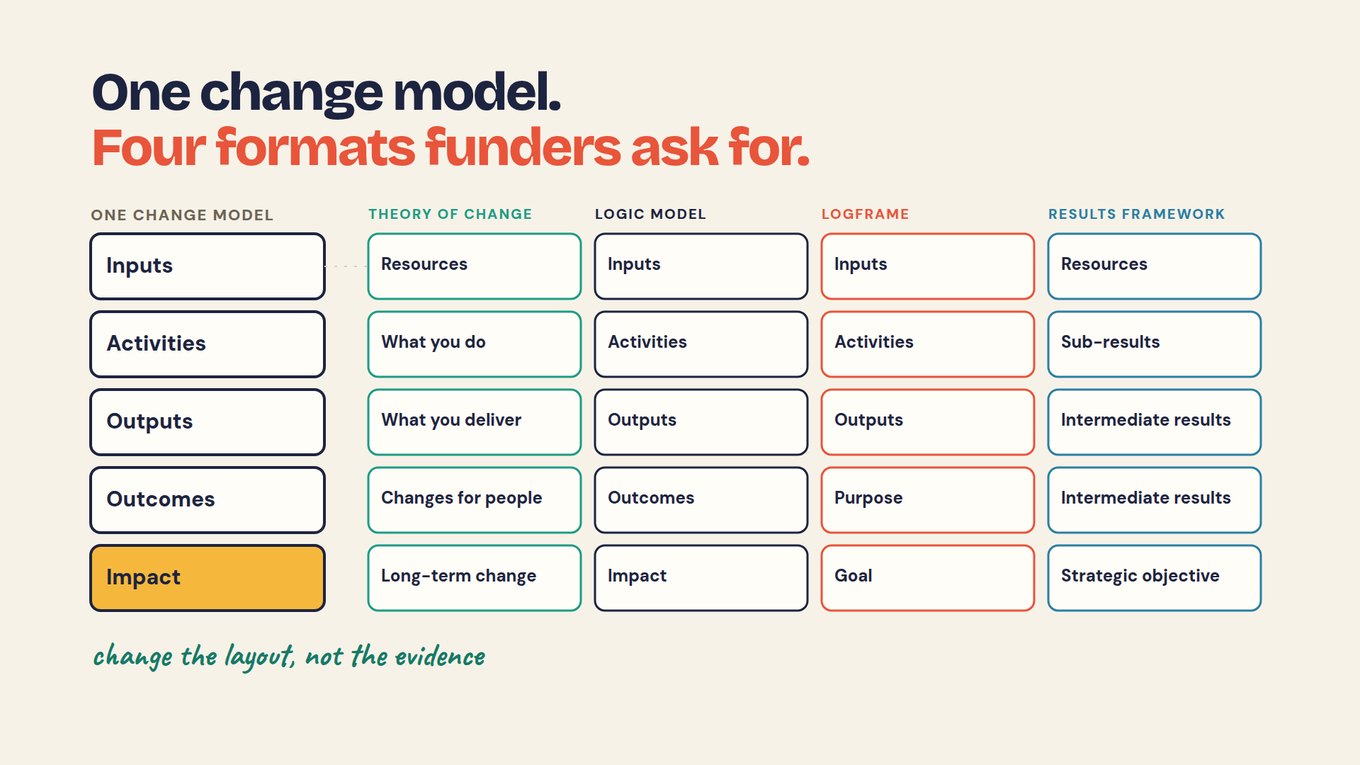
The pathway can be drawn in whichever format a funder prefers. A theory of change, logic model, logframe and results framework hold the same five levels under different labels, so you build it once and re-lay it; the theory of change guide covers the drawing itself.
How do you build an impact strategy?
Work through six steps in order, from the people affected to the review rules, and stop adding detail once each step answers its question in a few lines. A short, specific plan gets used; a long one gets filed.
- Understand the situation with the people affected. Describe the problem, whose experience matters and what is already known, and check existing evidence before collecting more.
- Choose priorities and boundaries. Say which changes you will pursue and which you cannot take responsibility for, such as an employer's hiring decisions.
- Write the pathway and its assumptions. Connect activities to near-term and longer-term outcomes, and under each arrow write what must hold for the next step to follow.
- Pick the few metrics that matter. Choose three to five that track the pathway's key steps, mostly outcomes rather than outputs.
- Agree them with the other side. Settle each metric's definition, due date and source with your funder or funded partner on the onboarding call.
- Set review points and decision rules. Decide when evidence is reviewed, who attends and what kind of finding calls for action.
How many metrics does an impact strategy need?
Fewer than most teams expect: a handful that follow the pathway's key steps, each with a definition that two people would count the same way. More metrics mean more collection and more room for definitions to drift.
Take a fictional regional workforce fund. On an onboarding call, one of its job-training partners says: "We want graduates in jobs that pay a living wage, and still there a year later." That sentence is the strategy in miniature. It becomes a pathway (training and mentoring, certification, placement within 90 days, retained at 12 months, living-wage jobs) and five metrics.
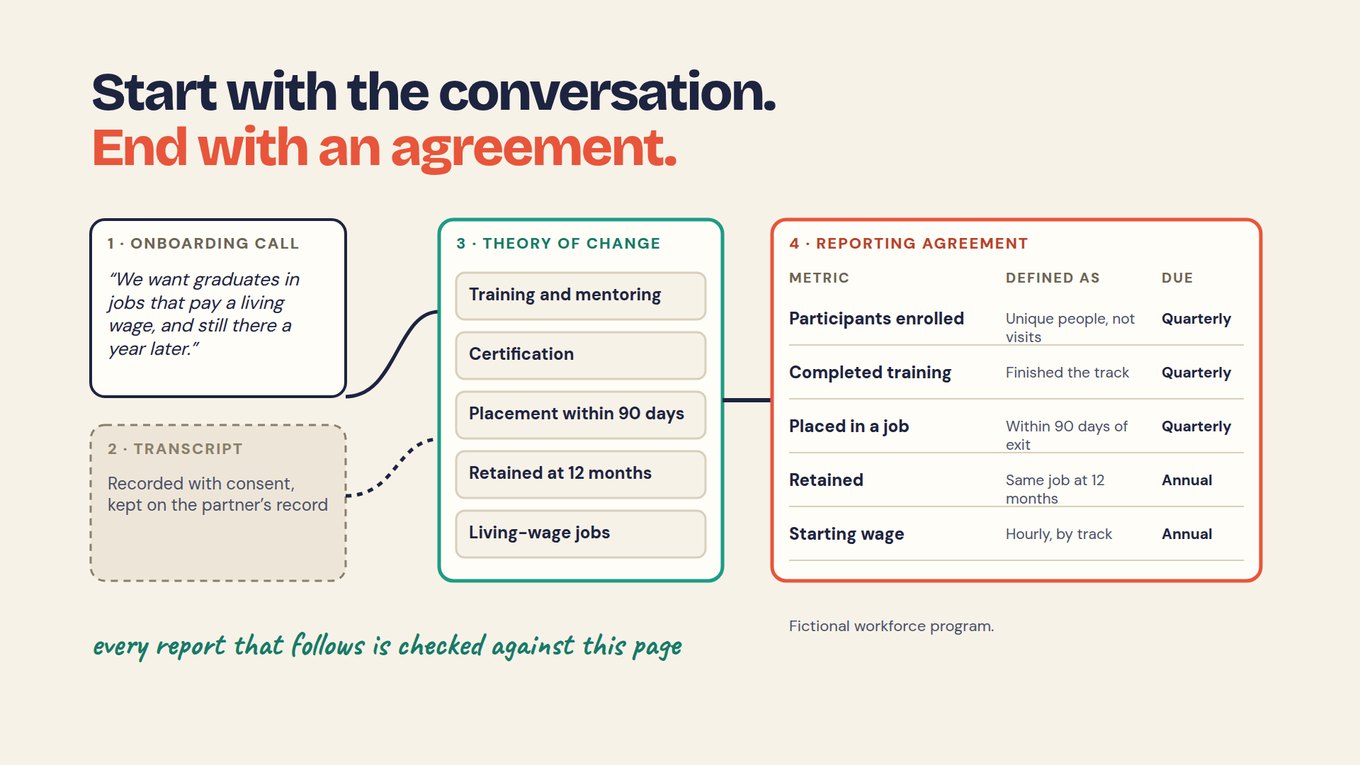
Notice the balance. Enrolled and completed training are outputs, useful for managing delivery. Placement within 90 days, retention at 12 months and starting wage by track are outcomes, and they carry the strategy. The definitions ("unique people, not visits", "same job at 12 months") are what make the numbers comparable across all four partners.
How does an impact strategy become a reporting agreement?
On the onboarding call: the funder and the funded partner talk through goals, who is served, the change expected, what is already collected, the reporting rhythm and how reports are read, then turn the transcript into a draft agreement both sides sign.
Record the call with consent and ask the question that could change a number. When someone says "placed", ask how they would count one person; the answer is the definition. Turn the onboarding call into a reporting agreement covers the six topics and the sign-off.
Some funders draft during the call itself. AHA Ventures, the investment arm of the American Heart Association, is growing its portfolio from 19 to more than 40 companies, and its head of impact drafts each company's logic model and data dictionary during the onboarding call, with Sopact Sense. In Sopact Sense, an Intelligence Cell can read each uploaded transcript on arrival with a prompt you configure, such as the one below.
PROMPT · PASTE INTO CLAUDE, CHATGPT OR YOUR AI TOOL
Below is the transcript of our onboarding call and our impact strategy.

1. In one sentence each, state the change we pursue, who it is for and how we said we would know.
2. Propose three to five metrics that follow our pathway. Mark each as output or outcome.
3. For each metric give: plain definition | when it is due | the form or survey it comes from.

Rules:
- Use only what the transcript and strategy say. Do not invent goals, targets or numbers.
- If a definition, due date or source was not discussed, write "not in our data".
- Quote the transcript line behind each metric.
- End with the questions we must settle before sign-off.

Transcript: [PASTE]
Strategy: [PASTE]
What does an impact strategy template look like?
One page per priority, eight short sections, each answered in a line or two; the right-hand column shows the fictional workforce fund's answers so you can see the level of detail.
Scroll horizontally to see all columns →
| Section | What to write | Workforce fund (fictional) |
|---|---|---|
| Intended change | The problem, who it affects, what progress means | Job seekers get living-wage jobs and keep them |
| Strategic choice | What you prioritize and what you will not do | Fund training tied to placement, not enrollment volume |
| Pathway | The steps, and the assumption under each arrow | Training and mentoring → certification → job within 90 days → same job at 12 months |
| Metrics | Three to five, each with a plain definition | Enrolled, completed, placed within 90 days, retained at 12 months, wage by track |
| Sources and timing | Which form each number comes from, and when it is due | First three quarterly; retention and wage annual |
| Ownership | Who signs off definitions, who reports | Portfolio manager at the fund; program lead at each partner |
| Review | When evidence is read and what triggers action | Each report checked against the agreement; one question per gap |
| Communication | What goes back to partners, board and participants | A short quarterly update, misses included |
How do you keep an impact strategy responsive?
Review evidence at the rhythm the decision needs, record the finding, its reading and the decision separately, and change the agreement only on purpose. Operational problems need quick attention; strategic outcomes such as 12-month retention take a year to show.
Gaps in reports are often the first signal. If a partner counts placements within six months, leaves out 12-month retention and gives one average wage instead of a split by track, that is three questions, not a failed strategy. If retention stays missing across partners, ask whether the pathway's assumption holds, or whether follow-up at 12 months is realistic for them.
When a definition changes, keep a change log: what changed, who approved it and from which quarter, so last year's results can still be read by last year's rule. The short video below is about turning a theory of change into day-to-day program decisions; watch for how evidence feeds a choice long before the annual report.
What can an impact strategy not promise?
A strategy states intent and a pathway; it does not show that the change happened, or that your work caused it. Outputs such as people enrolled are not outcomes, and a rise in placements after a new approach shows movement, not cause. A claim about cause needs a planned comparison with similar people who did not take part.
Placement and wage figures are often self-reported, and people who stop answering follow-ups tend to differ from those who stay, so report response rates next to results. An AI draft of a strategy or agreement can turn a passing remark into a commitment; people on both sides must read it against the transcript and decide.
How do you start an impact strategy this quarter?
Start with one priority and one funder or partner relationship, and take it from sentence to signed agreement before you add a second.
- Write the change you pursue in one sentence, in the words of the people it is for.
- Draw the pathway in five steps and write one assumption under each arrow.
- Pick three to five metrics along the pathway, marking each as output or outcome.
- Give each a plain definition, due date and source, and flag anything you cannot count yet.
- Take the draft to the next onboarding or check-in call and ask, for each metric, "Is this how you would count it?"
- Set the first review date and name who records the decision.
After the first cycle you have a one-page strategy, a signed agreement with defined metrics, and a first report you can check line by line against both.
Frequently asked questions
What belongs in an impact strategy?
The change you pursue and who it is for, your priorities and boundaries, the pathway with its assumptions, three to five metrics with plain definitions, owners, and when evidence is reviewed. Add what you will not do and why. Keep it to about a page per priority, so it is still read after the planning meeting and can be checked against each report.
How is an impact strategy different from a theory of change?
A theory of change explains why your activities should lead to the change you want, step by step, with the assumptions between steps. An impact strategy also chooses priorities, sets boundaries, assigns owners and decides which few metrics to report and how evidence will change your choices. The theory of change is one part of the strategy, not a substitute for it.
How many metrics should an impact strategy have?
Usually three to five per priority. Choose the ones that follow the key steps of your pathway, mostly outcomes, with one or two outputs to manage delivery. The fictional workforce fund in this guide uses five: enrolled, completed training, placed within 90 days, retained at 12 months and starting wage by track. Each needs a definition both sides would count the same way.
How often should an impact strategy be revised?
Review evidence at the rhythm of the decision: quarterly reports for delivery and placements, annually for retention and wages. Revise the strategy itself when evidence shows an assumption does not hold, not every time a number moves. When you change a definition, record what changed, who approved it and from which period, so earlier results stay readable.
Can one impact strategy cover several programs or sites?
Yes, if the shared priorities and core definitions are clear and local differences stay visible. Agree a small common set of metrics every site reports the same way, and let each site add its own measures around them. A shared data dictionary keeps the common set comparable, so results can be added up without forcing every program into one survey.
Does software create an impact strategy?
No. Software can hold the evidence, draft an agreement from a call transcript and show where reports differ from it. People still choose priorities, weigh trade-offs, set boundaries and decide what the evidence justifies. Treat any AI draft as a starting point to read against the transcript and your own judgment, never as the strategy itself.
