What is monitoring, evaluation and learning (MEL)?
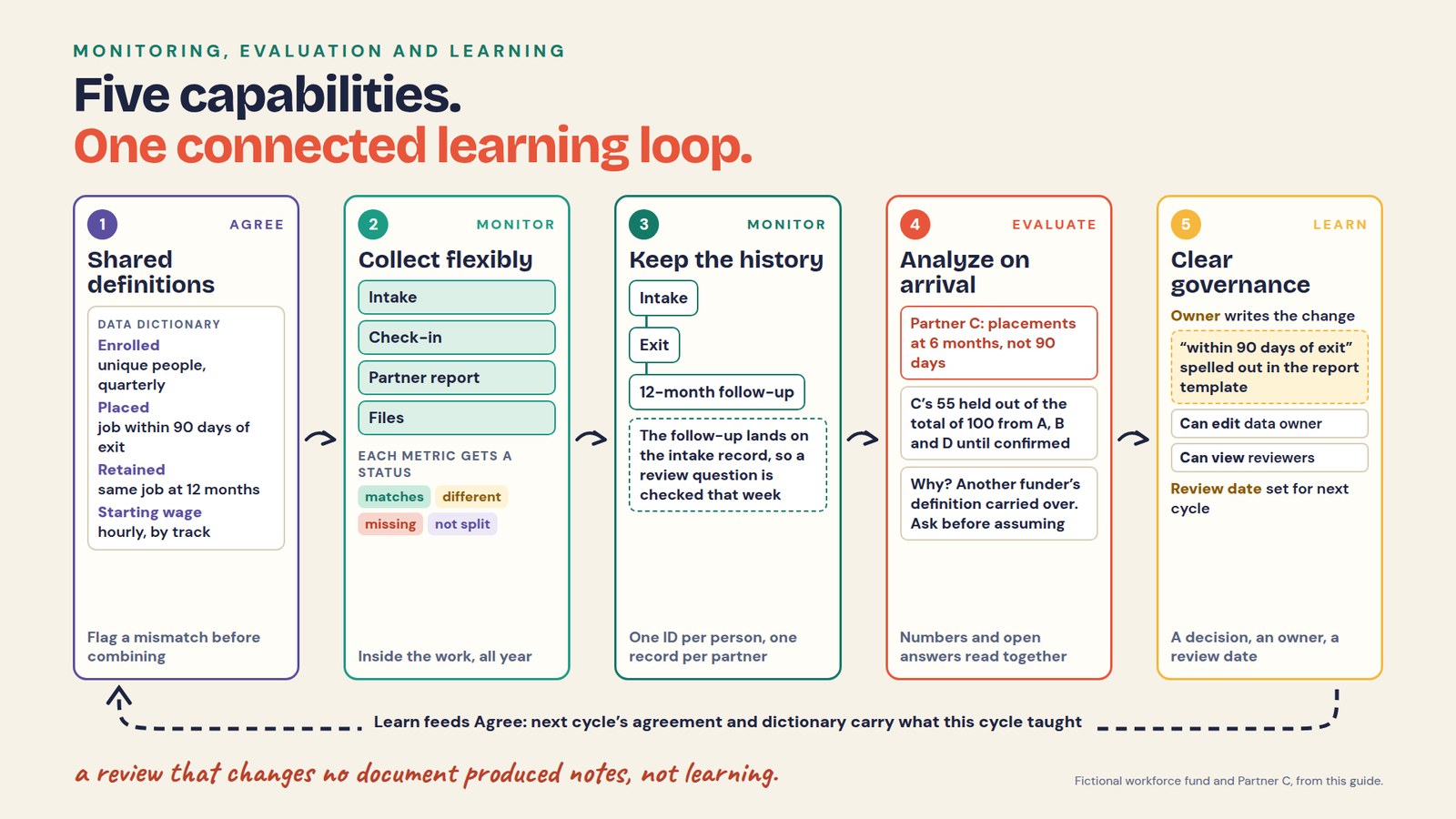
Monitoring, evaluation and learning (MEL) is a cycle in which monitoring tracks agreed measures during the work, evaluation asks what changed, for whom and why, and learning turns those findings into decisions that change what happens next. Learning is the part most often missing: a review that ends without a change written down anywhere has produced notes, not learning.
A plain test: after a MEL review, can you point to what changed, such as a clearer definition in the reporting agreement or a change to the program itself? If not, the evidence was gathered but not used.
THE SHORT VERSION
- Monitoring and evaluation produce findings; learning is the decision, and the written change, that follows from them.
- Every lesson has a home: the reporting agreement, the data dictionary, a funder's taste file or the program design.
- Report misses and what you changed because of them; a miss hidden in an average costs more trust than the miss itself.
What does each part of MEL do?
Monitoring spots a pattern, evaluation explains it, and learning decides what to change and when to check whether the change helped. Each part produces a different output, and the output of learning is an action with an owner and a review date.
| Part | Example question | Output |
|---|---|---|
| Monitoring | Did each partner count placements within 90 days? | A status per metric, with exceptions |
| Evaluation | Why did one partner count at six months? | An explanation, with its limits |
| Learning | What changes in next year's agreement? | An action, an owner, a review date |
A meeting is not learning if no decision follows. The CDC guidance on acting on findings puts intended use at the center of the whole exercise.
Why does MEL so often stop at evaluation?
Because findings arrive as a report at the end of the year, after the decisions they could have changed were already made. Learning needs evidence during the year, on the same records monitoring uses, and a standing place to write down what changes.
The loop has four steps: agree what to monitor from the agreement and dictionary, monitor inside the work all year, evaluate what changed for whom and why, then learn by deciding what changes next cycle. The fourth step feeds back into the first.
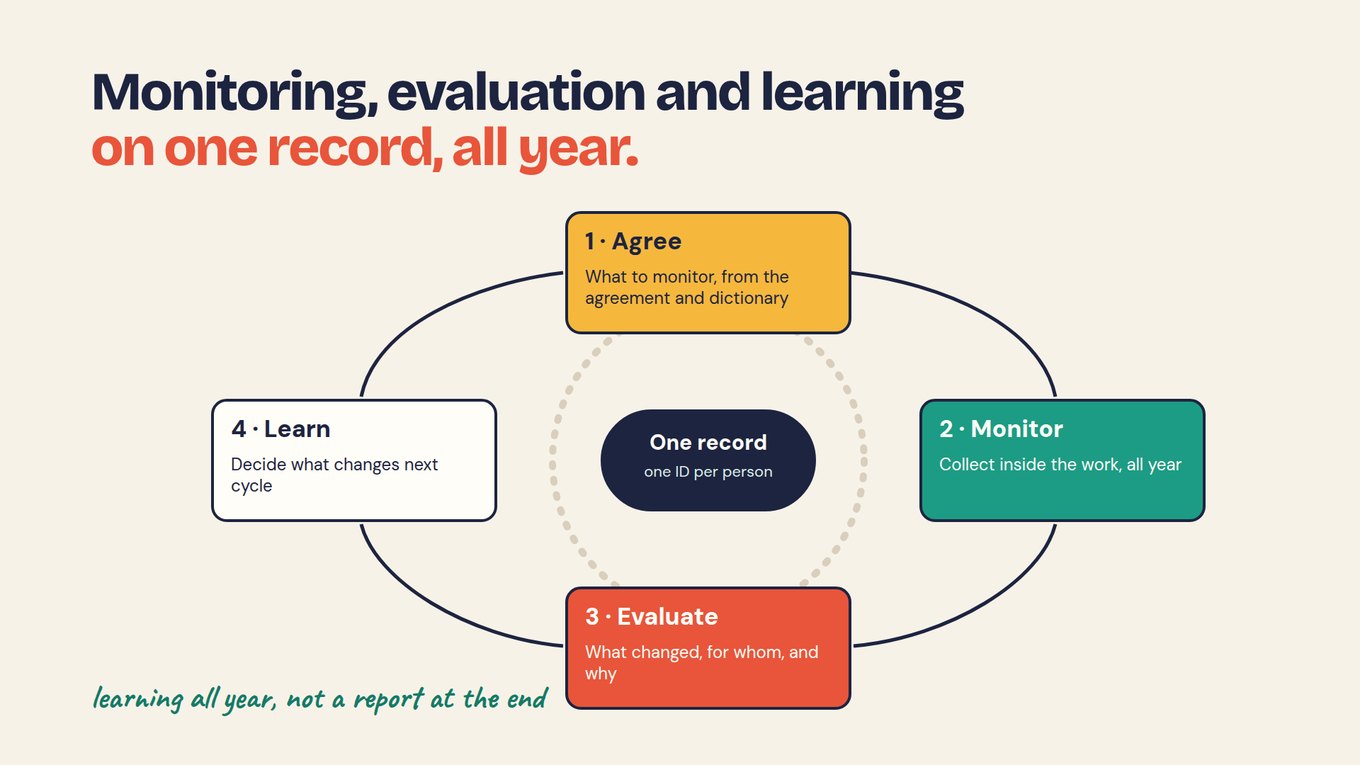
One record per person, with one ID from the first form, keeps the loop short. When a 12-month follow-up lands on the same record as intake, a question raised in a review can be checked that week, not after a new export.
The video below explains why so many M&E systems never reach the learning step: most of the effort goes into cleaning data, and the final report arrives after the decisions it could have informed. Watch for what changes when data arrives clean.
Where should each lesson be written down?
Write each lesson into the document that governs the next cycle: definitions into the agreement and data dictionary, lessons about readers into the taste file, and lessons about the work into the theory of change or program design. A lesson kept only in meeting notes gets relearned next year.
| What you learned | Where it goes | Example |
|---|---|---|
| A metric was read two ways | Agreement and data dictionary | Placement counted at six months, not 90 days |
| A breakdown nobody can produce | Agreement, or the intake form | Wage by track needs a track field at intake |
| A funder's repeated question | That funder's taste file | They want change per person, plus one voice |
| An assumption did not hold | Theory of change | Certification did not lead to jobs on one track |
| A miss | The next report | What happened, on the agreed definition, and what changed |
When a definition changes, change it for every partner from a stated period and keep earlier periods on the old wording. As a team practice, keep a short change log of what changed, who approved it and from when. The course chapter Check each partner report against the agreement shows the gap log that feeds it.
Program lessons usually land in the theory of change, where an assumption that did not hold gets rewritten. This short introduction walks the chain from outputs to outcomes; watch for where the assumptions sit.
How do you report a miss without losing a funder's trust?
Name the miss, give the number on the agreed definition, then say what you learned and what you changed, in that order. A program officer reading many reports at once, like the course's fictional funder who reads about 40 the week before the board, stops trusting the report that hides a miss in an average.
In the course's fictional example, Partner C, a job-training program, writes this under "What we learned" in its own taste file: last cycle it sent a six-month placement count where a funder had agreed 90 days, and it now maps every funder's ask before drafting. That sentence does more for the relationship than a better number would.
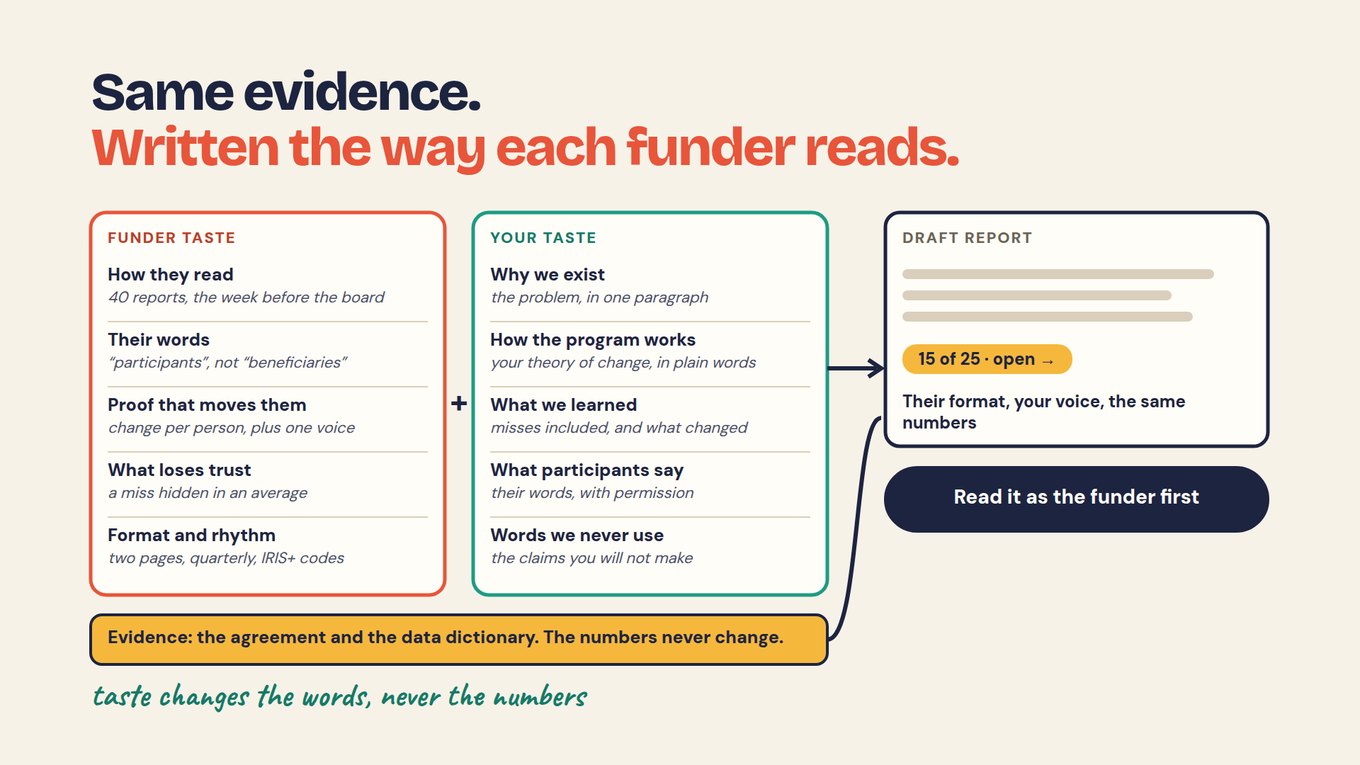
A taste file is a short note kept beside the agreement on how a funder reads; taste changes the words, never the numbers. Each report's questions go back into it with the date, so the next draft answers them first. Capture each funder's taste, and your own shows both files.
What does one MEL cycle look like in practice?
In the fictional regional workforce fund used across the course, one cycle runs from the agreement to a changed agreement: monitor the reports, evaluate the gaps, and write the lessons back before the next year starts. The fund supports four job-training partners, A to D.
Agree. On the onboarding call, the fund and its partners agreed five metrics: enrolled (unique people, quarterly), completed training, placed in a job within 90 days of exit, retained in the same job at 12 months, and hourly starting wage by track.
Monitor. Partner C matched on enrolled, 80 people, but counted placements within six months, left out 12-month retention and gave one average wage. The fund sent three questions and held C's 55 placements out of the total of 100 from Partners A, B and D until C confirms its 90-day count.
Evaluate. Why the different window? A partner reporting to several funders, each with its own template, can carry one funder's definition into another's report. The fund asks before assuming.
Learn. The fund spells out "within 90 days of exit" in the report template, adds the collection point to the placement row of its dictionary, and asks about other funders' definitions on every onboarding call. Partner C records the miss and its fix in its own taste file.
How do you run a learning review?
Hold it when a decision is due, bring the gap log and the findings, and end with a written change, an owner and the evidence that will show whether the change helped. Match the rhythm to the decisions: quarterly for delivery questions, annually for outcomes such as retention at 12 months.
- Record each finding and its limits, including who did not respond.
- Discuss other explanations with the people closest to the work, partners and participants included.
- Decide the action and who owns it.
- Write the change into the agreement, dictionary, taste file or program design.
- Name the evidence that will show whether it helped, and when you will look.
Any AI tool can prepare the review if told to keep evidence and suggestions apart:
PROMPT · PASTE INTO CLAUDE, CHATGPT OR YOUR AI TOOL
You are helping us prepare a learning review for [PROGRAM OR PORTFOLIO], period [PERIOD].
Attached: our reporting agreement, data dictionary, this period's gap log, and the reports or results for the period.

1. List each finding: what the evidence shows, which report or record it comes from, and its limits (who is missing, what is self-reported).
2. For each finding, suggest where the lesson belongs: the agreement, the data dictionary, a funder's taste file, or the program design, with the exact wording to add.
3. List any miss we should report, with the agreed definition and what we changed.

Rules:
- Do not calculate, estimate or invent any number. If a number is not in the attachments, write "not in our data".
- Keep what the evidence shows separate from your suggestions.
- A person on our team decides every change.
What goes in a MEL plan?
A MEL plan fits in one table: for each result or question, the measure, timing, who is responsible, the quality checks, the decision it serves and where its lessons will be recorded. The last row is the one most templates leave out.
| Element | What to specify | Workforce example |
|---|---|---|
| Result or question | The change or uncertainty that matters | Do placements last? |
| Measure | Definition, source, collection point | Same job at 12 months, follow-up survey |
| Timing | Collection and review dates | Annual, before the next agreement |
| Responsibility | Who collects, checks, interprets, acts | Partner collects; fund checks |
| Quality | Coverage and known limits | Responses shown beside the rate |
| Use | The decision it informs | Renewal and next year's agreement |
| Where lessons go | The document that changes | Agreement, dictionary, taste file |
Keep every definition in one maintained place, a shared data dictionary, so a lesson changes one row instead of a dozen spreadsheets. In Sopact Sense, every line of an AI Assistant answer links to a record you can open, which helps a review check a finding before acting on it.
What can MEL evidence prove, and what can't it?
MEL evidence shows what happened and what changed among the people you reached; a lesson drawn from it is a judgment, not a proof. Outputs such as sessions delivered are not outcomes, and a before-and-after change needs a comparison before it supports a claim about cause.
Follow-ups are self-reported and some people never answer, so show responses beside every rate. A change you test is itself a hypothesis: if placements rise afterwards, local hiring may explain it. Check AI-drafted findings against the record, and let the people accountable for the program decide.
Start with one learning review before your next decision
Choose one decision due in the next few months and run one full cycle toward it, from findings to a changed document.
- Name the decision and its date, such as renewing a partner or drafting next year's agreement.
- Put the agreement, dictionary, latest reports and gap log in one folder or AI project.
- List the findings with their limits, and for each one write where the lesson goes.
- Hold one short review with the people closest to the work, and end with actions, owners and review dates.
- Make the changes in the documents that week, and add any miss to the next report with what changed.
After the first cycle you hold findings with their limits, at least one changed definition or taste-file line, and one action with a check date.
Frequently asked questions
Is MEL different from M&E?
MEL adds learning to monitoring and evaluation, making the use of evidence an explicit part of the system. Good M&E can support learning too, and terminology varies between funders. The practical difference is whether your plan names who decides, when, and which document changes as a result of each finding.
What does the "L" in MEL mean in practice?
It means a finding leads to a decision and a written change. A clearer definition goes into the reporting agreement and data dictionary, a funder's repeated question goes into their taste file, and a program lesson goes into the theory of change. If a review produces discussion but no change anywhere, the learning step has not happened yet.
How many indicators should a MEL system track?
Enough to support the decisions you actually make, and no more than you and your partners can collect and review well. The fictional workforce fund in this guide agreed five metrics with its partners. Add one only when you can name the decision it informs and who reads it.
Does a dashboard create a MEL system?
No. A dashboard shows monitoring results; it does not define metrics, ask evaluation questions or decide anything. A MEL system also needs shared definitions, named responsibilities, review points and a place where lessons are written down. A dashboard supports a review only if everyone agrees what each number means.
How often should learning reviews happen?
Match them to the pace of decisions and of change. Delivery questions, such as enrolment, suit quarterly reviews; outcomes such as retention at 12 months can only be reviewed once a year. Schedule a review before each decision it should inform, not on a fixed calendar that produces meetings without new evidence.
Should we report misses and failures to funders?
Yes, on the agreed definition and with what you changed. In the course's funder taste example, what loses trust is a miss hidden in an average, not a miss that is named. A short "what we learned" line, with the number, its denominator and the change you made, shows a partner that is paying attention.