What is an ESG reporting platform?
An ESG reporting platform helps collect, manage, review and report environmental, social and governance information. The category includes systems for carbon accounting, sustainability performance, disclosure controls and stakeholder evidence. The right shortlist depends on the reporting job and the sources your team must defend.
A climate inventory, a controlled corporate disclosure and an impact fund's investee report need different methods and workflows. Some platforms span several of these areas. Start with the required output, then test the depth of the proposed configuration rather than choosing a universal winner.
Separate the reporting jobs before comparing vendors
| Reporting job | What the platform must support | What to demonstrate |
|---|---|---|
| Carbon accounting | Activity data, boundaries, emissions factors and calculation methods. | A calculation traced to its inputs and method, including an estimate and a correction. |
| Controlled disclosure | Owners, approvals, version history and the required reporting output. | A change moving from the source through review into the final report. |
| Multi-entity sustainability management | Shared definitions, local collection, aggregation and reporting periods. | Comparable returns from several entities, with missing and incompatible values exposed. |
| Value-chain engagement | Supplier or partner contributions and the relationships behind them. | A request, supporting evidence, clarification and an updated result. |
| Stakeholder and impact evidence | Surveys, reports, explanations and outcomes connected to relevant records. | A claim opened back to the permitted source evidence and its analytical definition. |
Sopact is most relevant to the last job and its connections to the others. It is not presented here as a replacement for a carbon calculation engine, statutory filing system or independent assurance.
Ten ESG reporting platforms to evaluate
These are starting points based on documented product focus, not hands-on performance rankings. Several vendors now cover broader sustainability workflows than their original category suggests. Confirm the specific products and configuration included in a demonstration.
| Platform | Relevant focus | Question for your evaluation |
|---|---|---|
| Workiva | Connected sustainability reporting and controlled reporting workflows. | How do collection, review and report changes connect across your teams? |
| Watershed | Enterprise sustainability measurement, reporting and action. | How does the proposed setup handle your climate and other sustainability measures? |
| Persefoni | Carbon accounting and sustainability management. | Which calculation, disclosure and evidence requirements are covered? |
| IBM Envizi | Enterprise ESG data management and reporting. | Who will maintain site-level collection, definitions and the reporting configuration? |
| Diligent ESG | ESG collection and reporting within a broader governance environment. | How does source evidence move through the required ownership and review process? |
| Novisto | Quantitative and qualitative ESG data management and reporting. | How are narrative evidence, metric definitions and framework mappings maintained? |
| Position Green | Sustainability data, reporting and approval workflows. | How can reviewers inspect and approve the figures your organization needs? |
| Sweep | Carbon and broader sustainability data, including value-chain contributions. | How does supplier collection connect to your reporting and operational questions? |
| Normative | Carbon accounting, disclosure support and reduction planning. | How are the calculation methods, source data and advisory responsibilities established? |
| Sopact | Connected stakeholder, investee, grantee and program evidence. | Can the operating team maintain definitions and inspect the sources behind a finding? |
What makes the evidence ready for review?
A useful reporting record has an owner, entity, period, unit, definition and source. A reported estimate should remain distinguishable from a directly measured value. A revised calculation should have enough history for a reviewer to explain why the figure changed.
Software can organize these controls, but purchasing it does not establish the accuracy of the underlying claim. A source document might repeat an unsupported statement. A citation helps the reviewer find that statement; it does not turn it into verified evidence.
Test the path from the report backward. Can the reviewer identify the included entities, inspect the calculation or interpretation, see missing contributions and open the supporting records? Then test forward: correct a source value and observe what needs to be recalculated, reviewed and released again.
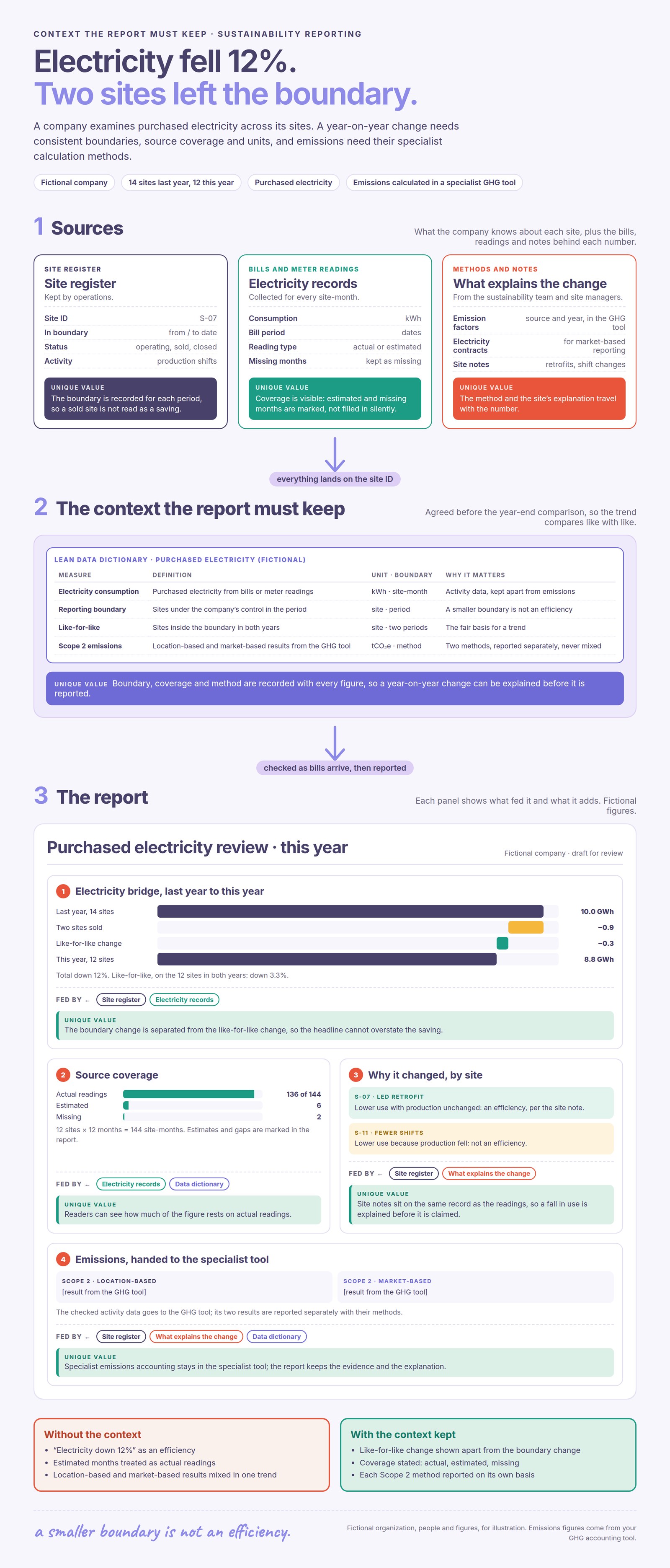
Here is a purchased-electricity review that passes the backward test: the included sites, the estimated readings and the method behind each figure stay visible, and the Scope 2 calculation stays with a specialist carbon tool.
Choose framework support from the reporting requirement
Identify the standards, stakeholder commitments and reporting requirements that actually apply to your organization before configuring a platform. For example, the IFRS Foundation's introduction to ISSB Standards explains the role of IFRS S1 and S2. A product's framework list does not determine your organization's obligations.
Ask the reporting owner to specify the relevant version, entity scope, period and review requirements. Have each vendor demonstrate those requirements. Similar-looking disclosures may use different boundaries or definitions; mapping them together should be a reviewed decision rather than an invisible shortcut.
Sopact can be evaluated for organizing stakeholder and impact evidence that supports the reporting process. Where legal interpretation, specialist accounting or assurance is required, retain those responsibilities in the appropriate review workflow.
Where Sopact can change the recurring work
A growing fund, association or business may already have a reporting system and still spend weeks assembling the evidence around its numbers. Partners send spreadsheets, narrative reports and survey responses. Staff reconcile periods, clarify definitions, read explanations and reconstruct the same context for each reporting request.
Sopact's proposition is to maintain that context as part of collection and analysis. The team owns the shared definitions, record relationships and review rules. AI helps apply the analysis to eligible evidence, while authorized people inspect and approve the findings.
Consider a fictional portfolio of twenty organizations reporting on workforce development. One reports people trained, another attendance entries, and a third people completing a course. Those numbers cannot be added as a single outcome. Establish the shared definition, retain local detail and resolve differences before aggregation.
The same discipline applies to narrative claims. A partner may report improved access but describe only a new service launch. Keep the claim, the evidence and the interpretation separate. The review should identify what is supported, what needs clarification and what remains an assumption.
Different local inputs can still support comparable reporting
Do not impose one large questionnaire solely to make aggregation easier. Agree a limited shared core of measures and contextual fields, then allow relevant local questions. A data dictionary should identify what can be combined and what should stay separate.
Collect organizational registration information once where appropriate and update changing details explicitly. Keep reporting-period context so today's affiliation or location does not silently rewrite earlier results. This reduces repetitive requests while preserving the meaning of the evidence.
Use AI for maintained analysis, not only report drafting
AI can help extract candidate information from reports, apply categories, surface contradictions and prepare a source-linked explanation. The larger benefit appears when the next cycle uses maintained definitions and relationships rather than starting from a new folder of uploads.
Test a definition change. If the team refines what counts as an access barrier, identify the affected evidence, reprocess the agreed scope and review revised classifications. Connect those findings to the relevant quantitative measures and periods. Keep uncertainty and exclusions visible.
This is a practical way to assess Sopact's differentiation without suggesting other ESG vendors lack AI or qualitative fields. The question is how deeply the workflow supports your team's evidence, and how much repeated work it removes while retaining accountability.
Watch: portfolio reporting from several sources
This video shows Sopact's approach to connecting portfolio information for reporting. Use it as a workflow demonstration, not evidence of carbon-accounting or regulatory-filing functionality.
Compare the work your team will maintain
Total ownership includes collection design, source transfers, clarification, data stewardship, analysis review and report preparation. Count the work required when a partner submits late, a definition changes or an approved figure needs correction.
Measure one current reporting cycle before evaluating a replacement. Ask the intended operator to perform the same cycle in the proposed configuration and record where specialist help remains necessary. Avoid assuming that a generated narrative removes the work of establishing whether its claims are justified.
A sensible architecture may retain a specialist sustainability or disclosure platform and use Sopact for a defined stakeholder-evidence workflow. Confirm mappings, access, corrections and transfer ownership before describing the systems as connected.
Pilot evidence your team must defend
- Select one reporting question and the entities and period it covers.
- Bring representative quantitative returns, narrative evidence and source files.
- Include a missing contribution, an incompatible measure and a revised value.
- Have the team reconcile the result and inspect the evidence behind it.
- Change one definition and observe the reprocessing and review required.
- Record who owns the ongoing workflow and what remains outside its scope.
For adjacent evaluation work, see ESG due diligence, ESG risk management and impact reporting software. For the report itself, use the impact reporting ebook and report examples.
Common questions
Is ESG reporting software the same as carbon accounting software?
No. Carbon accounting is a specific calculation and management task. ESG reporting can include wider measures, narratives, controls and disclosures. Some products cover both; test the depth needed for your primary job.
Does Sopact replace a regulated reporting platform?
Not by default. Evaluate Sopact for connected stakeholder and impact evidence. Keep specialist calculation, filing and assurance responsibilities where they belong.
Does a source-linked AI answer establish that a claim is true?
No. It makes the basis easier to inspect. Reviewers still need to assess the quality, relevance and limitations of the source and the interpretation.
Which ESG platform is best for a smaller team?
Choose around the actual reporting requirement and the work the team can maintain. Test one complete cycle rather than assuming either the broadest platform or the simplest interface is automatically the best fit.