


Related solution
Network & Membership Intelligence
Connect chapter reports and member feedback.
Explore the solution →

USE CASE / SOFTWARE GUIDE
Association management software, or AMS, helps membership organizations maintain member records, collect dues, manage renewals, run events and communicate. Good software makes these operations dependable and gives staff a useful view of the relationships they support.
A membership record can show that someone renewed or attended an event while leaving their experience unexplained. Feedback, chapter reports, interviews and professional-development evidence may remain outside the administrative system. The association then knows what happened but spends another reporting cycle assembling why it mattered.
Modern AMS products already use automation and AI. The useful distinction is which evidence they bring into the decisions your team makes. Sopact focuses on member and network intelligence: connecting forms, files and feedback so analysis remains available for questions across chapters, programs and successive cycles.
Keep dues, renewals and events dependable.
Read feedback with program and chapter context.
Use current evidence to refine support and participation.
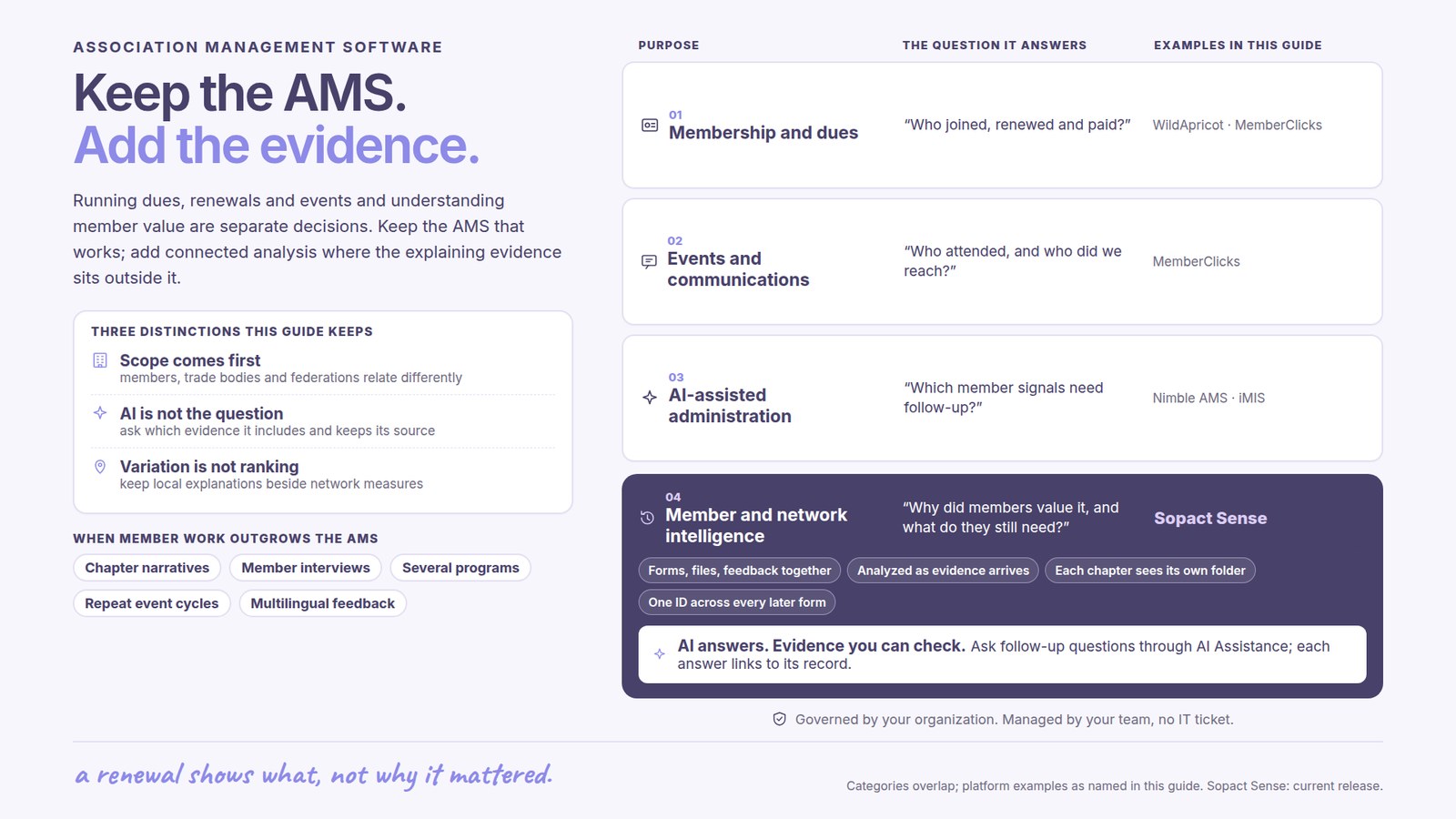
Membership administration includes the information and transactions that keep the organization functioning. Member categories, joining and renewal, payments, directories, events and communications need a clear system of record.
MemberClicks documents membership, renewals, events and communications in one AMS. WildApricot also covers a membership database, recurring payments and self-service. These are substantive operating capabilities, not simply contact lists.
For a buyer, the first distinction is scope: an individual-member association, a trade body whose members are organizations and a federation of independent groups have different relationships to maintain. Software selection should reflect those relationships before expanding into analysis.
Nimble AMS connects association activity in Salesforce and describes AI-assisted member signals and renewal workflows. iMIS’s AI strategy includes workflow efficiency, automation and engagement insight.
These capabilities overlap with parts of a broader member-intelligence goal. The question is not whether one vendor has AI and another does not. It is whether your important evidence is included, whether the answer retains its source and whether staff can use it without repeated preparation.
An association should keep capabilities that already work. A gap in analysis of chapter narratives does not by itself justify replacing a dependable dues or events system.
A renewal total describes a transaction. Member feedback can explain what people found useful, what they could not access and what support they still need. Chapter updates add the local conditions behind participation.
For a professional-development program, attendance alone may look healthy while interviews reveal that early-career members struggle to apply what they learned. The practical response could be mentoring or a different follow-up resource. That decision depends on reading experience alongside participation.
At network level, a common definition makes comparable measures useful without forcing every chapter to ask identical questions. Local explanations should remain attached so headquarters can understand a difference rather than turn every variation into a performance ranking.
In practice, each chapter can keep its own goal for the year and ask the questions that goal needs, such as mentoring quality for early-career members or the barriers that stopped people attending. The national office governs only what comparison requires: one member ID from the joining form, a few shared core questions such as overall value and renewal intent, and the definitions behind them.
The example below shows a fictional association with five chapters organized that way. Its renewal intent is comparable across chapters because the core question is the same everywhere, and each result keeps the chapter’s own explanation beside it.
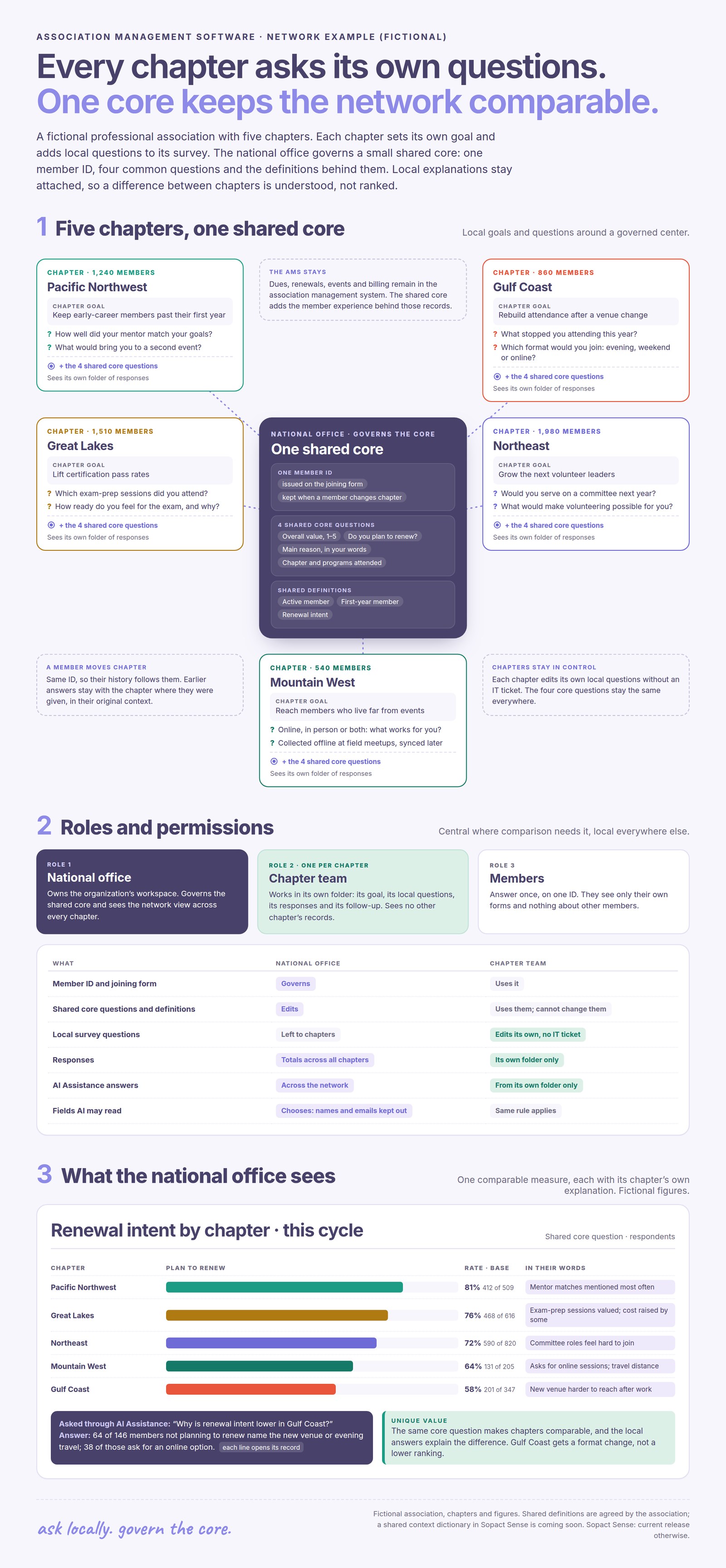
When renewal intent is lower in one chapter, the explanation sits with the number. In the example, members describe a new venue that is hard to reach after work, so the response is a change of format, not a lower place in a league table.
Sopact’s membership and network workflow connects applications, surveys, documents and feedback around the relevant person or organization. It complements the AMS responsibilities for dues, events and billing.
Incoming analysis is available through AI Assistance in the agreed workflow. Staff can examine a recurring issue, compare it with earlier feedback and use later evidence to understand whether a response helped. The value is less repeated consolidation before a new question can be answered.
Relationships and timing remain important. Someone can change chapters or take part in several programs. A useful analysis interprets the evidence in its original context instead of assigning all history to the person’s current affiliation.
In Sopact Sense, each chapter team works in its own folder: it edits its local questions without an IT ticket and sees only its own responses, including when it asks questions through AI Assistance. The national office governs the shared core and sees totals across every chapter. The association also chooses which fields AI may read, so names and contact details can stay out of the analysis.
Members answer on the one ID issued when they joined, so a move between chapters stays on the same record.
WorldSkills International’s published story describes a planned shared data foundation across its Member network. The need is to connect multilingual evidence and follow-up over successive event cycles.
The case illustrates the difference between running an event and learning across a network. The intended foundation supports changing questions and shared understanding; network-wide adoption and measured results are still to be established.
For another association, the equivalent question is which member experience remains invisible in the administrative record. That might be professional-development progress, chapter concerns or reasons behind repeat participation. The appropriate evidence depends on the association’s purpose.
Replace or expand the core AMS when the membership transactions themselves need to change. Add connected analysis when the main difficulty is interpreting evidence across programs and systems. Some organizations need both, but they are separate decisions with different migration work.
Sopact’s typical setup estimate is two days to two weeks for an agreed evidence workflow, not a migration of the whole AMS. Available exports, historical material and access needs determine the scope. Personalization and continuing support help the association own its questions as the network evolves.
The value should appear in staff decisions: less repeated preparation, a clearer account of member needs and learning that survives the next event or renewal cycle. For vendor-change intent specifically, see Momentive Software alternatives.
An AMS supports member records, dues, renewals, events, communication and related administration.
Many do. Evaluate the documented capabilities and included evidence rather than assuming all established platforms lack modern analysis.
That is not its role in this workflow. Sopact focuses on connected member and program evidence alongside the core AMS.
Yes, the workflow can preserve local questions while agreeing the shared definitions needed for meaningful network reporting.
No. In Sopact Sense each chapter team works in its own folder and sees only its own responses, including through AI Assistance. The national office sees totals across all chapters and governs the shared core questions.
The team can revisit earlier evidence and examine new feedback without rebuilding the reporting foundation each cycle.
Continue with a purpose
Related solution
Connect chapter reports and member feedback.
Explore the solution →Continue learning
Explore shared definitions and continuing analysis.
Start learning →
Customer story
A planned foundation for learning across a global Member network.
Read the story →Explore how Sopact can connect feedback and network evidence with the questions your association needs to answer.
See it with your workflow →