play icon for videos
Use case

Post-Award Grant Management Software | Sopact

Your grantees submitted reports. Do they match what they promised? Sopact tracks every commitment from interview to renewal — 6 intelligence reports, automatically.

TABLE OF CONTENT

Author: Unmesh Sheth

Last Updated:

March 27, 2026

Founder & CEO of Sopact with 35 years of experience in data systems and AI

Post-Award Grant Management: How to Track Outcomes Without Losing What Grantees Promised

Your grantees submitted progress reports last week. Six are late, two are incomplete, and none of them reference the outcome commitments their Program Officer wrote down during the award interview — because those notes live in a Google Doc that nobody has opened since March. This is not a follow-up problem. It is an architectural one. The system that reviewed applications was never designed to survive the award. What grantees commit to at the beginning and what they report at the end exist in separate universes, reconciled by hand, if at all.

This structural gap has a name: The Commitment Orphan. It is what happens when outcome commitments made at the moment of highest clarity — the award interview — have no persistent home in the system that will eventually ask grantees to report against them. Progress reports accumulate. Commitments disappear. Program Officers spend board-meeting week reconstructing what grantees were supposed to deliver.

Core Concept

The Commitment Orphan

Outcome commitments made at the award interview have no persistent home in the system that tracks progress reports. What grantees promise and what they report exist in separate universes, reconciled by hand — if at all.

Grantmakers Program Officers Foundation Staff Impact Funders KD 0 · AI Overview confirmed
1
Define tracking requirements
2
Collect post-award data
3
Analyze vs. commitments
4
Generate board reports
5
Renew with evidence
6
Intelligence reports generated automatically per grant cycle
0
Separate reporting projects to show what the grant produced
100%
Logic Model built at interview — scored against at every check-in
See Grant Intelligence in Action →

Step 1: Define What Post-Award Tracking Actually Requires

Post-award grant management covers three distinct workflows that most tools treat as separate problems: compliance tracking (who submitted, who is late), outcome verification (did they deliver what they committed to), and learning (what patterns explain which grants succeed). Most grant management software solves the first. Almost none solve the second or third — because solving them requires data that existed before the grant was awarded.

[embed: scenario-post-award-grant-management]

Describe your situation
What to bring
What Sopact produces
Large Portfolio
We have 80+ active grants. We cannot read every progress report.
Foundation Program Officers · Grants Managers · Portfolio Directors
I am the Grants Director at a mid-size foundation managing 80–200 active grants across 4 program areas. Every quarter, 60+ progress reports land in a shared folder. My team reads what they can. We flag obvious misses. But nobody has time to compare what each grantee committed to at interview against what they are now reporting — because those commitments live in notes, not in a system. The board asks for portfolio-level outcomes. We produce a narrative that reflects what grantees told us in their reports, not what they actually committed to produce. I need a system that reads every report against grantee-specific baselines automatically.
→ Platform signal: Sopact Sense is built for this — structured Logic Model at interview, automated check-in analysis, 6 portfolio intelligence reports per cycle.
Compliance Gap
We track submissions but cannot verify what grantees actually delivered.
Program Officers · Evaluation Staff · MEL Consultants
I am a Program Officer at a community foundation. We use a grant management platform — it tells us who submitted, who is late, and when payments are due. But it does not know what any grantee committed to. When I read a progress report, I am evaluating it against my memory of the award interview, not against a structured baseline. Two program officers reviewing the same grantee reach different conclusions because they weight different things. I need a system that connects what grantees committed to with what they report — not just a filing system.
→ Platform signal: If you need disbursement and payment tracking on top of outcome tracking, evaluate whether Sopact Sense plus your existing payment workflow covers both needs. Most foundations find it does.
Small Portfolio
We have 15 grants. A spreadsheet works for now — but we are growing.
Small Foundations · Family Offices · Corporate Giving Programs
I manage a small foundation grant portfolio — 12–20 grants, annual cycle. Right now I track everything in a spreadsheet: who submitted, what they reported, what we funded. It works, but I am losing institutional memory every cycle. When a grantee comes up for renewal, I am starting from scratch. I want a system that accumulates grantee intelligence over time — not just tracks submissions. I also want to produce a board report that does not take me two weeks to build.
→ Platform signal: Below 10 grants, a structured spreadsheet may be sufficient. At 15+ grants with renewal cycles, Sopact Sense's persistent grantee records and automated board reporting typically justify the transition.
📋
Rubric or Scoring Criteria
Your application review rubric, however informal. Even handwritten criteria can be structured into Sopact Sense for consistent check-in scoring.
🎯
Grantee Outcome Commitments
Notes from award interviews — any record of what each grantee said they would achieve. These become the Logic Model baseline in Sopact Sense.
📅
Check-in Schedule
Your reporting cadence: quarterly, semi-annual, annual. Sopact Sense deploys check-in instruments on schedule and flags missing data automatically.
👥
Stakeholder Roles
Who reviews which grantees. Sopact Sense tracks reviewer assignments and flags scoring inconsistencies across your team.
📁
Prior Cycle Data (If Any)
Previous progress reports, if available. Sopact Sense can analyze prior reports to establish baselines even before the Logic Model is formalized.
📊
Disaggregation Categories
Demographics, geographies, or program types you need to compare across the portfolio — structured at collection, not retrofitted from exports.
Multi-funder portfolios: If grantees report to multiple funders with different templates, Sopact Sense can collect data once and map it to each funder's reporting requirements — eliminating duplicate reporting requests.
From Sopact Sense — Post-Award Grant Intelligence
Progress vs. Promise Report
Each grantee's reported outcomes compared against their Logic Model commitments. AI synthesizes narrative sections into cross-grantee thematic patterns.
Portfolio Health Dashboard
Aggregate outcomes across all grantees by program area, geography, and cohort. Surfaces which areas overperform and which share risk patterns.
Missing Data Alerts
Specific, timely flags: which grantee, which check-in, which questions were unanswered. Generated the day a submission is due — not discovered at board-meeting week.
Fairness Audit
Outcome patterns by demographic, geography, and reviewer. Automatically generated — no separate equity analysis project required.
Renewal Summary
Every active grantee's commitments fulfilled, gaps documented, and outcomes compared against cohort benchmarks — ready for the renewal conversation.
Board Report
Executive summary with top performers, at-risk grantees, and renewal recommendations — generated overnight, not assembled over three weeks.
Start here
"Show me how to build a Logic Model from last cycle's award interviews."
Next step
"Design a check-in instrument for our workforce development grantees."
Board prep
"Generate a portfolio health report for our Q3 grantee cohort."
Build With Sopact Sense → Book a 20-minute demo

Fluxx and Blackbaud give Program Officers a place to file progress reports and flag missing submissions. They do not know what the grantee committed to at interview. Foundant added a forms layer, but the logic model, if one exists, lives in a Word document the grantee uploaded — not in a structured data field the platform can read. The result is that every progress report is evaluated in isolation, against no baseline, by a Program Officer who must remember six months of context.

Post-award tracking only works if it begins at pre-award. The commitments that should anchor every progress report are generated during selection — rubric scores, Logic Model outputs, outcome targets. If that data is not captured in a structured, persistent format, post-award tracking becomes manual reconciliation dressed up as grant management.

The Commitment Orphan: Why Progress Reports Fail Before They Are Written

The Commitment Orphan is not a technology failure. It is a design failure: the grant lifecycle is modeled as a sequence of handoffs rather than a continuous record. Application review teams hand off to Program Officers. Program Officers hand off context via notes. Grantees submit reports against templates that do not reference what they specifically committed to.

Sopact Sense is designed around a different model: the grantee record accumulates from first application through final report. The Logic Model built at the award interview does not go into a document — it becomes the scoring template for every subsequent check-in. When a grantee submits a progress report, Sopact Sense reads it against the commitments they made, not against a generic rubric. The Commitment Orphan disappears because there is no handoff — the context persists.

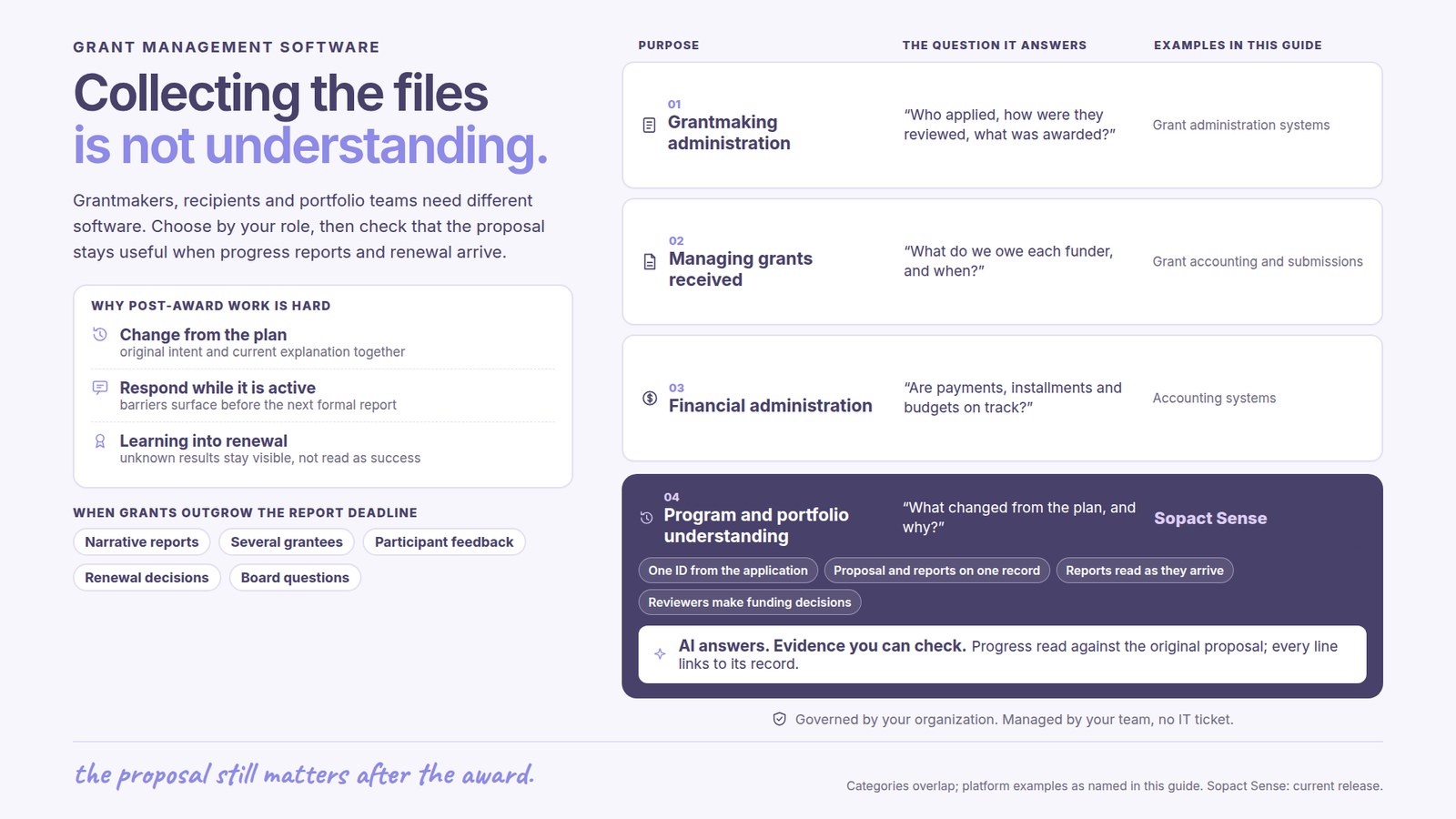
Instrumentl and SurveyMonkey Apply add form layers to the submission workflow. Neither builds a persistent record from application to outcome. Sopact connects every stage into one intelligence view that does not reset when the award is made.

Step 2: How Sopact Sense Collects Post-Award Data

Sopact Sense collects post-award data from grantees through structured check-in instruments built directly from the Logic Model. When a grantee is onboarded, their unique stakeholder ID connects their application record, their interview commitments, and every subsequent check-in. Outcome targets, activities, and output milestones are structured at the point of agreement — not imported later from a spreadsheet.

Progress reports are collected through forms designed inside Sopact Sense, with questions that reference the grantee's specific commitments. A grantee who committed to serving 200 youth in workforce development does not receive a generic "how many participants did you serve" question — they receive a question scoped to the commitment they made. Qualitative check-ins — narrative sections, stakeholder stories — are collected in the same instrument and analyzed by the same system, linked to the same grantee record.

Missing data alerts are generated automatically. Program Officers do not discover that six progress reports are late at board-meeting week — Sopact surfaces gaps the day they appear. Follow-up instruments can be deployed directly from the platform to the specific grantees whose submissions are incomplete.

This is what separates Sopact Sense from workflow platforms like Submittable or Fluxx: those platforms collect submissions. Sopact Sense collects data that is already structured against a grantee-specific baseline, ready for analysis without a preparation step.

Grant Intelligence · Sopact Sense
How Grant Reporting Actually Works with Sopact Sense
See how Logic Model–anchored check-ins replace manual progress report review and generate board-ready intelligence automatically.

Step 3: What Sopact Sense Produces from Post-Award Data

1
Commitment Orphan
Award interview commitments captured in notes, never in a system — orphaned from all future check-ins.
2
Blind Progress Review
Progress reports evaluated against memory and generic templates, not grantee-specific baselines.
3
Late-Discovery Gaps
Missing reports discovered at board-meeting week, not the day they were due.
4
Manual Board Reporting
Portfolio summary assembled from fragments across three systems, taking 2–3 weeks per cycle.
Capability Fluxx / Blackbaud / Foundant Sopact Sense
Tracks grantee commitments from interview No — commitments stay in notes, disconnected from check-ins Logic Model built at interview, becomes scoring template for every check-in
Reads progress reports against grantee-specific baselines No — generic templates, manual reviewer judgment Every check-in scored against the specific commitments that grantee made
Analyzes qualitative narrative sections No — narratives stored as attachments, read manually AI theme extraction, sentiment coding, cross-grantee pattern detection
Missing data alerts Submission status tracking — flags overdue reports Day-of alerts: which grantee, which check-in, which specific questions unanswered
Disaggregation by demographic / geography Requires manual export and spreadsheet work Structured at collection — disaggregation is automatic, not retrofitted
Board reporting Data export → manual deck assembly, 2–3 weeks 6 intelligence reports generated overnight the cycle closes
Persistent grantee record across cycles Each cycle largely starts fresh — no automatic context carry-forward Unique stakeholder ID accumulates from first application through multi-year renewal
What Sopact Sense delivers per grant cycle
Logic Model — structured at interview, scoring template for all check-ins
Grantee-specific check-in instruments — questions reference each grantee's commitments
Progress vs. Promise report — outcomes against commitments, AI-synthesized narrative themes
Portfolio Health dashboard — aggregate outcomes by program area and cohort
Fairness Audit — outcomes by demographic, geography, and reviewer pattern
Board Report — executive narrative, generated overnight
Renewal Summary — all active grantees' status in one view
Pricing varies by portfolio size. Contact Sopact for a quote based on your grant cycle volume.
See Grant Intelligence →

Sopact Sense produces six intelligence reports per grant cycle, generated the night the cycle closes. None of them require a Program Officer to assemble a deck. The reports cover:

Progress vs. Promise compares each grantee's reported outcomes against their Logic Model commitments. AI synthesizes narrative sections into thematic patterns across the cohort — not just within individual grantee reports. Program Officers see not just whether grantees delivered, but what explanations appear across multiple reports.

Portfolio Health aggregates outcomes across all grantees and cohorts. It identifies which program areas are overperforming, which are plateauing, and which grantees share risk patterns. This is the report that answers a board's "what did our grants actually produce?" question — without a three-week assembly project.

Missing Data Alert flags incomplete submissions before they become a crisis. The alert is specific: which grantee, which check-in, which questions were not answered.

Renewal Summary compiles every active grantee's follow-up status — commitments fulfilled, gaps noted, outcomes documented — into a single view that makes the renewal decision a calibrated judgment rather than a memory test.

Fairness Audit tracks outcome patterns by demographic, geography, and program area. Funders increasingly require this analysis. Sopact generates it automatically because the disaggregation categories were structured at the point of collection — not retrofitted from an export.

Board Report is an executive summary with top performers, risks, and renewal recommendations backed by evidence. It is generated overnight — not on the Thursday before the board meeting.

Step 4: Acting on Post-Award Intelligence

Renewal decisions should be driven by outcome evidence, not report quality. Sopact Sense surfaces the evidence: what a grantee committed to, what they reported, what the AI found in their qualitative narratives, and how their outcomes compare to cohort benchmarks. A Program Officer walking into a renewal conversation has a specific, documented basis for the decision — not a folder of PDFs they skimmed the night before.

For impact reporting to funders, the post-award data that Sopact accumulates across a full cycle becomes the source material for portfolio-level narratives. Funders asking "what did this grant produce?" get a report grounded in grantee-specific commitments and cross-cohort patterns — not a narrative assembled from whatever grantees chose to emphasize in their final reports.

Monitoring and evaluation practitioners working with grantmaker portfolios find that Sopact Sense eliminates the data cleaning step entirely. The data is structured when it is collected. Cross-grantee comparison is possible because every grantee's outcomes are measured against the same Logic Model framework — even when individual commitments differ.

For international funders managing multi-country portfolios, longitudinal data collection across grant cycles reveals patterns that single-cycle reporting cannot. Sopact's persistent grantee IDs support multi-year tracking without manual reconciliation across cycles.

Connect post-award findings to your next cycle's theory of change development. The cross-grantee patterns Sopact surfaces — which activities correlate with strong outcomes, which grantee characteristics predict success — become the evidence base for refining your selection criteria and program design.

Step 5: Tips, Common Mistakes, and What to Watch

Build the Logic Model at interview, not after. The single most common failure in post-award tracking is capturing grantee commitments in unstructured notes rather than structured data fields. If the Logic Model is a document, it cannot anchor a check-in instrument. Sopact Sense builds the Logic Model from the interview in structured form — but only if the interview is conducted through the platform.

Do not design check-in instruments before the Logic Model is complete. Progress report forms that ask generic questions produce generic answers. Questions should reference the specific activities, outputs, and outcomes a grantee committed to. In Sopact Sense, check-in instruments are generated from the Logic Model — the questions are grantee-specific by design.

Treat qualitative data as primary, not supplementary. Most grant management platforms treat narrative sections as attachments — something to read if there is time. Sopact Sense analyzes qualitative check-in data with the same rigor as quantitative fields: theme extraction, sentiment coding, cross-grantee pattern detection. The insight that explains why a cohort is underperforming is usually in the narratives, not the numbers.

Flag missing data immediately, not at board-meeting week. The cost of a late progress report is not the late report itself — it is the gap in the portfolio health picture it creates. Missing data alerts should trigger the day a submission is due, not the week the board deck is due.

Do not conflate compliance tracking with outcome tracking. Knowing that all progress reports were submitted on time tells you nothing about whether the grants are producing outcomes. Sopact Sense tracks both — but they are different questions requiring different data structures.

Frequently Asked Questions

What is post-award grant management software?

Post-award grant management software tracks grantee outcomes, progress reports, and commitment fulfillment after grants are awarded. The best platforms maintain a continuous record connecting the award criteria, the grantee's interview commitments, and every subsequent check-in — so Program Officers can evaluate outcomes against what was actually promised, not against a generic template.

What is The Commitment Orphan in grant management?

The Commitment Orphan is the structural gap between what grantees commit to at the award interview and what the post-award system actually tracks. When outcome commitments are captured as unstructured notes rather than persistent structured data, they become orphaned — disconnected from the progress reports that should be evaluated against them. Sopact Sense eliminates this gap by building the Logic Model in structured form at interview and using it as the scoring template for every subsequent check-in.

How does Sopact Sense differ from Fluxx for post-award tracking?

Fluxx tracks submissions and deadlines. It does not know what a grantee committed to at interview, and it does not read progress reports against grantee-specific baselines. Sopact Sense maintains a persistent grantee record from application through renewal, with every check-in scored against the Logic Model commitments the grantee made at onboarding. The result is intelligence — not just compliance.

What is the best post-award grant management software for nonprofits?

The best post-award grant management software for nonprofits maintains a continuous grantee record across all grant stages, analyzes qualitative and quantitative check-in data in the same system, generates missing-data alerts automatically, and produces portfolio-level intelligence reports without manual assembly. Sopact Sense is designed around this model — unlike workflow platforms like Foundant or Blackbaud, which manage the submission process but do not analyze outcomes against grantee-specific commitments.

How do I track grantee outcomes across multiple cycles?

Tracking grantee outcomes across multiple cycles requires persistent stakeholder IDs that survive cycle boundaries. In Sopact Sense, every grantee receives a unique ID at first contact. Their application data, interview commitments, check-in responses, and final reports accumulate on one record that carries forward to the next cycle. Multi-year outcome patterns emerge without manual reconciliation.

Can I use Sopact Sense for both application review and post-award tracking?

Yes. Sopact Sense is designed as a continuous intelligence platform that begins at application review and carries forward through the full grant lifecycle. The rubric scores, bias detection, and Logic Model built during application review carry forward to post-award tracking automatically. There is no handoff step — the context persists.

What reports does post-award grant management software produce?

Sopact Sense generates six intelligence reports per grant cycle: Progress vs. Promise (outcomes against commitments), Portfolio Health (aggregate cohort analysis), Missing Data Alert (incomplete submissions flagged), Renewal Summary (all active grantees' status), Fairness Audit (outcomes by demographic and geography), and Board Report (executive summary with recommendations). All six are generated automatically the night the cycle closes.

How do I manage missing grantee progress reports?

Sopact Sense generates missing-data alerts the day a submission is due — specifying which grantee, which check-in, and which questions were left unanswered. Follow-up instruments can be deployed directly from the platform. Program Officers do not discover missing reports at board-meeting week — gaps are surfaced and resolved in the check-in window.

What is a Logic Model in grant management, and why does it matter for post-award tracking?

A Logic Model maps a grantee's activities to outputs, outcomes, and impact — documenting the causal chain from what they do to what changes as a result. In post-award tracking, the Logic Model functions as the scoring template: every progress report is evaluated against the activities and outcomes the grantee documented at interview. Without a structured Logic Model, progress reports are evaluated against generic templates that cannot surface whether grantees delivered what they specifically committed to.

How does Sopact Sense handle qualitative data from grantee progress reports?

Sopact Sense collects qualitative narrative sections in the same instrument as quantitative data and analyzes them with AI: theme extraction, sentiment coding, cross-grantee pattern detection. The insight that explains cohort-level underperformance is usually in the narratives. Sopact surfaces those patterns automatically — Program Officers do not need to read every narrative to identify what is happening across the portfolio.

What is the difference between grant tracking software and grant management software?

Grant tracking software records deadlines, submissions, and payment schedules. Grant management software tracks outcomes against commitments, analyzes grantee performance relative to cohort benchmarks, and generates intelligence that informs renewal and portfolio strategy. Sopact Sense is grant management software — it produces intelligence, not just audit trails.

Every grant cycle generates Commitment Orphans. Sopact Sense closes the gap — automatically. See how it works →
📊
Bring us your last grant cycle.
Drop one program area — applications, a progress report, whatever you have. Sopact reads it, scores it against your rubric, and shows you the intelligence it would generate across the full portfolio. 20 minutes. No setup.
Build With Sopact Sense → Book a 20-minute live session
TABLE OF CONTENT

Author: Unmesh Sheth

Last Updated:

March 27, 2026

Founder & CEO of Sopact with 35 years of experience in data systems and AI

TABLE OF CONTENT

Author: Unmesh Sheth

Last Updated:

March 27, 2026

Founder & CEO of Sopact with 35 years of experience in data systems and AI