New webinar on 3rd March 2026 | 9:00 am PT
In this webinar, discover how Sopact Sense revolutionizes data collection and analysis.
Compare Submittable alternatives including Sopact, Fluxx, Good Grants, OpenWater, Foundant, and Bonterra. Honest guide on when to stay and when to switch.
Updated February 2026
For over a decade, enterprise application management software has perfected one specific thing: configuring workflows so human reviewers can process applications faster. Set up your platform. Configure your stages. Build your rubric. Assign your panels. Train your reviewers. Wait 4-6 weeks.
These platforms were designed for a pre-AI world — a world where the only way to evaluate a personal essay, score a research proposal, or assess a narrative budget justification was to put it in front of a human being. Every innovation in that decade made humans slightly faster at a fundamentally manual process: better rubric templates, smarter stage routing, more configurable reviewer assignment. Months of configuration. Twelve reviewers reading eighty essays each with inevitably inconsistent scoring. Subjective decisions where no two humans apply a rubric the same way. And at the end of six weeks, you still couldn't prove that your selection criteria predicted good outcomes.
But the world has changed.
AI now reads. Not keyword matching. Not rule-based filtering. AI reads a 50-page research proposal and scores it against 15 qualitative rubric dimensions — consistently, instantly, and without the scoring drift that happens when reviewer #12 reads their 80th essay at 2 AM. Welcome to the post-AI world of application review.
The question facing every organization using Submittable, Fluxx, OpenWater, or any legacy application platform isn't "which tool has better workflow configuration?" It's a harder question: is workflow configuration still the right problem to solve?
This guide compares 6 Submittable alternatives honestly — including where Submittable genuinely wins, where each alternative leads, and where the entire category is heading. If you're evaluating platforms in 2026, the most important decision isn't which workflow tool to buy. It's whether you need a workflow tool at all — or an intelligence platform.
Here's what Submittable, Fluxx, OpenWater, and every legacy application platform have in common: they all assume the human reviewer is the bottleneck that needs optimization.
Configure faster. Route smarter. Build better rubrics. Assign panels more efficiently. All of it optimizes the same thing: how quickly humans can read and score applications.
But what if the bottleneck itself is the wrong thing to optimize?
When AI can read every essay, score every proposal against your exact rubric criteria, and do it without fatigue, bias, or drift — the entire architecture of "route applications to human reviewers" becomes a legacy pattern. The 15 years Submittable spent perfecting reviewer workflows is impressive engineering. It's also 15 years of optimizing for a world that no longer exists.
This isn't theoretical. Organizations using AI-native platforms are reporting 70-80% reduction in review time — not because humans review faster, but because AI handles the reading and humans focus only on the 50 finalists where judgment genuinely matters, not the 1,950 applications where the answer was clear from paragraph two.
Before comparing alternatives, it's important to be honest about what Submittable does genuinely well — because for many organizations, these strengths still matter.
Application intake and form building. Submittable's form builder is mature, flexible, and battle-tested across thousands of organizations. Multi-page forms, conditional logic, file uploads, collaborative submissions — it handles the full range of intake complexity. A bad form builder creates applicant friction that reduces application quality. Submittable's is not bad.
Reviewer coordination at scale. Panel management, blinded review, conflict-of-interest management, multi-stage scoring, side-by-side comparison — the workflow orchestration reflects 15 years of iteration based on real customer feedback. This is deep.
Fund distribution. Submittable handles actual disbursement of funds — payment processing, tax documentation, compliance tracking. Most competitors (including Sopact) don't touch this. If you need intake-to-payment in one platform, this matters.
Corporate CSR ecosystem. Through its acquisitions of WizeHive, Bright Funds, and WeHero (August 2024), Submittable now offers employee giving, volunteer coordination, and matching gifts alongside grant management. For corporate social responsibility teams, this unified ecosystem is genuinely differentiated.
Customer support and maturity. Over 50% of Submittable customers launch within 14 days. Their support infrastructure reflects enterprise maturity that newer platforms haven't yet matched.
Submittable's strengths are real. But they share a common thread: they're all about managing the process of human review. That's exactly where the ceiling appears in a post-AI world.
Submittable collects enormous volumes of qualitative data — personal essays, narrative budget justifications, research proposals, impact statements. This is some of the richest data any organization receives. And Submittable can't analyze any of it at scale.
"Automated Review" — Submittable's AI feature — is actually rule-based automation: eligibility calculations, fraud detection, workflow routing. It doesn't read essays. It doesn't extract themes across 2,000 personal narratives. It doesn't score a research proposal against qualitative criteria like "demonstrates community engagement" or "shows realistic understanding of implementation barriers."
The result: organizations collect the data that would tell them the most about their applicants, then assign 20 humans to read it manually — with inevitable scoring drift, fatigue effects, and inconsistency.
Submittable's architecture is stage-based, not participant-based. When a grantee applies for renewal, their Year 1 application data doesn't automatically connect to their Year 2 data. There's no persistent identity that links application → progress report → outcome survey → alumni tracking across the participant's lifecycle.
This means organizations can't answer the question that matters most: "Which characteristics of our Year 1 applicants predicted the best outcomes in Year 3?" That requires data architecture, not workflow features.
Submittable's 15 years of workflow refinement is real. But 15 years of refinement also means 15 years of optimizing a fundamentally manual process. Every improvement — better rubric templates, faster reviewer assignment, smarter stage routing — makes humans slightly faster at something AI can now do in seconds.
The question isn't whether Submittable's workflow is robust. It is. The question is whether robust human review management is still the right thing to invest in.
Best for: Organizations drowning in qualitative data. High-volume programs where reviewer fatigue creates scoring drift. Multi-year programs needing longitudinal participant tracking.
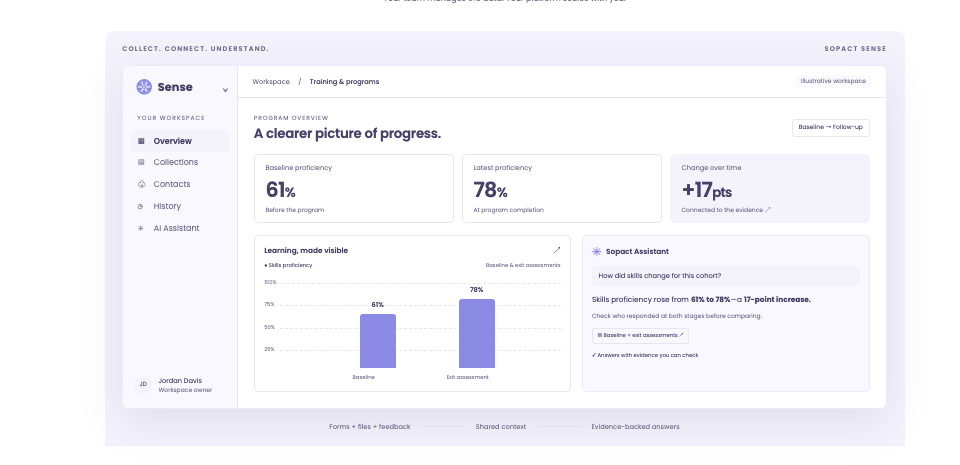
Sopact Sense approaches the problem from the opposite direction: instead of optimizing how humans review, it uses AI to read everything first — essays, documents, proposals, interview transcripts — then surfaces the applications and patterns that need human judgment.
How AI-powered application review actually works: When 1,200 scholarship applications arrive, Sopact's application review system doesn't route them to 15 human reviewers. Intelligent Cell reads every essay and scores it against your exact rubric criteria — "demonstrates resilience," "shows community engagement," "presents a realistic career plan" — using natural language understanding, not keyword matching. Each application receives a detailed AI assessment with specific evidence citations from the applicant's own writing. Reviewers see the AI's reasoning alongside the original text. The result: humans spend their time on the 50 finalists where judgment genuinely matters, not the 1,150 applications where the answer was clear from paragraph two.
Eliminating bias in grant review: One of the structural problems with human panel review is bias in grant review — scoring drift across reviewers, fatigue effects in late-evening sessions, and unconscious pattern matching that favors familiar writing styles. AI applies identical grant review rubric criteria to every application without fatigue, mood, or drift. This doesn't eliminate human judgment — it focuses human judgment on the decisions where it adds the most value.
The complete application management platform: Sopact provides full application management software capabilities — form building, multi-stage workflows, reviewer coordination, status tracking — alongside the AI layer. The online application system supports conditional logic, file uploads, collaborative submissions, and branded portals. The difference isn't that Sopact replaces workflow management. It's that the workflow is built around AI intelligence rather than human routing.
Key differentiators beyond review:
Intelligent Cell pre-scores every application against your rubric using NLP content understanding — not rule-based matching or simple eligibility calculations. It reads essays, personal narratives, and research proposals, extracting the qualitative substance that human reviewers would evaluate.
Intelligent Column analyzes patterns across your entire applicant pool — extracting themes from thousands of open-ended responses, identifying what the strongest applicants have in common, and surfacing insights that no individual reviewer could see by reading one application at a time.
Intelligent Row creates a complete participant profile that persists across programs and years. When a grantee applies for renewal, their Year 1 application data, progress reports, and outcome surveys are already connected — no manual reconciliation required.
Document intelligence reads and scores uploaded PDFs up to 200 pages — research proposals, budget narratives, recommendation letters, compliance documents — against any criteria you define.
Persistent unique IDs track every participant across the full lifecycle: application → onboarding → progress → outcomes → alumni. This is what enables the question that legacy platforms can't answer: "Which selection criteria in Year 1 predicted the strongest outcomes in Year 3?"
Honest limitations: No fund distribution — organizations needing intake-to-payment should evaluate Fluxx or keep Submittable for that function. No corporate CSR/giving ecosystem — no employee giving, volunteer coordination, or matching gifts. Not designed for government contract compliance workflows requiring ISO 27001 or FedRAMP.
Pricing: Flat tiers, published. Unlimited users, unlimited forms, full AI analysis included at every level — no premium gates on intelligence features. Implementation in 1-2 days, not weeks.
Best for: Large foundations needing end-to-end grant lifecycle management with financial tracking, compliance documentation, and audit trails.
Key differentiators: Deep financial tracking, configurable dashboards, strong compliance documentation, integration with accounting systems.
Honest limitations: No AI analysis of qualitative content. No longitudinal participant tracking. Complex implementation (weeks, not days). Custom pricing.
Best for: Small to mid-size foundations running 1-5 programs with under 500 applications per cycle.
Key differentiators: Published pricing (~€3K/year starting), fast setup, intuitive interface, responsive support.
Honest limitations: No AI capabilities. Limited customization. Basic reporting. Not for high-volume programs.
Best for: Associations and higher education running awards, scholarships, abstract management with complex judging.
Key differentiators: Strong AMS integrations (iMIS, Salesforce, MemberClicks), configurable judging workflows, launching AI scoring assistance in early 2026.
Honest limitations: Setup complexity. Interface not always intuitive. Reporting gaps. AI features are early-stage. Custom pricing (~$5,100-6,900/year starting).
Best for: Community foundations needing compliance-focused workflows with standardized processes.
Key differentiators: Purpose-built for community foundations, clear compliance workflows, Bonterra platform integration.
Honest limitations: No AI capabilities. Limited flexibility. Complex pricing as part of Bonterra.
Best for: Large enterprises needing grants, giving, advocacy, fundraising, and volunteer management under one vendor.
Key differentiators: Widest feature scope in this comparison. Enterprise compliance. Broad integrations.
Honest limitations: Breadth over depth. No AI content analysis. Complex implementation. Enterprise pricing. Integration of acquired products still evolving.
Workflow-first platforms (Submittable, Fluxx, OpenWater, Foundant, Bonterra) share a common architecture: collect data → route to humans → humans score → aggregate scores → report. AI, where it exists, is bolted onto this pipeline.
Intelligence-first architecture (Sopact) inverts this: collect data → AI reads everything → score against qualitative criteria → surface exceptions for human judgment → carry context forward to next cycle.
This matters for three reasons:
Scale. Workflow optimization hits a ceiling — you can only make humans review so fast. AI scoring scales linearly at near-zero marginal cost.
Consistency. Twenty human reviewers scoring 100 applications each will produce measurable scoring drift. AI applies identical criteria to every application, every time.
Compounding intelligence. When every application, progress report, and outcome survey connects to a persistent participant identity, each cycle makes the next one smarter. "Which essay themes in Year 1 predicted the highest employment outcomes in Year 3?" — that's institutional knowledge that improves every future selection decision.
Be honest about these scenarios — they point toward Submittable:
You need fund distribution built into your platform. If intake-to-payment in one system matters for compliance, Submittable handles this and most alternatives don't.
You run corporate CSR programs with employee giving and volunteering. Submittable's ecosystem (grants + giving + volunteering + matching gifts) is genuinely differentiated here.
Your review process is genuinely simple. 200 applications, 5 reviewers, 3-criterion rubric, 2 weeks. The case for AI exists but the pain isn't dramatic.
Vendor stability and enterprise compliance matter most. 15 years of track record, audit trails, established documentation.
You're already in the Submittable ecosystem and switching costs are high. If processes are configured and pain points are manageable, disruption may not be worth the gain.
You have more applications than your reviewers can read carefully. Reviewer fatigue, scoring drift, and reconciliation delays are structural problems that AI eliminates. If your program receives 500+ applications and your reviewers are spending 4-6 weeks on each cycle, AI-powered application review changes the economics fundamentally.
You need to analyze what applicants wrote, not just whether they checked boxes. Essays, narratives, proposals, open-ended responses — Sopact reads and extracts patterns across all of them. If the most important signal in your application is a personal essay or a research narrative, you need a platform that can actually read it.
You're concerned about bias in your grant review process. Scoring drift across reviewers, fatigue-driven inconsistency, and unconscious pattern matching are structural problems in human panel review. AI applies your grant review rubric identically to every application, every time — then flags exceptions for human judgment.
You need to connect today's selection decisions to tomorrow's outcomes. Persistent unique IDs and longitudinal tracking are architectural requirements — not features that can be bolted on later.
You review documents as part of your process. 50-page research proposals and budget narratives — document intelligence changes the economics of evaluating them.
You want a complete application management and online application system with AI analysis built in — without enterprise pricing. Full AI at every pricing tier, no premium gates.
Consider a mid-size scholarship program receiving 1,200 applications per cycle. Each includes academic records, a personal essay, two recommendation letters, and a budget justification.
With Submittable: Configure 4-stage workflow. Assign 15 reviewers, 80 applications each. Reviewers read every essay and recommendation. Scoring takes 4-5 weeks. Panel reconciliation adds another week. Reviewer 1 scores differently at hour 20 than hour 2. Three reviewers give consistently higher scores. Total: 6 weeks. And next cycle starts from zero.
With Sopact Sense: AI reads all 1,200 essays and 2,400 recommendation letters in minutes. The application review system scores each against your grant review rubric — "demonstrates resilience," "shows community impact," "realistic career plan." Surfaces top 100 for human review. Flags 30 where AI confidence is low. Humans spend 100% of time on the 130 applications where judgment matters. Total: days, not weeks. Zero scoring drift. And next cycle knows which essay patterns predicted the strongest outcomes.
No payment disbursement. Sopact doesn't process payments or manage fund distribution.
No corporate CSR ecosystem. No employee giving, volunteer coordination, or matching gifts.
No government procurement compliance. No ISO 27001 certification or government-specific portals.
Not an all-in-one for greenfield organizations. If you want CRM + grants + giving + volunteering + fundraising under one vendor, Bonterra's breadth may be more appropriate.
These aren't gaps being "worked on" — they're architectural boundaries that define what the platform is. Pretending otherwise would be dishonest.
The best Submittable alternatives depend on your specific needs. For AI-powered application intelligence and longitudinal tracking, Sopact Sense is the leading alternative. For foundation-focused grant lifecycle management, Fluxx excels. For affordable simplicity, Good Grants works well. For configurable awards workflows, OpenWater offers strong judging tools. For community foundation grantmaking, Foundant by Bonterra fits. For enterprise-wide social impact bundling, Bonterra has the broadest scope.
Submittable offers "Automated Review" — a premium feature that applies rule-based calculations, eligibility filters, fraud detection, and workflow routing. It does not perform natural language analysis of essays, narrative responses, or qualitative content. For AI that reads and evaluates what applicants actually wrote, platforms like Sopact provide a fundamentally different capability.
No. Automated Review is workflow automation — rule-based logic that calculates scores from numeric fields, verifies documents, and routes applications. AI scoring uses natural language processing to read and evaluate qualitative content: essays, proposals, narratives, recommendation letters. One automates the pipeline; the other understands the content flowing through it.
Good Grants (starting around €3K/year) is the most affordable dedicated alternative. Sopact Sense offers flat pricing with unlimited users, forms, and full AI analysis included. Submittable starts around $10,000/year with AI features locked behind higher tiers.
For most application review and impact tracking workflows, yes. For fund distribution — no. Organizations needing integrated payment processing should either keep Submittable for that function or evaluate Fluxx/Foundant.
Sopact is designed specifically for longitudinal tracking. Persistent unique IDs link every data point automatically — without manual reconciliation. Submittable's stage-based architecture treats each cycle as separate data.
Both handle intake and reviewer coordination. Submittable offers deeper workflow features including fund distribution. Sopact provides AI analysis of essays and recommendation letters, persistent tracking across cohorts, and evidence connecting selection criteria to outcomes. Choose Submittable for payment processing and compliance. Choose Sopact for qualitative analysis and longitudinal evidence.
Yes. Export records as CSV, rebuild forms in Sopact (typically 1-2 days), import historical data with persistent unique IDs. Migration support included at no additional cost.
AI-native means the platform was designed around AI from the ground up — data architecture, workflows, and pricing all assume AI is core. AI as add-on means AI features were bolted onto an existing manual workflow platform — typically gated behind premium pricing and limited by the original architecture.
Yes. Some organizations use Submittable for intake and fund distribution while feeding data to Sopact for AI analysis and longitudinal tracking. Sopact connects to existing systems rather than requiring full replacement.
1-2 days. Self-service platform. Configure AI scoring criteria in plain English. No professional services required for standard deployments.
Sopact focuses on data intelligence, not employee engagement. Organizations needing both CSR tools and AI analysis could use Submittable for the CSR ecosystem and Sopact for the analytical layer.