


What does AI do in ESG?
AI can help organizations organize and analyze environmental, social and governance information. Practical tasks include extracting fields from reports, classifying stakeholder comments, checking inconsistencies and preparing source-supported drafts. Its usefulness depends on the quality of the evidence and the decisions the team needs to make.
AI does not make an ESG claim true by writing it clearly or attaching a citation. A source may contain an estimate, an incomplete account or an unsupported claim. The team still needs to understand the measure, reporting boundary, period and strength of evidence.
Begin with one recurring task that consumes time or creates errors. Reviewing partner submissions may be a better starting point than asking a system to produce a complete sustainability report from an unorganized archive.
Practical applications of AI in ESG
Scroll horizontally to see all columns →
| Application | Possible output | Human review needed |
|---|---|---|
| Document review | Extracted dates, measures and supporting passages. | Check values, units, periods and context. |
| Stakeholder feedback | Themes across employee, customer or community accounts. | Review interpretation, missing perspectives and confidentiality. |
| Data-quality checks | Missing fields, inconsistent definitions or unusual values. | Resolve the issue with the source owner. |
| Evidence mapping | Sources associated with a defined reporting question. | Confirm relevance and whether the evidence is sufficient. |
| Reporting support | A draft explanation based on reviewed findings. | Approve claims, qualifications and final use. |
These tasks can reduce repeated handling of information. Test the improvement on the actual workload: how many errors are caught, how much review is still needed and whether the next cycle can be completed consistently. A convincing demonstration is not a measured productivity result.
Start with the claim and work backward
Write the statement the evidence is intended to support. “We delivered 20 workshops” requires different evidence from “participants improved their employment conditions.” A list of activities cannot establish the second claim without appropriate outcome evidence.
For each intended finding, define the population or business boundary, period, measure, source and limitations. Separate observed results from estimates and forecasts. If the source is a partner’s self-report, retain that distinction rather than describing the figure as independently verified.
Keep the original file and its version. A later correction should update the current view without erasing which source supported an earlier submitted report. For document processing, see AI document analysis.
Connect recurring collection without imposing one instrument
Different companies, suppliers or sites may have different operations. A long identical survey can ask irrelevant questions while still missing important local context. Agree the small shared core needed for a particular comparison, then allow relevant local measures.
A data dictionary should record the definition, unit, reporting period, calculation, exclusions and owner of each shared measure. A count of unique employees is different from training attendance entries. A target, estimate and observed value should not occupy the same field without clear labels.
Reuse reliable organizational information rather than asking for it in every return. Request updates when relevant and preserve historical context. If the reporting boundary changes, a trend may need explanation or restatement; the system should not hide that change.
Worked example: a community investment claim
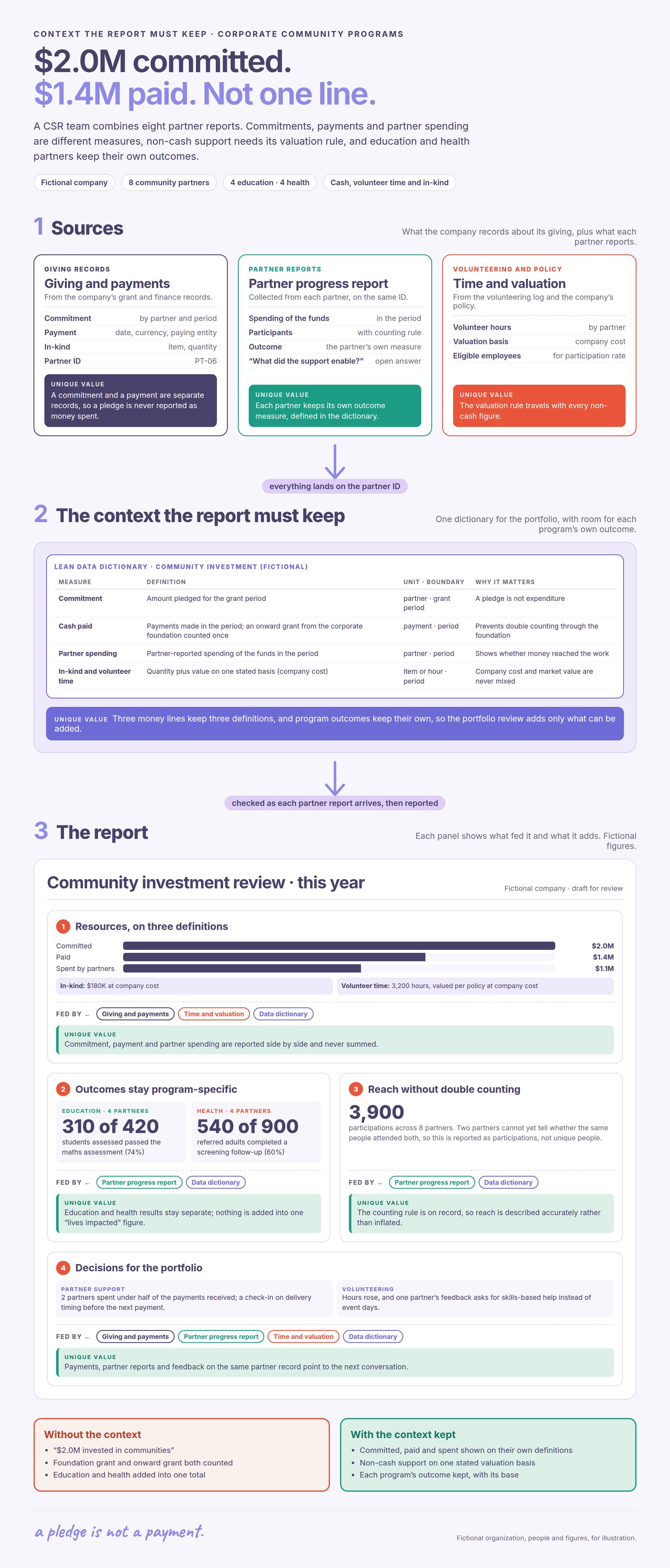
Imagine a company supports a skills program. The partner reports 200 participants, while an attached attendance table lists 200 session entries. The narrative says employment prospects improved, but no follow-up measure is included.
AI-assisted review can flag the inconsistent unit and locate the employment statement. It cannot conclude that 200 different people participated or that employment improved. The next action is to ask the partner to clarify the count and provide the evidence appropriate to the outcome claim.
If the partner confirms 80 distinct participants and supplies follow-up from 40, retain those figures separately. An employment result among those 40 describes the observed respondents, with coverage and selection limits. It should not silently become a result for everyone who enrolled.
A defensible report might describe verified delivery, available follow-up and the evidence still needed. That is more useful than a polished paragraph whose central claim cannot be supported.
Here is a community investment review that applies the same discipline across eight partners: participations are not reported as unique people, and each outcome claim stays with its own evidence.
Check quality at more than one step
- Source quality: Was the information collected for a suitable purpose, with a clear method?
- Processing quality: Were relevant pages, tables and fields read correctly?
- Definition quality: Do the units, periods and boundaries match the comparison?
- Interpretation quality: Does the conclusion follow from the evidence, including contradictory material?
- Reporting quality: Are uncertainty, coverage and important limits visible?
A citation helps a reviewer inspect the source. It does not establish that all relevant evidence was considered or that the cited statement was independently verified. Review enough context to distinguish a fact, a stakeholder opinion and an estimate.
Keep missing evidence distinct from poor performance. A blank field may mean a question was not applicable, data was unavailable or the contributor missed it. Those explanations need different responses.
Use reporting frameworks as defined requirements
If the task involves mapping evidence to a reporting framework, use the correct current version and a clearly defined question. A model can suggest where a passage may belong, but the responsible team must determine applicability and whether it satisfies the requirement.
Do not treat a suggested mapping as a compliance conclusion or assurance opinion. Requirements, boundaries and interpretations vary. Keep the framework reference, version, mapping rationale and reviewer with the result so the decision can be revisited.
This also helps prevent duplication. The same source may inform several reporting questions, but that does not mean its values should be added repeatedly to a combined total.
Use qualitative evidence without flattening differences
Employee, customer, supplier and community accounts may describe different effects of the same activity. Analyze those perspectives in context. A favorable overall result can coexist with a serious concern for a smaller group.
Define themes, preserve the original account and review unusual or contradictory responses. Avoid treating the most frequent phrase as automatically the most material issue. Frequency, severity, evidence quality and the decision context all matter.
Protect identities when reporting small groups or detailed narratives. A quotation can reveal someone through context even if their name is removed. See stakeholder feedback for the collection and response process.
Assign responsibility before scaling AI use
Name the people who own source collection, definitions, access, review and approval. Specify which routine changes teams can make themselves and which require review. Keep an appropriate record of changes to fields, categories and reporting rules.
Test access with realistic roles: a contributor, an analyst and a report recipient. Confirm that summaries do not expose material the recipient should not see. Review the service’s data handling and retention arrangements for the actual use.
The voluntary NIST AI Risk Management Framework provides a broader structure for considering risks in AI use and evaluation. It is a risk-management resource, not a certification that a particular ESG report is correct.
Run a focused pilot
- Choose one repeated reporting question and a representative document set.
- Define expected outputs and examples a reviewer has checked.
- Include poor scans, missing information, revised documents and conflicting definitions.
- Measure review effort and errors, not only generation speed.
- Test corrections, access and reproduction of an approved finding.
- Decide whether the workflow is useful enough to expand.
Include operational staff who will maintain the process. A pilot that depends on a specialist rebuilding it every cycle may not meet the needs of a growing team. Self-management and self-governance should be demonstrated through routine changes, controlled definitions and clear ownership.
Where Sopact fits
Sopact is relevant when recurring partner responses, documents and qualitative evidence need to stay connected for analysis and reporting. Evaluate the complete collection-to-review workflow rather than only a generated summary.
It should be clear which findings are ready to use, which need clarification and who can approve them. A connected record makes review more manageable; it does not remove the need for a valid measure, source checks or an appropriate causal explanation.
Continue with the portfolio evidence course. For the reporting step, use How to Write an Impact Report and the report examples.
Watch: connect portfolio reporting sources
This product walkthrough illustrates a reporting workflow across different sources. It is not independent assurance of the underlying data or a guarantee that an ESG claim is supported.
Frequently asked questions
Can AI automate ESG reporting?
It can assist with parts of collection, analysis and drafting. People remain responsible for the evidence, applicable requirements and approved conclusions.
Can AI prove an ESG initiative caused an outcome?
No. A causal claim requires an appropriate question, design and evidence. Organizing documents or attaching citations does not establish causality.
Does traceability prevent greenwashing?
Traceability makes claims easier to examine. Unsupported or selective claims can still have citations, so review their meaning, completeness and limits.
Can different portfolio companies use different questions?
Yes. Preserve locally relevant collection while agreeing the shared definitions needed for a valid comparison. Keep incompatible measures separate.
What is a good first AI project for an ESG team?
A repeated, bounded task with representative evidence and clear review responsibility, such as checking partner submissions for missing fields and inconsistent definitions.
