The practice
The five-stage workflow, the output–outcome–impact ladder, and the five questions every strong impact report has to answer.
The template
Seven sections as a reusable data dictionary — executive summary through recommendations, with the rule behind each section.
The build
Where Claude and ChatGPT are enough for a small report — and the four places they break on reliable, large, qual + quant data.
The sector cuts
Nonprofit, donor, CSR/ESG, and impact-investing variants — one architecture, each reader's framing.
What is an impact report?
An impact report is a document that explains what changed for the people a program reached, with evidence a funder, board, or evaluator can audit. It pairs three things — what the program did, who it reached, and what changed for those people — with each claim tied back to a participant record so a reader can reach the same conclusion the writer did.
Writing a social impact report? Start with the companion guide — how to write a social impact report: the five questions every social impact report answers and six design principles tuned for social-sector readers.
What this eBook is about
Impact Reporting: The Complete Best-Practice Guide fixes the architecture, not the prose. Most impact reports fail for three reasons that have nothing to do with writing — the data fragmented across tools, the work happened at year-end, and nothing was reproducible — so the report became a six-week scramble instead of a byproduct of clean data. This guide walks the whole arc: the purpose of an impact report, the difference between output, outcome, and impact, the five-stage workflow, the seven-section template, impact report design, and worked examples you can open in a browser.
Who should read it
Nonprofit and program leads who need to show funders the program worked; foundations and impact investors comparing outcomes across a portfolio; CSR, ESG, and sustainability leads who need disclosure that informs decisions instead of an 80-page checkbox; and the M&E, data, and evaluation teams joining numbers and stories reliably at scale.
What's inside
- The purpose of an impact report — accountability, learning, and trust, and why serving only one reads as compliance.
- Output vs. outcome vs. impact — the ladder that decides whether a funder reads or files your report, worked from one real cohort.
- How to write an impact report, step by step — the five-stage workflow from defining the question to publishing for three audiences.
- The seven-section template and the five questions every strong report answers.
- Impact report design — writing for the three-minute reader and passing the three-click evidence test.
- Nonprofit impact reporting best practices — reporting to donors and grantmakers from one cohort dataset.
- Impact report examples — four live samples (workforce, correlation, scholarship, ESG) you can open without a login.
- Can AI write your impact report? — where Claude and ChatGPT are enough, and the four places they break.
Why it matters
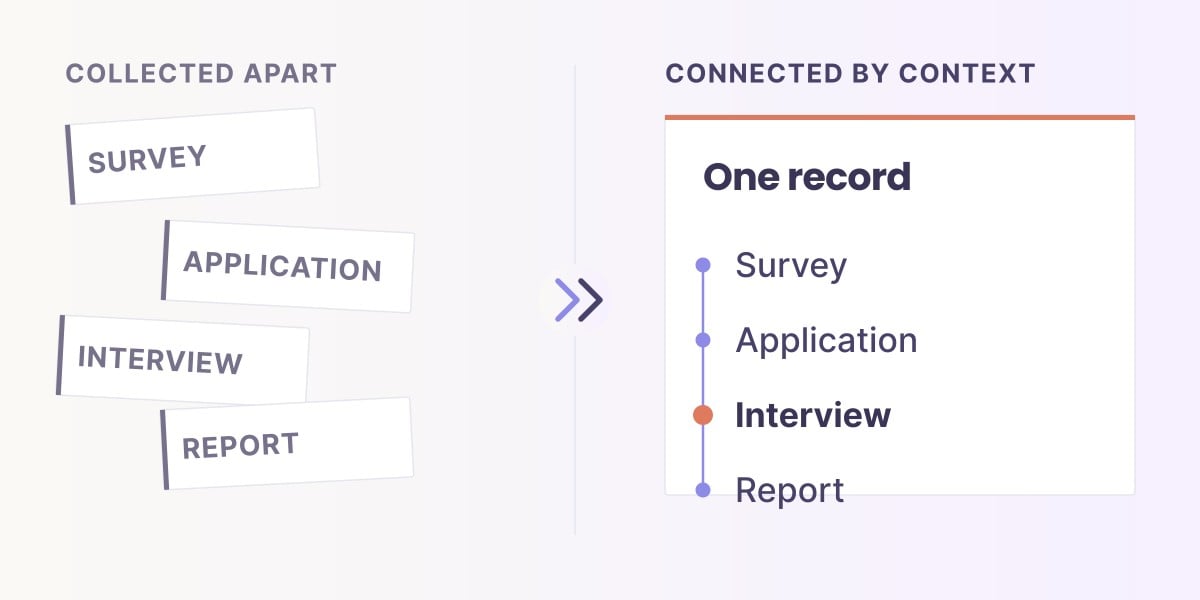
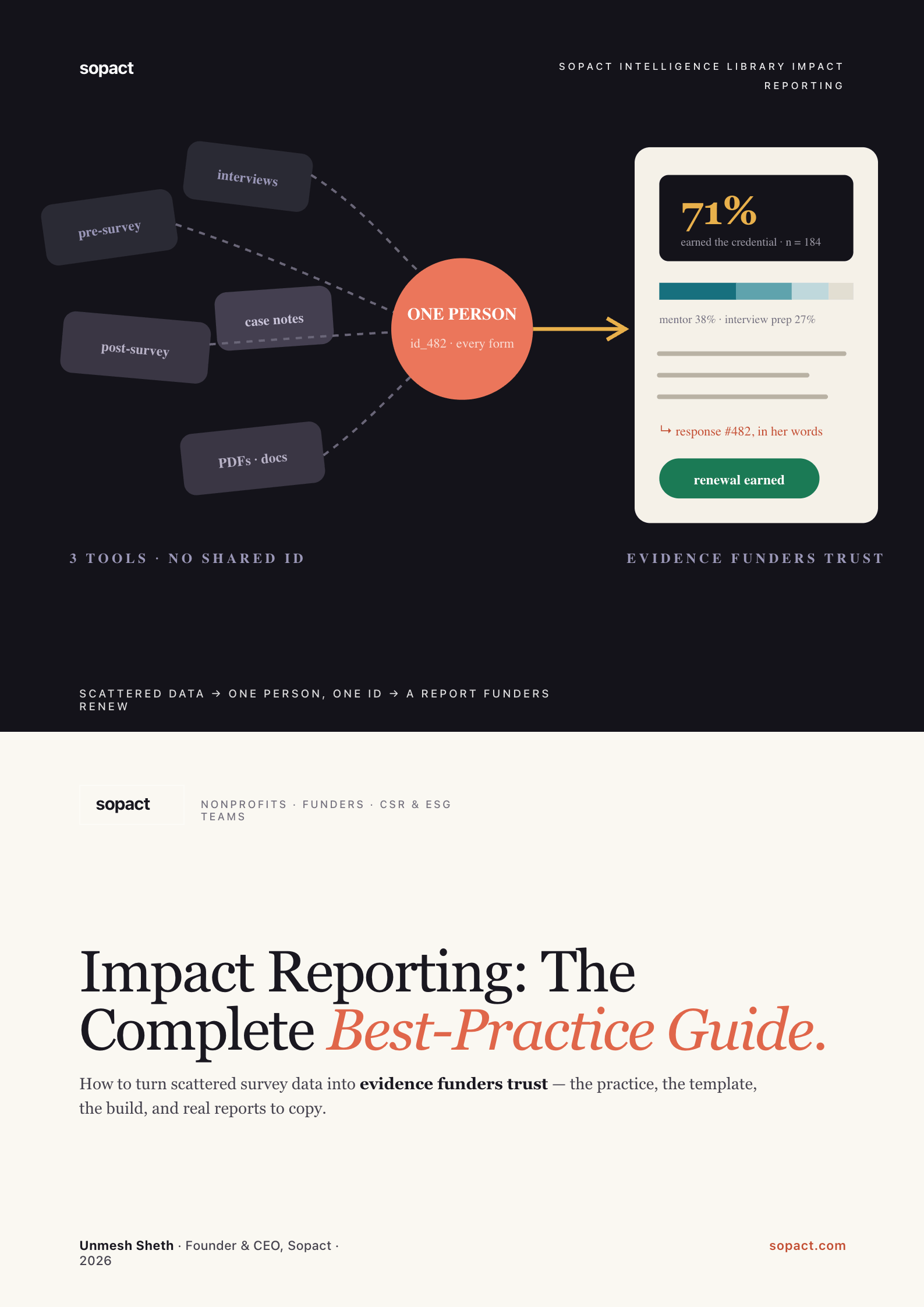
The strongest reports come out of data that was bound from the moment of intake — one participant ID across every form, open responses themed as they arrive, one source feeding the board, funder, and community versions with no reconciliation between them. Get the architecture right and storytelling, evidence, and compliance stop competing; they all run off the same source. Download the guide for the practice, the template, the build, and the sector cuts in one place.
Frequently asked questions
What is the purpose of creating an impact report?
An impact report serves three purposes at once. It accounts to funders, regulators, or LPs for resources spent. It informs the program team about what is working and what is not. And it builds external trust by showing the work to a wider audience. A report that serves only the first reads as compliance; a report that serves all three becomes a planning instrument the team uses to decide what to do next cycle.
How do you write an impact report?
Start with the decision the primary reader needs to make, then work backward. Collect baseline at intake, not at report time. Define five to seven outcome metrics with baselines aligned to your theory of change. Pair every quantitative claim with one qualitative observation from the same participants. Surface what underperformed alongside what outperformed. Lead with the headline finding before the methodology, and write the executive summary last.
What sections should an impact report include?
Seven sections, in order: executive summary, organizational context, methodology, quantitative outcomes, qualitative evidence, visual data, and recommendations. The executive summary is written last but placed first. The methodology section is the one most often skipped and the fastest way for an evaluator to spot a weak report. The recommendations section is what turns a backward-looking document into a forward-looking tool.
Is this impact report guide free?
Yes. How to Write an Impact Report is a free download from Sopact and part of the Sopact Intelligence Library. It covers the practice, the seven-section template, a worked example from raw data to finished report, and the nonprofit, donor, CSR, and impact-investing variants.