


Related solution
Network & Membership Intelligence
Connect local reports and member feedback.
Explore the solution →

USE CASE / SOFTWARE GUIDE
Union management software helps labor unions maintain member records and coordinate work such as dues, communications, representation and reporting. Good software supports the union’s operating responsibilities while helping staff understand the needs and experiences behind the membership record.
A local may need reliable dues processing and case deadlines. A national organization may also need a useful picture across locals with different employers, agreements and member circumstances. Counts alone cannot explain why participation changed or which recurring concern deserves coordinated support.
AI can make written feedback and reports easier to examine during ongoing work. Sopact focuses on that evidence: connecting permitted forms, files and comments so staff can ask current questions through AI Assistance. It is relevant to member and program intelligence alongside the systems responsible for union-specific administration.
Keep membership and representation responsibilities clear.
Read participation with the explanation members provide.
Use shared learning without losing local differences.
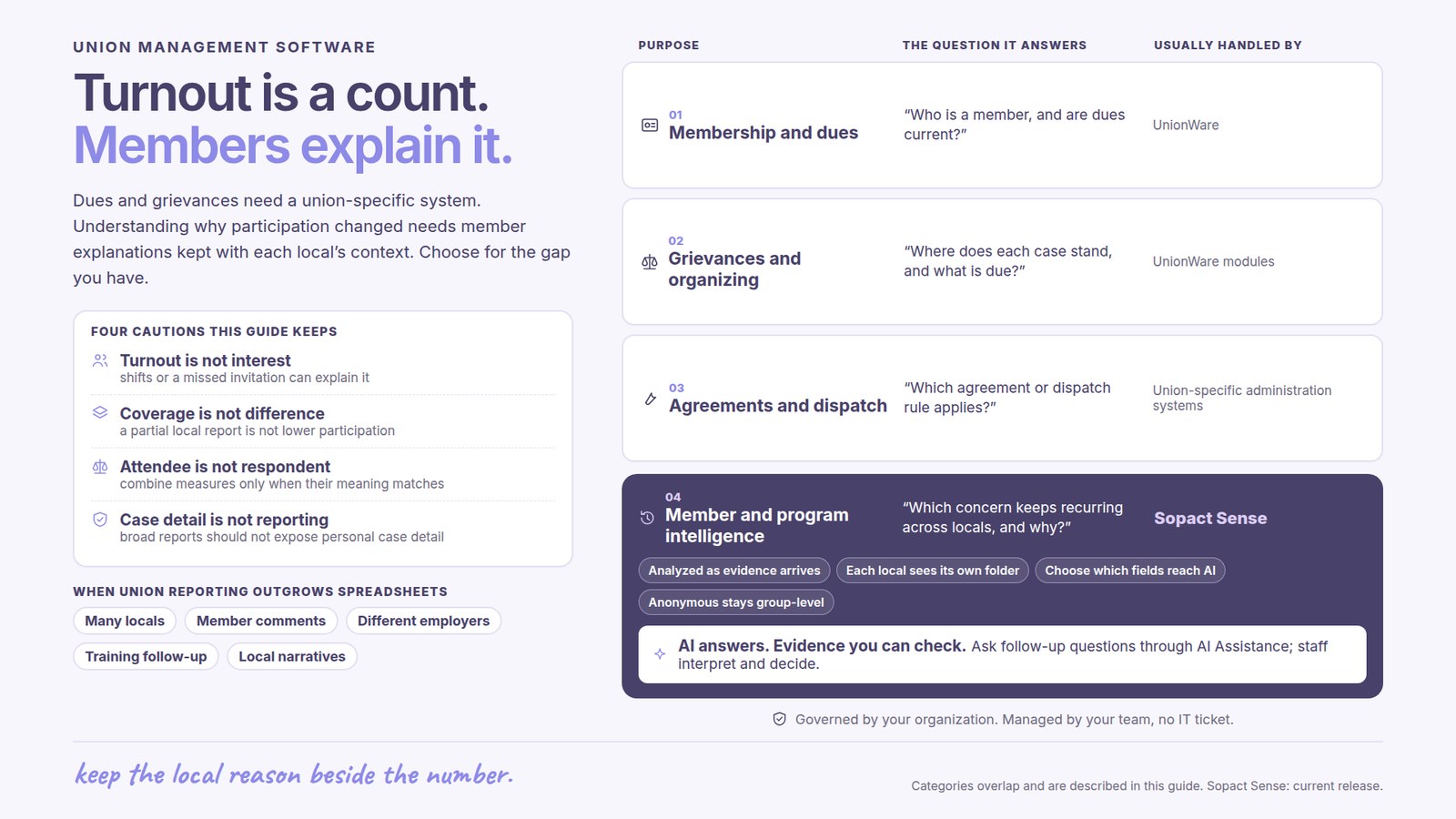
Membership records, dues, grievances, agreements, organizing and dispatch can require specialized workflows. Their importance varies by union. A product that analyzes member feedback should not be assumed to handle each of these responsibilities.
UnionWare documents membership and dues processing together with expansion modules for work such as grievances and organizing. Its services include migration, configuration, training and continuing support. Those are relevant strengths for a union seeking a core operating system.
The selection question is which responsibility is difficult today. A problem with dues reconciliation calls for a different solution from a problem understanding recurring concerns across local reports. Some unions need both improvements, but the scope should be explicit.
Meeting attendance, training participation and survey response describe different behaviors. Low turnout does not by itself explain whether members lack interest, work conflicting shifts or did not receive the invitation.
A useful report keeps the relevant population and period beside the result. It also shows which locals submitted evidence. Comparing a complete local report with a partial one can reward reporting coverage rather than reveal a real difference in participation.
Written feedback helps explain what the counts cannot. The value is a more informed discussion with local leaders, not an automatic score that classifies members or locals without understanding their circumstances.
Locals need questions relevant to their own members. Headquarters needs enough consistency to understand common issues and coordinate support. A shared reporting approach should serve both purposes.
Agree the meaning of measures that will be combined. Members contacted, survey respondents and meeting attendees are not interchangeable. A training completion has a different meaning from a person registering for a session.
Retain the local explanation around the measure. Changes in work schedules, venue access or the timing of a program may matter to interpretation. Keeping those details available makes a shared view more useful than a collection of totals detached from context.
Sopact connects permitted feedback, program records and local updates for analysis as new evidence arrives. Staff can explore a recurring question through AI Assistance without first combining another set of spreadsheets and narratives.
For a fictional training initiative, several locals may report good completion rates while members describe difficulty applying the material on the job. Leaders can examine whether the issue concerns course relevance, access to practice or employer conditions before deciding how to respond.
The benefit extends to the next cycle. Later evidence can show what members experienced after the union adjusted its support. The analysis informs human judgment; it does not establish the facts of a grievance or replace representation procedures.
The information needed for an individual representation matter can be more sensitive than the evidence needed to understand a network-wide training issue. Broad reporting should not expose personal case detail simply because it is technically available.
Anonymous member feedback should remain group-level evidence. Where named follow-up is intended, explain that use clearly. Written comments also deserve review before wider circulation because a role or incident can identify a person even without a name.
These are requirements for the agreed workflow, not a claim that every system implements identical controls. Decide what local staff, central teams and report readers need to see in order to perform their responsibilities.
For core administration, evaluate the union-specific workflow. For analysis, evaluate whether staff can understand the member experience and act with less repeated preparation. A well-functioning dues or grievance system may remain in place while connected evidence improves program learning.
Sopact’s typical setup estimate is two days to two weeks for an agreed analysis and collection scope. Historical material, source connections and access requirements determine the work. Personalization and continuing support help staff retain ownership as the union’s questions change.
The ASME resource below is a membership-organization example of qualitative feedback becoming usable in analysis. It is not a labor-union deployment or proof of grievance-management capability.
It supports member records and union operations such as dues, communication, representation and reporting, with scope depending on the union.
That is not the role described here. Sopact supports connected member and program analysis alongside the required operational systems.
Only where definitions, periods and evidence coverage are sufficiently comparable. Local context remains important.
Anonymous evidence should remain anonymous and be analyzed at an appropriate group level.
It can make narrative evidence easier to review across recurring reports, while staff retain responsibility for interpretation and action.
Continue with a purpose
Related solution
Connect local reports and member feedback.
Explore the solution →Continue learning
Learn how shared definitions support useful reporting.
Start learning →
Customer story
A membership-organization example of making qualitative evidence usable.
Read the story →Explore how Sopact can connect local evidence, feedback and follow-up around the questions your team needs to answer.
See it with your workflow →