


How do you measure behavior change after training?
Measure behavior change after training by defining an observable action, gathering suitable evidence of its use and comparing it over time under relevant conditions. Record who had an opportunity to apply the learning, how the behavior was assessed and whose evidence is missing.
Behavior is the application of learning in practice, often called training transfer. In the Kirkpatrick model, it is distinct from reaction, learning and results. A participant may understand a new procedure but lack the access or support to use it. Another may already perform it well before the course.
The practical goal is to find out what people do, what supports or prevents it and what help is needed. A before-and-after comparison can show observed change. It does not, by itself, prove that training caused it.
Define a behavior you can observe
Start with a specific task rather than a broad aspiration. “Shows leadership” leaves too much room for interpretation. “Agrees a next action and owner at the end of a team review” gives reviewers something to look for.
Scroll horizontally to see all columns →
| Broad goal | Possible observable behavior | Evidence to consider |
|---|---|---|
| Improve service handoffs | Include the agreed information before transferring a case | Reviewed handoff records and recipient feedback |
| Apply a coaching skill | Ask an open question and agree a next step during a relevant conversation | Consented observation or structured reflection with a reviewer |
| Use a new work procedure | Complete the required steps under the defined conditions | Work samples, observation or appropriate system records |
| Report suspicious messages | Use the approved reporting route when a relevant message is encountered | Proportionate reporting data and an explanation of the opportunity |
Agree on the standard with people who understand the job. Specify the conditions, acceptable variation and what the reviewer should record. If the standard changes later, preserve that change rather than presenting the new score as directly comparable.
When should you follow up?
Choose timing around a realistic opportunity to apply the behavior. Sixty or ninety days can be useful in some programs, but it is not a universal rule. A daily task can be observed earlier; a seasonal task may require a much longer window.
Ask whether the opportunity actually occurred. “Has not used the skill” can mean no relevant assignment, an unavailable tool, a changed role or difficulty applying the learning. Those situations call for different responses.
For sustained use, collect more than one relevant observation. A single late survey is a snapshot. It can describe current reported practice but cannot establish when a change began, whether it was continuous or why it lasted.
Choose evidence that fits the claim
Scroll horizontally to see all columns →
| Source | What it can contribute | What to check |
|---|---|---|
| Learner self-report | Experience, examples and perceived barriers | Recall, interpretation and whether use was actually observed |
| Supervisor observation | Practice in the work setting | Opportunity to observe and consistency of the standard |
| Work sample | Evidence of a defined task or output | Comparable difficulty, context and assessment criteria |
| System event | A recorded action or sequence | Whether the event represents the intended behavior |
| Customer or recipient account | Experience of the behavior's effect | Perspective, coverage and other influences |
Combining sources can help examine a finding, but agreement between two weak measures does not automatically establish accuracy. Choose proportionate evidence and retain disagreements for review. An employee's explanation is valuable context, not proof that all other causes have been ruled out.
Build the follow-up plan before training
- Name the behavior and purpose. State which action matters and what decision the evidence will support.
- Choose the unit. Decide whether you need individual, team or site-level evidence.
- Establish the starting point. Use a relevant baseline where feasible. If none exists, report the later observation as a snapshot and explain that limitation.
- Agree on sources and access. Tell participants what is collected, who sees it and how it will be used.
- Set an opportunity-based review window. Include a way to record that the behavior could not yet be attempted.
- Assign review and support. Decide who will examine findings and arrange an appropriate response.
Individual change requires an appropriate way to connect observations for the same person. Group-level questions may not require identified tracking. Do not collect personal information solely to make a dashboard more detailed.
Useful follow-up questions
- Since the training, have you had an opportunity to perform [specific task]?
- Describe one occasion when you used [behavior]. What happened?
- Which part could you do independently, and where did you need support?
- What made applying the learning easier or harder?
- What support would help with the next opportunity?
For observers, ask what they saw, when they saw it and which standard they used. Distinguish observed behavior from an impression of overall performance. Avoid requiring a supervisor to rate a task they have not seen.
Use training survey questions for additional collection examples. Keep the follow-up focused on application rather than repeating the end-of-course satisfaction form.
A worked example with coverage and sustained use
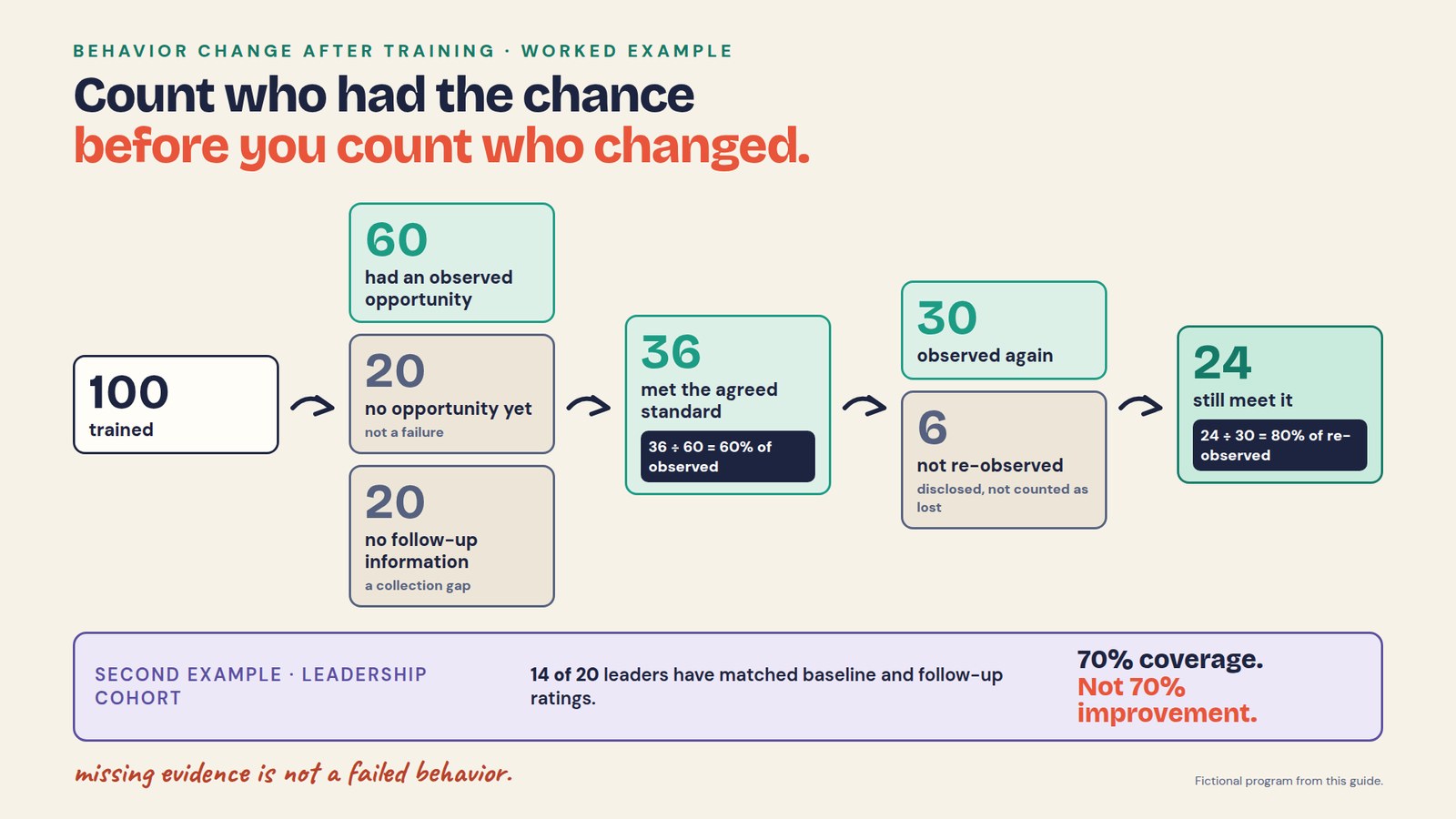
This fictional program trains 100 participants. During the first follow-up window, 60 have an observed opportunity to perform the task. Thirty-six meet the agreed standard. The result is 36 ÷ 60 = 60% of observed participants, with observed evidence covering 60% of the trained cohort.
Twenty participants report no opportunity and 20 have no follow-up information. Neither group should be treated as failing the behavior standard. Keep them separate so the team can distinguish work allocation from collection gaps.
Of the 36 who initially met the standard, 30 are observed again during a second suitable opportunity. Twenty-four still meet it. You can report sustained observed performance for 24 ÷ 30 = 80% of those re-observed, while disclosing that six initial achievers were not observed again.
Do not describe the six who now fall below the standard as having permanently lost the skill. Review the task conditions, observation quality and support available. The evidence identifies a concern to investigate; it does not diagnose its cause.
Leadership program example: separate change from coverage
Consider a second, separate fictional example: an external provider runs a leadership cohort for 20 people. For delegation, 14 have numeric baseline and follow-up ratings from themselves and the same manager, using the same measure version. That is 70% matched comparison coverage. It is not a 70% improvement rate.
Within those 14 matched leaders, 12 manager ratings increased, one stayed the same and one decreased. The other six leaders are outside this comparison because of missing evidence, insufficient observation, no opportunity or a changed manager. Their absence must remain visible.
The useful decision is where to investigate, arrange practice or request permitted follow-up. The pattern does not establish that training caused improvement, and it says nothing yet about financial ROI. If the provider uses a different comparison rule, such as manager-only pairs, it must calculate and label that sample separately.
See the step-by-step matched comparison and late-response calculation, then use the client report example and editable template.
Which metrics should you use?
Choose a small set appropriate to the behavior, rather than collecting every available measure. Define the denominator and assessment rule before reporting the figure.
- Application rate: those meeting the defined application criterion divided by the eligible observed group.
- Frequency: how often the behavior occurred relative to relevant opportunities.
- Quality: performance against an agreed rubric or standard.
- Time to competence: elapsed time to meeting a defined standard, with unobserved or incomplete cases handled explicitly.
- Sustained use: performance maintained across specified observations, with follow-up coverage shown.
- Evidence coverage: the share of the intended population for whom the required evidence is available.
Compare similar opportunities and conditions. A team handling more difficult tasks may have a lower raw success rate despite strong practice. Use the training metrics guide to connect these measures to the wider scorecard.
Use the findings to improve support
Look for patterns in both performance and context. Missing access may require an operational fix. Unclear instructions may require agreement on the process. Limited practice may call for coaching or a supported assignment. Additional training may be one part of the response, not the automatic answer.
Review the interpretation with people close to the work. If several comments mention workload, that is a reason to investigate workload—not a demonstrated causal explanation for every low score. Record what action was agreed, who owns it and when the team will check whether it helped.
Across several locations, keep a small shared core of definitions and allow locally relevant evidence. A data dictionary can distinguish common behavior measures from site-specific questions. Aggregation should follow comparable meanings and periods, not simply identical field names.
Example: security-training behavior
For security awareness, define a safe action such as using the approved reporting route or following a verification step. Assess the behavior in an appropriate, disclosed context. A simulated-message click rate alone does not capture the whole response and may depend on the difficulty of the simulation.
Review whether people can easily find the reporting route, whether they receive useful feedback and whether the process creates delays. Use proportionate monitoring, limit access to individual results and explain the purpose. A training evaluation should not quietly become a different employee-monitoring program.
Keep the claim narrow: a change in observed reporting behavior is not proof that the organization is secure or that training alone prevented incidents.
What should software or a provider demonstrate?
Ask for a representative cohort with a baseline where available, repeated observations, missing follow-up and different application opportunities. Check whether the result preserves the assessment definition, source and coverage.
Sopact's approach connects recurring feedback and evidence to the relevant records, with shared definitions and review. For behavior evaluation, the value to test is whether your team can see the observation in context, understand missing evidence and manage follow-up without rebuilding the analysis from separate files.
AI may help organize comments and surface patterns. It does not establish a training effect by quoting a participant's explanation. Use an appropriate evaluation design and consider other changes when making causal claims. For buying criteria, see training evaluation software.
Watch: connecting training program data end to end
This Sopact walkthrough shows how training program data connects across the full participant journey. See the Training & Programs solution · Book a custom demo.
Also see: Behavior within training evaluation
This companion video introduces the evaluation context. Select your follow-up timing and evidence for the actual behavior rather than treating an example schedule as a rule.
Frequently asked questions
Must behavior change be measured at 90 days?
No. Choose timing around meaningful opportunities to apply the behavior. Repeated observations may be needed to assess sustained use.
Does a pre-and-post comparison prove training caused the change?
No. It shows observed change for the measured group. Other influences and the evaluation design must be considered before making a causal claim.
What if there was no baseline?
You can report current observed or reported practice with clear limitations. Do not reconstruct a precise baseline from memory and present it as an equivalent measurement.
Can a quiz measure behavior transfer?
A quiz generally provides evidence about knowledge or judgment in the assessment setting. Transfer requires evidence of applying learning in the relevant setting.
What should happen when someone has not applied the learning?
Check whether they had an opportunity, what was observed and which barriers or support needs they describe. Agree on a proportionate response rather than assuming the course or the participant failed.
