play icon for videos

Social Impact Report: What It Is, How to Write One, Examples

A social impact report names what changed for whom. Five questions every report must answer, six design principles, a worked example from a 320-participant workforce program, and links to nine published reports

US
Pioneering the best AI-native application & portfolio intelligence platform
Updated
May 9, 2026
360 feedback training evaluation
Use Case
Use case · Social impact report
A social impact report tells funders what happened.
A strong one names what changed for whom.
Most stop at what happened.

Social impact reporting is the practice of producing reports that show change for stakeholders, not only activity counts. The discipline lives in five questions every report has to answer.

This guide explains the framework in plain terms: what the five questions are, the six design principles that hold across funders and sectors, the choices that separate weak reports from strong ones, and what a social impact report looks like when the data underneath it was collected to support the questions a funder is going to ask. Worked example comes from a 320-participant workforce program. No prior background needed.

On this page
The five questions every report answers
Six design principles
Definitions for the recurring terms
Method-choice matrix, six rows
Worked example: 320-participant workforce program
Real social impact reports
The framework

Five questions every social impact report must answer

Strong social impact reports are not longer than weak ones. They answer five questions weak reports skip. The questions are the same across funders, sectors, and report formats. A report that answers all five reads as evidence. A report that skips two or more reads as marketing.

The five questions, in the order a reader needs them answered
01
For whom?
Disaggregation by who experienced the change. Gender, age, geography, cohort. Aggregate hides the answer.
02
Compared to what?
Baseline at intake. Prior cohort. A modeled counterfactual. A number alone is not a result.
03
With what evidence?
Quantitative outcomes paired with qualitative evidence. Voices traceable to specific records, not floating quotes.
04
With what confidence?
Sample size. Response rate. What the data cannot say. The honesty section is the trust section.
05
Now what?
The decisions the report enables. What changes for the next cohort. Reports that close without this read as compliance.
The thesis

Every section of a social impact report should earn its place by answering one of the five questions. If a section answers none of them, cut it. A 12-page report that answers all five outperforms a 40-page report that answers two.

Reading the framework. The questions are sequenced for the reader. A funder reads top to bottom: who was this for, how do I know it changed, what is the evidence, how confident are we, and what happens next. Reports that lead with framework alignment or theory of change diagrams before naming who and how lose the funder before page three.

Definitions

Social impact report, in plain terms

The vocabulary around social impact reporting has accumulated layers. Most readers arrive having heard the term in a funder email, a board meeting, or a grant requirement. The five questions below cover what the term means, how a strong report differs from a weak one, and where the recurring confusions live.

What is a social impact report?

A social impact report is a document that names what changed for the people a program served. It documents outcomes (not only outputs), shows comparison (baseline or counterfactual), pairs numbers with voices, names confidence and limits honestly, and points to decisions the data enables next. The audience is some combination of funders, board members, donors, and the community the program is accountable to.

The contrast that matters. An activity report says "we delivered 240 sessions to 320 participants." A social impact report says "of 287 participants who reached exit, 71% were placed within 90 days, with 82% of women placed and 64% of men, compared to 64% in the prior cohort." The first is delivery. The second is change.

Social impact report meaning

The phrase has two layers. The narrow meaning is the formal document a program produces for funders and stakeholders, usually annually or per grant cycle, summarizing change for the people served. The broader meaning is the practice of reporting on social outcomes generally, including board summaries, donor letters, community newsletters, and live dashboards. The principles on this page apply to all of them.

Most teams encounter the term first in a funder requirement: "submit a social impact report by the end of the grant cycle." The funder usually has a format expectation. Asking for the format up front saves a rebuild later.

What is social impact reporting, as a practice?

Social impact reporting is the discipline of producing the reports above. It includes deciding what to measure, collecting data with the structure required to support disaggregation, pairing quantitative results with qualitative evidence, naming confidence and limits, and translating findings into something the audience can act on. It overlaps with social impact assessment (the work of measuring) and impact reporting more broadly (covering environmental, financial, organizational impact too).

Done well, social impact reporting reads more like a learning record than a marketing document. The team producing the report finds the gaps as honestly as the wins, because the wins are more credible when the gaps are named alongside them.

What goes in a social impact report?

Eight sections cover most reports across most funders: executive summary leading with outcomes; program context naming who the program serves and why; methodology describing what was measured and how; baseline and outcomes showing comparison; disaggregated results by participant segment; qualitative evidence linked to specific records; framework alignment if a funder asked for one (IRIS+, SDGs, B4SI, GRI); confidence and limits naming sample, response rate, and what the report cannot say; and a closing decisions ahead section.

For the section-by-section template walkthrough, see impact report template. This page focuses on the questions the sections must answer, not the section labels themselves.

How is a social impact report different from a social impact assessment report?

A social impact assessment is the work of measuring change: scoping, baseline, method, measurement, evidence pack. A social impact assessment report documents that work in detail, including methodology, sample, confidence, and framework alignment, usually for technical readers. A social impact report is the audience-facing version that translates the assessment findings into something funders, board, and community can read. Same data behind all three. Different framing for different readers.

See social impact assessment for the methodology side.

Recurring confusions

Four pairs that get conflated

Output vs. outcome
Sessions delivered is an output. Employment at 90 days is an outcome. Reports that lead with outputs read as activity logs.
Baseline vs. counterfactual
Baseline is the same person at intake. Counterfactual is what would have happened without the program. Both are forms of comparison; neither replaces the other.
Quote vs. linked quote
A floating quote is decoration. A quote linked to a participant record connects qualitative evidence to a specific outcome. Funders trust the second.
Annual report vs. social impact report
An annual report covers the whole organization, including financials and operations. A social impact report focuses on outcomes for the people served. They overlap; one is not a substitute for the other.
Design principles

Six principles every strong social impact report follows

The principles are not stylistic. Each one is a direct response to the most common reasons social impact reports lose credibility with funders and boards. Six is enough to cover the standard failure modes without padding.

01 · Outcomes

Lead with what changed for people

Outputs in the appendix, outcomes on page one.

An executive summary that opens with sessions delivered or participants enrolled signals to a funder that the program measures activity, not change. Open with the strongest outcome, named for a specific group, with comparison.

Why it matters. Funders read top-down. The first 200 words decide whether the report gets read or skimmed.

02 · Disaggregation

Segment by who experienced the change

A program average tells a board nothing.

Aggregate hides the answer. A 71% placement rate means very different things if women placed at 82% and men at 64%, or if one cohort placed at 84% and another at 58%. The disaggregation reveals where the program works and where it does not.

Why it matters. Disaggregation is what turns a report into a learning instrument.

03 · Voices

Quotes traceable to specific records

Floating quotes read as marketing copy.

A quote attached to a participant record (with reference link, segment, and outcome) connects qualitative evidence to a quantitative result. A quote without traceability is decoration. The discipline of linkage is what separates evidence from anecdote.

Why it matters. Reviewers can spot curated quotes. Linked ones survive scrutiny.

04 · Confidence

Be honest about what the data cannot say

Naming limits builds trust faster than hiding them.

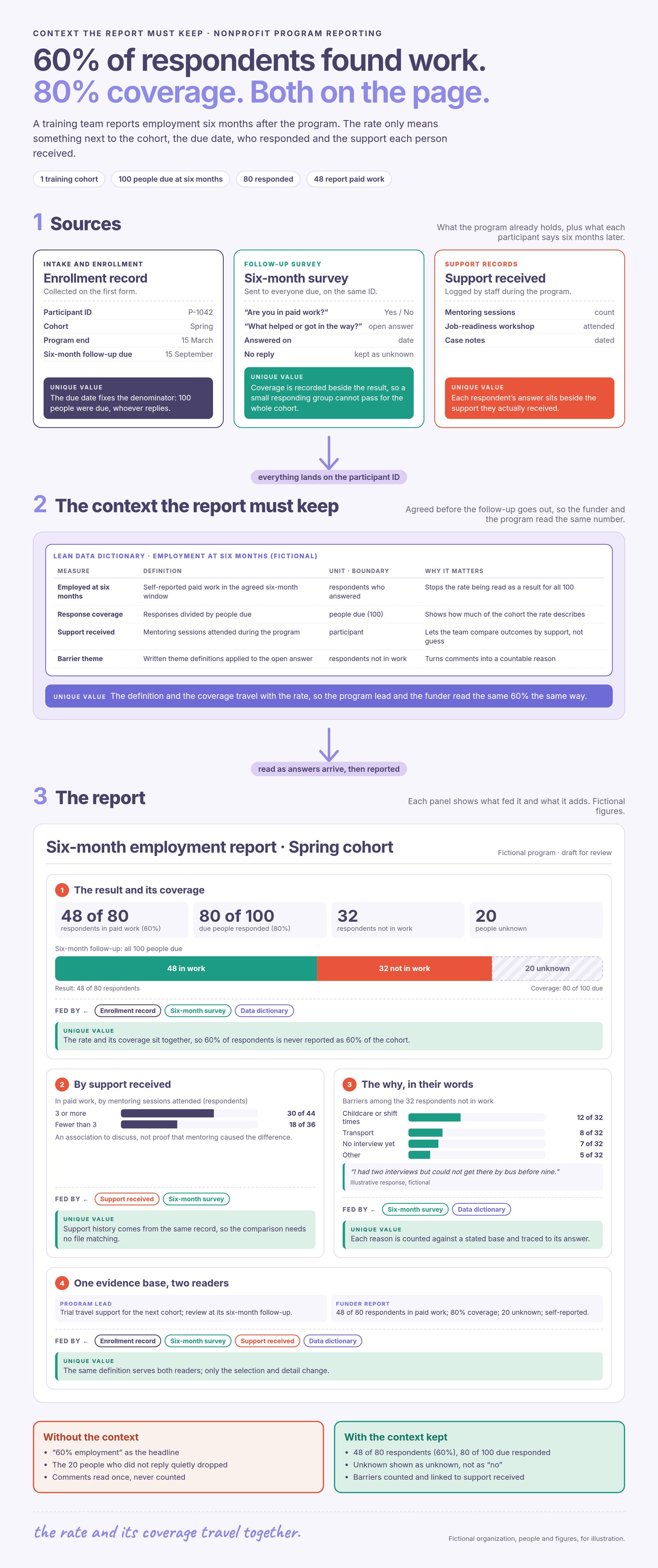
Sample size, response rate, missing follow-up, what comparison the data does and does not support. Reports that pretend confidence they do not have invite a methodology question that collapses the rest of the report. A short limits section is the trust section.

Why it matters. Funders renew programs that report honestly. Polish without limits reads as defensive.

05 · Audience

Same data, audience-tailored framing

A funder, a board, and a community read different reports.

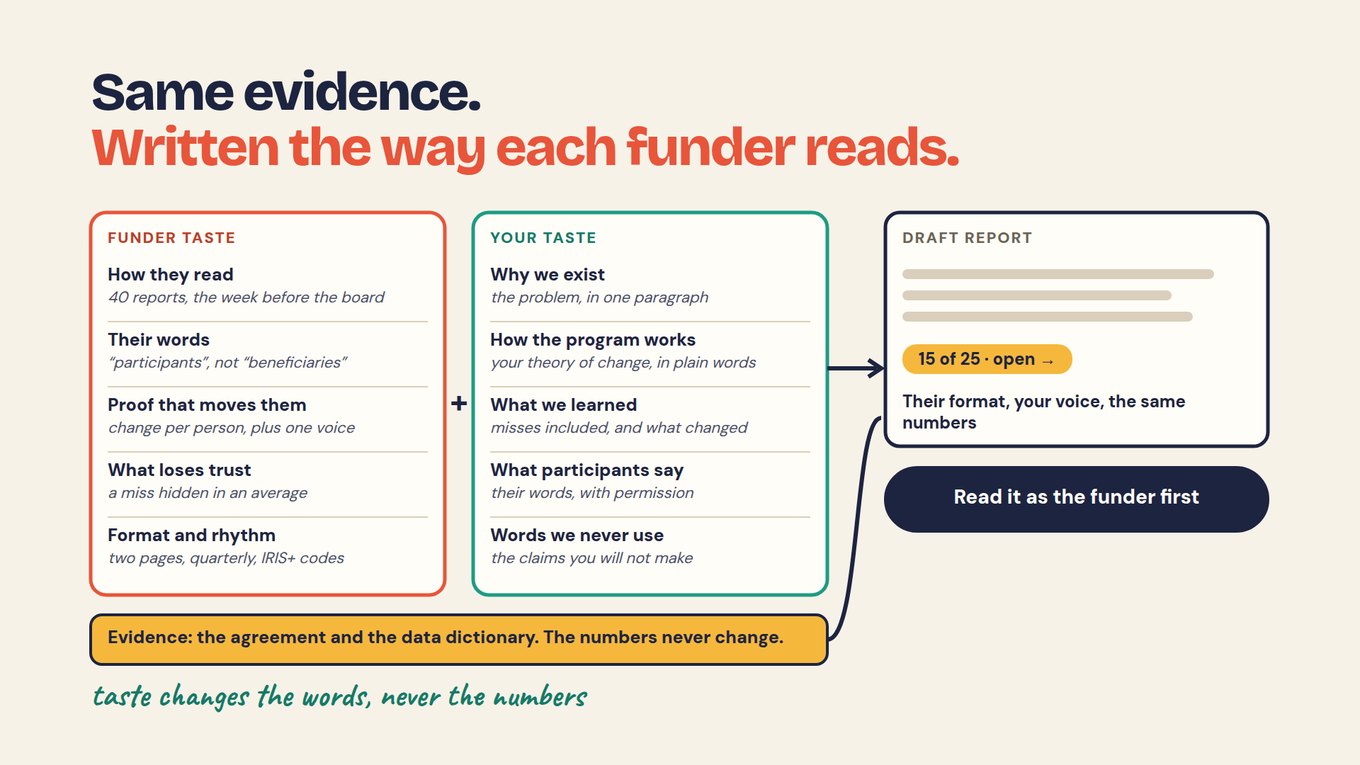
Funders need framework alignment and methodology. Boards need decisions and risks. The community needs voice and accountability. The data is the same. The framing is not. One report cannot serve all three; pick the primary audience and produce shorter derivatives for the others.

Why it matters. Reports trying to serve all audiences serve none of them well.

06 · Currency

Live record, not laminated PDF

A PDF goes stale on day one. A live record updates.

PDF reports are a snapshot of a moment. Live records (web reports, dashboards) update as new follow-up data arrives. For programs running multiple cohorts, the live format compounds: each report cycle adds to the same record rather than restarting from zero. PDFs still serve compliance and archival; the working report can be live.

Why it matters. Funder questions arrive between report cycles. A live record answers them.

Methods

Six choices that separate weak reports from strong ones

Strong social impact reports are the result of six decisions, made early. Each decision has a default that produces a weak report and a working alternative that produces a strong one. The defaults are not malicious; they are what happens when nobody chose otherwise.

The choice
Default that breaks
What works
What this decides

The change you measure

What goes on page one.

Broken

Lead with sessions delivered, participants enrolled, hours of programming. The report reads like a quarterly operating update.

Working

Lead with the strongest outcome for a named segment, with comparison. Outputs move to context or appendix.

Decides whether the report reads as change or activity.

Who you compare to

Without comparison, no result.

Broken

A standalone number. "71% placed within 90 days." Reader has no anchor for whether that is good, average, or worse than last year.

Working

A baseline at intake, a prior cohort, or an external benchmark. Always at least one anchor against which the result is interpreted.

Decides whether the report supports any inference at all.

How you segment

Aggregate hides the answer.

Broken

Program-wide averages. Single rate for the whole cohort. Looks tidy. Tells the funder nothing about for whom the program works.

Working

Disaggregate by gender, age, geography, cohort, race, income. The segments tell the learning story: what worked for whom, what did not.

Decides whether the report becomes a learning instrument.

How qual joins quant

Voices need linkage to records.

Broken

Floating quotes pulled from interviews, dropped beside numbers. No traceability to the participant record. Reads as marketing copy.

Working

Quotes carry a reference link, segment tag, and the outcome that participant achieved. Linked evidence survives scrutiny.

Decides whether qualitative evidence reads as evidence or anecdote.

What you say about gaps

Honesty is the trust section.

Broken

Curated highlight reel. Strong outcomes only. Drop-off, missing follow-up, and segments that did not move are quietly omitted.

Working

Short confidence-and-limits section: sample, response rate, what the data cannot say. Names two or three honest gaps.

Decides whether the funder reads the report as credible.

How long it stays current

PDF goes stale on day one.

Broken

Annual PDF generated end of cycle. New follow-up data arrives the next month. The PDF cannot update; the report is already wrong.

Working

A live record that updates as new data arrives. PDF derivative for compliance and archival. The working report is the live one.

Decides whether the report is current or frozen when funder questions arrive.

Compounding effect

The first decision controls all the others. Outcomes named on page one require disaggregation to be readable. Disaggregation requires baseline comparison to be interpretable. Comparison requires linked qualitative evidence to be credible. Credibility requires honest limits to survive scrutiny. And scrutiny keeps coming after the report is shipped, which is why a live record outlasts a PDF. Get the first decision right and the rest cascade. Get it wrong and every later decision pays for it.

Worked example

A workforce program produces its annual social impact report

A 320-participant workforce training program serves three audiences with one annual report: a foundation funder requiring framework alignment, a board needing decisions and risks, and the community holding the program accountable. Same data behind all three. Different framing for each. The five questions and six principles below were applied to a real cycle.

We ran the program with 320 enrollees across four cohorts last year. 287 reached exit. The funder wants placement at 90 days disaggregated by gender and prior employment status, and they want to see the qualitative evidence behind the placements that did happen. The board wants to know which cohort underperformed and why. The community wants the participant voice in the report, not paraphrased. Last cycle we sent the same 28-page PDF to all three. The funder asked for cohort breakdown we did not have. The board asked for risks we had not surfaced. The community said the participant quotes felt curated. We are not doing that again.

From Workforce program lead, end of reporting cycle, anonymized.

Quantitative axis
What was counted and compared
Placement rate at 90 days, by gender and cohort
Wage at placement vs. wage at intake (paired)
Confidence score change pre to post on a 5-point scale
Retention at 6 months, by placement industry
Comparison: 71% placement (current) vs. 64% (prior cohort)
Bound at collection
Qualitative axis
What participants and coaches said
Open-text exit survey: what helped, what did not
Mid-program coaching notes coded for theme
Six follow-up interviews (placed and not placed)
Each quote linked to participant ID + outcome
Themes: confidence, network access, employer fit
What the strong report produced
Outcome on page one
Executive summary opens with the placement result, named for women specifically (82%), then men (64%), with prior-cohort comparison. Sessions delivered moves to a context paragraph.
Disaggregation that learned
Cohort 3 placed at 58% against the 71% average. Disaggregation revealed an industry-fit problem the aggregate hid; the program adjusted intake screening for cohort 5.
Quotes linked to records
Six participant voices, each tagged with cohort, placement status, and confidence-score change. The funder could verify the quote against the underlying response.
Confidence section, three lines
Sample 287 of 320 enrollees. Response rate 89%. The data does not support comparison to non-program peers because no counterfactual was collected.
Why the prior report fell short
Output-led summary
Opened with sessions delivered, hours of training, and a satisfaction score. The funder had to scroll to page five to find a 90-day placement number.
Aggregate-only results
Reported program-wide averages. The cohort-3 underperformance was invisible. Board could not ask the right question because the data did not surface it.
Floating quotes
Three pull quotes from interviews, beautifully designed, no traceability. Community felt the quotes were curated; the program could not defend them under scrutiny.
No limits section
No mention of response rate, missing follow-up, or what the data could not say. When the funder asked one methodology question, the rest of the report was harder to defend.
The structural point

The strong report was not longer than the prior one. It was the same length, with different decisions about what went on which page. The decisions were enabled by data architecture: a persistent stakeholder ID linking intake to exit to follow-up, qualitative responses sitting in the same record as quantitative outcomes, and segments defined at intake rather than retrofitted at report time. Once the underlying data is structured to support the five questions, the report writes itself.

Examples

Real social impact report examples, by program type

The principles on this page apply across program types. Three example programs below show what shifts when the report is built around outcomes for people instead of activity counts. Each links to a published report in the Sopact gallery.

Example 01

Workforce and economic security

Pre-post comparison, placement at 90 days, wage change, retention at 6 months.

A workforce program reports on placement and earnings change for participants from intake through six-month follow-up. The typical shape: enrollees collected at intake with a baseline survey, an exit assessment at program completion, placement check at 90 days, and a retention check at 6 months. Each touchpoint links to one persistent participant ID, so paired pre-post comparison and disaggregation by gender, prior employment, and cohort are possible without manual reconciliation.

What breaks. Without persistent IDs, the 90-day follow-up arrives as a separate spreadsheet that has to be matched to enrollment by name and email. Names change, emails change, and matches drop. Reports lead with sessions delivered because the team cannot reliably link enrollees to placement records.

What works. Persistent IDs from intake forward. The placement rate appears on page one of the report, disaggregated by gender. The qualitative evidence (open-text exit responses, follow-up interviews) is coded and linked to specific participant outcomes. The board sees which cohorts placed best and asks the right next question.

A specific shape

320 enrollees, 287 reached exit, 255 follow-up responses at 90 days. 71% placed within 90 days (women 82%, men 64%); 64% in prior cohort. Median wage at placement +28% over intake. Confidence section names sample 287/320 and notes no counterfactual collected.

See a published economic security report →
Example 02

Affordable housing programs

Tenancy retention, cost-burden change, service utilization, resident voice.

A housing program reports on tenancy retention and cost-burden reduction for residents over a 12-month window. The typical shape: intake at move-in with a baseline housing-stability survey, mid-tenancy check at 6 months, and a 12-month retention milestone. Resident voice is captured through structured exit interviews and ongoing open-text responses to standing prompts about what is working and what is not.

What breaks. Reports that lead with units delivered or capital deployed do not answer the funder question, which is whether the residents are housed stably. Without paired baseline-and-outcome measurement under one ID, retention rates cannot be disaggregated by household type or income segment, and the report lands as a development update rather than an impact report.

What works. Outcome on page one (12-month retention by household type), disaggregation revealing where the program serves single-parent households well and where it does not, resident quotes linked to specific tenancy records, honest section on the units that did not retain. The funder reads the report as evidence of a working program, including the parts that did not.

A specific shape

180 households, 172 reached 12-month milestone. 91% retention overall; 96% for two-parent households, 84% for single-parent. Cost-burden moved from 52% of income to 31% (median). Confidence section names 8 households not reached for follow-up and asks the operator's question: were they more likely to have exited unstably?

See a published affordable housing report →
Example 03

Youth and education programs

Skill change pre-post, school engagement, narrative voice from young participants.

A youth program reports on skill development, school engagement, and personal growth for participants over a school year. The typical shape: intake with baseline self-assessment plus parent or teacher input, mid-year check, and end-of-year exit assessment with both quantitative scoring and open-text reflection. Narrative voice is central; a youth program report that does not include the participant's own words reads as paternalistic.

What breaks. Reports that aggregate skill scores across a whole cohort hide the fact that the program serves different age groups, schools, and entry points differently. A 4.1 average pre-to-post score change tells a board nothing useful. And open-text responses sitting in a separate file from the quantitative scores cannot be analyzed alongside outcomes.

What works. Disaggregated skill scores by age band and school site. Narrative coded for theme (confidence, peer relationships, academic interest) and linked to the participant whose score changed. Examples that name a participant outcome alongside the participant's own reflection. The community-facing version of the report leads with voices; the funder version leads with the disaggregated quantitative results. Same data, different framing.

A specific shape

240 participants across four sites. Confidence scores moved 2.8 to 3.9 on a 5-point scale at one site, 3.1 to 3.4 at another. Site-level disaggregation revealed where the program design needed adjustment. Linked open-text responses explained why the gap existed.

See a published youth program report →
A note on tooling
Sopact Sense Google Forms SurveyMonkey Qualtrics Submittable Salesforce

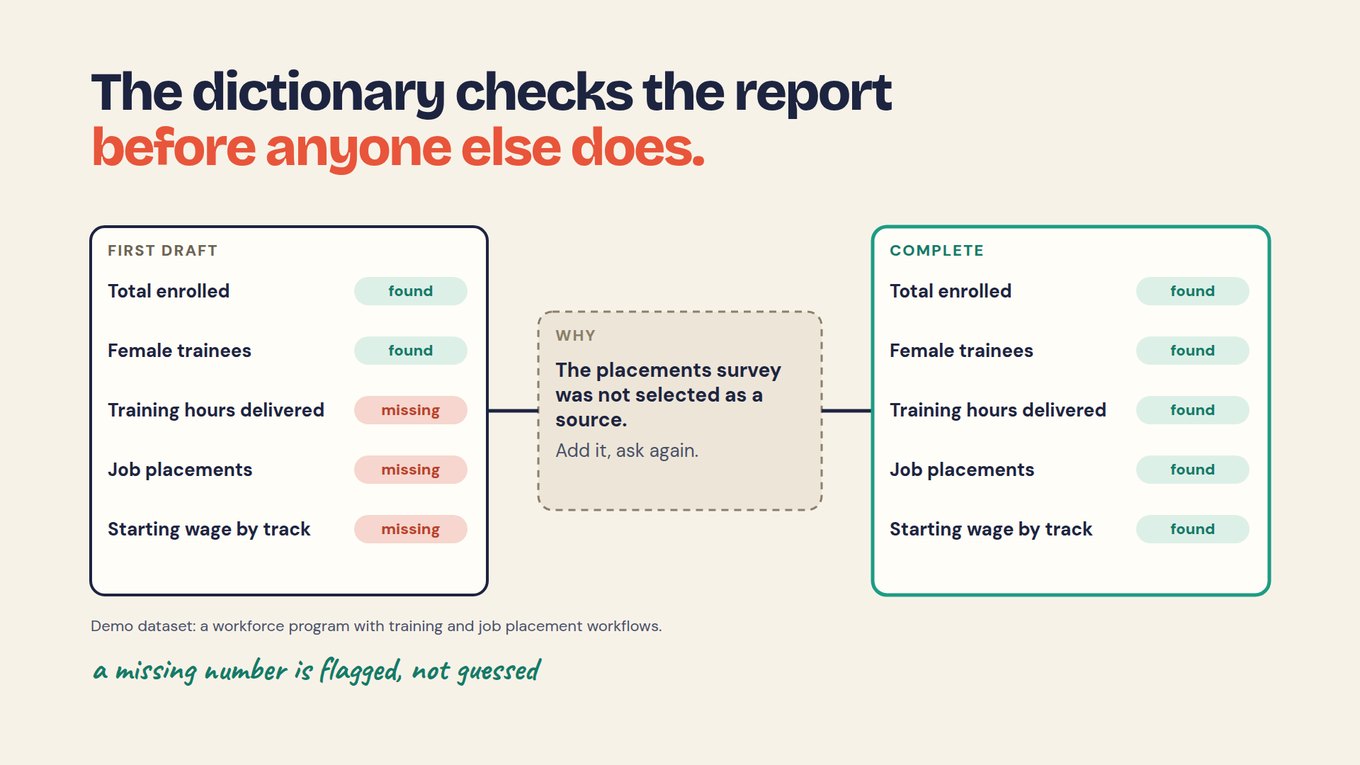
The tools above all collect data well. The structural gap on social impact reporting is not collection. It is the link between intake, mid-program, exit, and follow-up under one persistent stakeholder ID, with qualitative and quantitative responses sitting in the same record. Most reporting failures are not authoring failures; they are reconciliation failures inherited from the data architecture. A report that takes weeks to produce is usually a report fighting fragmented data, not a report fighting a hard writing problem.

Sopact Sense closes that gap by assigning persistent stakeholder IDs at the first contact (intake form, application, enrollment) and linking every subsequent touchpoint to that ID by default. Mixed methods sit in the same record. The five questions a strong social impact report has to answer are answerable from the live record without a year-end reconciliation pass. Once the underlying data supports the questions, the report writes itself.

FAQ

Social impact report questions, answered

Q.01

What is a social impact report?

A social impact report is a document that names what changed for the people a program served. A strong social impact report answers five questions: for whom did the change happen, compared to what, with what evidence, with what confidence, and what decisions does the report enable. A weak one stops at activity counts.

Q.02

What is social impact reporting?

Social impact reporting is the practice of producing reports that show change for stakeholders, not only activity counts. It pairs quantitative outcomes (rates, scores, retention) with qualitative evidence (voices, narratives) and reports them with disaggregation and honest confidence statements. Done well, it reads more like a learning record than a marketing document.

Q.03

What is the difference between a social impact report and a regular impact report?

Impact reports cover any kind of impact: social, environmental, organizational, financial. Social impact reports focus on change for people: employment, health, education, housing, confidence, well-being. The principles overlap with general impact reporting. The audience expectations are stricter on disaggregation, qualitative evidence, and stakeholder voice.

Q.04

Social impact report meaning?

A social impact report is the formal account a program gives of what changed for the people it served. It documents outcomes (not only outputs), shows comparison (baseline or counterfactual), pairs numbers with voices, names confidence and limits honestly, and points to decisions the data enables next.

Q.05

What goes into a social impact report?

An executive summary that leads with outcomes. A baseline and endline comparison with sample size. Disaggregated results by participant segment. Qualitative evidence linked to specific records, not floating quotes. A framework alignment section if a funder asked for one. A confidence and limits section that names what the data cannot say. And a forward-looking section pointing to decisions next.

Q.06

How to write a social impact report?

Start with the change theory the report tests, not with the activities. Lead the executive summary with outcomes for the people served, disaggregated by who. Pair every quantitative result with qualitative evidence traceable to a specific record. Include a confidence section that names sample, response rate, and what the report cannot conclude. End with the decisions the report enables next term.

Q.07

What is a social impact report template?

A social impact report template is the structural skeleton most reports follow: executive summary, program context, methodology, baseline and outcomes, disaggregated results, qualitative evidence, framework alignment, confidence and limits, decisions ahead. The eight-section anatomy holds across funders. Sopact maintains a longer template walkthrough at the impact report template page.

Q.08

Where can I find social impact report examples?

Sopact maintains a gallery of nine published social impact reports across workforce, affordable housing, youth programs, STEM education, and gender-lens investment. The reports apply the principles on this page in real programs. The collection sits at sopact.com/reports.

Q.09

What is a social impact report format?

Most social impact reports follow one of three formats: a static PDF for compliance and archival, an interactive web report for funder and board review, or a live dashboard that updates as new data arrives. The PDF is most common. The live record format is the strongest for programs running multiple cohorts because it never goes stale on day one.

Q.10

How long should a social impact report be?

There is no fixed length. Funder-facing reports run 12 to 40 pages depending on grant scale. Board-facing summaries run 4 to 8 pages. Community-facing reports work best at 2 to 4 pages with strong visuals. The discipline is the same across lengths: outcomes for people, evidence linked to records, honest about limits.

Q.11

What is a nonprofit impact report?

A nonprofit impact report is a social impact report produced by a nonprofit organization for funders, board, donors, and the community. The principles are identical whether the document is called a nonprofit impact report, a non-profit impact report, or a non profit impact report; spellings vary, the discipline does not. Most cover a fiscal year or grant cycle, span one to several programs, and are required by foundation funders and large institutional donors.

Q.12

How is a social impact report different from a social impact assessment report?

A social impact assessment is the work of measuring change. A social impact assessment report documents that work in detail, including methodology and confidence. A social impact report is the audience-facing version that translates the assessment into something funders, board, and community can read. The same data can sit behind all three. See the social impact assessment page for the methodology side.

Q.13

Can I use Google Forms or SurveyMonkey to produce a social impact report?

Yes for collection, no for production. Google Forms and SurveyMonkey collect data well. They do not link a participant across intake, exit, and follow-up under one persistent ID, which is what disaggregated outcome reporting requires. Most teams using those tools end up reconciling records by hand at report time, which is the step that social impact reporting platforms (sometimes marketed as social impact reporting software or social impact reporting tool) are built to remove.

Q.14

How does Sopact help organizations produce social impact reports?

Sopact Sense links every survey, document, and interview to one persistent stakeholder ID from intake forward. Mixed methods sit in the same record by default, so qualitative evidence stays connected to quantitative outcomes. Reports generate from a live record rather than from a year-end reconciliation pass. The collection architecture is what makes the report architecture possible.

Bring the report you have

See what your social impact report would look like with the right data underneath it

A 60-minute working session. Bring the report you produced last cycle, or the funder requirement you are working toward. We map the report to the five questions, identify which ones the current data can answer and which ones it cannot, and show what the report looks like when the underlying data supports all five. No procurement decision required.

Format
60 minutes, screen-share, with Unmesh.
What to bring
Last cycle's report, or a funder requirement.
What you leave with
A mapped gap analysis and a draft architecture for next cycle.