


Related solution
Case Management
Keep notes, assessments and check-ins connected to the person.
Explore the solution →

USE CASE / SOFTWARE GUIDE
Caseload management software helps service teams organize assigned cases, see outstanding work and understand staff capacity. Good software supports timely follow-up and informed supervision by showing the work behind the case count, including complexity, changing needs and responsibilities outside direct client contact.
Two workers with the same number of cases may face very different demands. One may be onboarding several people while another is conducting occasional follow-ups. If supervisors see only totals, they can miss growing preparation work, repeated referral difficulties or a gap that is affecting several clients.
AI can make notes and feedback easier to interpret during those discussions. Sopact connects incoming evidence with participant and program context so staff can explore current questions through AI Assistance. Its value is understanding service demand and reducing repeated reading, alongside the tools used for assignment, schedules and operational task management.
Consider service stage and current support needs.
Read notes and feedback alongside activity and follow-up.
Use the evidence in supervision and program planning.
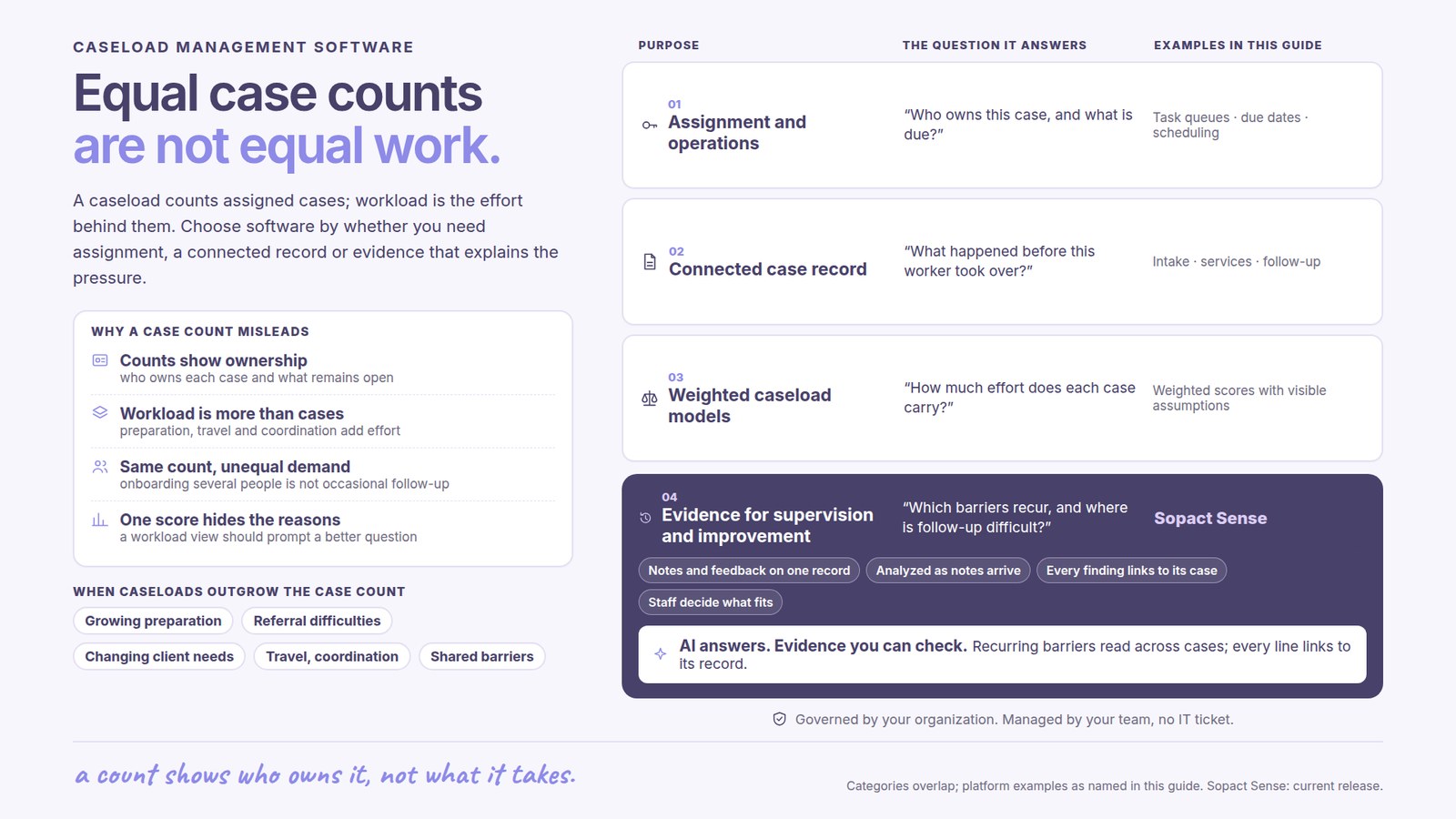
Caseload describes assigned cases; workload includes the effort required to manage them and other responsibilities. The Child Welfare Information Gateway’s workload brief treats this as a management issue that extends beyond counting records. Its practice context is child welfare; no universal staffing ratio should be inferred for every service.
For a buyer, the distinction changes what the software needs to explain. Case totals help establish ownership. Workload discussions also need the service stage, expected contact, preparation, travel or coordination appropriate to the program.
A workload view should help a supervisor ask a better question. It should not reduce staff effectiveness or client need to one unexplained score.
Some organizations primarily need task queues, due dates, scheduling and a clear owner for each case. Those operational requirements belong in the evaluation of the case system. Customer-support ticket routing is a different purchase from managing continuing human-service relationships.
Where the issue is fragmented service information, a broader case-management system should connect relevant intake, services and follow-up. The record helps a new worker continue support with less reconstruction.
Sopact is relevant when the team needs to understand what the records collectively say: which barriers recur, where follow-up is difficult and how needs change. Teams that also need automatic assignment or staff scheduling should evaluate those operational functions separately.
A team may have a manageable case count but still spend excessive time preparing meetings or chasing an unavailable referral. Moving the same work to another worker does not resolve that underlying problem. Notes, service history and staff feedback can help explain what is consuming capacity.
Weighted caseload models can support discussion when their assumptions fit the service and remain visible. The weights should reflect an agreed understanding of work, with room for professional review. An old classification may no longer describe the current need.
For example, several apparently routine cases may involve repeated attempts to access the same external service. The useful response could be a partner discussion or a change in referral arrangements. That is a different decision from assigning every case a higher priority.
Sopact connects case notes, assessments, participant feedback and program information. Analysis becomes available as new evidence arrives in the configured workflow, so authorized staff can examine a recurring concern through AI Assistance with its sources available.
The practical benefit is less time reading disconnected records before a supervision meeting and a clearer view of the explanations behind activity. A supervisor can explore whether delays share a common barrier, then review the relevant evidence with the team.
This differs from generating a brief summary of one case at the end of the month. The analysis remains useful for new questions and later follow-up. Staff decide whether the interpretation fits and what action is appropriate; the software does not establish a person’s need or a worker’s performance by itself.
A lower open-case total does not necessarily mean better service. Cases may close because support concluded, because someone disengaged or because a record was administratively closed. Those reasons should remain distinguishable.
Useful measures depend on the service: timely contact, successful handoffs, unresolved follow-up and the client’s experience may matter more than throughput alone. Review them alongside staffing and coverage so a change in the team is not mistaken for a change in client need.
The outcome-tracking guide explains how to connect service activity with later evidence. Caseload reporting and outcome learning can use related records while answering different management questions.
The organization should retain control of the meanings behind its reports: what counts as active, which period is being discussed and what an outstanding action represents. These definitions help staff interpret findings consistently as the program changes.
Sopact combines personalization with continuing team support. Its typical setup estimate is two days to two weeks for an agreed collection and analysis scope. Connections to case systems and historical material should be included in that discussion.
Choose the improvement that reduces recurring work. If assignment is the problem, strengthen the operational system. If the team cannot explain the demand behind the caseload, connected evidence can make supervision and program planning more useful.
It helps teams organize assigned cases, outstanding work and capacity so supervisors and staff can coordinate service and follow-up.
Caseload is the number of assigned cases. Workload includes the effort those cases require and other duties, so equal case counts can represent different demands.
Automatic assignment is not the claim of this workflow. Sopact’s relevant role is connected evidence and analysis that supports staff questions, supervision and program decisions.
No. A weighted model is useful only when its assumptions fit the service, are understood by staff and remain open to review.
No. Closure is an administrative status. Use the reason for closure and appropriate client evidence to understand what happened.
Continue with a purpose
Related solution
Keep notes, assessments and check-ins connected to the person.
Explore the solution →Continue learning
Learn how to connect collection, analysis and follow-through.
Start learning →
Customer story
A youth-program implementation designed to connect participant evidence across years.
Read the story →Explore how Sopact can connect notes, feedback and program evidence to make supervision and follow-up better informed.
See it with your workflow →