


What is a theory of change template?
A theory of change template is a fill-in page that takes you from the long-term change back to your activities, with a line for the assumption under each arrow and a column for the indicator that will show whether each step happened. You fill it once per program and keep it as the one model every funder report draws on.
Below you get the template twice: blank, as text you can copy, and filled in with a worked example. For the concept itself, read what a theory of change is.
THE SHORT VERSION
- Fill the template from the top down, starting with the long-term change and who experiences it, not from the bottom up with your activities.
- Under every arrow write one assumption, and beside every output and outcome write one indicator with its plain definition.
- Keep the filled template as your single model and re-lay it as a logic model, logframe or results framework when a funder asks, changing labels only.
What should a theory of change template include?
Five levels (inputs, activities, outputs, outcomes and the long-term change), an assumption between each pair, an indicator for each output and outcome, and a short list of outside factors and open questions. Anything more belongs in a companion data dictionary, not on the one page.
Copy the block below into a document or spreadsheet. The brackets are the only parts you replace; the order is the order you fill it in.
TEMPLATE · COPY AS TEXT
THEORY OF CHANGE: [PROGRAM NAME]
Reported to: [FUNDERS]    Reviewed on: [DATE]    Approved by: [NAMES]

1. LONG-TERM CHANGE (impact)
   Who: [the people who should experience it]
   Change: [what is different for them, and by when]

2. LATER OUTCOME
   Change: [ ]
   Indicator: [ ]   Definition: [ ]   Due: [ ]
      ↑ Assumption to reach 1: [ ]

3. EARLIER OUTCOME
   Change: [ ]
   Indicator: [ ]   Definition: [ ]   Due: [ ]
      ↑ Assumption to reach 2: [ ]

4. OUTPUTS (what you deliver)
   [ ]
   Indicator: [ ]   Definition: [ ]   Due: [ ]
      ↑ Assumption to reach 3: [ ]

5. ACTIVITIES (what you do)
   [ ]
      ↑ Assumption to reach 4: [ ]

6. INPUTS (resources and relationships)
   [ ]
      ↑ Assumption to reach 5: [ ]

OUTSIDE FACTORS WE DO NOT CONTROL: [ ]
OPEN QUESTIONS (owner, date): [ ]
Prefer a spreadsheet? Download the theory of change worksheet (CSV for Excel or Google Sheets) → It has columns for the situation, intended changes, actions, reasoning, assumptions, evidence and who reviews what.
What does a completed theory of change template look like?
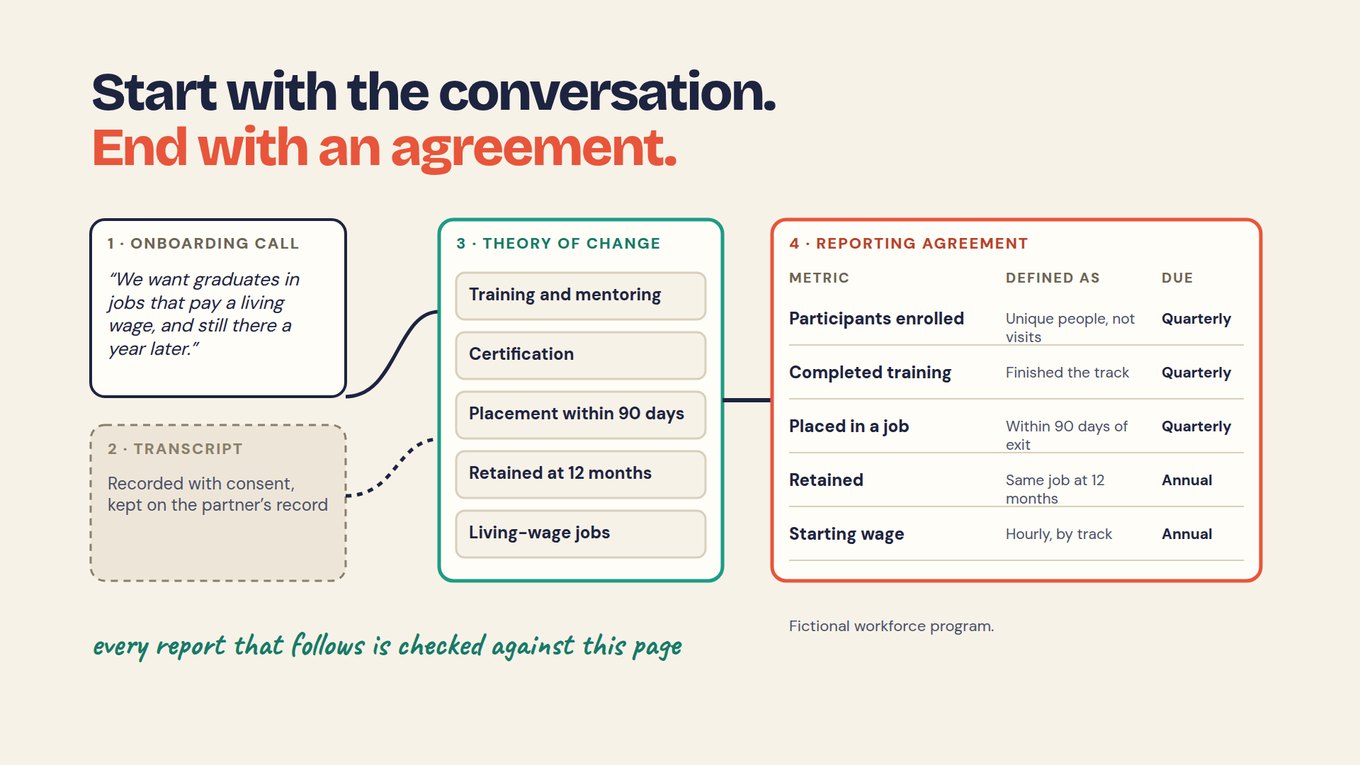
Below is the template filled in for a fictional job-training partner of a regional workforce fund, the running example in Sopact’s measurement and reporting course. Each row gives a level, what the program expects there, the assumption to reach the next row and the agreed indicator.
Scroll horizontally to see all columns →
| Level | Workforce model | Assumption to reach the next level | Indicator (definition, due) |
|---|---|---|---|
| Long-term change | Graduates in living-wage jobs | None: this is the top of the model, the change named on the onboarding call | Starting wage (hourly, by track; annual) |
| Later outcome | Retained in the same job at 12 months | The job, or the next one, pays a living wage | Retained (same job at 12 months; annual) |
| Earlier outcome | Placed in a job within 90 days of exit | The job fits the person, so they stay | Placed in a job (within 90 days of exit; quarterly) |
| Outputs | People enrolled, completed training, certified | Employers recognize the certification | Participants enrolled (unique people, not visits); completed training (finished the track); both quarterly |
| Activities | Training and mentoring | Content matches what local employers hire for | Not in the agreement |
| Inputs | Trainers, mentors, employer contacts | Staff and funding are in place for each cohort | Not in the agreement |
Outside factors: transport, caring duties and whether local employers are hiring. Open question: are suitable jobs within reach of every cohort, and who will check?
The filled template came out of one conversation. On the onboarding call the partner said it wants graduates in jobs that pay a living wage and still there a year later; that sentence became the levels, and the fund’s five metrics became the indicator column.
How do you fill in each box of the template?
Work from the top down: the long-term change first, then the outcomes that lead to it, then what you deliver and do, and only then the assumptions and indicators. Filling from the activities upward gives you a list of what you already do, not an explanation of why it should work.
1. Long-term change and who experiences it
Name the people and what is different for them. “Improve lives” guides no decision; “graduates in living-wage jobs” does.
2. Outcomes, later and earlier
Ask what must be true right before the long-term change, then what must be true before that. Each outcome is a change for people with a time window, such as placement within 90 days of exit. “Run four workshops” is an activity target, not an outcome.
3. Outputs
List what the program delivers and can count on its own: people enrolled, completed training, certified. Outputs show the work happened, not that anything changed.
4. Activities and inputs
Name what you do and what you need. An activity that connects to no outcome above it is a question for the budget.
5. The assumption under each arrow
One sentence per arrow; the next section shows how to make each testable.
6. Indicators and definitions
Beside each output and outcome, write the indicator, a plain definition two people would count the same way, and when it is due. Those rows become the reporting agreement and the entries in a shared data dictionary.
If you have notes or a call transcript, an AI tool can draft the template; the prompt below keeps it to your material.
PROMPT · PASTE INTO CLAUDE, CHATGPT OR YOUR AI TOOL
Fill in the theory of change template below using only our notes. Do not add goals, outcomes, targets or numbers that are not in the notes.

Rules:
1. Fill from the top down: long-term change, later outcome, earlier outcome, outputs, activities, inputs.
2. Under each arrow, write the assumption our notes support. If the notes give none, write "no assumption stated".
3. For each output and outcome, give the indicator, definition and due date from our notes. If any is missing, write "not in our data".
4. Quote the line from our notes behind every entry.
5. List the open questions we must answer before sign-off.

Template:
[PASTE THE BLANK TEMPLATE]

Our notes, call transcript or existing logic model:
[PASTE]
How do you write the assumption under each arrow?
Write one plain sentence that says what must be true for the next level to follow, specific enough that a record or a conversation could show it wrong. “Participants are motivated” cannot be tested; “employers in our area recognize the certification” can.
A good assumption names the outside actor or condition it depends on, such as employers or transport, and points to evidence, such as the placement survey that would show whether certified graduates are hired.
Then pick the assumption that would most change your plan if wrong. In the workforce template it is that suitable jobs are within reach; if not, placements stall however good the training is. Write who will check it, and by when.
The short video below looks at the costliest way to get this wrong. Watch for the difference between a theory that lists boxes and one that states why each step should follow.
How do you turn the template into a logic model, logframe or results framework?
Move the same rows under the funder’s labels: the levels, assumptions and indicators stay; only the names and the layout change. A logframe calls your outcomes “purpose” and the long-term change “goal”; a results framework calls the long-term change the strategic objective.
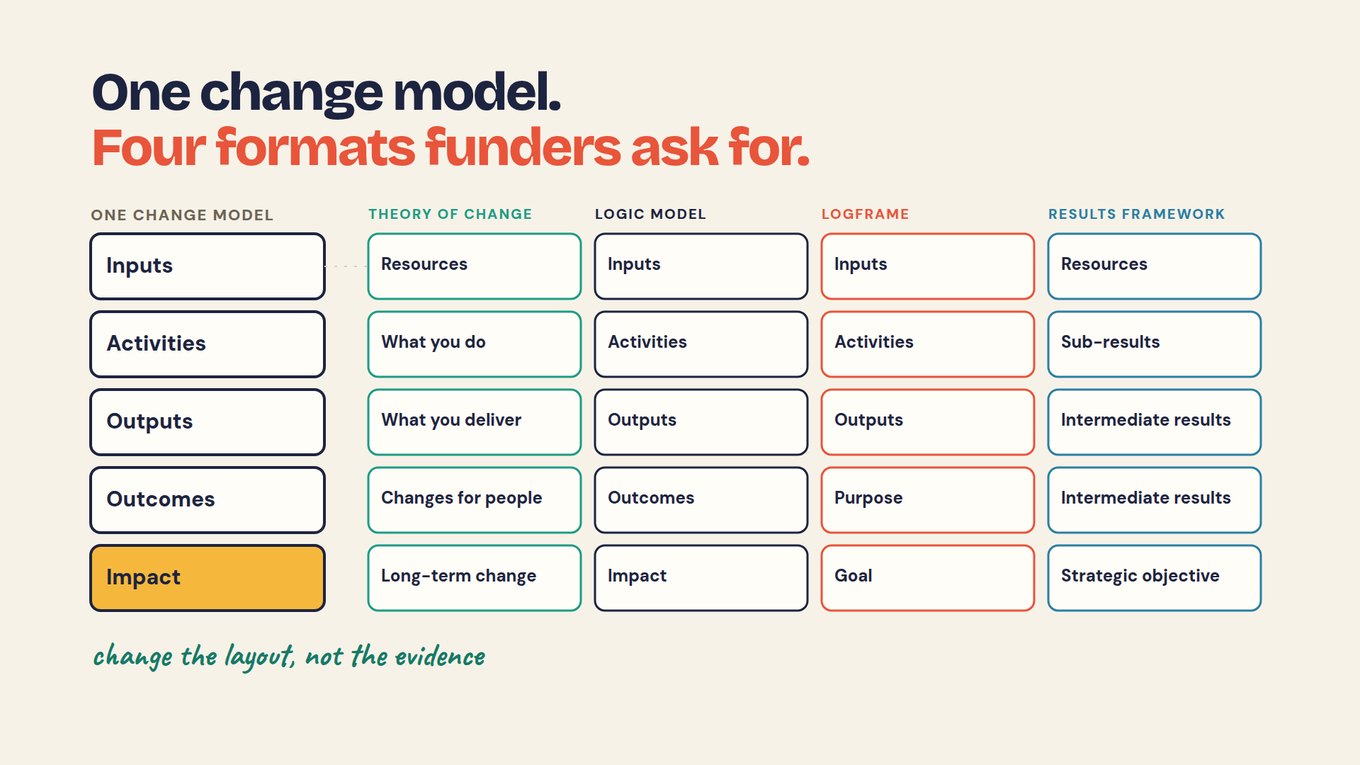
Scroll horizontally to see all columns →
| Part of your template | Logic model | Logframe | Results framework |
|---|---|---|---|
| Long-term change | Impact | Goal row | Strategic objective |
| Outcomes | Outcomes | Purpose row | Intermediate results |
| Outputs and activities | Outputs, activities | Output and activity rows | Intermediate results, sub-results |
| Assumptions | Often a side note | Assumptions column | Critical assumptions |
| Indicators | Sometimes a separate table | Indicator and means of verification columns | Indicators under each result |
If a format asks for something the template lacks, such as a baseline, write “not in our model” rather than inventing it. For ready layouts, use the logic model template and the logframe template; the course chapter One change model, four formats shows the full re-lay with a prompt.
What can a filled template not tell you?
A filled template states what you expect; it does not show that any step happened, and a later change in results does not prove the program caused it. Each arrow stays a question until records answer it.
Outputs are not outcomes: a full outputs row says the work was delivered, not that anyone was placed. Outcome indicators rely on follow-up, so self-report and non-response limit them, and a causal claim needs a comparison. BetterEvaluation’s guidance on describing a theory of change covers how to use the model in evaluation.
An AI draft is a draft: people who know the program decide whether each link is plausible and check every entry against its source. In Sopact Sense, each participant keeps one ID from the first form, so the placement and 12-month rows can be answered from the same person’s record, and each line of an AI Assistant answer links to a record you can open.
The companion video shows the step after the template: using the model in program decisions rather than filing it with the proposal. Watch how each outcome row becomes a question the team checks as records arrive.
Start with one filled template this month
Choose one program with a report due soon and fill the template for it, using the metrics you already send.
- Copy the blank template and write the long-term change and who experiences it.
- Fill two outcome rows, later and earlier, each with a time window.
- Add outputs, activities and inputs, then one assumption under every arrow.
- Put each metric you already report beside the output or outcome it measures, with its definition and due date.
- Show the draft to a participant, a frontline staff member and your funder contact, and mark what they question.
- Re-lay it in the format your main funder uses and check that no window or definition changed.
After the first cycle you have one filled template, an assumption to test first, and indicator rows ready for your reporting agreement.
Frequently asked questions
What should a theory of change template include?
At minimum: the long-term change and who experiences it, two or three outcomes with time windows, outputs, activities and inputs, and one assumption under each arrow. Add an indicator with a plain definition and due date beside each output and outcome, plus outside factors and open questions. Detailed definitions belong in a companion data dictionary.
Does every theory of change need six boxes?
No. Six parts (problem, inputs, activities, outputs, outcomes, impact) are a common teaching structure, and the template above folds the problem into the long-term change row. A simple program may need fewer outcome rows; a partnership may need several pathways and a narrative. Keep the five levels recognizable so the template can be re-laid in a funder’s format.
Can I use the template before collecting any results?
Yes, and that is the best time. Filling it before collection tells you which indicators to collect, from which form, and when. Mark each assumption as supported by existing evidence or still a hypothesis, and write “not in our data” where you have no indicator yet. The first reports then test the model instead of being fitted to it afterwards.
Is a filled theory of change template proof of impact?
No. It explains how you expect change to happen and what you will measure. Whether the explanation holds needs evidence for each arrow, gathered over time, and a claim that the program caused a result needs a comparison or an evaluation design. Report what the indicators show, who is missing from them, and what remains untested.
Do we need a separate template for each funder?
No. Fill one template per program and re-lay it for each funder, changing only labels and layout. If a funder asks for an outcome you do not track, add it to the one template with its definition. Separate templates drift apart, and within a year two funders can see two different placement numbers for the same people.
