play icon for videos
Use case

Theory of Change Examples: Workforce, Education, Health

Four complete ToC pathways — each with paired metrics, narrative prompts, and assumption monitors. Copy the structure, instrument it in Sopact Sense in hours.

TABLE OF CONTENT

Author: Unmesh Sheth

Last Updated:

March 26, 2026

Founder & CEO of Sopact with 35 years of experience in data systems and AI

Theory of Change Examples That Actually Work

Monday morning. A funder just emailed asking for evidence that your program produces the outcomes you described in last year's grant report. You open your Theory of Change document — the one with the beautiful diagram, the colored boxes, the causal arrows drawn by a consultant three years ago. Then you open your data. The columns don't match the outcome stages. The participant records end when the program ends. The four bullet points labeled "Key Assumptions" at the bottom of the diagram were never connected to a single monitoring instrument. That list of assumptions is The Assumption Graveyard: where beliefs about causation go to be forgotten rather than tested.

Every Theory of Change example in this guide is designed to solve The Assumption Graveyard problem. Each pathway connects every causal stage to a specific data collection instrument. Every assumption has a monitoring mechanism. Every example is built for Sopact Sense — where data collection and the Theory of Change framework live in the same system, not in two separate documents that drift apart over time.

x
Core Concept — Theory of Change Examples
The Assumption Graveyard

The structural problem where assumptions are listed as bullet points in a Theory of Change but never connected to a monitoring instrument — where beliefs about causation go to be forgotten rather than tested, discovered only when a funder asks why outcomes didn't materialize.

Workforce Training K-12 Education Healthcare Agriculture Assumption Monitoring
4sector pathways with full data architecture
5 stagesinputs → activities → outputs → outcomes → impact
3+assumption monitoring questions per pathway
30 daysto first assumption signal — not 18 months
💼
Workforce Training
Baseline → skills → employment → income stability
🎓
K-12 Education
Academic growth + belonging as parallel streams
🏥
Healthcare
Chronic disease: adherence → clinical outcomes
🌾
Agriculture
Smallholder: training → yield → food security
Ready to instrument your Theory of Change so assumptions get tested — not buried? Build With Sopact Sense →

Step 1: Which Example Fits Your Program Type?

Before copying a pathway, you need to match the causal structure to your program logic — not just the sector label. A workforce training program that serves justice-involved adults operates on different assumptions than one serving recent graduates. A K-12 education example built for SEL (social-emotional learning) requires different instruments than one built for academic mastery. The scenario selector below helps you identify which structural pattern fits your context.

Step 1: Which Theory of Change Example Fits Your Program?

Select the scenario that matches your situation — then see what to bring and what Sopact Sense produces

1 · Your Situation
2 · What to Bring
3 · What You Get
Starting Fresh
We need a Theory of Change pathway for a new or existing program
Program directors · M&E staff · New nonprofits · Funder-facing teams

We're running a workforce training program and need a complete Theory of Change — not just a diagram, but a pathway connected to data collection instruments. We have a general sense of our causal logic but have never formally mapped assumptions or connected outcome stages to measurement instruments. Our funder is asking for evidence of causation, not just output counts.

Use the sector example as a starting template — replace the example indicators with your specific outcome definitions, then design monitoring questions for the three assumptions most likely to break in your context.
Rebuilding / Inherited
We have a ToC diagram but the assumptions were never monitored
Evaluation leads · Program directors · Organizations post-grant-audit

We inherited a Theory of Change from three years ago — professionally designed, funder-approved, sitting in a PDF nobody opens. When our new funder asked how we know our activities cause our outcomes, I couldn't answer. The assumptions are listed in a bullet box at the bottom of the diagram and have never been connected to data. I need to close The Assumption Graveyard and rebuild around what we can actually measure.

Start with the assumption audit: take every assumption in your existing diagram and ask "what data would tell me if this assumption is breaking?" If you can't name a data instrument, the assumption is in the graveyard. Sopact Sense closes it by embedding monitoring questions in mid-program check-ins.
Multi-Program Organization
We run multiple programs and need a consistent ToC structure across them
Impact directors · Portfolio managers · Federated nonprofits · Funders

We fund or operate programs across four sectors — education, workforce, health, and agriculture. Each program has its own logic but we need consistent outcome stage definitions and assumption monitoring protocols so we can compare across cohorts and produce portfolio-level evidence. We don't want four separate systems that can't talk to each other.

Use the four sector examples as structural templates — each operates on the same five-stage causal model but with sector-specific indicators and assumption monitoring questions. Sopact Sense supports multiple program frameworks within one platform with shared stakeholder ID architecture.
🎯
Causal Logic Written Out
A plain-language description of why your activities should produce your outcomes for your specific population.
📋
Existing Assumptions List
Any assumptions already documented — even in a bullet list. These become the starting point for monitoring question design.
📊
Current Data Collection
What you currently collect — intake forms, surveys, tracking spreadsheets. Shows what's instrumentable without additional burden.
👥
Stakeholder Population
Who you serve — demographics, starting conditions, barriers. Determines which sector example structure fits your causal logic.
📅
Program Timeline
Program cycle length, cohort cadence, and follow-up windows — determines short, medium, and long-term outcome definitions.
🔍
Funder Evidence Requirements
What specific evidence your funders require — output counts, outcome indicators, or causal attribution across cohorts.

What Sopact Sense Produces

  • Sector-specific causal pathway: Five-stage model adapted to your program type with named indicators at each stage.
  • Assumption monitoring plan: Each assumption assigned a monitoring question and a data collection instrument — closing The Assumption Graveyard.
  • Paired quantitative + qualitative instruments: Every numeric indicator paired with an open-text probe revealing why the change did or didn't occur.
  • Unique stakeholder ID chain: Persistent IDs from first contact through long-term follow-up — baseline to 12-month outcome in one record.
  • Mid-program assumption signals: Barrier and assumption data surfaced at week 4–6 — in time to adjust before outcomes are locked.
  • Funder-ready impact narrative: Evidence package combining quantitative outcome data with qualitative causal evidence by construction.

The Assumption Graveyard: Why Most Theory of Change Examples Fail

The Assumption Graveyard is the structural problem hiding inside every Theory of Change that has a neat list of "Key Assumptions" with no monitoring plan attached. The assumptions read like good thinking: "Employers value portfolio-based hiring." "Parents support homework completion." "Patients have reliable transportation." They are written carefully, reviewed by a board, and then buried — never connected to a data instrument that would tell you when an assumption is failing in the first cohort, in time to adjust.

The standard Theory of Change example doesn't tell you what to do when an assumption breaks. It tells you what assumptions you believed when you built the diagram. These are different documents serving different purposes, and conflating them is why most impact data arrives too late to influence program design.

Each example in this guide treats assumptions as experiments. Every assumption has a monitoring question. Every monitoring question has a data collection instrument in Sopact Sense. When an assumption starts failing — when employer partners are not responding to placement referrals, when patients are missing appointments due to transportation barriers — that signal appears in the data at the first collection point, not in a funder report eighteen months later.

This is the operational difference between a Theory of Change that functions as documentation and one that functions as a feedback system. For a deeper treatment of the measurement architecture behind this approach, see our guide on nonprofit impact measurement systems and the foundational Theory of Change framework overview.

Step 2: Workforce Training Theory of Change Example

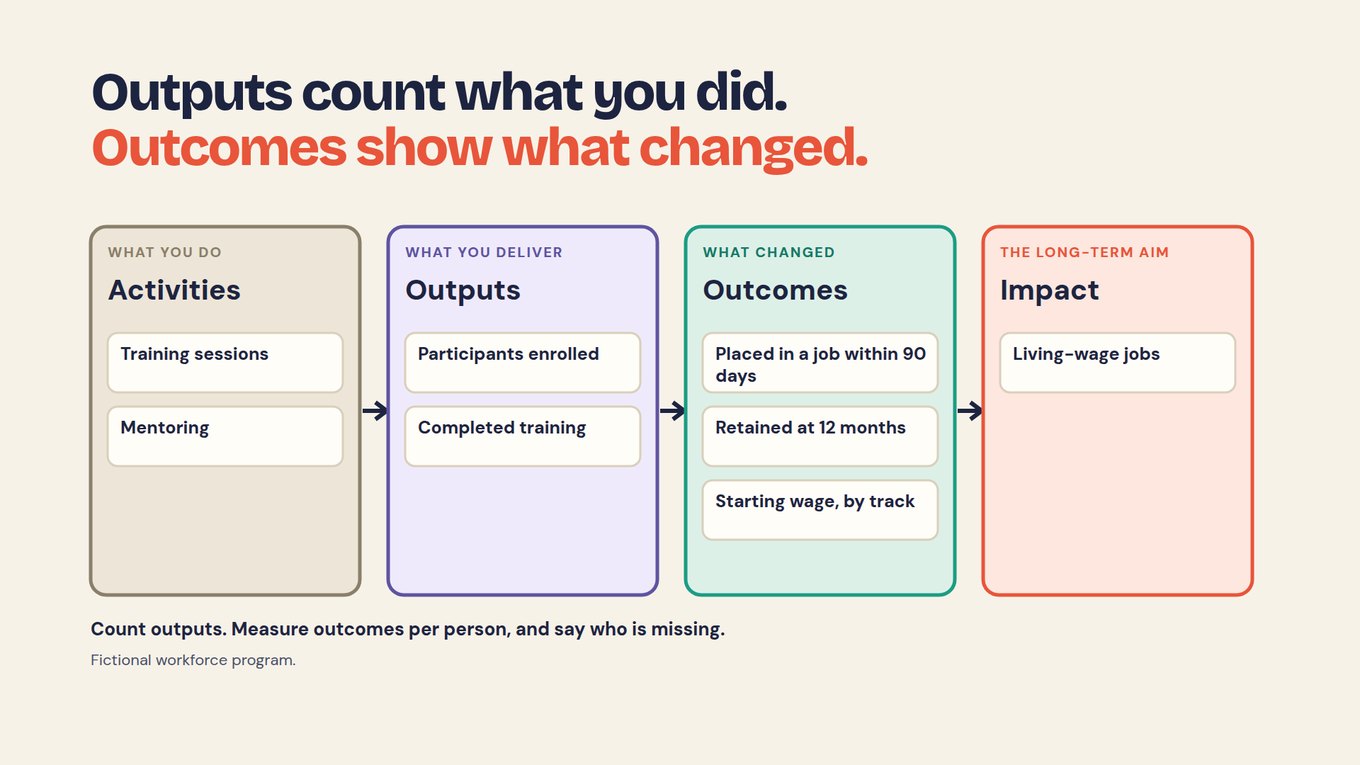
The workforce training pathway is the most commonly requested Theory of Change example — and the one most often built incorrectly. The structural mistake is treating job placement as an output rather than an outcome, which compresses the causal chain and eliminates the intermediate steps where program adjustments actually happen. Placement is an output: the employer said yes. Employment retention at six months is the short-term outcome. Income stability and career trajectory at 12–24 months is the medium-term outcome.

The example below follows the full causal chain from baseline assessment through long-term career indicators, with paired quantitative and qualitative instruments at each stage. The mid-program open-text question ("What's your biggest challenge so far?") is not decorative — it is fed into Sopact Sense's Intelligent Cell for theme extraction, which routes to program staff for real-time support adjustments. This is how The Assumption Graveyard is avoided: the assumption that "mentors respond within 24 hours" is tested every week by the data, not assumed in perpetuity.

💼

Workforce Training Theory of Change Example

Skills-based training → employment → income stability · Cohort programs serving 40–200 participants

Causal Pathway
P
Preconditions
Employer partnerships, curriculum, funding, qualified trainers
1
Activities
12-week bootcamp, mentorship, mock interviews, employer networking
2
Outputs
Completions, portfolios built, certifications, employer connections
3
Short-Term Outcomes
Skills gained, confidence increase, job applications, placements at 90 days
4
Long-Term Outcomes
Income stability at 12 months, career progression, wage growth
Data Collection Instruments
Intake / Baseline
Enrollment Assessment
Employment status, prior skills (0–5), confidence (1–5 scale), barriers to job search
Mid-Program Check-in
Week 4 Pulse Survey
"What's your biggest challenge so far?" — open text → Intelligent Cell theme extraction → staff alert within 48hrs
Post-Program
Exit Assessment
Skills post-test (same as baseline), confidence (1–5), portfolio completion, employer connections made
90-Day Follow-Up
Employment Survey
Employment status, role title, salary, "What helped most in your job search?" — linked to original ID
12-Month Follow-Up
Retention Survey
Still employed?, wage change, barriers encountered, "What would have improved the program?"
Employer Survey
Partner Satisfaction
Graduate readiness (1–5), hiring intent for future cohorts — tests the portfolio-valued assumption
Assumption Monitoring — Closing the Graveyard
AssumptionEmployers in our market value portfolio-based hiring over credentials
Monitoring QuestionEmployer satisfaction survey: "Would you hire this candidate again?" + hire-to-application ratio by cohort
AssumptionSkills gained in training translate to confidence to apply for jobs
Monitoring QuestionConfidence delta (exit vs. baseline) + application count at 90 days — broken if confidence up but applications zero
AssumptionMentor response time under 24 hours maintains participant engagement
Monitoring QuestionMid-program check-in: "Have you been able to connect with your mentor?" — threshold alert if <70% yes

For organizations running workforce programs connected to workforce development funding, see also our workforce development program measurement guide.

Step 3: K-12 Education Theory of Change Example

The K-12 education Theory of Change example exposes the most common structural error in education measurement: measuring academic outcomes without measuring the social-emotional conditions that predict whether academic outcomes are achievable. GPA delta without belonging data cannot tell you why some students improved and others didn't. Belonging without GPA data cannot tell you whether belonging is a driver of academic outcomes or a downstream effect of them. Both instruments are required from baseline, connected to the same student ID.

The example below tracks academic growth and sense of belonging as parallel outcome streams — not because they are equally important, but because the causal relationship between them is the hypothesis your program is testing. If belonging increases but GPA does not, your instructional model has a problem. If GPA increases but belonging does not, your students are succeeding despite a hostile environment, which is a different kind of failure. Intelligent Column analysis correlates belonging shifts with GPA gains by cohort and teacher — surfacing the pattern before year-end, not after.

🎓

K-12 Education Theory of Change Example

Academic growth + belonging as parallel streams · After-school, tutoring, SEL, enrichment programs

Dual-Stream Causal Pathway — Both Required from Baseline
📚 Academic Growth Stream
ActivityTutoring sessions, skills instruction, homework support
OutputSessions attended, assignments completed, assessments taken
Short-TermGPA improvement, subject mastery gains (pre/post assessment delta)
Long-TermGrade promotion, graduation rate, college readiness
Why both streams matter: GPA delta without belonging data cannot tell you why some students improved. Belonging without GPA cannot tell you whether belonging drives achievement or results from it. Both instruments are required from baseline — connected to the same student ID — because the causal relationship between belonging and academic outcomes is the hypothesis your program is testing.
Data Collection Instruments
Enrollment Baseline
Student Intake Form
Current GPA, subject confidence (1–5), sense of belonging (1–5), learning barriers, prior program participation
Mid-Program
6-Week Check-In
"What's making it hard to come to sessions?" — open text for barrier extraction. Attendance pattern flag if <70%
Post-Program
End-of-Cycle Survey
GPA (same period prior year), belonging (1–5), confidence, "What changed for you this semester?"
Academic Records
Grade Pull
Official GPA linked to student ID — not self-reported. Same grading period prior year as baseline comparison
Mentor Observation
Tutor Notes
Structured rubric: engagement level, barrier indicators, relationship quality — processed by Intelligent Cell
Family Survey
Parent/Guardian Check-In
Observed changes at home — homework completion, attitude, school talk — tests assumption about home reinforcement
Assumption Monitoring — Closing the Graveyard
AssumptionBelonging and academic confidence are prerequisites for academic gains — not downstream effects
Monitoring QuestionCorrelation between Week 6 belonging score and end-of-cycle GPA delta — broken if GPA up but belonging flat or declining
AssumptionHome environment supports what students learn in sessions
Monitoring QuestionParent survey: "Does your child discuss what they're learning at home?" — route to family engagement staff if <60% yes
AssumptionConsistent mentor relationships drive social-emotional gains
Monitoring QuestionMentor continuity rate — flag if student changes tutors mid-cycle; correlate tutor stability with belonging scores

Step 4: Healthcare Theory of Change Example — Chronic Disease Management

The healthcare Theory of Change example presents the most complex assumption structure of the four pathways: the assumption that clinical improvement (HbA1c reduction) will follow from behavioral change (medication adherence, self-management) assumes that the barriers to behavioral change are addressable within the program's scope. When they are not — when patients cannot afford medications, cannot get to appointments, cannot access nutrition support — the causal chain breaks at the Activity stage, not at the Outcome stage. You discover this at 6-month HbA1c review, not at week three when the barrier first appeared.

The example below includes a barriers check-in instrument at the Activity stage: "What's stopping you from managing your diabetes?" This open-text response is processed through Intelligent Cell to extract barrier themes — cost, transportation, family support, medication side effects — which route directly to care navigators for personalized intervention. The assumption that "care navigators respond within 48 hours to barrier reports" is tested by the workflow itself, not listed in a bullet point and forgotten.

🏥

Healthcare Theory of Change Example — Chronic Disease Management

Patient enrollment → care coordination → adherence → clinical improvement · Diabetes, hypertension, CHF programs

Causal Pathway
P
Preconditions
Care navigators, clinical partners, culturally appropriate materials, coverage access
1
Activities
Education workshops, care navigation, medication counseling, self-management coaching
2
Outputs
Sessions attended, care plans created, referrals completed, prescriptions filled
3
Short-Term Outcomes
Medication adherence, appointment attendance, self-management confidence, HbA1c at 3 months
4
Long-Term Outcomes
HbA1c sustained at 12 months, reduced hospitalizations, quality of life improvement
Critical design note: Most healthcare assumption failures happen at the Activity stage — not the clinical intervention level. Patients cannot adhere to medications they cannot afford, attend appointments they cannot get to, or follow nutrition plans that require food access they don't have. The barriers check-in instrument at the Activity stage is not optional — it is the earliest signal that the causal chain is breaking.
Data Collection Instruments
Enrollment Baseline
Clinical Intake
HbA1c, blood pressure, medications list, self-management confidence (1–5), barriers screening (cost, transport, literacy)
Activity-Stage Check-In
Barriers Probe — Week 3
"What's stopping you from managing your diabetes?" — open text → Intelligent Cell → care navigator alert within 48hrs
Mid-Program
3-Month Clinical Review
HbA1c, medication adherence (pill count / pharmacy data), appointment attendance rate, confidence delta
Post-Program
6-Month Assessment
HbA1c, self-management behaviors (structured checklist), "What supported you most in managing your condition?"
Long-Term Follow-Up
12-Month Outcome Survey
HbA1c, ER visits in past 12 months, quality of life (EQ-5D), still using self-management practices — linked to original ID
Navigator Observation
Care Plan Notes
Structured rubric: barrier types encountered, resolution status, patient engagement level — processed by Intelligent Cell
Assumption Monitoring — Closing the Graveyard
AssumptionPatients have reliable access to medications (cost, pharmacy proximity, insurance coverage)
Monitoring QuestionBarriers check-in: "Have you been able to take your medications as prescribed?" — route cost/access flags to navigator same day
AssumptionCare navigator response within 48 hours to barrier reports maintains engagement
Monitoring QuestionNavigator response time audit — threshold alert if >48hr gap. Correlate response speed with 3-month appointment attendance
AssumptionBehavioral change (adherence) precedes and drives clinical improvement (HbA1c)
Monitoring QuestionCorrelate Week 3 adherence self-report with 3-month HbA1c — broken if HbA1c stable despite low adherence (measure artifact)

For healthcare programs embedded in broader community health frameworks, see our social determinants of health measurement guide and our program evaluation methodology resource.

Step 5: Agriculture Theory of Change Example — Smallholder Productivity

The agriculture Theory of Change example operates on the longest causal chain and the most external assumptions of the four pathways. Unlike workforce training or healthcare, where the program has direct influence over most causal stages, smallholder agriculture is heavily mediated by weather, market prices, land tenure security, and cooperative fairness — none of which the program controls. This makes assumption monitoring more critical here than in any other sector, because a failed assumption can nullify an entire season's work before any outcome data arrives.

The example below treats mid-season check-ins — collected in local languages and processed through Intelligent Cell — as the primary early-warning system. When farmers report that buyer cooperatives are delaying payments or that drought is worse than expected, those signals update the assumption monitoring dashboard. Extension support is rerouted before the harvest. The assumption that "buyer cooperatives pay fair prices and on time" is tested by farmer reports every 30 days — not assessed once per year in a program review.

🌾

Agriculture Theory of Change Example — Smallholder Productivity

Training + inputs + market access → yield improvement → food security · Smallholder farmer programs

Causal Pathway
P
Preconditions
Extension workers, input suppliers, cooperative partnerships, land tenure security
1
Activities
Agronomic training, improved seed/input access, cooperative linkage, demonstration plots
2
Outputs
Training sessions completed, inputs distributed, farmers linked to cooperatives, plots established
3
Short-Term Outcomes
Practice adoption rate, input usage, yield at harvest (kg/acre), cooperative sales made
4
Long-Term Outcomes
Multi-season yield stability, household food security, income resilience during climate shocks
Critical design note: This pathway has more external dependencies than any other sector example — weather, market prices, land tenure, cooperative payment practices. A failed external assumption can nullify an entire season before any outcome data arrives. Mid-season check-ins collected in local languages are the primary early-warning system, not the end-of-season harvest report.
Data Collection Instruments
Enrollment Baseline
Farm Intake Assessment
Current yield (kg/acre), practices used, input access, land tenure status, prior training, household food security (HFIAS)
Mid-Season Check-In
30-Day Field Survey
"What challenges are you facing this season?" — collected in local language, open text → Intelligent Cell → extension staff alert
Harvest Assessment
Post-Harvest Survey
Yield (kg/acre vs. baseline), practices adopted, cooperative sales (qty, price received), post-harvest losses
Market Linkage
Cooperative Payment Tracker
Payment received (Y/N), payment timeliness, price vs. market rate — tests the cooperative fairness assumption directly
Multi-Season Follow-Up
Year 2 Stability Survey
Yield vs. Year 1, still using practices, food security score (HFIAS), response to climate event if occurred
Extension Observation
Field Visit Notes
Structured rubric: practice adoption, barrier types, plot condition — linked to farmer ID, processed by Intelligent Cell
Assumption Monitoring — Closing the Graveyard
AssumptionBuyer cooperatives pay fair prices on time — making market linkage a viable pathway to income
Monitoring QuestionCooperative payment tracker: timeliness and price vs. local market rate — if <80% paid on time, trigger cooperative partnership review
AssumptionImproved inputs are available and affordable when farmers need them during planting season
Monitoring QuestionMid-season check-in: "Were you able to access and afford the recommended inputs?" — stockout or cost barrier triggers emergency input distribution review
AssumptionYield gains persist across at least three seasons — not just the season with direct program support
Monitoring QuestionYear 2 stability survey: practice continuation rate + yield comparison to Year 1 — broken if gains don't persist without active extension support

Step 6: How to Instrument Any Theory of Change Example in Sopact Sense

Every example above follows the same three instrumentation principles regardless of sector. Understanding these principles lets you adapt any pathway to your context without losing the causal structure that makes the example work.

Principle 1: Baseline-to-follow-up continuity through unique IDs. Every participant, patient, student, or farmer enters the system through a first-contact form that assigns a unique stakeholder ID in Sopact Sense. That ID persists through every subsequent data collection touchpoint — midpoint surveys, output tracking, outcome measurement, long-term follow-up. This is what enables pre-post analysis rather than cross-sectional snapshots. Sopact Sense assigns IDs at enrollment, not after.

Principle 2: Quantitative and qualitative pairing at every causal stage. Every numeric indicator in these examples is paired with at least one open-text question. The numeric indicator tracks whether the change occurred. The open-text question tells you why. Intelligent Cell processes qualitative responses for theme extraction; Intelligent Column aggregates themes across all participants to surface patterns. You cannot build The Assumption Graveyard when your monitoring system is producing qualitative evidence every 30 days.

Principle 3: Assumptions as monitored experiments, not listed beliefs. Every assumption in each example is connected to a specific monitoring question and a specific data instrument. "Employers value portfolio-based hiring" is tested by employer satisfaction ratings. "Insurance covers diabetes education" is tested by the barriers check-in. When an assumption starts failing, the data shows it — not the post-hoc report. This is the core operational difference between a Theory of Change that lives in a diagram and one that lives in a feedback system.

For the complete data collection architecture behind these principles, see our impact measurement and management framework and our guide to using the Theory of Change template inside a data collection system.

1
The Assumption Graveyard
Assumptions listed in a bullet box, never connected to a monitoring instrument — discovered as failures only at funder reporting.
2
No Individual Tracking
Aggregate snapshots at different moments — cannot prove the same people who received activities achieved the outcomes.
3
Late Signals
Mid-program data not collected — assumption failures discovered at year-end, after the cohort has graduated and adjustments are impossible.
4
Qualitative Data Unprocessed
Open-text responses collected but never analyzed — causal mechanism evidence sitting unread in a spreadsheet column.
Framework ElementStatic Example / TemplateSopact Sense Architecture
AssumptionsListed as bullet points — reviewed annually if at allEach connected to a monitoring question and collection trigger — updated as data accumulates
Stakeholder trackingAggregate counts — no individual longitudinal recordUnique IDs from first contact; every instrument linked to the same participant record
Mid-program signalsNo mid-program data — first insight at year-end reviewBarrier and assumption probes at week 3–6 — in time to adjust before outcomes are locked
Qualitative dataOpen-text collected but rarely analyzed at scaleIntelligent Cell extracts themes and routes barriers to staff within 48 hours
Pre-post comparisonPost-program survey only — no baseline for comparisonBaseline instrument at enrollment linked to the same ID as post-program assessment
Cross-sector structureEach example built separately — no common architectureSame five-stage model across all sectors — enables portfolio-level comparison
What Sopact Sense Produces Across All Four Sector Examples
Assumption Monitoring Plan
Every assumption assigned a question and instrument — no bullet points without monitoring triggers
Longitudinal Participant Records
Baseline to follow-up in one stakeholder record — same individuals tracked, not population snapshots
Mid-Program Barrier Signals
Week 3–6 probes surface assumption failures before outcomes are locked — in time to adjust
Paired Quant + Qual Evidence
Every numeric indicator paired with an open-text probe — Intelligent Cell processes at scale
Cross-Sector Comparison
Common five-stage structure across sectors enables portfolio-level outcome analysis
Funder Causal Evidence
Impact reports showing causal attribution — not just output counts — by construction
Ready to instrument any of these examples in Sopact Sense so assumptions get tested — not buried? Build With Sopact Sense →

Step 7: Tips, Troubleshooting, and Common Mistakes

Don't copy a sector example without adapting the assumptions. The assumptions in each example are illustrative — they reflect the most common conditions for that sector but not every program context. Before instrumenting any pathway, spend 30 minutes listing the three assumptions your program is most likely to violate. Design a monitoring question for each one. That exercise closes The Assumption Graveyard faster than any other single action.

Distinguish your causal stage structure before designing instruments. The sequence — Input, Activity, Output, Outcome, Impact — is not decorative. An instrument designed to measure an Activity (did the farmer attend training?) measures something structurally different from one measuring an Outcome (did the farmer's yield increase?). Mixing these in the same data collection form produces data that cannot be analyzed causally.

Qualitative instruments require analysis infrastructure, not just collection. Adding an open-text question to a form without a plan for processing responses is a common failure mode. Sopact Sense's Intelligent Cell extracts themes from open-text responses automatically — but you need to decide in advance what themes you are looking for and what action each theme triggers. Design the analysis workflow at the same time you design the question.

Multi-program organizations need program-level ToC structures, not one master diagram. Each program should have its own Theory of Change with its own outcome stages, instruments, and assumption monitoring plan. A master organizational Theory of Change can articulate how programs contribute to a shared long-term vision, but it cannot substitute for program-level measurement architecture. Sopact Sense supports multiple program frameworks within one platform.

Use the mid-program check-in as an assumption monitor, not just an engagement survey. The mid-season and mid-program check-in questions in each example are designed to surface assumption failures before outcome measurement. "What's stopping you?" is not a satisfaction question — it is a causal probe. Treat the responses accordingly: route barrier themes to program staff within 48 hours, not to an annual report.

x
01
The Data Lifecycle Gap — Why Examples Fail Without Architecture
The Data Lifecycle Gap — Why Theory of Change Examples Need Data Architecture

Why copying a Theory of Change example without building the data architecture behind it produces the same result as no framework at all — and how the Data Lifecycle Gap explains why assumption monitoring requires longitudinal stakeholder data, not annual surveys.

See the full impact measurement architecture →
02
Theory of Change for Funder Trust — From Examples to Evidence
Theory of Change for Reporting & Funder Trust

How to take the causal pathway examples in this guide and turn them into funder-ready evidence — demonstrating causation, not just output counts, and building the reporting relationship that converts compliance to partnership.

The examples in this guide are starting templates. The video shows what they look like when two or three cycles of data have run through them — and how that evidence reads to a program officer asking "how do you know it works?"
See the grant reporting architecture →

Frequently Asked Questions

What is a theory of change example?

A theory of change example is a complete causal pathway for a specific program type, showing how inputs and activities connect to outputs, outcomes, and long-term impact — with named data collection instruments at each stage. A working example includes not just the diagram but the measurement architecture: specific indicators, baseline and follow-up instruments, and assumption monitoring questions. The four examples on this page cover workforce training, K-12 education, chronic disease management, and smallholder agriculture.

What is the theory of change for a training program?

A training program Theory of Change follows the pathway: enrollment and baseline assessment → training activities and attendance → skill certification and portfolio completion (output) → employment and 90-day retention (short-term outcome) → income stability and career progression at 12–24 months (long-term outcome). The key assumption is that skills acquired in training translate to employer hiring decisions — which requires both portfolio quality instruments and employer satisfaction data to test. See the workforce training example above for the complete pathway with paired quantitative and qualitative indicators.

What is a theory of change for education?

An education Theory of Change maps how instructional activities produce academic mastery and the social-emotional conditions (belonging, engagement, confidence) that predict whether mastery is achievable and sustained. A functional education ToC measures both streams from baseline — not just GPA at end of year — because belonging data collected only at outcome measurement cannot tell you whether belonging caused achievement gains or resulted from them. The K-12 example above tracks both streams from enrollment with pre-post paired instruments.

What is a theory of change for healthcare nonprofits?

A healthcare Theory of Change for chronic disease management maps the pathway from patient enrollment and baseline clinical assessment through care coordination activities, adherence tracking outputs, and clinical improvement outcomes (e.g., HbA1c reduction at 6 months), to long-term indicators like reduced hospitalizations and improved quality of life. The critical structural requirement is a barriers monitoring instrument at the Activity stage — because most healthcare assumption failures happen at access (transportation, cost, family support), not at the clinical intervention level. See the chronic disease management example above.

What is a theory of change for agriculture programs?

An agriculture Theory of Change maps how training, input provision, and market linkages connect to practice adoption, yield improvement, and multi-season resilience for smallholder farmers. The most common structural error in agricultural ToC examples is treating yield increase as a long-term impact rather than a medium-term outcome — because yield improvement that isn't sustained across three or more seasons hasn't changed the underlying resilience condition. The agriculture example above structures yield as an outcome and food security plus climate shock recovery as long-term impact indicators.

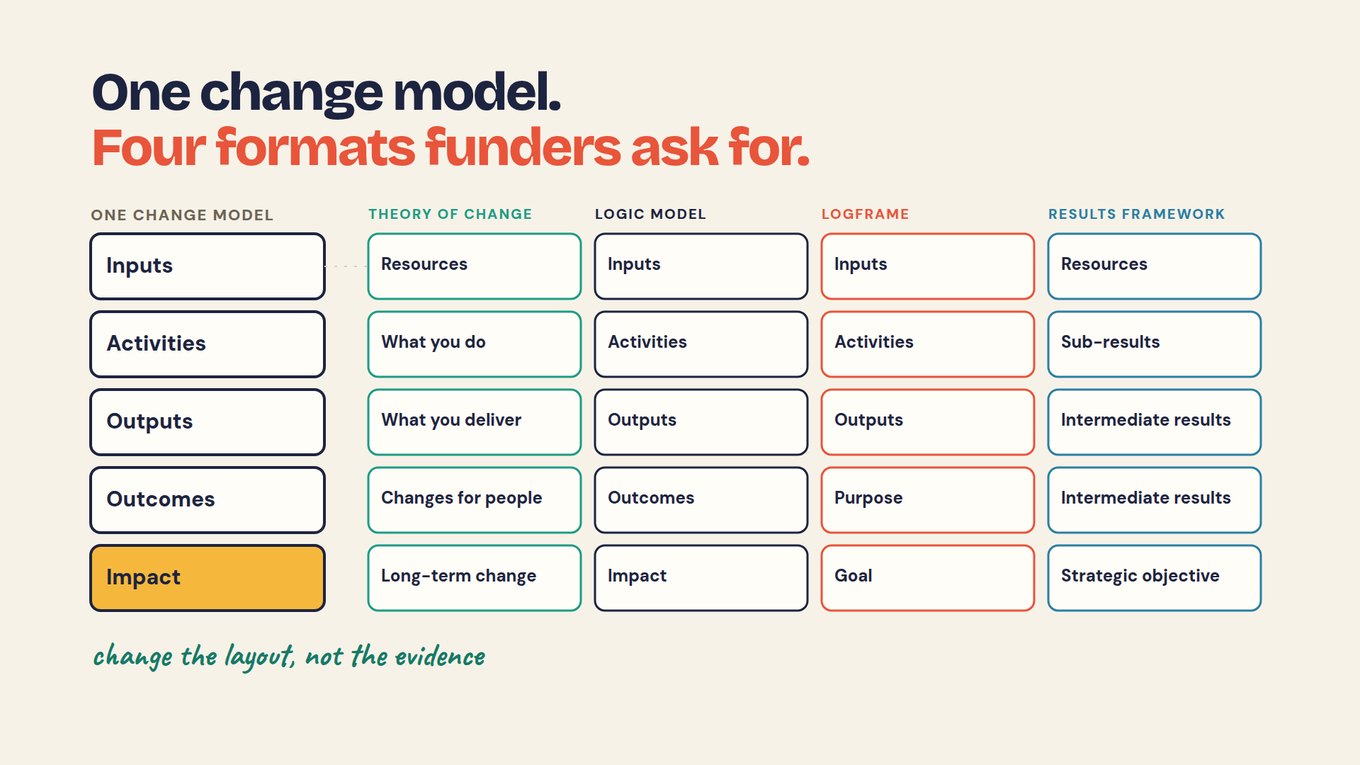
What is the difference between a theory of change and a logic model?

A logic model presents the causal chain in a compact linear format: inputs → activities → outputs → outcomes. A Theory of Change adds the causal mechanisms, assumptions, and external conditions that explain why the pathway should work. In practice, a logic model describes what you do; a Theory of Change explains why doing those things should produce the predicted change for your specific population under your specific conditions. Both are structural frames — neither is a measurement system until you connect each stage to a data collection instrument.

How do I adapt a theory of change example to my program?

Start by mapping your population against the example's assumed population — where they differ, your causal mechanisms may differ too. Then list every assumption in the example and mark which ones you believe are safe for your context and which need monitoring. For assumptions you cannot verify in advance, design a monitoring question and assign a data collection point. Finally, replace the example's indicators with indicators that match your specific outcome definitions. What you should not change is the structural principle: unique participant IDs from enrollment, paired quantitative and qualitative instruments, and assumption monitoring at the Activity stage.

What is the Assumption Graveyard in Theory of Change design?

The Assumption Graveyard is the structural problem where assumptions are listed in a Theory of Change as a bullet box but never connected to a data collection instrument or monitoring cadence. The assumptions are written carefully during program design and then never revisited until a funder asks why expected outcomes didn't materialize. Sopact Sense closes The Assumption Graveyard by requiring each assumption to have a named monitoring question and a data collection trigger — typically embedded in mid-program check-in instruments.

How many steps should a theory of change have?

Most functional Theories of Change for social programs have five stages: inputs/preconditions, activities, outputs, outcomes (short and medium-term), and long-term impact. Some programs separate short-term and medium-term outcomes into distinct stages, giving six total. More stages are not more rigorous — they are more data collection points, each of which requires an instrument, a responsible staff member, and a monitoring cadence. Design for the number of stages you can instrument and monitor, not the number that looks most comprehensive in a diagram.

Can I use one theory of change for multiple programs?

An organizational Theory of Change can articulate how multiple programs contribute to a shared long-term vision, but it cannot substitute for program-level measurement architecture. Each program requires its own outcome stages, its own instruments, and its own assumption monitoring plan — because different programs serve different populations through different mechanisms. Sopact Sense supports multiple program-level frameworks within one platform while maintaining a common stakeholder ID structure across programs.

What makes a theory of change "work" in practice?

A Theory of Change works in practice when it functions as a feedback system rather than a documentation artifact. The test: does your Theory of Change tell you, within 30 days of a program cycle starting, whether any of your key assumptions are failing? If your ToC cannot answer that question — if it only produces information at outcome measurement time — it is a diagram, not a strategy. The examples on this page are designed to produce assumption-monitoring signals at the Activity stage, mid-program check-in, and output measurement — not only at the outcome and impact stages. See also our Theory of Change template guide for the data architecture that makes this possible, and our grant reporting guide for how working ToC examples translate into funder-ready evidence.

Where can I find more theory of change examples?

This page covers four sector pathways: workforce training, K-12 education, healthcare (chronic disease management), and agriculture (smallholder productivity). For additional examples organized by program type, see sopact.com/theory-of-change-examples. For the underlying framework, see our Theory of Change overview. For building your own from a template, see Theory of Change template.

02
Theory of Change for Funder Trust — From Examples to Evidence
Theory of Change for Reporting & Funder Trust

How to take the causal pathway examples in this guide and turn them into funder-ready evidence — demonstrating causation, not just output counts, and building the reporting relationship that converts compliance to partnership.

The examples in this guide are starting templates. The video shows what they look like when two or three cycles of data have run through them — and how that evidence reads to a program officer asking "how do you know it works?"
See the grant reporting architecture →
Theory of Change Learning Center
TABLE OF CONTENT

Author: Unmesh Sheth

Last Updated:

March 26, 2026

Founder & CEO of Sopact with 35 years of experience in data systems and AI

TABLE OF CONTENT

Author: Unmesh Sheth

Last Updated:

March 26, 2026

Founder & CEO of Sopact with 35 years of experience in data systems and AI