


What is continuous feedback?
Continuous feedback is an ongoing process for collecting, reviewing and responding to people's experiences during an active relationship or service. It can combine scheduled check-ins, short surveys, conversations and feedback at meaningful events. Continuous does not mean asking everyone constantly or promising an immediate answer to every comment.
The goal is to make useful evidence available while a team can still act. That requires a collection plan, time to review, clear responsibilities and a way to check what happened after a response. An always-open form alone provides none of those things.
In customer experience, the process may connect onboarding check-ins with later support and renewal feedback. In employee experience, it may combine recurring listening with a response to a workplace change. Member networks and programs can use the same principle while adapting the questions and cadence to their circumstances.
Choose the right opportunities to listen
Begin with a relationship or workflow, not a request to collect more data. Identify the points where people have enough experience to give useful feedback and where the team can do something with the result.
| Collection pattern | Useful when | Watch for |
|---|---|---|
| Scheduled check-in | You need comparable observations at defined stages | Questions sent before someone has reached the relevant stage |
| Event-based request | A service interaction or milestone creates a clear experience to review | Several teams surveying the same person after related events |
| Always-available channel | People need a way to raise an issue outside the schedule | Assuming voluntary comments represent everyone |
| Focused pulse | The team needs a short check on a specific question over time | Repeating questions before acting on the last wave |
A pulse survey is one possible part of this process. A detailed periodic study may still be useful for questions that need deeper investigation. Choose a mix the team can review and the audience can reasonably answer.
Plan collection around the decision
For each source, record who is asked, what is collected, when it is collected, who reviews it and what decision it supports. A customer onboarding check-in may need setup stage, unresolved obstacles, a satisfaction item and an open comment. A relationship review may need different questions.
Collect stable registration information once where appropriate. Update changing attributes with dates, rather than repeatedly asking people to enter the same information or silently changing the context of past responses. Keep the original question and response period with each answer.
Across sites or chapters, agree on the core fields needed for comparison and allow local questions where the work differs. A common data dictionary makes those shared definitions explicit. One compulsory form for every location is not the only way to create a useful overview.
Tell people what the channel is for and what response they can expect. A feedback survey should not be presented as an urgent support channel if no one monitors it that way. Where a separate service channel exists, provide a clear route to it.
Connect the relevant context without over-collecting
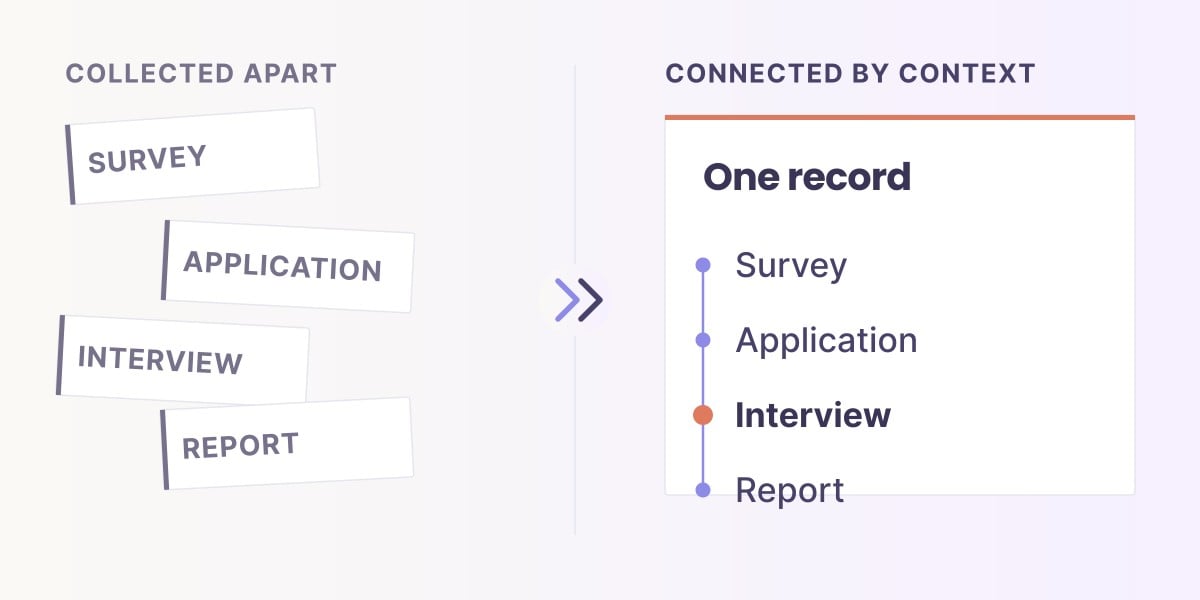
A response becomes easier to interpret when the team knows the relevant account, service stage, date or location. Link that context where the purpose and permissions allow it. Keep anonymous feedback anonymous; do not infer an identity in order to create a more complete record.
Separate the response from the person or organization it refers to. One customer can give several responses over time. Several people may comment about the same account. Decide which unit a report counts so a highly active account does not unintentionally dominate the findings.
Retain source identifiers during imports, record corrections and flag uncertain matches. Do not merge records solely because two people share a name. When data arrives from support tools, surveys or documents, check that timestamps, permissions and original text survive the connection.
Review numbers and comments together
Start with coverage: what arrived, what is missing and which groups are represented. Then summarize relevant ratings and read the open text using a defined codebook. Keep each theme connected to the passage that supports it, and allow multiple themes when a comment describes several issues.
AI can assist with applying categories and finding relevant evidence across a large stream. People still need to define categories, inspect uncertain results and decide what a finding means. Review uncommon themes and contradictory evidence, not only the largest categories.
A change in sentiment can reflect a changed customer mix, a revised question or a new coding definition. Before calling it a trend, check that the periods are comparable. If the same people respond at several stages, distinguish their matched change from the overall results of all respondents.
For recommendation surveys, NPS verbatim analysis explains how to connect comments to score groups. For a wider evaluation method, see survey data analysis.
Match collection volume to review capacity
Set a review cadence that fits the decision. Some feedback needs quick operational attention; other patterns need a weekly or monthly review. The important question is whether the evidence reaches the right person in time, not whether every chart refreshes instantly.
Track the age of unreviewed responses, the number of unresolved items and the time needed to review a typical batch. If the queue grows, examine unnecessary collection, duplicate records, unclear categories and responsibilities before simply asking an analyst to read faster.
Automated summaries can help organize the workload, but they should not hide the underlying coverage. Make it possible to see which records were processed, excluded, awaiting review or outside the current analysis. A summary of a small selected subset should not be presented as the complete feedback stream.
Separate individual follow-up from changes to the service
One response may call for direct contact, while a recurring theme may suggest a wider process change. Keep those tasks distinct. Record the issue, supporting evidence, owner, next step and review date. A resolved support ticket does not automatically mean the underlying service problem has disappeared.
When follow-up is appropriate, use authorized information and the contact preferences provided. An anonymous submission may still inform a group-level response even when an individual reply is impossible.
Share a clear update: what the team heard, what it has done, what it is still investigating and what it cannot change. Listening can improve trust, but it does not guarantee future participation. Check whether people find the process useful rather than assuming more communication will raise response rates.
A worked example: feedback across onboarding and renewal
Consider a fictional service team collecting a short setup check-in and a later relationship review. Some customers describe confusing instructions; others report waiting for a first reply. Those need separate categories even if both use the word “support.”
The team keeps the response date, account, setup stage, rating and original comment together. Reviewers examine the coding and find that the setup issue is concentrated in one configuration path. They assign an owner to improve the instructions and record when the change goes live.
At the next review, the team compares relevant responses before and after the change, checking whether the customer mix and questions stayed comparable. It also examines support contacts and unresolved cases where appropriate. Fewer mentions are useful evidence to investigate; they are not proof that the change caused every improvement.
For renewal outcomes, the team links cancellation records only where authorized and interpretable. A negative comment is not a certain churn prediction. Outcomes need their own dates, definitions and analysis window.
How Sopact reduces repeated work
Sopact combines collection, context, analysis and governance around the relevant records. The operating team can plan recurring inputs, keep comments beside measures and history, apply reviewed definitions and inspect the evidence behind a finding. The aim is a process the team can maintain as data grows.
The potential time saving comes from less manual application of codes and less rebuilding of joins between survey exports, comments and context. When a definition changes, reprocess the affected scope and review the result. Keep the judgment about the meaning of the category and the next action with people.
Evaluate the whole workflow using a representative batch and the expected volume. Check source coverage, access controls, processing time, exception handling and reporting effort. Other products may already automate parts of the process; compare the work that remains in your actual setup.
Include setup, processing, maintenance and human review when assessing total ownership cost, and keep the quality standard equivalent.
Frequently asked questions
Does continuous feedback mean a survey every week?
No. It means a maintained process for listening and responding. The right cadence depends on the experience, the audience's burden and the time needed to act. Scheduled, event-based and open channels can work together.
How is it different from a pulse survey?
A pulse is a short recurring questionnaire. Continuous feedback includes the wider collection, review and response process, which may use pulses alongside conversations, service feedback and other sources.
Can it be anonymous?
Yes. Anonymous feedback can identify group-level concerns. Individual follow-up or matched trajectories need a different, clearly explained design. Do not imply that anonymity and named follow-up are simultaneously available from the same unlinked response.
How do we avoid a backlog?
Collect only useful evidence, assign review owners, apply stable analysis rules, retain exceptions and monitor unresolved work. Reduce unnecessary requests when the team cannot use the responses. Automation helps only when the process around it is clear.
What should we measure about the feedback process?
Track coverage, response burden, review delay, unresolved items, actions completed and whether the next review found evidence of improvement. Keep these process measures separate from claims about customer or employee outcomes.
