


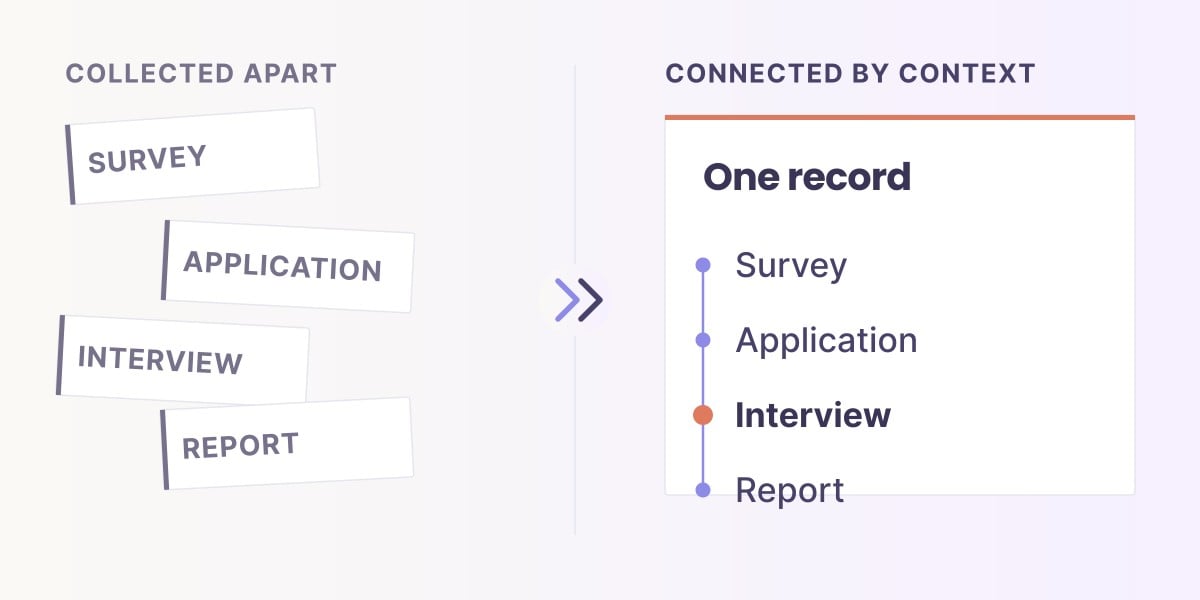
What is the difference between a pulse survey and stakeholder intelligence?
A pulse survey is a short survey used to collect timely feedback, often repeatedly. Stakeholder intelligence is a broader process for bringing relevant feedback, context, analysis and follow-up together. A pulse can be one input to that process. They are not mutually exclusive products or competing privacy models.
A pulse is not necessarily anonymous or one-off. It can be anonymous, confidential or identified, depending on its purpose and configuration. A stakeholder workflow can also use anonymous group feedback when identifying respondents is unnecessary or would undermine the collection purpose.
The useful question is what happens after the responses arrive. Does the team have enough context to interpret the result, review the evidence and decide what to do next? That question applies to a member network, a customer program, an employee team or a partner relationship.
Compare the method with the wider workflow
| Question | Pulse survey | Stakeholder intelligence workflow |
|---|---|---|
| What is its role? | A concise collection method for a focused question. | A process connecting relevant evidence to interpretation and action. |
| How often does it run? | Once or at a planned recurring cadence. | At the cadence appropriate to the decisions and source data. |
| Must people be identified? | No. The privacy design depends on the purpose. | No. Identity should be used only where appropriate and necessary. |
| Can it show change? | Yes, if the design and comparisons support the question. | It can combine suitable observations over time with other context. |
| What else may be needed? | Definitions, response coverage, interpretation and follow-up. | Data relationships, source review, governance and clear ownership. |
When is a pulse survey enough?
A short pulse can be a good fit when the question is focused and the team already has a way to act on the result. For example, a member organization might ask whether a revised event schedule is easier to use. It may need a group-level view and comments, not a detailed history for every individual.
Keep the instrument proportionate. Ask questions that lead to a decision, explain how responses will be used and choose a cadence the team can respond to. Repeating a survey more often does not help if results accumulate without review.
For the collection method itself, see pulse surveys. For interpreting the responses, see survey analysis.
When do you need a wider evidence workflow?
The need becomes clearer when several sources contribute to the decision. A membership team may have an annual return, event feedback, chapter interviews and administrative records. A customer team may need check-in responses alongside service activity. A partner team may need survey results and supporting documents.
In these situations, another pulse alone may not resolve the problem. The team needs to know how the sources relate, which definitions are shared, who is represented and what has already been done. Where individual follow-up is appropriate, the link to the relevant person or organization must be planned and governed.
Do not define the purpose as finding “who is unhappy” by default. Sometimes the right action is to improve a process for a whole group while protecting the privacy of the people who raised the concern.
Choose the privacy model before collection
| Design | Appropriate use | Important limit |
|---|---|---|
| Anonymous group feedback | Understanding a group without seeking respondent identity. | Do not promise personal follow-up or try to reconstruct identities afterward. |
| Confidential responses | Authorized processing with defined limits on what is reported or shared. | Explain who can access identifiable information and how reporting protects respondents. |
| Identified follow-up | A service or relationship question where a named response is necessary and appropriate. | Make the purpose and access clear; collect only the context needed. |
Privacy labels and implementation differ between products. For example, Officevibe documents its anonymity model, while its manager guidance describes replying to anonymous feedback. Anonymous feedback does not necessarily prevent a conversation, and a product that offers anonymity is not necessarily limited to isolated snapshots.
Group trends and individual change are different analyses
Suppose a fictional association receives 100 pulse responses in April and 120 in July. If the respondents are not linked, a score difference describes the responding groups at those times. It does not establish that the same individuals improved or declined.
If an appropriate identified or confidential design yields 65 matched respondents across both periods, their paired results answer a different question. Report the matched group and its coverage rather than treating it as the whole membership. Changes in membership composition, participation and missing responses still affect interpretation.
Neither design is inherently superior. Choose the design that fits the question and privacy commitment. For the distinction, see longitudinal and cross-sectional approaches.
Keep local questions and shared definitions compatible
A network does not always need one survey imposed on every chapter. Agree the few fields needed for comparison, then allow local questions that help each team. Document meanings, response options, timing and permitted mappings in a data dictionary.
Keep stable registration information separate from repeated feedback, updating changing details when needed. Where anonymous collection is intended, do not add identifying context merely to make a dashboard more detailed. A small group or a distinctive comment may also need careful handling before wider reporting.
What should you test in the software?
Pulse and engagement tools can already support recurring collection, reporting and analysis. Officevibe, for example, documents feedback trends and reporting. The decision should concern the actual workflow, not a claim that every pulse platform is one-off or lacks history.
- Collection: can the team maintain the intended cadence, versions and privacy design?
- Context: can relevant sources be linked where appropriate, without exposing restricted information?
- Analysis: can the team examine scores, comments, response coverage and contradictory evidence together?
- Review: can a reviewer inspect definitions, calculations and source passages?
- Follow-up: is there a clear owner and a record of what action was taken?
- Maintenance: what happens when a definition, membership structure or source changes?
Where Sopact’s approach is useful
Sopact focuses on connecting collection, context, analysis and governance so operating teams can manage growing evidence without repeatedly rebuilding it in exports. The opportunity is broader than sending a shorter survey: it is bringing recurring responses, relevant records and reviewed qualitative evidence into the same working process.
People still define the questions and coding framework. The workflow should make it easier to apply that framework across authorized material, inspect exceptions and connect themes to the quantitative results. A cited passage is useful evidence, but it does not automatically establish prevalence or the cause of a score change.
Test this with one recurring question. Compare the effort required to organize the data, apply or revise the codebook, check missingness and prepare the next report. Include review time and setup.
How to expand an existing pulse process
- Keep what already works. Retain the useful questions, collection channel and privacy promises.
- Name the unanswered decision. Identify exactly what extra context or follow-up is missing.
- Map the sources. Define which records can be connected appropriately and which should remain separate.
- Agree a review process. Specify the codebook, calculation, coverage checks and responsible owner.
- Pilot the next cycle. Test a changed definition and a missing response as well as the typical case.
- Return a useful answer. Explain what was learned, what will change and what remains uncertain.
Do not retrospectively identify anonymous responses. If future collection needs a different privacy model, explain that change before collecting new data.
Frequently asked questions
Is a pulse survey always anonymous?
No. A pulse describes a short collection format. Its privacy design can be anonymous, confidential or identified depending on the purpose and configuration.
Can a pulse survey be longitudinal?
Yes, when the design appropriately links repeated observations from the same participants. Repeated anonymous group surveys can also track group-level trends, with different interpretation limits.
Does stakeholder intelligence require names?
No. It requires useful, governed evidence for a decision. Some decisions need identity; others need only a group view. Choose the minimum appropriate context.
Can we use a pulse inside a stakeholder workflow?
Yes. A pulse can be one source alongside interviews, records, documents and other feedback. Define how each source contributes to the question.
Does more frequent collection create better engagement?
Not automatically. Question relevance, response burden, privacy and visible follow-through matter. Use a cadence the team can support.
What should we read next?
Explore stakeholder intelligence for the wider workflow or reputation monitoring for the distinction between direct feedback and public conversation.
