


Related solution
Customer Experience
Connect feedback with service context and follow-up.
Explore the solution →


Live webinar: Wednesday, October 7, 2026 | 9:00 AM PT
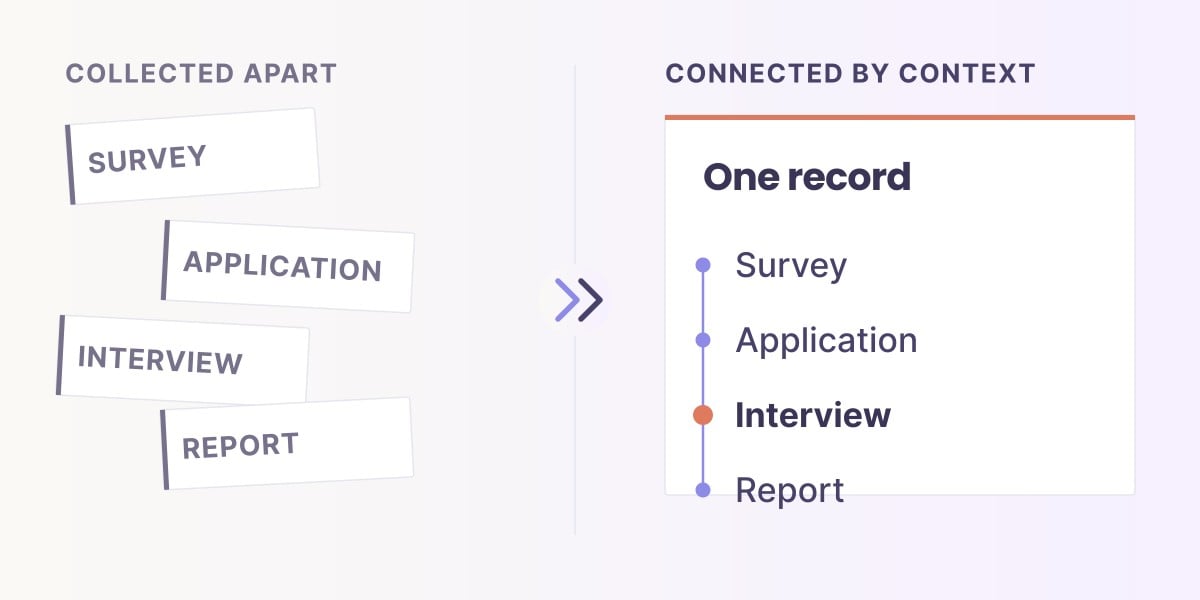
Building context across your data. In 30 minutes, see how to connect data and definitions across teams, with the right permissions and governance, so scattered data points become intelligence your teams and AI can actually use.
Save your spot (free)USE CASE / SOFTWARE GUIDE
NPS survey software collects likelihood-to-recommend ratings, calculates Net Promoter Score and helps teams understand the reasons behind the responses. Good software makes the score interpretable and the comments useful, so a customer-experience team can decide what to improve and follow what happens afterward.
The arithmetic is straightforward; the difficult work is explaining change. A different response group can move the score. A positive rating can contain a serious concern. A follow-up marked complete may leave the customer’s problem unresolved. Without the response base, written explanation and service context, a trend chart leaves those questions unanswered.
AI can organize comments and answer questions about survey results. Sopact focuses on bringing that analysis together with relevant customer and program history, making new evidence available through AI Assistance as it arrives. The buying decision is whether you need an NPS collection tool, a broader experience platform or continuing analysis across several sources.
Understand whose responses produced the score.
Read praise and concerns alongside the rating.
See what later feedback says after the team acts.
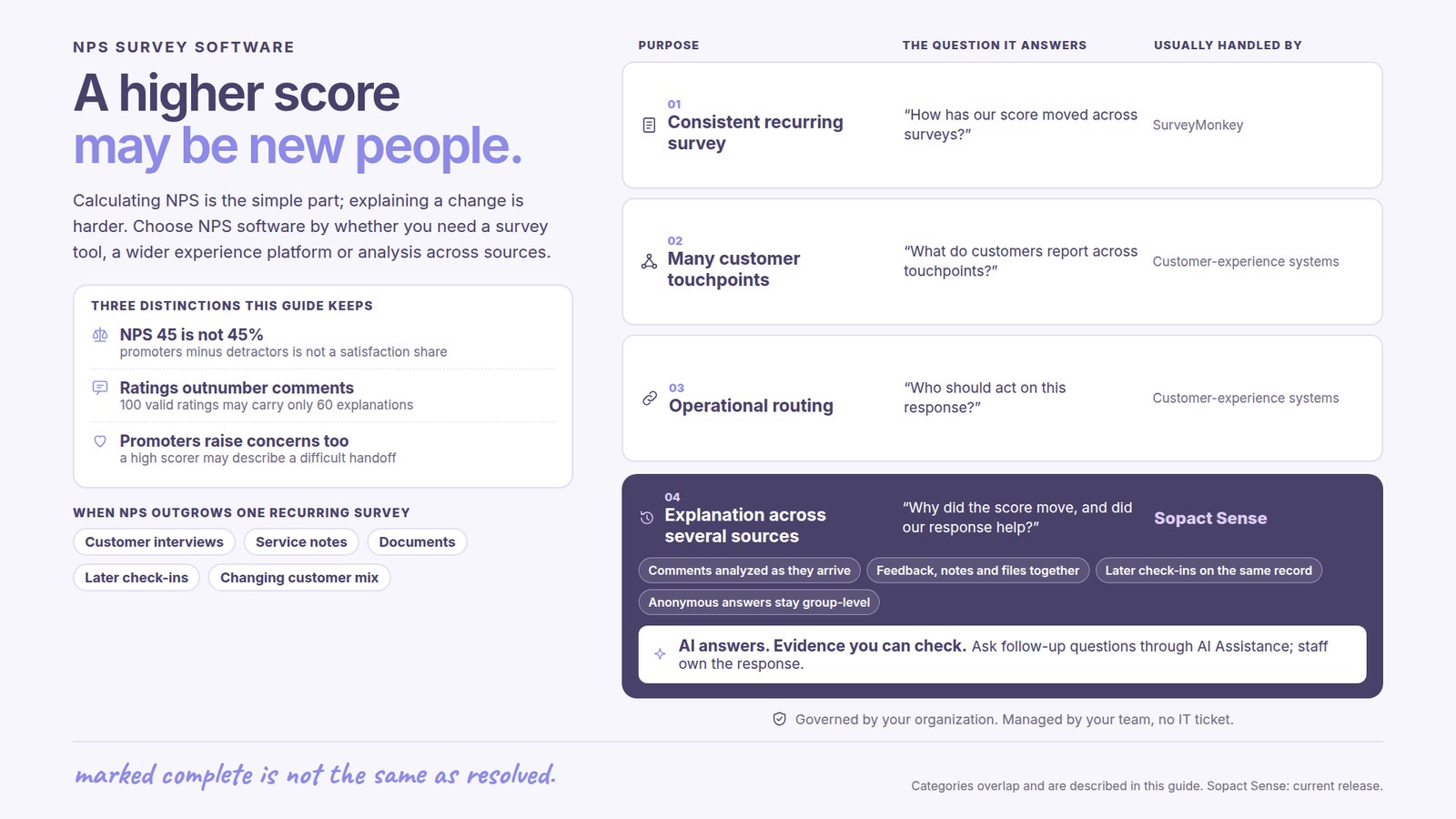
NPS uses a 0–10 recommendation question. Ratings of 9–10 are promoters, 7–8 are passives and 0–6 are detractors. The score is the percentage of promoters minus the percentage of detractors, using all valid responses as the base. Passives remain in that base even though they appear in neither percentage being subtracted.
For an illustrative survey with 100 valid responses, 60 promoters, 25 passives and 15 detractors produce an NPS of 45. Report the score as 45, not 45% satisfaction. SurveyMonkey’s NPS documentation explains the standard grouping and automatic calculation.
The score describes recommendation intent among respondents. It does not establish why a person answered, whether they will renew or what nonrespondents think. Those questions need comments, later evidence and an appropriate research design.
A survey platform suits a team that needs a consistent question, distribution and analysis of the answers. SurveyMonkey offers built-in NPS scoring and multi-survey NPS reporting over time. These are useful capabilities when the evidence is principally in recurring surveys.
A wider customer-experience system may be appropriate when the purchase also involves many touchpoints, operational routing and organization-wide reporting. Decide which of those responsibilities the new system must actually perform.
Sopact is relevant when the explanation is spread across feedback, interviews, service notes, documents and subsequent check-ins. Its value is keeping this material usable for the next question. An existing service or survey system may remain part of that workflow; the available connections and imports determine the agreed scope.
Teams often start with detractors, but promoters and passives also explain useful opportunities. A high scorer may value the relationship while describing a difficult handoff. A passive respondent may like the service but not yet have enough experience to recommend it. Reducing every answer to positive or negative loses these distinctions.
Review which comments support a theme and whether the same issue appears across relevant groups. Count comment coverage separately from score coverage: a survey can have 100 valid ratings and only 60 written explanations. The latter cannot explain every rating.
AI can help organize that reading. The useful output preserves the original responses and allows a reviewer to examine mixed opinions or correct an interpretation. The value is a clearer basis for action, not a more confident label on incomplete evidence.
An NPS response may describe a problem that appears in an earlier interview or service note. Sopact brings the permitted evidence together so staff can investigate the relationship without first preparing another collection of exports. Incoming analysis remains available through AI Assistance as the relationship develops.
For example, a service team might discover that customers praise staff responsiveness but repeatedly describe having to explain the same issue to a new person. That points toward continuity of service, not simply faster replies. Later feedback can help the team understand whether a changed handoff addressed the concern. This is an illustrative decision, not a measured customer result.
Staff retain responsibility for the interpretation and response. Anonymous survey answers remain group-level evidence. Connecting named records is appropriate only where identity and that use are part of the agreed collection purpose.
Keep question wording, collection timing and the customer group visible beside a trend. A relationship survey and a survey immediately after a successful support encounter can produce different results because they ask about different experiences.
When the same customers respond in both periods, a matched view answers how those respondents changed. A view of everyone who answered each survey describes the two respondent groups. Both can be useful, but they are not interchangeable. Show coverage and explain material changes in who responded.
Use the score with the decision it supports. A service team may need to investigate a recurring concern; leadership may need to understand which customer groups are underrepresented. A higher score should begin an explanation, not end the analysis.
Sopact’s typical setup estimate is two days to two weeks for an agreed collection and analysis workflow. Historical feedback, required source connections and access needs determine the scope. Analysis on arrival helps staff prepare for a decision; completing the customer response still takes human work.
Your team retains ownership of its questions and reporting with personalization and continuing Sopact support. Evaluate the benefit through less repeated preparation, clearer explanations and better-informed follow-up, rather than the number of dashboards produced.
The King Center story below is relevant to making written program feedback usable. It is not evidence of an NPS increase. For a related but different measure, see CSAT survey software.
It collects recommendation ratings, calculates Net Promoter Score and supports analysis of comments and trends.
Yes. They remain in the total valid-response base used to calculate promoter and detractor percentages.
No. NPS is the difference between promoter and detractor percentages. It is not the share of satisfied customers.
No. Consider response coverage, population, timing and other changes before attributing the movement to an intervention.
It connects feedback with relevant earlier and later evidence so staff can investigate recurring concerns and follow the result of their response.
Continue with a purpose
Related solution
Connect feedback with service context and follow-up.
Explore the solution →Continue learning
Connect collection and analysis with useful service decisions.
Start learning →
Customer story
Explore how open-ended program feedback became usable during delivery.
Read the story →Explore how Sopact can connect recommendation feedback, customer context and later follow-up around your service decisions.
See it with your workflow →