New webinar on 3rd March 2026 | 9:00 am PT
In this webinar, discover how Sopact Sense revolutionizes data collection and analysis.
Fellowship Management Software: AI-Powered Review, Selection & Fellow TrackingSubheading: The only fellowship platform that reads every word of every application document before your committee meets
Fellowship programs face a review challenge that grant and scholarship programs do not: every applicant submits not one document but a bundle — a personal statement, one or more writing samples or research proposals, two to three reference letters, academic credentials, and supplemental materials. Each document type requires different evaluation criteria. A personal statement is assessed for intellectual trajectory and clarity of purpose. A research proposal is evaluated for methodological rigor and feasibility. A reference letter is analyzed for specificity, endorsement strength, and the reviewers' ability to observe the applicant under pressure.
Most fellowship management software treats this bundle as a filing problem: documents arrive, are stored, and are forwarded to reviewers as attachments. The analysis — reading every document against different evaluation criteria, comparing quality across a pool of 200 applicants, detecting when reviewers apply the same rubric differently — remains entirely manual. For programs receiving 150–500 applications per cycle, that manual layer consumes 6–10 weeks before a single strategic selection decision is made.
Fellowship management software is a platform that manages the complete fellowship program lifecycle — from application intake through review, selection, fellow onboarding, progress tracking, and outcome measurement. It serves foundations awarding research and professional fellowships, universities managing competitive academic programs, professional associations running leadership development initiatives, and government agencies administering public interest fellowships.
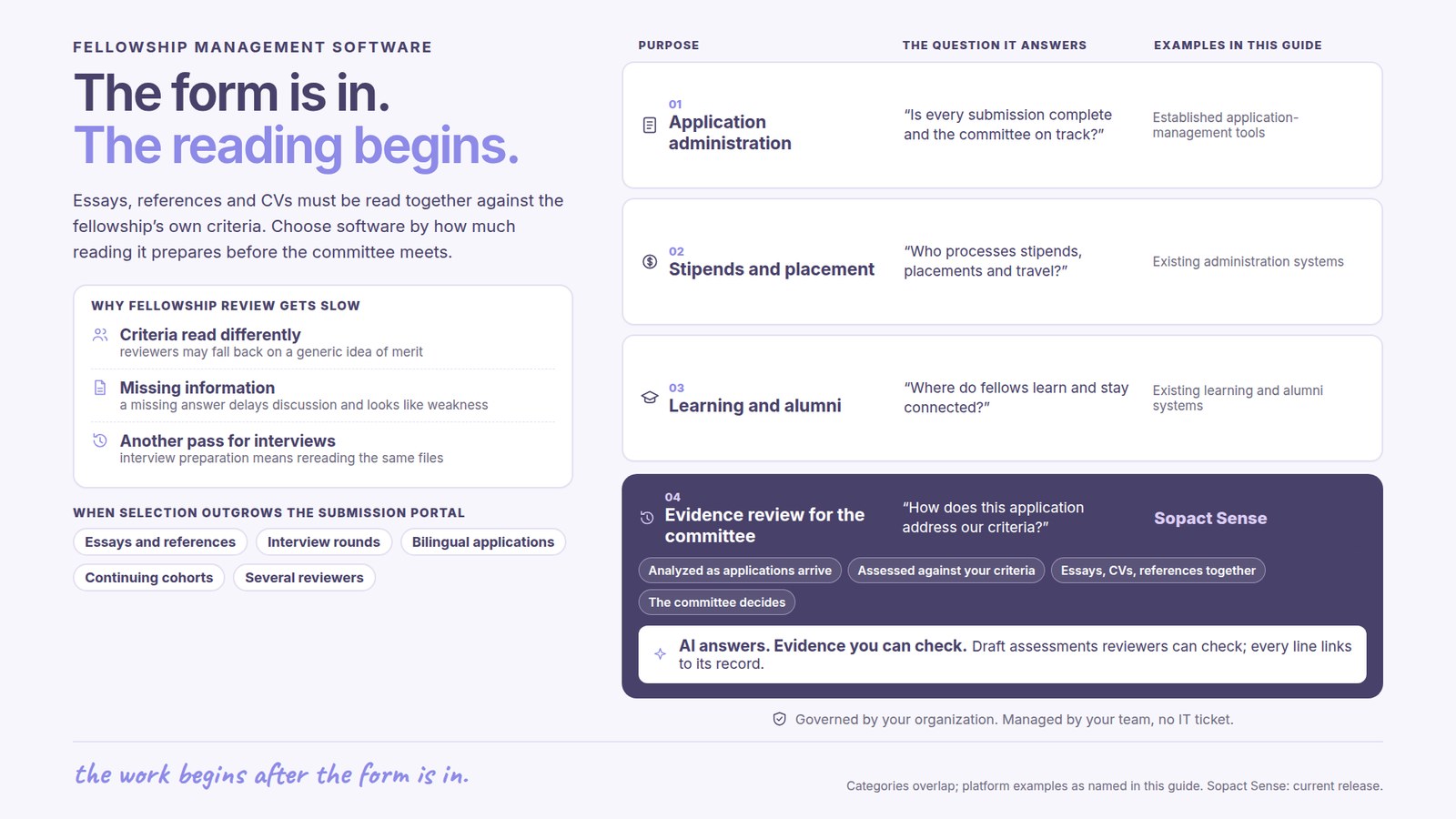
Modern fellowship management systems go beyond intake and routing. The defining capability gap between legacy platforms and AI-native systems is whether the software reads the content of submitted documents or stores and routes them. A fellowship application that includes a 1,200-word personal statement, a 3,000-word research proposal, and two reference letters contains the majority of the evaluation signal in that qualitative content — content that every legacy fellowship management platform leaves entirely to manual reviewer reading.
The application bundle problem. Fellowship applications are uniquely document-heavy compared to scholarship or grant applications. The program receiving 300 applications is actually receiving 300 × 5 documents = 1,500 individual files that each need to be read, evaluated against specific criteria, and integrated into a holistic applicant profile. At 20 minutes per application, that is 100 person-hours before scoring begins.
Multi-round complexity. Most fellowship programs run two or three review rounds: an initial screen against eligibility and completeness criteria, a substantive review panel, and a finalist interview or site visit stage. Data from round one needs to flow cleanly to round two without re-entry, and the scoring framework may evolve between rounds.
Longitudinal fellow tracking. Unlike scholarships (one-time awards) or grants (fixed project periods), fellowships often involve ongoing relationships: mid-year check-ins, deliverables, cohort programming, mentor matching, alumni engagement, and multi-year outcome tracking. The platform managing selection needs to connect to the platform managing the fellowship experience — not hand off to a separate system.
Reference letter intelligence. Reference letters for fellowship applications contain critical evaluation signal — but most programs extract almost none of it. Strong references include specific, observable evidence of the qualities being evaluated. Weak references are generic and unsubstantiated. AI analysis of reference letters can surface which letters actually provide evidence vs. which are formulaic endorsements — a capability no legacy fellowship management platform offers.
Stage 1 — Application intake with persistent fellow IDs. Every applicant receives a unique Contact ID from first submission. All documents submitted across the application cycle — initial form, personal statement, uploaded writing samples, reference letter links — connect to the same record automatically. If an applicant applies to two fellowship tracks, the system recognizes them. If a prior-year applicant reapplies, their history is available.
Stage 2 — Document analysis before reviewer assignment. Intelligent Cell processes every document in the application bundle the moment it arrives. A personal statement is scored against intellectual clarity, alignment with program focus, and evidence of prior impact. A research proposal is evaluated for methodological rigor, feasibility, and outcome measurement plan. A reference letter is analyzed for specificity, endorsement strength, and relationship context. Reviewers receive pre-analyzed application summaries — not raw document stacks.
Stage 3 — Calibrated reviewer panels. Intelligent Column tracks scoring patterns across the reviewer panel throughout the cycle. If one reviewer's scores are consistently 1.5 points higher than the panel median, that drift is visible before decisions are final. If two reviewers score the same application dramatically differently, that flag surfaces for discussion — not after the decision has been made.
Stage 4 — Selection with evidence. Intelligent Grid generates committee-ready briefings combining ranked scores with the specific evidence that drove each rating. Instead of a committee meeting where members recall applications reviewed three weeks earlier, the session operates from live, evidence-linked data: ranked finalists with score distributions, representative quotes from personal statements, reference letter quality indicators, and cross-applicant rubric analysis.
Stage 5 — Fellow lifecycle tracking. Persistent Contact IDs connect each fellow from application through program participation: mid-program surveys, mentor feedback, deliverable tracking, and post-fellowship outcome measurement. Foundations can query — three years later — which application characteristics predicted successful completion. That longitudinal intelligence makes each fellowship cycle more evidence-based than the last.
Research fellowships — academic and professional research programs with proposal and writing sample requirements. Complex multi-document review; proposal quality is the primary evaluation signal.
Leadership development fellowships — programs selecting emerging leaders based on trajectory, character, and potential. Personal statement quality and reference letter specificity are primary signals; standardized scoring is difficult without AI analysis.
Public interest and policy fellowships — government and nonprofit programs with rigorous eligibility criteria, multi-round selection, and post-program outcome expectations.
Professional association fellowships — credentialing and recognition programs administered by industry associations with annual cycles and multi-stage review committees.
University graduate fellowships — competitive academic fellowships with faculty review panels, conflict-of-interest requirements, and multi-year recipient tracking.
Corporate and CSR fellowships — company-sponsored social impact fellowships requiring ongoing participant tracking and outcome reporting to leadership.
For the detailed review process methodology — how AI scores each document type in the fellowship bundle, how rubric design works for qualitative criteria, how bias manifests across fellowship review panels — see the Fellowship Review Process guide →
Fellowship management software is a platform that manages the complete fellowship program lifecycle — from application intake and document collection through multi-round review, selection, fellow onboarding, progress tracking, and post-fellowship outcome measurement. It serves foundations awarding research and professional fellowships, universities administering graduate fellowship competitions, professional associations running leadership development initiatives, and corporate CSR programs sponsoring social impact fellows. Modern AI-native fellowship management systems go beyond intake and routing to analyze the content of submitted documents — personal statements, research proposals, writing samples, and reference letters — against evaluation rubric criteria, producing citation-level scores before human reviewers engage with the application bundle.
Fellowship programs have three requirements that scholarship programs typically do not. First, the application bundle is significantly more complex — most fellowship applications include a personal statement, research proposal or writing sample, multiple reference letters, and academic credentials, each requiring different evaluation criteria. Second, the selection criteria are primarily qualitative — intellectual trajectory, research rigor, leadership potential — where AI document analysis provides substantially more value than in scholarship programs with heavy standardized-score weighting. Third, fellowship programs involve longitudinal relationships with recipients: ongoing check-ins, deliverables, cohort programming, and multi-year outcome tracking that requires persistent fellow identity across the platform, not just during the selection cycle.
Sopact Sense's Intelligent Cell processes each document in the fellowship application bundle against the rubric criteria defined for that document type. A personal statement is scored on dimensions like clarity of intellectual purpose, alignment with program focus areas, evidence of prior impact, and coherence of career trajectory — with specific sentences from the document cited as evidence for each criterion rating. A research proposal is evaluated separately on methodological rigor, feasibility of timeline and budget, originality of contribution, and outcome measurement plan. Each document type receives its own rubric-based analysis, and the results are combined into a unified applicant profile that reviewers see instead of raw document stacks.
Yes — and this is one of the most underutilized capabilities in fellowship review. AI analysis of reference letters can distinguish between substantive references (which include specific, observable evidence of the qualities being evaluated, describe how the referee has directly observed the applicant in relevant contexts, and provide concrete examples) and generic endorsements (which use vague praise without evidence and describe the applicant primarily through impressions rather than instances). Sopact Sense analyzes reference letters for specificity of evidence, endorsement strength relative to the rubric criteria, and the relationship context that gives the reference credibility. This surfaces signal that manual review systematically misses — reviewers rarely have time to analyze letter quality as a distinct dimension alongside application content.
Fellowship management software supports any program that involves competitive application and ongoing fellow relationships: research fellowships at universities and independent institutes (where proposal quality is the primary selection criterion); leadership development fellowships run by foundations, nonprofits, and government agencies (where personal statement and reference letter analysis is critical); professional association fellowships that credential and recognize emerging practitioners; corporate CSR fellowships connecting talent to social impact organizations; public interest and policy fellowships with rigorous eligibility requirements and post-program reporting expectations; and graduate academic fellowships with faculty review panels and multi-year recipient tracking. The architecture is the same across all types — persistent fellow IDs, multi-document bundle analysis, calibrated reviewer panels, and longitudinal outcome tracking.
Multi-round fellowship review requires data continuity between rounds without re-entry, and the flexibility for scoring criteria to evolve between rounds as the selection committee refines what they're looking for. Sopact Sense manages multi-round review through persistent Contact IDs that carry all application data forward into each new round, and through Intelligent Cell's ability to re-score applications instantly when rubric criteria change between rounds. Round-one screeners see eligibility and completeness summaries. Round-two reviewers see substantive AI-scored analysis of the full bundle. Finalist committees see evidence-linked comparison briefings generated by Intelligent Grid — without any data re-entry or manual reconciliation between stages.
General application management platforms (Submittable, SurveyMonkey Apply, OpenWater) handle intake and routing for any type of application. Fellowship management software is distinguished by three capabilities specific to the fellowship context: multi-document bundle processing that evaluates each document type against distinct criteria (not a single rubric applied uniformly); longitudinal fellow tracking that extends beyond selection into program participation and outcome measurement; and reference letter intelligence — analysis of letter quality as a distinct evaluation dimension. General platforms store reference letters as attachments; fellowship-specific AI platforms analyze whether those letters actually provide the evidence the review criteria require.
The operational cost of a manual fellowship review process is significant and often unrecognized. A program reviewing 300 applications with a 5-person review panel, each reading 60 applications at 20 minutes per application, spends 100 person-hours on reading alone — before scoring, calibration discussions, data reconciliation, and committee reporting. If those reviewers are program staff at $50–$80/hour, that is $5,000–$8,000 in direct labor per review cycle, repeated annually. For a program receiving 500+ applications across two review rounds, the manual cost regularly exceeds $20,000 per cycle. AI-native fellowship management software that reduces review labor by 60% delivers ROI in the first cycle for most programs at any reasonable subscription price.
Yes — and longitudinal tracking is where fellowship management software creates the most long-term value. Persistent Contact IDs connect each fellow from application through program participation: mid-program surveys are linked to the original application record, mentor feedback connects to the applicant who received it, deliverables track against what was proposed, and post-fellowship outcome data (career placement, research publication, social impact metrics) becomes queryable against selection criteria years later. This longitudinal dataset answers the question that annual reports cannot: which application characteristics actually predicted successful fellows? That intelligence, accumulated across multiple cohorts, makes selection criteria evidence-based rather than intuition-based.