What is SROI (social return on investment)?
SROI, or social return on investment, puts a dollar value on the outcomes a program creates, removes what would have happened anyway or was caused by others, and divides the result by the value of what was put in, giving a ratio such as 1.48:1. The ratio is one division at the end; the trust sits in every step before it.
Social value is not cash. A ratio of 1.48:1 means an estimated 1.48 units of social value for each unit invested, under a stated scope and set of assumptions, and nobody receives 1.48 in return.
THE SHORT VERSION
- Build a value map first: one row per outcome, with its evidence, financial proxy and adjustments, and leave a row unvalued rather than guess.
- Apply deadweight, attribution, displacement and drop-off one after another, discount future years, then divide by the present value of inputs.
- Report the ratio with its value map, a sensitivity table and what you left unvalued, because the assumption that moves it most needs the best evidence.
What is the SROI formula?
SROI ratio = present value of adjusted outcomes ÷ present value of inputs. Two related figures use the same parts and answer a different question, so name the one you report.
| Figure | Calculation | Teaching example below |
|---|---|---|
| SROI ratio | PV of adjusted outcomes ÷ PV of inputs | 14,810.50 ÷ 10,000 = 1.48:1 |
| Net present value | PV of adjusted outcomes − PV of inputs | 4,810.50 |
| Net SROI ratio | Net present value ÷ PV of inputs | 0.48:1 |
The video below walks through the formula and how to read a ratio. Watch how each side of the division is defined, and treat its figures as illustrations rather than values to borrow.
Are there seven or eight SROI principles?
Eight: older guides list seven, and Social Value International added an eighth, “Be responsive”, in 2021. SVI explains the addition, and the ratio should be read against all eight rather than as a standalone score.
In practice: involve the people affected, understand what changes, value what matters, include what is material, do not overclaim, be transparent, verify and respond. The SVI standards and guidance hold the formal wording, and the Guide to SROI sets out the full method.
How do you calculate SROI step by step?
Seven steps take you from scope to a reported ratio, and only the sixth is arithmetic.
- Set the scope. The activity, period, stakeholders, purpose and every input, including donated time and goods.
- Map outcomes. What changes for whom, including negative and unintended changes.
- Gather evidence. How many people, how much change, for how long.
- Value outcomes. Choose a financial proxy per outcome and record why it fits.
- Adjust. Remove deadweight, attribution and displacement; set duration and drop-off.
- Calculate and test. Discount each year, divide by inputs, and run the sensitivity scenarios.
- Report and use. Show the map, the assumptions, what was left unvalued and what will change.
What goes in an SROI value map?
A value map, which the SROI Guide calls the Impact Map, holds one row per outcome linking the stakeholder, the change, its evidence, its value and its adjustments, with the scope and inputs written above. A row you cannot value yet stays on the map marked “not yet valued”; it is not zero.
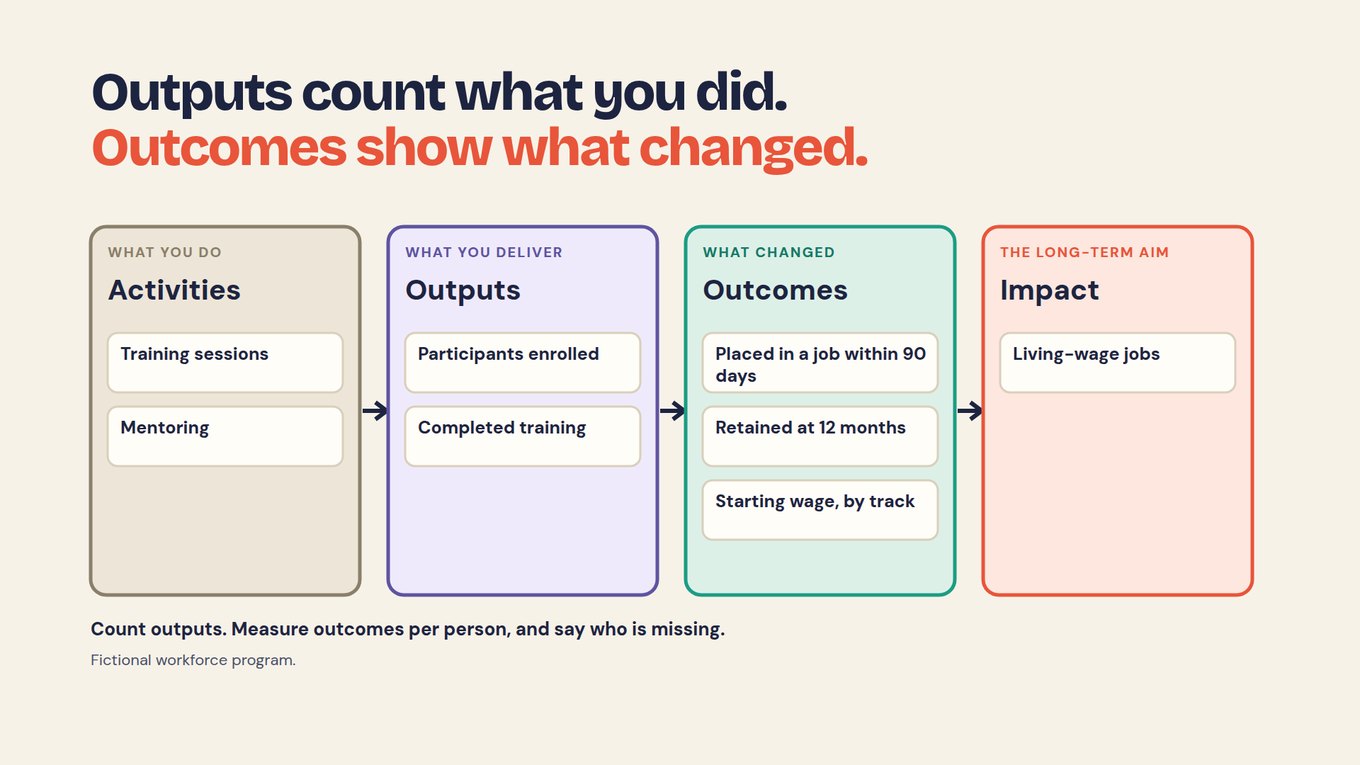
Write outcomes before you look for any price. In the fictional workforce program used across the free course, enrolments and completed training are outputs; placement within 90 days, retention at 12 months and starting wage are the outcomes a value can attach to.
| Part | What to record | Workforce row (fictional) |
|---|---|---|
| Scope and inputs | Activity, period, stakeholders, all resources | Partners A, B and D; grants plus donated employer time |
| Outcome and evidence | Change, indicator, quantity, source | 100 placed within 90 days; 12-month retention not yet reported |
| Value | Proxy, unit, source, year, why it fits | Wage gain from own records, once wage before enrolment is collected |
| Adjustments and status | Each adjustment with its reason; owner, date | Not yet valued |
Check rows for overlap: “less financial stress” and “better wellbeing” may be one change counted twice.
How do you choose a financial proxy for SROI?
Pick a proxy that matches the outcome, stakeholder, unit, place and year, keep its source and any conversion, and write one sentence on why it fits; if nothing fits, leave the row unvalued. A borrowed value from another setting may not reflect your stakeholders’ experience.
Look first at your own before-and-after records, then official statistics and valuation studies with open methods. Check units before multiplying: a typical annual wage is not the wage gain your graduates made.
What are deadweight, attribution, displacement and drop-off?
They are four adjustments that remove the parts of the gross value your work did not cause, applied one after another to what remains. Each is a judgment that needs evidence, and applying four percentages is not the same as proving cause.
| Adjustment | Question | Workforce example | Caution |
|---|---|---|---|
| Deadweight | What would have happened anyway? | Some trainees would have found work alone | Do not assume zero because you lack comparison data |
| Attribution | How much is due to others? | A job center or family also helped | Say whether the % is removed or kept |
| Displacement | Did the outcome push another out? | A graduate took a job another jobseeker would have filled | Look beyond your own participants |
| Drop-off | How much fades each year? | Fewer graduates in the same job in year two | Apply only when valuing several years |
Social Value International’s guidance on not overclaiming covers how to estimate deadweight and attribution. The sequence matters: 20% then 25% off 10,000 leaves 6,000, not the 5,500 a combined 45% would give.
What does an SROI calculation look like, worked through?
Take 10 outcome units valued at 1,000 each, remove 20% deadweight and 25% attribution, let the outcome fade 10% a year over three years, discount at 5% and divide by inputs of 10,000: the ratio is about 1.48:1. These are teaching numbers, not results from any program or recommended rates.
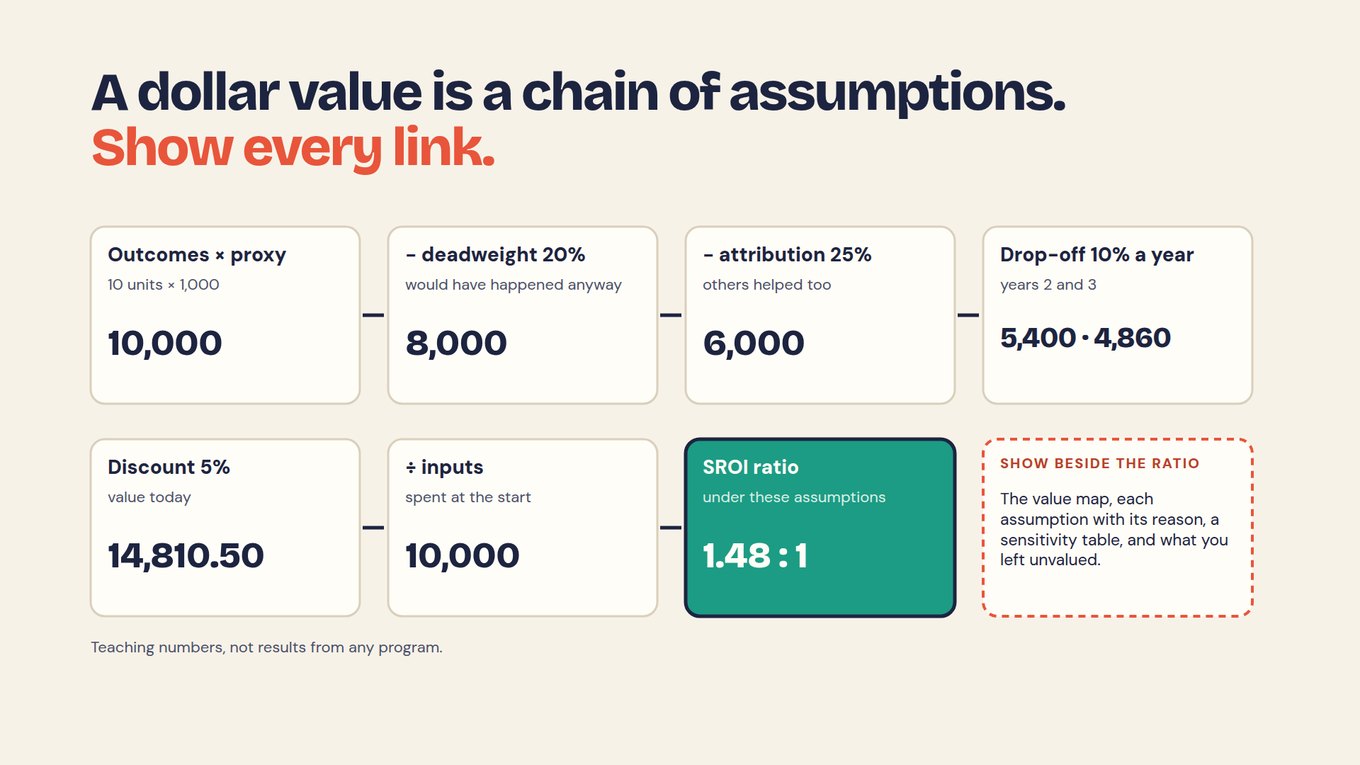
Displacement is zero here, stated openly for teaching, never as a default. Inputs are spent at the start; each year’s value arrives at year-end.
The calculator below shows each year’s adjusted value and present value, using these same assumptions.
So the ratio is 14,810.50 ÷ 10,000, about 1.48:1, and the net SROI ratio about 0.48:1. A sentence a reader can check reads: “Adjusted outcomes have a present value of about 14,811 against inputs of 10,000, a ratio of 1.48:1 under the stated value, contribution, duration and timing assumptions.”
Try the SROI calculator
The explorer uses the same teaching figures above. It values one recurring outcome for a fixed group, applies adjustments and drop-off, and discounts each year-end value. For several outcomes, check overlap and material negative effects before combining values.
INTERACTIVE SROI EXPLORER
Change an assumption. See what changes.
Start with the article’s teaching figures, or enter your own. See the ratio, the annual values behind it, and the effect of changing one assumption.
Estimated social value per unit of input. This is not cash returned.
Fixed group; one recurring outcome. Inputs at the start. Value arrives at each year-end.
Not a complete or assured SROI. Check material negative outcomes, overlap, stakeholder priorities, and evidence quality separately.
See the calculation by year
| Year | Adjusted value | Present value |
|---|
Year 1 value = units × proxy × (1 − deadweight) × (1 − attribution) × (1 − displacement). Later years apply drop-off. Present value discounts each year by (1 + discount rate)year.
Test one assumption at a time
Compare with your current inputs. These are illustrative stress tests, not confidence intervals or suggested rates.
Which assumptions change the SROI ratio most?
Change one assumption at a time and watch the ratio; in the teaching example, duration decides whether it is above 1. The assumption that moves the ratio most is the one that needs the best evidence.
Compare duration, proxy, and deadweight in the calculator ↑
For the workforce program, the evidence that an outcome lasts past year one is 12-month retention, so collect it before claiming multi-year value. A scenario range is not a confidence interval; each end needs a reason.
What can an SROI ratio not tell you?
A ratio above 1 does not prove cause, savings or value for money, and one below 1 does not prove failure. It covers only the outcomes you could value, under your assumptions; harms and outcomes without a fair proxy sit outside it.
Label forecast SROI (expected outcomes) apart from evaluative SROI (outcomes that happened), and never let forecast value read as achieved. Do not average ratios across a portfolio or compare ratios built on different scopes and proxies.
The outcome counts are where most ratios go wrong. In Sopact Sense, each count comes from records that one ID per person keeps connected, and every line of an AI Assistant answer links to a record you can open, so you can match every number to its source before it enters the map.
PROMPT · PASTE INTO CLAUDE, CHATGPT OR YOUR AI TOOL
Here is our SROI value map: [PASTE TABLE with outcome, quantity, proxy and source, deadweight, attribution, displacement, duration, drop-off, discount rate, inputs].

1. Recalculate each row year by year, showing every step, applying adjustments one after another to what remains.
2. Discount each year's value and give the SROI ratio, net present value and net SROI ratio.
3. Rerun the ratio for one year only, and for each proxy 25% lower, and say which assumption moves it most.

Rules: do not fill any blank cell or supply a proxy we did not give. Where a value is missing, write "not in our data" and leave that row out of the total. Flag any row whose units do not match its proxy.
Start with one outcome row
Value one outcome well before you attempt a whole program.
- Write the boundary: activity, period, stakeholders, purpose and every input, including donated time.
- List the outcomes, including any harm, before looking up a single value.
- For one outcome, fill the proxy record or mark it “not yet valued”.
- Apply deadweight, attribution, displacement and drop-off in turn, each with a written reason.
- Discount each year, calculate the ratio, and run the one-year and lower-proxy scenarios.
- Ask a colleague to rebuild your total without seeing it; the teaching example gives 14,810.50.
After the first cycle you have one valued row, its sensitivity range and the evidence that would narrow it. A credible dollar value for your results helps decide whether a full ratio is worth building.
Make your assumptions visible.
Enter one outcome and its supporting assumptions. Keep unknown values blank until you have evidence.
Build your own scenario →Frequently asked questions
What is the full form of SROI?
SROI stands for social return on investment: a method, set out in Social Value International’s guidance, for valuing an activity’s social outcomes in money terms and comparing that value with what was invested. It is usually reported as a ratio, alongside the value map and assumptions behind it.
What is a good SROI ratio?
No threshold makes a ratio good in itself. Analyses with different boundaries, proxies and adjustments cannot be compared by ratio alone. A ratio is useful when readers can see the value map and sensitivity tests behind it, and when it informs a choice within one analysis, such as between two designs valued the same way.
Is SROI the same as financial ROI?
No. Financial ROI measures cash returned to an investor. SROI estimates the value of social outcomes, much of which never appears as cash for anyone, such as steadier income for a graduate. Present it as estimated social value under stated assumptions, never as money the funder will receive.
What discount rate should we use for SROI?
Use the rate required or recommended by the guidance that governs your decision, such as a government appraisal rule, and record why you chose it. The 5% on this page is a teaching figure only. Treat prices and inflation consistently across years, and include the rate in your sensitivity tests when the choice is uncertain.
Can we leave out an outcome we cannot value?
You can leave it out of the ratio but not out of the report. Keep it on the value map as “not yet valued”, describe it with its count and evidence, and say how its absence might change the reading. This matters most for harms: a positive ratio that leaves a known harm unmentioned misleads readers.
Does this calculator produce an assured SROI?
No. It shows transparent arithmetic for one simplified outcome. A full analysis needs stakeholder involvement, evidence for each outcome, materiality judgments, documented proxies and adjustments, and review. Assurance is a separate process against Social Value International’s standards, not something a calculator provides.