Sopact Academy · Measurement & reporting · Chapter 2
How to Build a Logic Model: Steps, Example and AI Prompt
Turn your theory of change into a practical logic model. Separate activities, outputs and outcomes, check evidence gaps and choose the next improvement.
How to Build a Logic Model: Steps, Example and AI Prompt
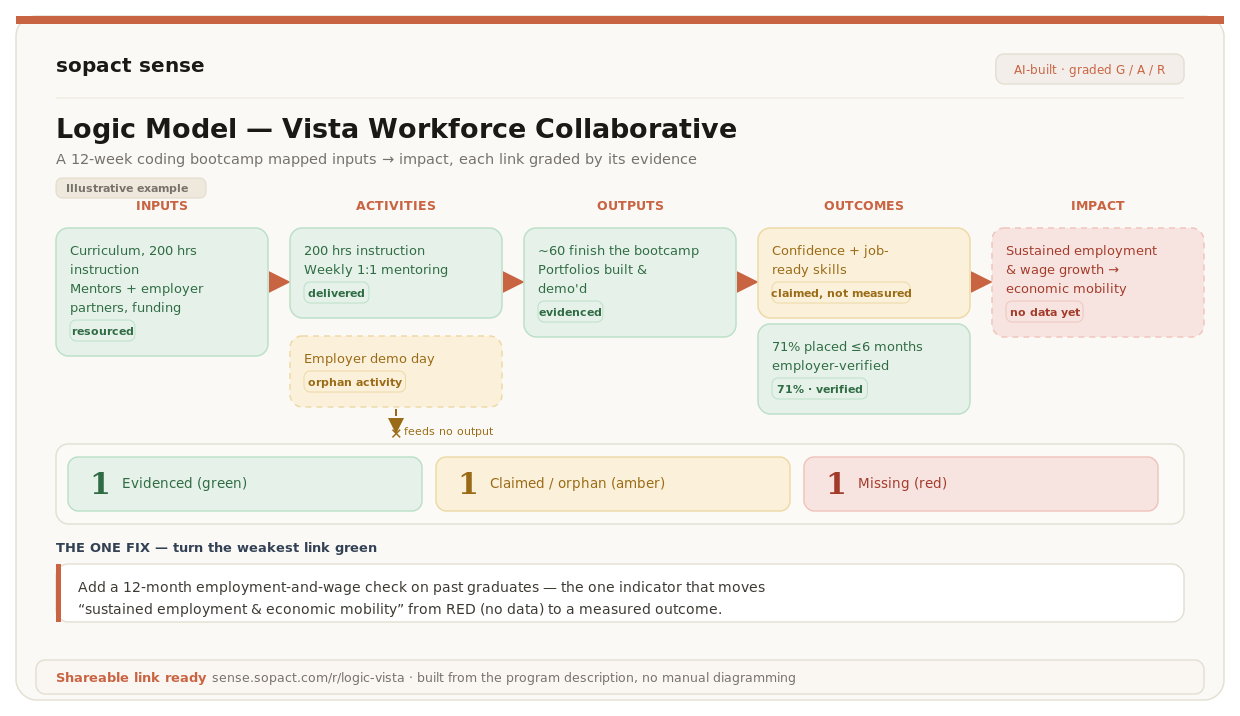
A logic model connects the resources you have, the activities you deliver and the outcomes you intend to support. Build a small table for one workflow, then add the evidence needed to check delivery and outcomes. Its value is showing where the plan does not yet connect—not filling every box.
Use this when the intended change is clear but responsibilities, delivery and evidence are not. You do not need to create another theory-of-change document first. If the reasoning itself is uncertain, explain the proposed change before turning it into a delivery plan.
Keep delivery and change separate.
In our fictional training example, an instructor runs practice sessions so learners can apply a skill at work. These are related but different things to record:
Resource: instructor time and a place to practise. Activity: supervised practice. Output: sessions delivered and participation. Outcome: learners can use the skill in a relevant setting.
Attendance tells you whether someone took part. It does not establish that their skill improved. Similarly, a completed follow-up survey helps measure an outcome; completing the survey is not the outcome itself.
Build one row before building the whole model.
Name the workflow, people involved and decision the model should support.
List the resources and activity for one intended outcome.
State what direct delivery record would show the activity happened.
Explain why it could contribute to the outcome and what conditions matter.
Identify the outcome evidence, collection moment and responsible person.
Review the weakest connection and decide what to clarify next.
For the training team, the condition is that learners have an opportunity to apply the skill after the course. The team can ask about that opportunity during follow-up. It should not promise that a training session controls what happens in every workplace.
Ask what is missing before adding more collection.
An empty evidence cell can mean three different things. The information may exist but not appear in the document. The team may have no usable measure. Or the proposed link between activity and outcome may need reconsideration.
Not documented? Ask the workflow owner for existing records. Not measured? Decide whether the question warrants new collection. Not explained? Revisit the reasoning with the team and people affected.
These lead to different actions. Do not add a survey just because a webpage omits an indicator. Do not delete an activity merely because a draft diagram leaves it unconnected.
Use AI for the first draft, then inspect it.
Ask an assistant to arrange approved notes into resources, activities, outputs and outcomes. Require a source beside every factual entry and label proposed additions. Check one row manually before reviewing the rest.
A focused prompt
“Build one logic-model table from these materials. Separate delivery from outcomes. Show the source and assumption for each connection. Distinguish information not supplied from a confirmed evidence gap. Do not invent activities, measures or claims that the work caused an outcome. List the questions the owner must resolve.”
Leave with a workable collection decision.
Choose one important outcome. Record the evidence you already have, what additional evidence is justified, when it can be collected and who will review it. Reuse existing attendance or service records where appropriate; every box does not need its own survey question.
In a partner network, the same table might connect staff coordination, a handoff record and completed service. The handoff count and service outcome remain distinct. Keep the model’s version and owner so changes to delivery are reflected in later reports.
Step 5: diagnose gaps without guessing their cause
An unexplained connection is a question to investigate. It is not automatically proof of ineffective program design. Separate the three situations below before deciding whether to change the program or collect more data.
Gap type
What you actually know
Appropriate response
Documentation gap
The reviewed material does not explain an activity’s purpose or evidence
Ask the program owner for the relevant explanation and records.
Measurement gap
The team confirms an important question lacks usable evidence
Design proportionate collection with a definition, source, owner and review date.
Design question
The pathway remains implausible or incomplete after discussion and evidence review
Revisit the activity, assumptions or intended outcome with the team and affected people.
For example, if the public program page does not state coaching hours, do not conclude that coaching is unrecorded or that it leads nowhere. Ask what records exist and why frequency matters to the proposed pathway. Session counts might help describe delivery; they would not, by themselves, establish coaching effectiveness.
Prioritize issues by their effect on the decision. A missing outcome definition may matter more than a missing count of an incidental activity. A serious concern raised by participants may require attention even when it does not fit neatly into the current boxes.
Add this to your plan
Record what you decided in this chapter in the same working evidence plan you started in Foundations, so definitions, sources and checks stay in one place.
Prepare an evidence register and a tested governance baseline before applying AI to program data.
How to Turn Findings into Action and Check What Changes
The Loop — the method in one read
the-loop
Loop
The method
0
One continuous method for reliable, traceable AI reporting across case, application, grant, and program workflows: collect clean, analyze on arrival, and improve in time.
For growing data collection, connected analysis and recurring reporting
What Is Case Intelligence?
What Is Case Intelligence?
what-is-case-intelligence
Case
Foundation
1
One current, traceable record for each person—connecting intake, services, notes, surveys, documents, outcomes, decisions, and follow-up.
Workforce and training · Youth and mentoring · Case management · Scholarships · Accelerators · Education · Nonprofit programs
What is grant intelligence?
What Is Grant Intelligence?
what-is-grant-intelligence
Grant
Foundation
1
One connected evidence record from application and committee review through the awarded grant, grantee reporting, renewal, and board accountability.
Foundations and grantmakers · Public grant programs · Scholarships and fellowships · Accelerators
Connected Data Intelligence
Understand the approach
connected-data-intelligence
Feedback
Foundation
1
Connect recurring collection, relevant history, AI analysis, and governance in a workflow your team can maintain.
Growing organizations managing recurring data collection without a dedicated data team.
Measurement and Reporting: From Agreement to Evidence-Based Report
Measurement and reporting: from agreement to report
embedded-impact-measurement
Reporting
Start here
1
Turn the onboarding call into a reporting agreement, share one data dictionary, and write reports funders can compare and check.
For funders and the organizations they fund
Connect company context before collecting another return
Connect context
track-investees-impact-agreement-variance
Portfolio
Portfolio intelligence tools
1
Build a repeatable collect, review and improve cycle
Methodology — continuous, not annual
loop-methodology
Loop
The method
1
The continuous collect–analyze–improve cycle, adopted as an experiment: start with the step that already pays and add one data-collection step at a time.
Teams tired of rebuilding spreadsheets and forms who want a measurement system that compounds instead of resetting.
Agree the theory of change and core metrics on the onboarding call