


Related solution
Applications & Grants
Connect application evidence, human review and the next program stage.
Explore the solution →

USE CASE / SOFTWARE GUIDE
Application management software helps organizations collect applications, coordinate review and communicate selection decisions for grants, scholarships, awards and other programs. Good software gives applicants a clear process and gives reviewers the evidence needed to make consistent, explainable decisions. The term here refers to program applications, rather than IT application management or employment recruiting.
The main constraint is often the work between submission and decision: reading attachments, finding evidence against each criterion, reconciling different interpretations and identifying what needs an interview. A portal can organize those tasks while reviewers still spend weeks preparing the material themselves.
AI changes the comparison when analysis is available as applications arrive, ready for reviewers to inspect and use in further questions. A summary shortens reading; analysis tied to the program’s criteria can also prepare the next decision. Sopact brings that analysis into AI Assistance and, for continuing programs, carries the evidence into onboarding, assessments, mentoring and follow-up.
Typical Sopact setup: two days to two weeks for the agreed scope.
Evidence is ready for reviewer questions and closer inspection.
People decide which applications need interviews and who is selected.
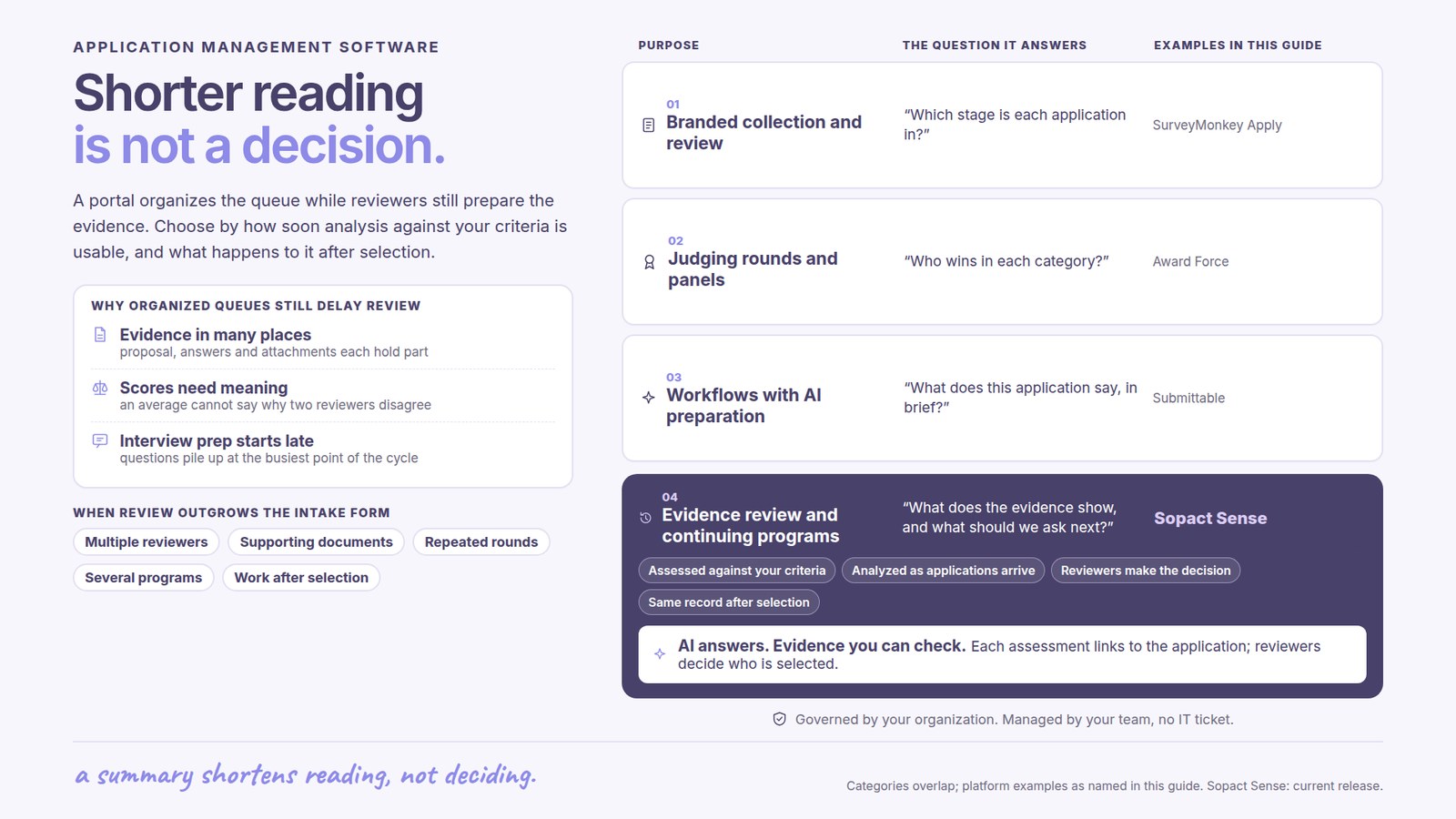
The first requirement is a workable selection process. Applicants need to understand what to submit and what happens next. Administrators need to track completeness and progress. Reviewers need the right material, relevant criteria and a way to retain the reasoning behind a decision.
The next requirement depends on the program. A one-time award may finish with selection and communication. An accelerator begins a longer relationship involving onboarding, mentoring and progress reviews. A grant can continue into agreed outcomes and recurring partner reporting. The platform should fit that responsibility without adding stages the organization does not need.
A form builder may be sufficient for straightforward intake with little review coordination. A dedicated application system becomes more useful when multiple reviewers, supporting documents, repeated rounds or several programs make the process harder to manage. A connected program platform matters when the evidence must remain useful after selection.
A proposal, a written answer and an attachment may each contain part of the information needed to assess a criterion. Reviewers spend time locating and restating that material before exercising judgment. Preparing a comparable assessment reduces this repetitive work and makes missing evidence easier to discuss.
Two reviewers can give the same application different scores because they interpret a criterion differently or notice different evidence. A useful process makes the basis of the assessment visible. A numerical average alone cannot explain whether the disagreement concerns the evidence, the criterion or the applicant’s fit.
When initial reading begins only after the deadline, questions for applicants accumulate at the busiest point in the cycle. Analysis as applications arrive can help reviewers identify gaps and prepare follow-up earlier, within the program’s agreed process. The final decision still depends on the required evidence and the committee’s judgment.
A short AI summary can reduce the time spent reading an application. The larger gain comes when the application is already analyzed against the program’s criteria, the evidence is available for questions, and reviewers can start deciding what needs closer attention. Compare the time to launch, the time until analysis is usable, and the work people still need to do before a decision.
| Stage | What Sopact provides | What to establish with any provider |
|---|---|---|
| Set up the workflow | Sopact’s typical setup estimate is two days to two weeks, depending on the agreed scope. The team personalizes the collection and analysis around the program. | Does the proposed timeline include forms, criteria, analysis, reviewer access and a usable first cycle, or only an account and intake form? |
| Analyze incoming evidence | Configured analysis runs as data arrives and becomes available in AI Assistance. Reviewers can examine the interpretation and identify missing evidence or questions for an interview. | Is analysis triggered on arrival, on entry to a review round, by a person generating a summary, or after a separate export? Who can use the result? |
| Review and decide | People check the analysis, consider exceptions, conduct any interviews and make the final judgment. | How much preparation remains, and which delays come from committee schedules, applicant responses or necessary deliberation? |
| Continue the program | Where needed, the same evidence informs onboarding, pre/post assessments, mentoring and later progress. | Will the program team reuse the analysis, or reconstruct the applicant’s context in another system? |
The two-day-to-two-week range is Sopact’s operating estimate, not a promise that every migration or integration fits that window. In the published Carnegie Mellon Project Olympus example, the application workflow launched in five days and the application batch was assessed overnight against a custom rubric. The human committee retained selection responsibility.
Submittable Next illustrates why this distinction needs precision. Its documented Smart Summary is generated for an application by authorized staff and can then be viewed by reviewers. Its separate Smart Reviewer can automatically provide feedback when applications enter a configured review round. The documentation identifies these as beta features and describes different access for administrators and reviewers. Buyers should establish which feature and edition are included in their proposed workflow.
Sopact’s distinction is analysis during collection that remains available for AI Assistance and subsequent program work. A reviewer can move from an assessment to the evidence and the question that needs follow-up. An accelerator team can later use the applicant’s stated needs alongside onboarding, mentor observations and progress updates. Faster preparation and continuing use of the evidence are separate benefits; a platform should be judged on both when the program needs both.
Sopact reports that this approach can remove two to three months of review work in application processes it supports. That is Sopact’s experience-based estimate, not a published industry average or a guaranteed saving. The useful comparison for your program is the preparation and reconciliation effort removed, with interviews and final judgment still accounted for.
For an award, scholarship or fellowship cycle that ends at selection, prioritize timely analysis, clear evidence, reviewer coordination and an explainable decision. A long participant journey is not automatically a requirement. For training, accelerators and grants, selection often begins a continuing relationship: carrying the analysis forward can reduce repeated intake and help staff understand whether the support provided addresses the original need.
SurveyMonkey Apply focuses on branded collection, coordinated review and automated workflows for grants and program applications. It also describes implementation guidance and personalized training. A team whose main need is managing stages and participants in an application process should include that operating model in its evaluation.
Award Force documents different judging modes, panels and rounds for awards and competitions. Those controls can be central when the purpose is selecting winners across categories. They answer a different question from tracking what happens to a founder or participant after joining a program.
Submittable combines application workflows with AI preparation and review features, as described above. Its specific edition and feature access matter. Ask each provider to scope the same first usable cycle, including analysis and reviewer access, before comparing implementation timelines.
Sopact is particularly relevant where the bottleneck combines substantive evidence review with ongoing program knowledge. Its case is the reduction in preparation and the continuing use of the analysis, with the customer’s criteria, human judgment and program ownership retained.
An application may describe the venture’s stage, market evidence and support needs. Carrying that context into onboarding helps the program begin with a more informed discussion. Mentor observations and later updates can then show how those needs evolve, rather than creating a new disconnected account of the founder at each stage.
Application and pre-program evidence describe the starting point. Post-program assessments and later feedback address different questions: what changed, whether the participant could apply it and what support is still needed. Using these sources together helps staff plan follow-up and improve the program.
A proposal and its review explain why the work was funded. That knowledge can inform onboarding and the outcomes the grantee and funder agree to follow. Later reports are more meaningful when the original commitments and context remain available alongside new evidence.
For selection-only scholarships, fellowships and awards, keep the emphasis on the decision. Continuing participant management is valuable when the program requires it, not because every application platform must sell a longer journey.
Programs change their questions, criteria and reporting needs. Routine ownership matters after launch: staff should understand the process they operate and be able to maintain it without rebuilding the evidence each cycle. Sopact’s personalization and continuing team support are intended to support that ownership over the life of the program.
Selection and later delivery can involve different people and access needs. The fact that evidence stays connected does not mean every mentor or program colleague should see confidential reviewer comments. Agree the information needed at each stage and retain the distinction between the original application, the assessment and the final decision.
A useful purchase discussion covers the first usable cycle and the ongoing responsibilities. Compare the work removed from reviewers, the questions they can answer sooner and the preparation avoided after selection. Those benefits matter more than the speed of an isolated summary.
It helps organizations collect program applications, manage review and communicate decisions. Depending on the program, it can also connect the selected applicant with onboarding, delivery and follow-up.
Sopact’s typical operating estimate is two days to two weeks for the agreed workflow. Scope, historical data and integrations should be discussed explicitly. The published Project Olympus example reports a five-day launch.
In a configured Sopact workflow, analysis runs as data arrives and can be used in AI Assistance. Reviewers inspect the analysis and decide what needs further evidence, an interview or a final committee judgment.
No. A summary condenses information. Review requires relating evidence to criteria, resolving gaps or different interpretations, and making a human decision. Some platforms offer both summaries and more structured AI assessments.
No. A selection-only award or scholarship may finish at the decision. Training, accelerator and grant programs often benefit from using the same evidence in onboarding, assessments, mentoring and progress review.
Continue with a purpose
Related solution
Connect application evidence, human review and the next program stage.
Explore the solution →Continue learning
Explore how program criteria guide evidence review.
Start learning →
Customer story
A five-day launch and custom-rubric assessments prepared for a human committee.
Read the story →Explore how Sopact can prepare incoming application evidence for review and keep it useful through the stages your program actually needs.
See it with your workflow →