Which Submit.com alternative fits your program?
Sopact is worth evaluating as a Submit.com alternative when your main challenge is connecting application evidence, human review and recurring program analysis in a workflow your team can maintain. If your current intake, judging and reporting process works well, replacing the platform may add disruption without solving a meaningful problem. Start with the work that remains difficult, then test a replacement against that work.
Submit.com supports more than intake. Its published platform description includes review, approvals, payments and post-award reporting. A useful comparison therefore needs to examine your actual process rather than assume that one product stops at the decision. Source: Submit.com platform overview.
This guide helps program managers compare the alternatives, decide what should change before migration and plan a contained evaluation. For a wider shortlist, see the submission software comparison.
Redesign the work before moving the forms
A platform move is an opportunity to reconsider why staff collect, read and re-enter information. Copying every existing form, spreadsheet and approval step into a new system can preserve the same workload behind a different interface.
Consider a fictional professional fellowship. An applicant submits a proposal and supporting documents. Reviewers assess the proposal, the selected fellow completes onboarding, and program staff later collect progress updates. If onboarding asks the fellow to repeat the approved goals and staff retype those goals into a reporting template, the process creates avoidable work even when every step is digital.
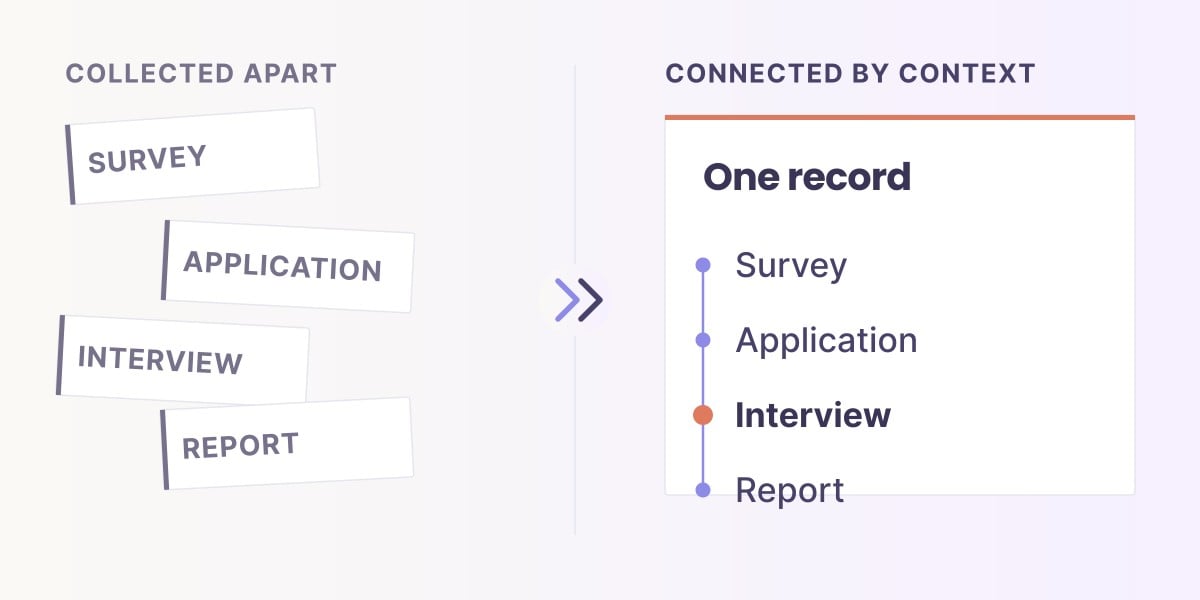
An alternative design carries the approved proposal forward as the starting point for a reporting plan. AI can prepare candidate goals and supporting passages for a staff member to verify. The fellow confirms the commitments and reporting dates. Later updates refer to those agreed commitments, with changes recorded rather than silently replacing the original plan.
The benefit comes from removing repeated preparation while preserving review. It does not come from letting an AI score become the final selection decision. Before implementation, the team must decide who approves extracted information, how corrections are recorded and which records each person may access.
Separate three kinds of work
- Administrative routing: invitations, submission status, reminders and reviewer assignments.
- Evidence review: finding the passages relevant to a criterion, identifying missing information and resolving conflicting interpretations.
- Program learning: relating later updates to commitments, comparing suitable groups and deciding what needs attention.
Improving the first category alone will not necessarily reduce the other two. Ask each vendor to demonstrate the entire sequence on a completed cycle, including a difficult application and an incomplete follow-up report.
Submit.com and Sopact: what should you compare?
Submit.com documents phases that can connect an initial application to later budget, milestone and outcome reports. That makes “the record ends at the decision” an unsuitable reason to switch. The practical question is whether the configured workflow supports the questions, evidence and maintenance responsibilities your team needs. Source: multi-phase submissions.
| Work to evaluate | What to establish in Submit.com | What to test in Sopact |
|---|---|---|
| Application through follow-up | Demonstrate your existing phases, reporting forms and links to the original submission. | Connect the application, approved commitments and dated updates without asking staff to reconstruct the history. |
| Evidence behind review | Show how reviewers find source material, record judgments and resolve disagreement in your configuration. | Check AI-prepared findings against original passages; record corrections and preserve the human decision. |
| Repeat applicants | Demonstrate how a repeat applicant and separate application cycles appear in your workflow. | Keep the person or organization connected while retaining separate applications, awards and reporting periods. |
| Recurring reporting | Use an actual management question and demonstrate the current report, including its filters and limitations. | Inspect the records behind a result, identify missing updates and review narrative evidence alongside structured fields. |
| Staff ownership | Have a program manager change a field, review step and report without a prepared demonstration. | Test the same changes, including approvals, version history and the effect on previously collected data. |
| Operational dependencies | Inventory payment, communication, identity and integration functions currently in use. | Specify which responsibilities remain in existing systems and how records and statuses will be reconciled. |
These are evaluation tasks, not claims that a competitor lacks each function. Submit.com also documents reporting, charting and CSV extraction. Compare the work needed to produce your particular analysis rather than assuming all reporting is manual. Source: reporting and data extraction.
Make AI-assisted review useful and accountable
A reviewer needs more than a plausible explanation of a score. They need the relevant source, the criterion applied and a way to correct the interpretation. In a pilot, choose applications with incomplete evidence, contradictory statements and borderline eligibility. These reveal more than a polished example that every reviewer already agrees on.
Keep eligibility separate from merit. A missing attachment may need clarification; it should not automatically become a low score for leadership potential. Similarly, fluent writing is not necessarily evidence of delivery capacity. Define the criterion and examples before comparing human and AI-assisted review.
For multilingual applications, preserve the original response alongside the material used for review. Test whether the same substantive evidence receives comparable treatment across languages. Translation support and comparable assessment are different jobs; one does not prove the other.
Let reviewers revise suggested findings and record why. Examine repeated disagreements to improve the rubric or review guidance. Do not interpret a consistent machine output as proof that a rubric is fair, or an AI ranking as permission to bypass committee judgment. The application review course helps teams plan these responsibilities before configuring the workflow.
The video below looks at application platforms built before AI and extended with it later, and what that means for review. Watch for the difference between a summary feature and a review process designed around reading every application the same way.
Connect the records without flattening the program
A persistent identity is useful, but one person can have several applications and awards. Keep those relationships explicit. An update for last year's award should not appear to satisfy this year's reporting obligation merely because the applicant has the same email address.
Define a small common set of fields for comparisons: program, cycle, award identifier, reporting period and the outcomes the team has agreed to examine. Use a data dictionary to specify each field's meaning, permitted values and update rules. Individual programs can retain additional questions that reflect their own work.
Collect stable profile information once where appropriate and confirm it when necessary. Store changing information, such as employment or organizational location, with its effective date. Otherwise, an updated profile can accidentally rewrite the apparent circumstances of an earlier application.
Missing updates also need a visible status. Reporting that 18 awardees improved means little without knowing how many were expected to respond, how many did respond and whether the comparison uses the same people at both points. Connected records make those checks possible; they do not establish that the award caused the change.
Evaluate the switch through one complete cycle
1. Start with a completed round
Use a permitted set of applications, the rubric used at the time, reviewer decisions and follow-up reports. Include exceptions and incomplete records. Agree on the outputs before starting: an evidence-backed review, an approved handoff into reporting and a management summary that can be traced to its sources.
2. Measure the work that remains
Record staff time spent preparing files, locating evidence, checking AI suggestions, resolving disagreements, joining records and assembling the report. Keep setup work separate from recurring work. The meaningful total cost of ownership includes maintenance and quality review, not just the time a system takes to generate an answer.
For example, compare the time required to prepare the same committee packet in each workflow, then include the corrections needed before it is usable. This produces an organization-specific result rather than an unsupported claim that every team will save a fixed number of hours.
3. Test a real change
Ask a program manager to revise a reporting question and explain what happens to historical responses. Have a reviewer correct a source interpretation. Change a user's access and check the resulting view. Self-management is convincing when ordinary staff can make an approved change safely, not merely when the initial demonstration looks easy.
4. Reconcile the history before going live
Submit.com documents CSV export, but a migration must account separately for attachments, comments, decisions, permissions and records that may need a different extraction method. Inspect an actual export and agree how each required element will move or remain available. Do not assume a single file contains the complete program history.
Match record counts and a sample of individual histories before opening a live cycle. Keep the existing system available until your team has accepted the replacement workflow and its reporting. A pilot can narrow the decision; it is not a guarantee that every migration will be quick or simple.
When should you keep Submit.com?
Keep it when the configured program works well and a targeted improvement addresses the remaining friction. A field definition, reviewer guideline or revised reporting phase may be more useful than moving platforms. If payment administration or an integration is central to operations, establish its replacement or continued ownership before making a switch.
Evaluate Sopact when the unresolved work centers on connected evidence, recurring analysis and staff ownership of those activities. The strongest case for change is a demonstrated reduction in repeated work with the review controls intact. A new product name or an AI label is not enough.
Common questions about Submit.com alternatives
Does Submit.com support reporting after selection?
Yes. Its multi-phase documentation describes collecting progress and outcome information alongside the original application. Evaluate how your current configuration works before deciding what needs replacing.
Can Sopact support applications beyond grantmaking?
The same collection and evidence-review approach can apply to fellowships, scholarships, awards and other selection programs. The criteria, records and follow-up questions should reflect the particular program rather than inherit a generic grant template.
Will a connected record eliminate matching work?
It can reduce repeated matching after identities and relationships are established. Historical duplicates, changed identifiers and separate application cycles still need validation and clear rules.
Should AI make the final selection?
No. Use AI to prepare evidence and suggested findings for authorized reviewers. People remain responsible for resolving exceptions, applying the program's criteria and approving decisions.
What should we review before choosing an alternative?
Review a complete cycle on your data, including the applicant experience, reviewer controls, source evidence, reporting, export completeness and ongoing staff maintenance. For broader options, compare application management software and the needs of a fellowship program.