play icon for videos
Use case

Best Foundant Alternatives (2026): Honest Comparison for Mid-Market Foundations

Compare 6 Foundant GLM alternatives including Sopact, Fluxx, Submittable, and GivingData. Honest guide on where Foundant wins, where its outcome intelligence gap appears, and which platform closes it.

TABLE OF CONTENT

Author: Unmesh Sheth

Last Updated:

February 20, 2026

Founder & CEO of Sopact with 35 years of experience in data systems and AI

Best Foundant Alternatives (2026): Honest Comparison for Mid-Market Foundations

Updated February 2026

Foundant GLM has earned its reputation honestly. For over a decade, community foundations, private foundations, and grantmaking nonprofits have chosen it because it genuinely delivers: a clean, intuitive interface, configurable workflows, unlimited users, responsive customer support, and a 92% renewal rate that is hard to argue with. If you need to go from spreadsheets to a structured grantmaking process without hiring a technology team, Foundant GLM is a legitimate answer.

But reputation and fitness are different things. What made Foundant the right choice for the grantmaking workflows of 2014 is not automatically what makes it the right choice for the impact accountability demands of 2026. Boards want evidence, not just activity reports. Funders want proof of outcomes, not just grantee compliance forms. The question foundations are increasingly asking isn't "did we process applications efficiently?" It's "did our grants produce the change we intended — and how do we know?"

That's a question Foundant GLM was not architecturally designed to answer.

This guide compares Foundant GLM honestly against its best alternatives — including Sopact Sense, Fluxx, Submittable, Bonterra Grantmaking, GivingData, and Good Grants. It covers where Foundant genuinely wins, where each alternative leads, and why the most important software decision for foundations in 2026 may be less about which grant management platform to buy, and more about whether grant management alone is still enough.

Foundant Alternative · Updated February 2026
Foundant GLM manages grants well. What it cannot do is prove they worked. As funders and boards demand outcome evidence — not just compliance data — "we processed 87 grants" is no longer a sufficient answer.
The Core Question This Guide Answers

Foundant GLM excels at grant administration — the process from application to award to compliance. The gap it leaves is grant intelligence — the evidence of what those grants actually produced. This guide compares 6 Foundant alternatives honestly, including when Foundant is genuinely the right choice and when a different architecture is needed to answer the question that matters most: did our grants produce the change we funded?

What This Guide Covers
1
Where Foundant GLM genuinely leads — and the specific scenarios where it remains the right choice in 2026
2
The outcome intelligence gap — why grant administration and impact evidence require different architectures
3
6 alternatives compared honestly — including honest limitations for each, even Sopact
4
The deployment pattern that works — how Sopact extends Foundant rather than replacing it for most mid-market foundations

What Foundant GLM Does Well (Credit Where It's Due)

Before comparing alternatives, credit belongs where it is earned. Foundant GLM has real strengths — and dismissing them would make this comparison dishonest.

Designed specifically for foundations. Foundant was built for grantmakers, not adapted from a general-purpose CRM or workflow tool. The grant lifecycle — LOI intake, evaluation, award, post-award reporting, multi-year tracking — is baked into the architecture, not bolted on afterward. Community foundations in particular find GLM purpose-fit in ways that horizontal CRMs never quite achieve.

Unlimited users at a flat price. Every stakeholder — applicants, reviewers, board members, grantees, staff — can access the system without triggering per-seat charges. This removes a common pricing friction for multi-stakeholder grant programs and is a meaningful differentiator against platforms that charge per user.

Genuinely intuitive. User reviews consistently note that GLM is easy to learn, fast to configure, and accessible to non-technical staff. The interface reflects a decade of iteration based on real customer feedback from program officers who are not software engineers. Setup in days, not months, is realistic for standard deployments.

AI-assisted applicant summaries. Foundant recently introduced an AI Summary feature that condenses applicant data into quick overviews for reviewers. This reduces reviewer reading time on standard grant applications and accelerates initial screening — a meaningful quality-of-life improvement for busy program officers.

Integrations with the financial layer. QuickBooks Online integration, DocuSign, and Candid (formerly GuideStar) give foundations direct connections to compliance, financial reporting, and grantee verification. These aren't decorative features — they serve real audit and accountability needs.

Anonymous review to reduce bias. GLM supports blinded reviewer access to applicant names and organizational details, reducing one category of scoring bias in the review process.

Community and support. Foundant's customer community — user forums, webinars, responsive support channels — creates genuine peer-to-peer learning that software alone doesn't provide. For organizations that value vendor relationship over pure features, this matters.

Where Foundant GLM Hits a Ceiling

Foundant's strengths are real. But they share a common thread: they are all about managing the process of grantmaking. Collecting applications. Routing to reviewers. Tracking compliance forms. Generating correspondence. Processing follow-ups. These are the operations of a grant program. They are not the evidence of its impact.

The ceiling appears when foundations begin asking the questions that matter most — and find Foundant GLM cannot answer them.

The Outcome Intelligence Gap

Foundant GLM collects outcome data through follow-up forms and grantee reports. But collecting is not analyzing. When a foundation receives 50 grantee narrative reports describing program outcomes, GLM stores them. It cannot read them at scale, extract themes across all 50, identify patterns in what worked versus what didn't, or score responses against a consistent rubric.

The result: program officers read every narrative manually — a process that typically yields inconsistent synthesis, buried in notes, that rarely surfaces as institutional knowledge. The data exists in the system. The intelligence does not.

Real outcome intelligence requires analyzing what grantees wrote, not just whether they filed the form. That is the gap.

Rigid Workflow Architecture

Users consistently flag — even in positive reviews — that Foundant's workflow is structured around a fixed grant lifecycle model. Post-launch editing is constrained. Organizations with non-standard processes find workarounds rather than true configurability. One competitor's comparison page notes directly that Foundant controls your launch timeline and that post-launch editing is limited to summary details.

For foundations with straightforward, repeating grant cycles, this rigidity is invisible. For foundations trying to adapt programs mid-cycle, run unconventional funding models, or evolve their processes year over year, the architecture becomes friction.

Reporting That Requires Exporting

Foundant's ad hoc reporting is genuinely functional for structured, quantitative grant data — dollars disbursed, applications received, reviewer scores. But when users want richer analysis — cross-program trends, qualitative theme extraction, visualizations beyond tables — the consistent feedback is that reporting is difficult and requires exporting to Excel or external BI tools.

One Capterra reviewer said directly: "reporting is very difficult. No graphs." Another noted: "It's starting to feel like you need to be a techy to use some features, especially reporting." This isn't a fringe complaint — it appears across multiple independent review platforms and reflects a real architectural limitation of the system's reporting layer.

No Stakeholder Intelligence Beyond the Grantee

Foundant GLM manages the foundation's relationship with grantees during the grant lifecycle. It does not manage the grantee's relationship with their own participants — the communities, program beneficiaries, and stakeholders whose outcomes the grant was designed to change.

A foundation awards a workforce development grant. The grantee serves 200 participants. GLM tracks whether the grantee filed their progress report. It does not capture whether participants found employment, at what wage, after how many months, or what barriers they encountered. That data lives in the grantee's own systems — or, too often, nowhere at all. The foundation cannot measure what it funded.

AI Summary Is Not AI Analysis

The AI Summary feature condenses applicant data for reviewers — a genuinely useful productivity tool. But condensing what an applicant wrote is different from analyzing it against qualitative rubric criteria. "Summarize this narrative" and "score this proposal against 12 dimensions of community readiness" are fundamentally different tasks. GLM does the former. It does not do the latter.

Similarly, the AI Summary works at the individual application level. There is no equivalent capability to analyze patterns across all applications, extract what the top 20% of applicants have in common, or surface cross-applicant themes that would inform future program design. Intelligence at the portfolio level requires a different architecture.

The Two Questions Every Foundation Needs to Answer — And Which Platforms Answer Which

Grant administration answers "did we process grants well?" Impact intelligence answers "did those grants produce the change we funded?"

✕ Grant Administration Only
What Foundant GLM Answers Well
📋Did applicants submit complete applications?
Did reviewers score every application?
💸Were grants awarded and disbursed correctly?
📁Did grantees file compliance reports on time?
💼Are financial records audit-ready?
✓ Grant Intelligence Required
What Boards & Funders Are Now Asking
🎯Did our grants produce the outcomes we funded?
👥Which participant populations benefited most?
🔍What do the strongest grantee narratives have in common?
📈Which Year 1 criteria predicted Year 3 outcomes?
🧠What should next cycle fund differently?
↓ GRANT ADMINISTRATION IS NECESSARY BUT NO LONGER SUFFICIENT ↓
01
Narrative data sits unanalyzed
Grantees submit narrative reports describing what happened in their programs. GLM stores them. No system reads them at scale, extracts themes across all grantees, or scores them against consistent rubric criteria. The richest data goes unused.
02
Participant outcomes are invisible to the foundation
Foundant tracks grantee compliance — whether the grantee filed their report. It cannot track whether participants in those programs found employment, completed training, improved health outcomes, or achieved the change the grant was designed to produce.
03
Each cycle restarts without institutional learning
Because selection data, progress data, and outcome data are architecturally separate, the foundation cannot ask "which grantee characteristics in Year 1 predicted the strongest outcomes in Year 3?" Every new funding cycle starts from intuition rather than evidence.
80%
of program officer time spent on administrative tasks vs. strategic analysis
5%
of grantee narrative data typically analyzed at scale in grant management systems
0
foundations using only Foundant GLM can prove participant-level outcome attribution

The Question Foundations Are Really Asking

The honest conversation happening inside foundations in 2026 is not "which grant management platform should we switch to?" It is: "We are spending millions on grants. We can prove we processed the grants. We cannot prove the grants produced the change we funded. What do we do?"

Foundant GLM solves the first problem exceptionally well. It does not solve the second.

The platforms in this comparison divide broadly along that line — those that manage the process of grantmaking, and those that generate intelligence from it. The right choice depends on which problem is more urgent for your foundation.

6 Foundant Alternatives Compared Honestly

6 Foundant GLM Alternatives — Honest Feature Comparison (2026)

Grant administration vs. grant intelligence: which platforms do which, and where each genuinely leads

Platform Grant Administration AI Qualitative Analysis Participant Tracking Longitudinal Intelligence Fund Disbursement Best For
Foundant GLM
The comparison baseline
✓ Strong Partial — AI Summary (condenses, doesn't score) ✗ Grantee only ✗ None Via integrations Mid-market foundations needing structured grant workflow
Sopact Sense
★ AI-native intelligence layer
Partial — complements Foundant ✓ Native — reads, scores, themes at scale ✓ Persistent unique IDs across cycles ✓ Selection → outcomes connected ✗ Not included Foundations needing outcome evidence, not just compliance
Fluxx Grantmaker
High-volume foundations
✓ Strong + visual dashboards ✗ None ✗ None ✗ None ✓ Yes Large private foundations with complex, high-volume workflows
Submittable
Corporate CSR ecosystem
✓ Strong + configurable post-launch Partial — rule-based automation only ✗ None ✗ None ✓ ACH/check/prepaid Corporate foundations needing grants + giving + volunteering unified
Bonterra
Enterprise social impact
✓ Broad — grants + advocacy + fundraising ✗ None ✗ None ✗ None ✓ Yes Enterprises needing all social impact functions under one vendor
GivingData
Analytics upgrade from Foundant
✓ Strong + better reporting visualization ✗ None ✗ None ✗ None Via integrations Foundations frustrated by Foundant reporting limits
Good Grants
Simple, affordable grantmaking
Partial — simple programs only ✗ None ✗ None ✗ None ✗ None Small foundations under 300 applications with simple workflows
Key Insight

Every platform in this table other than Sopact answers "did we process grants well?" — and most of them answer it well. Only Sopact answers "did those grants produce the change we funded?" If your board, major donors, or co-funders are starting to ask the second question, none of the grant administration alternatives close that gap. Sopact is an intelligence layer that extends grant management platforms — not a replacement for them.

1. Sopact Sense — Stakeholder Intelligence for Mid-Market Foundations

Best for: Foundations and nonprofits that manage grants well but are failing to prove the impact of their grantmaking. Organizations where the follow-up report is the end of the data story rather than the beginning. Multi-year programs where connecting selection criteria to long-term outcomes is a strategic priority.

Sopact Sense is not a grant administration competitor to Foundant GLM in the traditional sense. It does not replace Foundant's application intake, workflow configuration, or compliance tracking. What it does is extend the data story from grant award through grantee program delivery to participant-level outcomes — the layer of intelligence that grant management platforms were not built to provide.

The core shift: Foundant manages the foundation-to-grantee relationship. Sopact manages the grantee-to-participant relationship and the intelligence that flows from it. Together, they answer both questions — "did we process grants well?" and "did those grants produce the outcomes we funded?"

How Sopact approaches what Foundant cannot do:

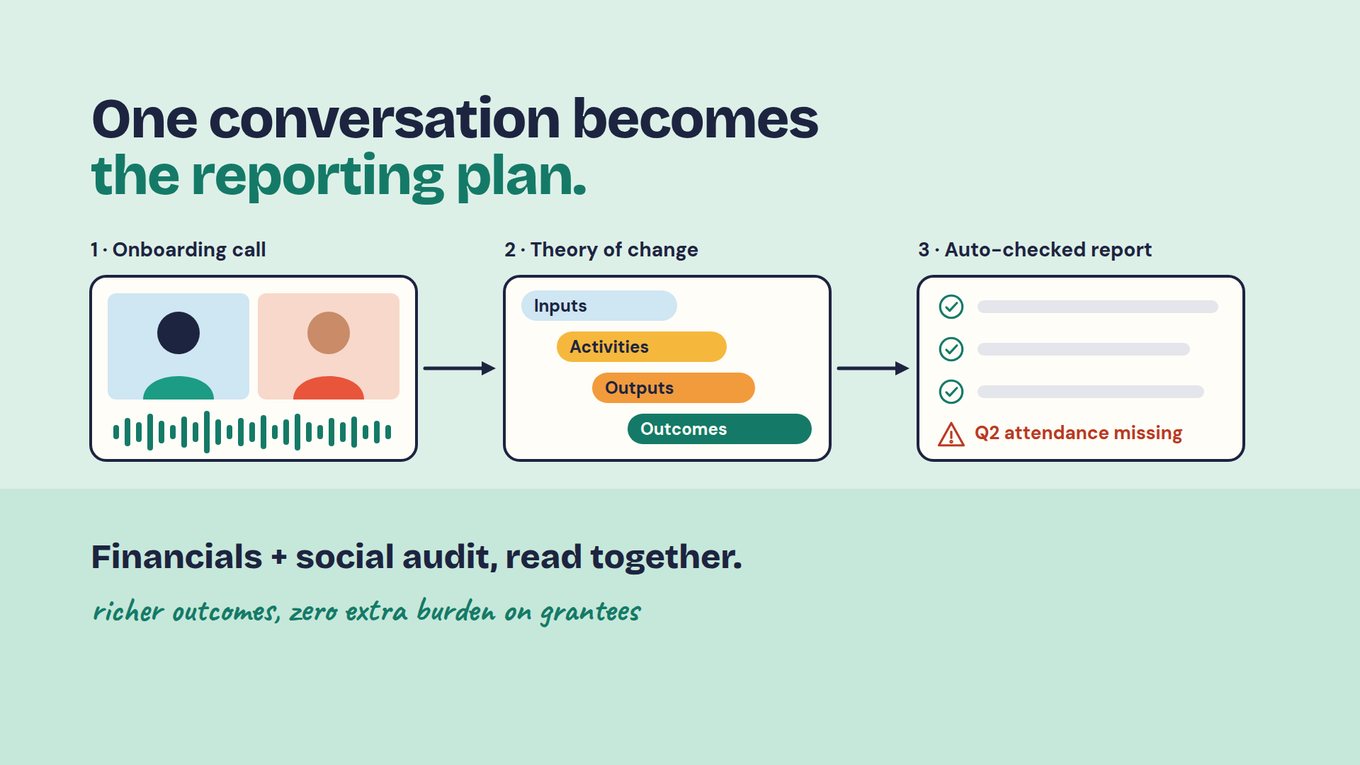
When a foundation's grantees submit narrative reports, Sopact's application review and analysis capabilities can read those documents, extract themes across all grantees, and score against rubric criteria — "demonstrates community engagement," "shows evidence of systems change," "presents realistic attribution" — using natural language understanding, not keyword matching. What would take a program officer weeks of manual reading and inconsistent synthesis happens in hours, with explicit evidence citations and consistent scoring.

The bias in grant review problem extends beyond the selection stage into ongoing evaluation. Human officers reading 30 narrative reports will apply different standards to different grantees, miss patterns visible only in aggregate, and produce synthesis shaped by which reports they read first. AI applies a consistent grant review rubric to every document — then flags outliers for human attention.

The persistent participant identity. Every participant in a grantee's program — workforce development clients, scholarship recipients, program beneficiaries — receives a persistent unique ID that links their data across every touchpoint: intake survey, mid-program check-in, six-month follow-up, employment verification, one-year outcome. Sopact's application management software and online application system capture this data at the source, without requiring manual reconciliation across separate systems.

This is what enables the question Foundant cannot answer: "Which characteristics of Year 1 grantees predicted the strongest participant outcomes in Year 3?" That is not a reporting question. It is an intelligence question — and it requires data architecture, not just data collection.

Intelligent Suite for foundations:

Intelligent Cell reads individual documents, survey responses, and open-ended answers — scoring them against qualitative criteria without manual reviewer involvement. Intelligent Column analyzes patterns across your entire grantee portfolio — what themes appear in the strongest-performing grantee reports? What warning signals appear in underperforming ones? Intelligent Row builds a complete longitudinal profile for each grantee and participant, connecting every data point across time. Intelligent Grid delivers portfolio-level reporting that a board or funder can actually use — not a table of compliance checkboxes, but evidence of outcome trajectories.

Honest limitations. Sopact does not replace Foundant's grant administration capabilities — application intake workflows, compliance tracking, payment disbursement, Candid/GuideStar integration, DocuSign, and QuickBooks. For organizations that need those features, Foundant remains the right operational layer. Sopact is the intelligence layer that sits alongside it, not instead of it. No volunteer management, no employee giving, no government procurement compliance.

Pricing. Flat tiers, published. Full AI analysis at every level — no premium gates. Implementation in 1–2 days for standard deployments.

2. Fluxx — High-Volume Foundation with Complex Financial Tracking

Best for: Large private and family foundations with complex, high-volume grant portfolios requiring configurable dashboards, robust financial tracking, and peer community collaboration.

Fluxx differentiates through visual, card-based portfolio management and deep configurability for foundations with non-standard workflows. Its peer-led customer community is genuinely valuable for foundations navigating complex grantmaking environments. Strong integrations with financial systems and data export capabilities give Fluxx an analytical edge over Foundant for foundations needing richer reporting.

Honest limitations. No AI analysis of qualitative content. Complex implementation (weeks to months). Custom pricing — typically higher than Foundant for equivalent functionality. No participant-level outcome tracking. The analytical advantage over Foundant is meaningful but does not extend to stakeholder intelligence.

3. Submittable — Application Intelligence with Corporate CSR Ecosystem

Best for: Corporate foundations needing a unified platform for grants, employee giving, volunteer coordination, and matching gifts. Organizations where application intake configurability and fund disbursement in a single platform are priorities.

Through acquisitions (WizeHive, Bright Funds, WeHero), Submittable now offers the broadest corporate social responsibility ecosystem in this comparison. Its fund disbursement capabilities — ACH, check, prepaid cards — are more developed than Foundant's. Workflow configurability post-launch is more flexible.

Honest limitations. "Automated Review" is rule-based workflow automation, not qualitative AI analysis. No participant-level outcome tracking. AI features do not analyze narrative content. Custom pricing (~$10,000+/year). Implementation takes weeks. The CSR ecosystem advantage is specific to corporate contexts.

4. Bonterra Grantmaking — Enterprise Social Impact Bundling

Best for: Large enterprises needing grants, giving, advocacy, fundraising, and volunteer management under a single vendor relationship with enterprise compliance requirements.

Bonterra's breadth — spanning fundraising, advocacy, volunteering, and grantmaking — is its distinctive advantage. For organizations wanting a single vendor across their entire social impact function, Bonterra offers what no other platform in this comparison can match in scope.

Honest limitations. Breadth over depth. No AI qualitative analysis. Complex implementation requiring dedicated technical resources. Enterprise pricing. Products are still integrating following multiple acquisitions. Mid-market foundations often find the complexity exceeds their capacity.

5. GivingData — Modern Analytics-First Grant Management

Best for: Foundations that have outgrown Foundant's reporting and want stronger data visualization and analytics without the full complexity of Fluxx.

GivingData emphasizes richer reporting and visualization over Foundant's more basic analytics layer. Data exports to BI tools are cleaner. Dashboards are more visual. For foundations where reporting difficulty is the primary Foundant frustration, GivingData addresses that specific pain point.

Honest limitations. Smaller customer base and less mature support infrastructure than Foundant. No AI qualitative analysis. No participant-level tracking. Custom pricing. Less purpose-built for community foundation workflows than Foundant.

6. Good Grants — Simple, Affordable Grantmaking

Best for: Small foundations and nonprofits running 1–3 programs with under 300 applications per cycle, where simplicity and published pricing matter most.

Good Grants (starting around €3,000/year) is the most affordable dedicated alternative in this comparison. Setup is fast, the interface is clean, and support is responsive. For organizations that have outgrown spreadsheets but don't need the full weight of Foundant's feature set, it is a practical fit.

Honest limitations. No AI capabilities. Limited customization. Basic reporting. Not designed for high-volume programs, complex multi-stage evaluation, or any form of outcome intelligence.

3 Foundation Scenarios: What Foundant GLM Alone Cannot Answer

Real-world situations where grant administration is necessary — but not sufficient

Workforce Development
Scholarship Program
Multi-Year Community Grants
✕ With Foundant GLM Alone
Community Foundation — Workforce Development Portfolio
23 grantees funded to run job training programs
Each grantee files a follow-up report in GLM on time
Reports describe activities: "trained 45 participants, held 8 workshops"
Program officer reads all 23 reports manually — 3 weeks of work
Board asks: "How many participants got jobs, at what wage, after how long?"
Answer: "We don't have that data." Reports tracked activities, not outcomes.
✓ Foundant GLM + Sopact Sense
The Same Foundation — With Participant Intelligence
Each grantee onboards their participants through Sopact with a persistent unique ID
Intake, mid-program, 3-month, 6-month, and 12-month data collected per participant
AI analyzes all 23 grantee narratives — themes, strengths, warning signals — in hours
Intelligent Grid produces employment outcome data across all 23 programs
Foundation connects: which grantee models predicted the best participant employment rates?
Next cycle is funded with evidence, not intuition
The Outcome

The board gets an answer. The foundation produces an evidence map: which programs, serving which participant populations, under which grantee models, produced the strongest 12-month employment outcomes. $4M in workforce development grants generates compounding institutional knowledge — not just compliance documentation.

93%
reduction in narrative review time with AI analysis
100%
of participant outcomes tracked longitudinally
0
cycles wasted without learning what worked
✕ With Foundant GLM Alone
Family Foundation — Multi-Year Scholarship Program
120 applicants per cycle — essays, transcripts, recommendations scored by 6 reviewers
Reviewer #1 and Reviewer #6 apply rubric differently after reading 20+ essays each
Scholars awarded based on composite scores — selections feel inconsistent year to year
Annual follow-up form filed by each scholar — GPA and enrollment status tracked
Foundation cannot analyze: which essay characteristics predicted scholar success?
Each new cycle re-debates selection criteria from scratch — no evidence base
✓ Foundant GLM + Sopact Sense
Consistent Selection — Evidence-Driven Criteria
AI applies consistent rubric scoring to all 120 essays simultaneously — zero drift across reviewers
Bias in grant review eliminated through AI pre-scoring — humans review top 20 for judgment calls
Each scholar receives a persistent unique ID connecting application to longitudinal outcomes
Year 3: foundation queries — which Year 1 application characteristics predicted 4-year completion?
Selection criteria updated with evidence — not committee intuition
Board impact report shows genuine outcome attribution, not just financial disbursement
The Outcome

Reviewer inconsistency — the hidden bias in every human review panel — is replaced by AI-consistent scoring against an explicit rubric. More importantly, the foundation builds a three-year evidence base connecting selection criteria to scholar outcomes. The theory of change becomes testable, then provable.

6→1
reviewers needed for primary scoring — humans focus on top candidates only
100%
rubric consistency across every application in every cycle
3yr
longitudinal evidence connecting selection → outcomes
✕ With Foundant GLM Alone
Private Foundation — Multi-Year Community Development Grants
14 grantees funded over 3 years for community health and economic mobility programs
Each files annual reports in GLM — compliance is tracked, no missed deadlines
Reports describe outputs: "held 12 community meetings, distributed 800 food boxes"
Year 3 board review: what changed in the community? "We don't have that data."
Major co-funder asks for evidence of community-level impact — foundation cannot produce it
Co-funding renewed on faith, not evidence — a risk at every renewal conversation
✓ Foundant GLM + Sopact Sense
Outcome Evidence That Survives a Co-Funder Conversation
Each grantee's community participants enrolled with persistent unique IDs from Year 1
Annual data collection captures health indicators, economic status, housing stability per household
Intelligent Column identifies which grantee interventions produced the strongest community shifts
Year 3 report: "32% of tracked households show improved economic stability — highest in grantees using X model"
Co-funder receives evidence, not narrative — renewal conversation is about scaling what worked
Theory of change validated with 3 years of longitudinal participant data
The Outcome

The foundation arrives at a major co-funder renewal conversation with three years of longitudinal outcome data — not activity summaries. The conversation shifts from "tell us what you did" to "show us what changed and why we should scale it." That is the difference between grant administration and grant intelligence.

3yr
longitudinal community outcome data — not just annual compliance snapshots
100%
of co-funder renewal conversations anchored in outcome evidence
+32%
example: economic stability improvement across tracked households

The Architectural Difference: Grant Administration vs. Grant Intelligence

Grant administration platforms — Foundant, Fluxx, Submittable, Bonterra — share a common architecture: collect applications → route to reviewers → award grants → collect compliance reports → store data. The workflow is the product.

Intelligence platforms — Sopact — extend that architecture: collect applications → analyze narratives and documents at scale → award grants → collect grantee outcome data → analyze what participants experienced → connect selection criteria to long-term outcomes → surface what the next grant cycle should do differently.

This matters for three reasons that compound over time.

First: what you can prove. Grant administration tracks compliance — "did the grantee file their report on time?" Intelligence tracks causation — "did the grant produce the change we funded, in whom, under what conditions?" Boards, major donors, and government co-funders are increasingly asking the second question. Compliance data does not answer it.

Second: what you can learn. When grant data stays at the application and compliance level, every funding cycle starts from intuition. When grant data extends to participant-level outcomes connected to selection criteria, every new funding cycle is informed by evidence from the last. Institutional knowledge compounds.

Third: how you prove your theory of change. Every foundation has a theory of change — a hypothesis about how grantmaking produces social outcomes. Foundant can prove you made the grants. Sopact can prove whether the theory was right.

When to Choose Foundant GLM (Genuinely)

Be honest about these scenarios — they point toward Foundant:

Your primary need is grant administration, not outcome intelligence. If your foundation's urgent problem is moving from spreadsheets to structured grantmaking — application intake, reviewer coordination, compliance tracking, correspondence management — Foundant GLM does this well and at a fair price. The upgrade from manual chaos to organized workflow is real, and GLM delivers it.

Community foundation compliance workflows are core. For community foundations managing donor advised funds, scholarship programs, and community grantmaking alongside each other, Foundant's community foundation-specific design reflects deep institutional knowledge of how those programs actually work.

Your board doesn't yet require outcome evidence. Many foundations are still in the process of transitioning from activity reporting ("we made 87 grants") to outcome reporting ("we changed these outcomes for these people"). If your board is satisfied with activity data, you don't need the architecture for outcome intelligence yet.

Existing Foundant relationships are strong. If staff trust the platform, grantees are comfortable with the application portal, and the vendor relationship is working — switching costs are real. The case for moving needs to be clear before disruption is worthwhile.

You need GuideStar/Candid, DocuSign, and QuickBooks integration out of the box. These are mature, production-ready integrations that Foundant has refined over years. Newer platforms may not match them.

When to Choose Sopact Instead

Your foundation is increasingly asked to prove outcomes, not just report activities. If funders, boards, or co-funders are asking "what changed, for whom, because of your grants?" — and you don't have an honest answer — that gap requires a different architecture than Foundant provides.

You need to analyze what grantees and participants wrote, not just whether they filed forms. Narrative reports, community survey responses, interview transcripts, participant feedback — this is the richest data your grantees produce. If it is sitting unread in a file store, Sopact's application review and AI analysis capabilities extract intelligence from it at scale.

You're concerned about consistency in your grant review and evaluation process. Bias in grant review — inconsistent rubric application across reviewers, fatigue effects in multi-stage evaluation, pattern matching that favors familiar organizational types — is a structural problem in human-only review. A consistent grant review rubric applied through AI eliminates scoring drift without removing human judgment from high-stakes decisions.

You need to track participant outcomes across multi-year programs. If the change your grants fund happens over three to five years — employment, educational attainment, housing stability, health outcomes — you need persistent participant identity from intake through outcome, not just grantee compliance at the program level. Sopact's application management software provides this architecture natively.

You want to learn which selection criteria predict the best outcomes. This is the compounding intelligence question. Every funding cycle where you collect outcome data but cannot connect it to selection criteria is institutional knowledge lost. Persistent unique IDs and longitudinal tracking make that connection architectural rather than aspirational.

You need AI analysis of uploaded documents. Budget narratives, research proposals, site visit summaries, grantee financial statements — document intelligence reads and scores these against any criteria you define, without requiring a human to read every page.

See Sopact in Context

Before deciding whether to move from Foundant, see how the intelligence layer actually works — and which of your existing workflows it connects to.

🔍
Application Review at Scale
See how Sopact reads, scores, and themes grantee narratives — without replacing your Foundant intake workflow.
See How It Works →
📊
Reduce Bias in Grant Review
Understand how consistent AI scoring eliminates reviewer drift — and which decisions still need human judgment.
See the Approach →

Real-World Scenario: A Community Foundation Moving From Compliance to Evidence

A community foundation has used Foundant GLM for five years. Application intake works. Reviewer workflows run smoothly. Grantees file follow-up reports on time. The system is doing what it was designed to do.

Then the board asks a new question at the annual strategy session: "We've granted $4 million in workforce development over three years. Can we show employment outcomes for the participants in those programs?"

The program officer goes to Foundant. She can show: 23 grants made, total dollars disbursed, follow-up forms filed by each grantee. She cannot show: how many participants gained employment, at what wage, after how many months, whether outcomes varied by grantee model, or which Year 1 grantee characteristics predicted Year 3 outcomes.

The data to answer those questions was never collected at the participant level — because Foundant's architecture captures the foundation-to-grantee relationship, not the grantee-to-participant relationship. The intelligence was never generated, because the system was built to track compliance, not to analyze outcomes.

With Sopact alongside Foundant: Every grantee's participants are enrolled through Sopact's online application system with a persistent unique ID from their first interaction. Their data — intake, mid-program, six-month, twelve-month — flows through Intelligent Cell for qualitative analysis and Intelligent Row for longitudinal tracking. At year three, the foundation can produce an evidence map: which programs produced which outcomes for which participant populations, and what characteristics of the grantees themselves predicted the best results. The board gets an answer. The next funding cycle is smarter.

What Sopact Doesn't Do (Be Honest)

No grant administration capabilities to replace Foundant's core. Sopact does not offer Foundant's application intake workflows, configurable grant lifecycle stages, compliance documentation, or grantee correspondence management. These are different product categories. Using both in concert is a common deployment pattern.

No fund disbursement. Sopact does not process grant payments to grantees. Organizations needing payment processing should use Foundant, Fluxx, or Submittable for that function.

No GuideStar/Candid integration. Grantee verification against IRS records and charity databases is not a current Sopact feature.

No volunteer management or employee giving. Corporate foundations needing those CSR program layers should evaluate Submittable or Bonterra for that function.

No government procurement compliance. Organizations requiring ISO 27001 certification or government-specific audit trails should evaluate SmartSimple or enterprise-configured solutions.

These are architectural boundaries, not roadmap items. Naming them honestly is more useful than pretending they don't exist.

Frequently Asked Questions

What are the best alternatives to Foundant GLM?

The best Foundant alternatives depend on your primary need. For stakeholder intelligence, qualitative outcome analysis, and longitudinal participant tracking, Sopact Sense fills the gap Foundant leaves on the impact measurement side. For complex grant administration with richer reporting, Fluxx leads. For corporate CSR with employee giving and fund disbursement, Submittable is strong. For enterprise-wide social impact bundling, Bonterra offers the broadest scope. For simple, affordable grantmaking, Good Grants is the lowest-complexity option.

Does Foundant GLM have AI-powered analysis of grantee narratives?

Foundant introduced an AI Summary feature that condenses applicant information for reviewers — a useful productivity tool. This is not qualitative analysis of what applicants or grantees wrote against rubric criteria. AI Summary summarizes; it does not score, extract cross-applicant patterns, or analyze thematic trends across a portfolio. For that capability, platforms like Sopact provide a fundamentally different architecture.

What are Foundant GLM's biggest limitations?

Based on user reviews across Capterra, G2, TrustRadius, and GetApp, the most consistent limitations are: reporting difficulty (limited visualization, requires exporting to Excel for complex analysis), rigid workflow architecture (limited post-launch editing), no qualitative analysis of narrative content, no participant-level outcome tracking beyond grantee-level compliance data, and no AI analysis of themes across the grantee portfolio.

How does Sopact compare to Foundant for impact measurement?

They serve complementary functions. Foundant manages the grant lifecycle — intake, review, award, compliance, correspondence. Sopact manages the intelligence lifecycle — analyzing qualitative data, tracking participant outcomes longitudinally, and connecting grant selection criteria to downstream impact. Foundant answers "did we process grants well?" Sopact answers "did those grants produce the change we funded?" Many foundations use both.

Can Sopact replace Foundant completely?

Not for grant administration workflows — application intake, compliance tracking, financial reporting, QuickBooks integration, and grantee correspondence are Foundant's strengths that Sopact does not replicate. Sopact replaces the intelligence layer that Foundant lacks: qualitative analysis, participant tracking, and outcome evidence. The most common deployment is both platforms handling their respective functions.

What is Foundant GLM's pricing?

Foundant does not publish pricing publicly. Pricing is subscription-based and scales by organization type and size. The pricing structure is positioned as fair relative to competitors, and the unlimited-user model is a meaningful differentiator. Organizations must request a quote directly from Foundant.

How does Foundant compare to Fluxx?

Foundant is better suited to mid-market foundations wanting a purpose-built, intuitive system with strong community support. Fluxx is better suited to large foundations with complex workflows, high application volumes, and need for deeper data visualization. Fluxx's configurability is greater; its implementation complexity and cost are also greater. Foundant's simplicity is an asset for organizations that don't need the full weight of Fluxx's feature set.

Can Foundant track participant outcomes, not just grantee compliance?

Foundant tracks the foundation-to-grantee relationship through the grant lifecycle. Tracking grantee-to-participant outcomes — employment, educational attainment, health outcomes, community-level change — requires collecting data at the participant level, which Foundant does not do natively. That data architecture lives in Sopact, in the grantee's own program management systems, or nowhere at all if no system is in place.

How quickly can I deploy Sopact alongside Foundant?

Sopact deploys in 1–2 days for standard configurations. It does not require replacing Foundant — it connects to the data that Foundant and your grantees already produce, extending the intelligence layer without disrupting the administrative layer.

Is there an AI-native alternative to Foundant for grant management?

Foundant has added AI Summary features, which represent incremental AI additions to a workflow-first architecture. Sopact is AI-native — the platform was designed from the ground up for qualitative analysis, persistent participant tracking, and outcome intelligence. The difference is not which platform has AI features; it is whether AI is the architecture or an add-on to an existing workflow system.

Ready to Go Beyond Grant Administration?
Foundant manages what you funded. Sopact proves what it produced. Both questions deserve an answer.
🎯
See Application Review
Watch how AI reads, scores, and themes grantee narratives at portfolio scale in hours — not weeks.
See the Use Case →
📋
Grant Review Rubric Design
How to define rubric criteria that AI can apply consistently across every application — and that humans can audit.
Read the Framework →
🚀
Book a Demo
See Sopact with your own grantee data. Deploys in 1–2 days alongside Foundant — no migration required.
Book a Demo →
📺 Watch more: Sopact on YouTube — platform walkthroughs, use case demos, and impact measurement guides. Subscribe →

Upload feature in Sopact Sense is a Multi Model agent showing you can upload long-form documents, images, videos

AI-Native

Upload text, images, video, and long-form documents and let our agentic AI transform them into actionable insights instantly.
Sopact Sense Team collaboration. seamlessly invite team members

Smart Collaborative

Enables seamless team collaboration making it simple to co-design forms, align data across departments, and engage stakeholders to correct or complete information.
Unique Id and unique links eliminates duplicates and provides data accuracy

True data integrity

Every respondent gets a unique ID and link. Automatically eliminating duplicates, spotting typos, and enabling in-form corrections.
Sopact Sense is self driven, improve and correct your forms quickly

Self-Driven

Update questions, add new fields, or tweak logic yourself, no developers required. Launch improvements in minutes, not weeks.