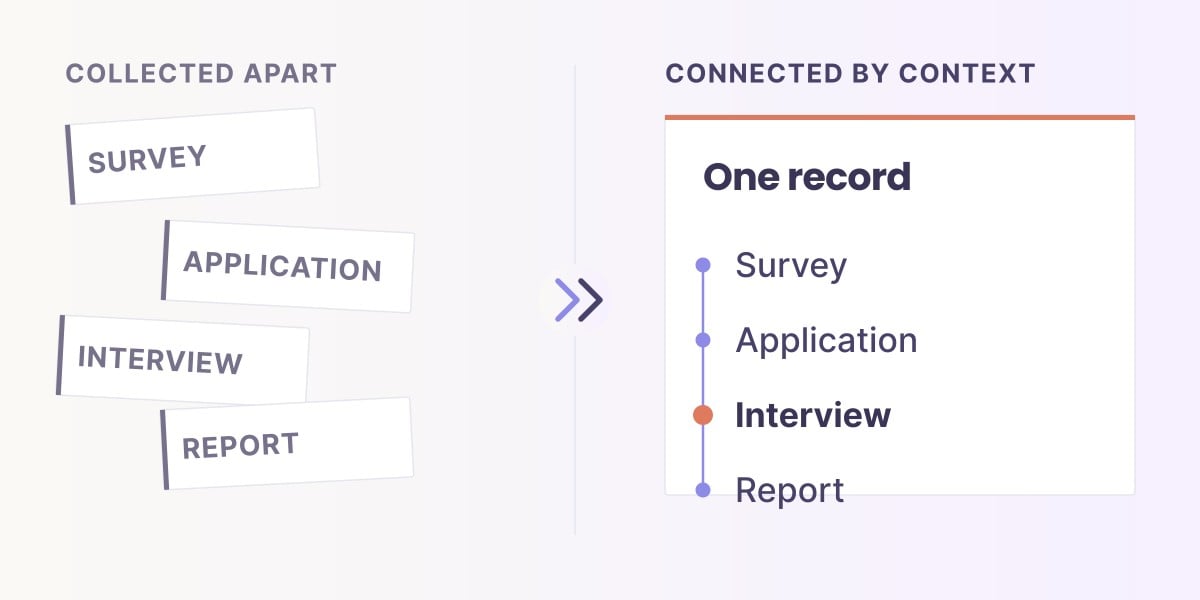
What is a practical Fluxx alternative?
A practical Fluxx alternative is a second way to run one grant workflow, usually application review for a small program, outside the configuration your team has layered onto Fluxx over the years, while Fluxx keeps the administration it already does well. It is a test of whether the work gets lighter, not a decision to leave.
In the video on this page, Unmesh Sheth, Sopact's founder, starts from conversations he keeps having with grant managers who have run Fluxx, Submittable or Foundant for years. They have built out the workflows and trained the reviewers, and the approval cycle still takes too long. Nobody calls the platform broken. They describe a process that grew heavier with every program the foundation added.
Fluxx supports the grant lifecycle, grantee relationships, reporting and financial workflows, and its current AI offering includes Finn for questions across grants data and documents, plus Grantelligence for analytics (Grantmaker overview; Fluxx AI overview). The choice is rarely about a missing feature. It is whether the configuration you have built still serves the people who maintain it.
When configuration becomes the liability
Unmesh illustrates the pattern with Maya, a composite of the grant leads Sopact talks to. Her foundation gives about $25 million a year, sees roughly 800 applications a cycle, manages 380 live grants and holds 12,000 profiles, all on the same heavily configured platform for more than a decade. When the foundation bought it, the workflow was three steps: apply, review, award. Flexibility was the reason to buy.
Then each exception became a custom field. Each reviewer preference became another version of the rubric. Each new program added an approval step, and setup questions went back to the vendor. When someone needed an answer, the data went out to a spreadsheet. In the deck's telling, a new cycle now takes two to three months to configure before the first application arrives.
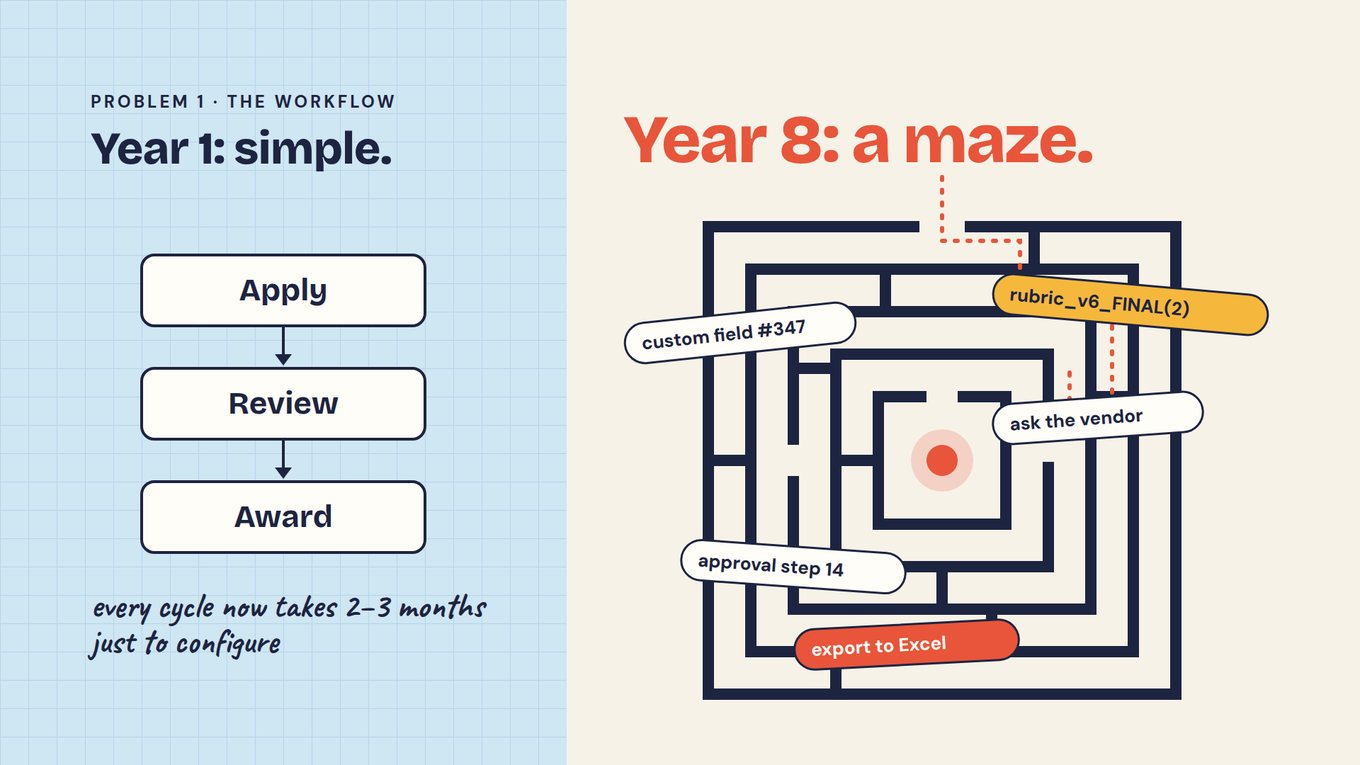
The second half of the story is the one Unmesh says he hears most. A team buys a long list of features, configures some, trains people on fewer and uses a slice of them every day. The rest of the work leaks into email, spreadsheets and sticky notes. Then the administrator who built the workflow leaves, and nobody dares touch it. The configuration has stopped being an asset the team controls and become a dependency it works around.
None of this is peculiar to Fluxx; any system flexible enough to absorb years of exceptions can end up here. Fluxx's services page describes templates, implementation support and user control over later changes (Source: Fluxx services), so it would be wrong to assume every Fluxx customer needs outside help for every edit. The useful question is narrower: who in your foundation can change a rubric today, and what breaks when they do?
WATCH · THE CONVERSATION BEHIND THIS PAGE
Why a well-configured grant system can still feel slow
This is the conversation the page is built on. Unmesh names Fluxx among the platforms in his opening, then walks through where a grant cycle loses its months and why so much of what was bought goes unused. Watch for the point where he stops describing the problem and argues for moving one low-risk workflow at a time while the current system keeps running, because that is the approach the rest of this page puts to the test.
Jump to: 0:03 — Years on Submittable, Fluxx and Foundant · 2:29 — Custom fields, rubrics and approval steps · 3:29 — The admin who built it left · 9:30 — One step at a time, current system intact
Use this in your evaluation: While you watch, list the custom fields, rubric versions and approval steps in your own Fluxx setup that nobody on the current team would change without help. That list is the starting point for the inventory below.
Read your own configuration before you compare vendors
Before any demo, sit down with the people who run your Fluxx setup and write down what has accumulated. The aim is to separate the configuration that still carries a decision from the configuration nobody can explain anymore.
| Layer | What to look for | What it tells you |
|---|---|---|
| Custom fields | Fields added for one program or one exception that still appear on every form. | How much applicants and staff complete that no report or reviewer reads. |
| Rubric versions | Several live or archived versions; criteria that differ by reviewer, program or year. | Whether scores from two cycles can be compared at all. |
| Approval steps | Steps added program by program; who approves at each one and why. | Where applications wait, and which steps exist to make up for information the form never asked for. |
| Recurring exports | Spreadsheets rebuilt every cycle for the board, finance or evaluation. | Which questions the system cannot answer where the data lives. |
| Ownership | Who can change each item above today, and who last did. | Whether the setup depends on someone who has left. |
One entry deserves extra care: definitions. Changing “people reached” from estimated reach to unique participants is a change in meaning, not a cosmetic label edit. Record who owns each definition, when it changed and whether earlier values can still be compared. Undocumented changes will follow you into any system you move to.
What to keep in Fluxx, and what to test elsewhere
Long-time Fluxx teams depend on it for approvals, budgets, payments, portals and integrations. Those are reasons to keep it. A contained alternative takes the one piece of work where the inventory shows the most drag, usually application review for a single program, and leaves the operational record where it is.
Having an assistant is not the distinction, since Fluxx describes AI access controls and analytics alongside its grantmaking tools. What differs in Sopact is how the workflow is assembled: one persistent ID per applicant or grantee from application through reporting; an Intelligence Cell that reads each answer, essay or document as it arrives, using a prompt the program team writes and revises; an Intelligence Row summarizing each grantee; and an AI Assistant that answers plain-language questions with sources, which Claude or ChatGPT can also query through MCP. The test is whether program staff can maintain that without a specialist.
| Work | Keep it in Fluxx when | Test it in Sopact when |
|---|---|---|
| Administration, payments, portals and integrations | They run reliably and finance, grantees or connected systems depend on them. | Rarely in a first pilot. Keep the award and payment record in Fluxx, with a named owner for returning pilot records to it. |
| Application review for one program | The rubric and reviewer setup work, and staff can change them. | Reviewers spend weeks reading and reconciling, or rubric versions have multiplied. |
| From award to reporting plan | Approved commitments reach grantee reporting without re-entry. | Grantees retype what the proposal already said. |
| Portfolio questions | Current reporting or Finn answers the board's real question with the records visible. | The answer starts with an export and a week of reconciling. |
| Changing the process | The team can revise a question or rubric and knows the effect on past records. | Only one person, or the vendor, can make the change. |
Ask for the same tasks on both sides, including an exception neither vendor has seen in advance. A scripted demo shows what a system can do, not what your team will maintain.
Test an alternative on one program
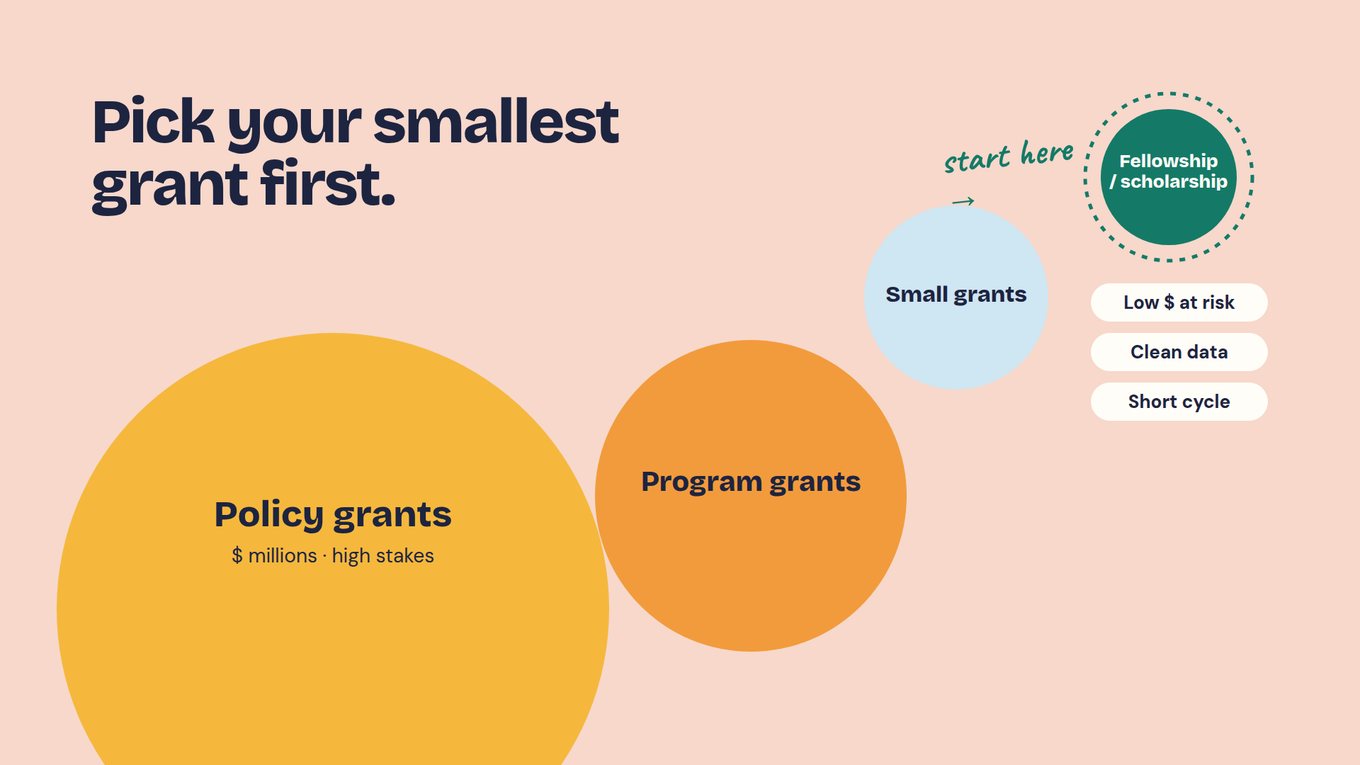
Unmesh's advice in the video is to think end to end but begin with the lowest-risk part of the cycle: application review, and within that a fellowship or scholarship rather than a large grant that needs heavy due diligence. Small programs put less money at risk, tend to have cleaner data and run a short cycle. Some are not in the main system at all: one foundation Sopact is talking to runs three fellowship programs outside its main platform, which makes a clean first test.
Pace separates this from a replacement project. Unmesh notes that traditional grant-system implementations take six to nine months. In the deck he describes a university program that another vendor said would take three months to go live; it went live on Sopact in a week and had 3,000 applications scored three weeks later. That is one account of a well-scoped program, not a forecast for yours.
- Pick the program from your inventory. Choose the smallest program where the drag is visible: several rubric versions, long reconciliation or an owner who has left. Confirm which records stay in Fluxx.
- Rebuild the intake, not the form. Keep the questions that feed a decision, drop the fields nobody reads and ask for the narrative and documents once, up front.
- Put the rubric where program staff can see it. Write the Intelligence Cell prompt against your criteria, and have the program lead, not an administrator, make the first revision.
- Run it next to the current process. Keep Fluxx running for the same cycle, or rerun a recent one, so reviewers can compare scores and reasons with their own.
- Measure staff work, not only speed. Record setup, reading, reconciling, corrections and report assembly separately.
- Change something mid-cycle. Revise a criterion and check what happens to applications already scored. That tests ownership, the problem you started with.
If the pilot expands, an exported spreadsheet is not the whole migration; documents, review notes and historical decisions need their own plan, and record counts should reconcile. The sequence Unmesh lays out at 9:30 is one step at a time: keep the current system intact, connect accounting through APIs or MCP when that step arrives, and add the next workflow only after the last one has proved itself.
What the pilot can and cannot tell you
A good pilot answers a narrow question: can your team run and change this workflow with less effort than the configured version, and do reviewers trust what it produces? For that, every AI finding has to open to the passage it came from and the version of the criteria used, and a missing answer must look different from a weak one. Reviewers record corrections and overrides with reasons, people make the funding decisions, and AI output is checked before anyone relies on it. One program cannot tell you whether funded work caused an outcome; that needs an evaluation design. It can show whether the hours spent preparing each answer go down, the cost a heavily configured setup tends to hide.
Keep Fluxx, complement it or replace a defined workflow?
Keep and improve the current setup when the inventory shows the problem is a handful of stale fields or undocumented definitions. Cleaning those up inside Fluxx, with training for whoever now owns them, may be enough.
Run a complementary workflow when Fluxx still handles administration well but one program's review or reporting has become the bottleneck. Agree which system owns each record and how updates return to Fluxx, so the second system does not create a new reconciliation job.
Consider a wider change only after the pilot has shown its benefit over a full cycle and every critical responsibility, from payments to portals, has a home. The goal is a process your team can maintain, not replacement for its own sake. For a broader shortlist, read the grant management software comparison.
Common questions about Fluxx alternatives
Does Fluxx have AI and portfolio analytics?
Yes. Fluxx describes Finn for questions across grantmaking data and documents and Grantelligence for analytics, along with AI access controls. Test those functions on your own questions before looking elsewhere. The case for an alternative rests on something different: whether your team can change the review and reporting workflow, see the source behind each finding and keep definitions consistent without depending on one administrator or the vendor.
Do we have to leave Fluxx to try Sopact?
No. The approach Unmesh describes is to keep the current system running and move one low-risk workflow, such as application review for a fellowship or scholarship program. Fluxx stays the record for awards, payments and integrations. Agree in advance which records the pilot creates, who owns them and how results return to Fluxx, so staff are not maintaining two versions of the same grant.
The person who configured our Fluxx setup has left. Where do we start?
Start with the configuration inventory: list the custom fields, rubric versions, approval steps, recurring exports and definitions, and note who can change each one today. Some items can be retired inside Fluxx with a little training, and the support for later changes on the Fluxx services page is worth asking about. Others belong to a program whose process no longer fits the configuration; that program is the natural candidate for a contained test.
How long will a migration take?
It depends on data quality, historical records, integrations and scope. Unmesh notes that traditional grant-system implementations take six to nine months, which is why this page recommends a contained pilot first. A small program can be running quickly, but a wider move needs a plan for documents, review notes, relationships and access, drawn up after inspecting a real sample of your records rather than before.
What should we bring to a first conversation?
Bring the inventory, one recently completed cycle from the program you would test and the board or committee question that currently takes longest to answer. Include at least one application where reviewers disagreed, since that is where a new workflow shows its value or its gaps. The Applications, awards & grants course gives a practical structure for organizing the review process beforehand.