


Related solution
Applications & Grants
Connect application material, review decisions and the program that follows.
Explore the solution →


Live webinar: Wednesday, October 7, 2026 | 9:00 AM PT
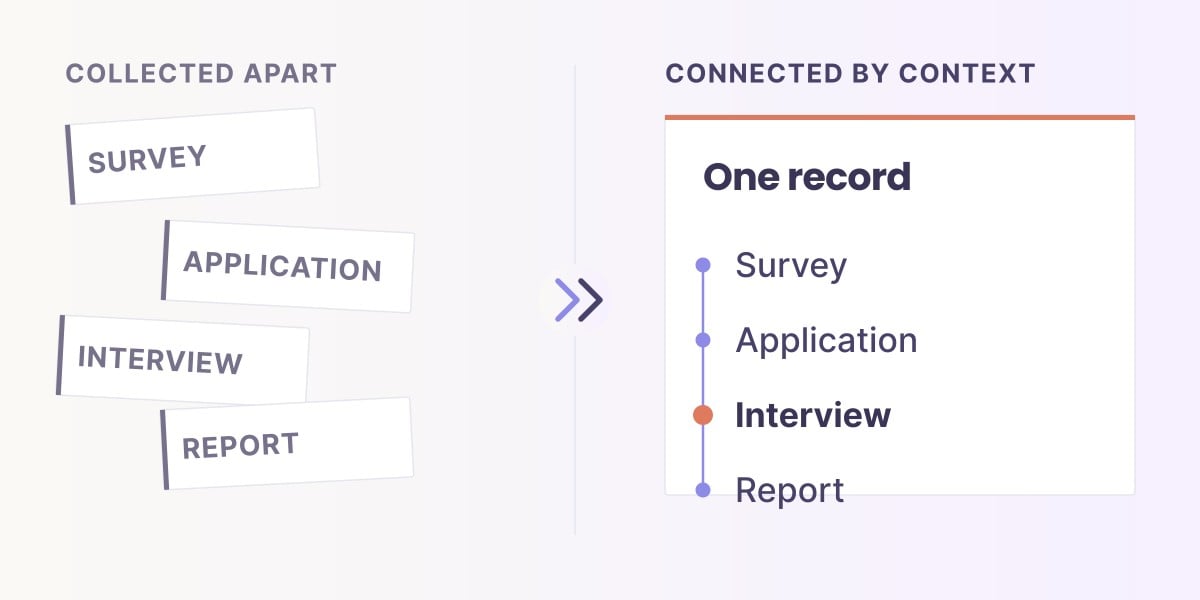
Building context across your data. In 30 minutes, see how to connect data and definitions across teams, with the right permissions and governance, so scattered data points become intelligence your teams and AI can actually use.
Save your spot (free)USE CASE / PRACTICAL GUIDE
AI application review software helps selection teams examine applications and supporting documents, locate relevant evidence and prepare assessments against defined criteria. Good software makes the basis of an assessment clear enough for reviewers to check, correct and use in their decisions. Grantmakers, scholarship providers, fellowship teams and award committees use it to reduce preparation work while retaining human judgment over selection.
The challenge is not only the number of applications. Relevant evidence may be spread across an essay, a proposal and attachments, while different reviewers interpret the same criterion differently. A compressed summary can omit the qualification that changes a judgment. Teams need assistance that reduces reading and preparation without concealing missing evidence or making a draft assessment look final.
AI-assisted and AI-native review are different buying propositions. A summary added to an application system can shorten reading; a process built around AI can prepare evidence as material arrives and keep it connected to the application and subsequent program. Buyers should compare when analysis begins, what evidence it uses and how reviewers retain control. Those differences affect preparation work more than an AI label does.
Sopact analyzes incoming application evidence for use in AI Assistance and human review. For training, accelerators and grants, that analysis can continue into onboarding, assessments and mentoring. Selection-only awards, scholarships and fellowships may need the review benefit without a longer participant journey.
Help reviewers locate relevant application material.
Relate that material to the program’s criteria.
Keep judgment and final decisions with the committee.
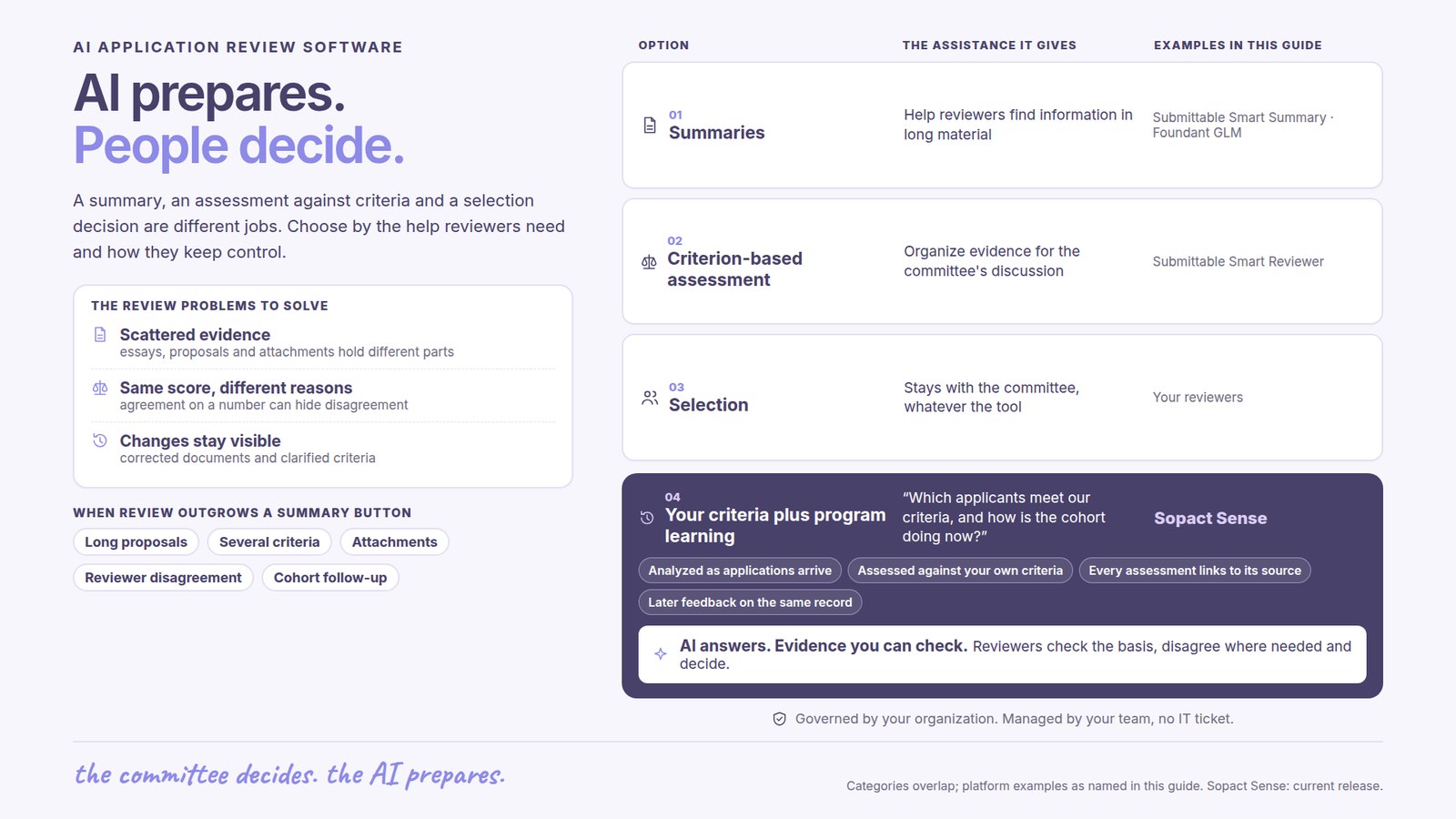
A program may care about readiness, community involvement or the feasibility of a proposed project. The relevant evidence can appear in several parts of an application. Reviewers spend time finding it before they can discuss its meaning. Useful assistance brings that material into the assessment and makes omissions visible; it should not fill gaps with plausible assumptions.
Two reviewers may assign the same score for different reasons. Another may interpret a criterion more strictly. A committee needs to see the basis of an assessment to resolve those differences. Consistent output formatting helps organize the discussion, but it does not establish that the underlying judgment is sound.
An applicant may correct a document, or a program may clarify a criterion during review. The team needs to know which material and criteria informed the assessment it is using. Otherwise, a fresh-looking summary can be mistaken for an assessment of the latest evidence. Buyers should establish how updated material affects an existing assessment and who is responsible for reviewing the change.
A short AI summary can reduce the time spent reading an application. The larger gain comes when the application is already analyzed against the program’s criteria, the evidence is available for questions, and reviewers can start deciding what needs closer attention. Compare the time to launch, the time until analysis is usable, and the work people still need to do before a decision.
| Stage | What Sopact provides | What to establish with any provider |
|---|---|---|
| Set up the workflow | Sopact’s typical setup estimate is two days to two weeks, depending on the agreed scope. The team personalizes the collection and analysis around the program. | Does the proposed timeline include forms, criteria, analysis, reviewer access and a usable first cycle, or only an account and intake form? |
| Analyze incoming evidence | Configured analysis runs as data arrives and becomes available in AI Assistance. Reviewers can examine the interpretation and identify missing evidence or questions for an interview. | Is analysis triggered on arrival, on entry to a review round, by a person generating a summary, or after a separate export? Who can use the result? |
| Review and decide | People check the analysis, consider exceptions, conduct any interviews and make the final judgment. | How much preparation remains, and which delays come from committee schedules, applicant responses or necessary deliberation? |
| Continue the program | Where needed, the same evidence informs onboarding, pre/post assessments, mentoring and later progress. | Will the program team reuse the analysis, or reconstruct the applicant’s context in another system? |
The two-day-to-two-week range is Sopact’s operating estimate, not a promise that every migration or integration fits that window. In the published Carnegie Mellon Project Olympus example, the application workflow launched in five days and the application batch was assessed overnight against a custom rubric. The human committee retained selection responsibility.
Sopact reports that this approach can remove two to three months of review work in application processes it supports. That is Sopact’s experience-based estimate, not a published industry average or a guaranteed saving. The useful comparison for your program is the preparation and reconciliation effort removed, with interviews and final judgment still accounted for.
An application summary, an assessment against criteria and a final award decision are different things. Buyers should be clear about which part of the work the AI assists and what the human reviewers remain responsible for.
A summary can make a long proposal easier to approach. It is useful when the main burden is reading volume. But a readable overview does not necessarily explain whether the application meets the program’s criteria, and important qualifications can be lost in compression.
An assessment relates the application to what the program values. The benefit is a more organized starting point for committee review. Reviewers need to understand the supporting material and be able to disagree with the assessment. A draft score without an understandable basis can create another task rather than remove one.
Committees consider context, trade-offs and the purpose of the opportunity. AI can assist preparation, but its output should not be treated as an authoritative judgment of a person’s merit. The selection process should make responsibility clear to the people using it.
Sopact publishes this guide. The shortlist groups platforms by purpose; it is not an independent ranking. Linked product documentation supports the descriptions. Features and services depend on the selected product and agreement.
| Platform | Main buying need | What matters in this choice |
|---|---|---|
| Submittable — assistance within application management | Review within application management | Smart Summary and Smart Reviewer serve different preparation and assessment needs. Submittable Next documentation identifies beta availability and different access roles. Confirm what administrators and committee members can use in the proposed version. |
| Foundant GLM — summaries within grant administration | Summaries within grant administration | AI application summaries sit within a foundation-oriented grant process that also includes review, agreements and follow-up. Relevant when reducing reading effort is one requirement within a larger grant-management purchase. |
| Sopact — program-specific assessment and continuing analysis | Criteria and program analysis | Application assessment can be organized around a program’s own criteria, with supporting material for human review. Relevant when the organization also wants to connect selection evidence with later participant feedback and program results. |
Compare summarization and criterion-based review separately. A committee reading brief eligibility statements needs different assistance from one assessing complex proposals against several program priorities.
When AI is a separate review step, someone must initiate the analysis after collection and keep its output aligned with the material under consideration. The operational question is how much preparation remains between receiving an application and having useful evidence ready for the committee.
Sopact supports analysis generated during collection. This provides a foundation for preparing review material as applications arrive, while the committee retains the selection decision. Its participant relationships also keep the application connected with later program evidence. Assess the quality and relevance of that preparation alongside speed; an automatically prepared assessment still requires human judgment.
Submittable Next documents Smart Summary for application summaries and Smart Reviewer for assessment using a custom feedback form. The documentation reviewed on October 4, 2026 labels both as beta. It also distinguishes access: reviewers can see generated summaries, while Smart Reviewer feedback is available to specified administrative roles rather than reviewers.
This changes the buying conversation. Establish whether the assistance is meant for administrators preparing a shortlist or for committee members reading applications. Confirm the version and availability offered to your organization; a product announcement alone does not establish the committee’s working experience.
Foundant GLM includes AI application summaries alongside its grant review and administration functions. It is relevant when the purchase is primarily a grant-management system and shorter preparation is one benefit. A summary and a documented criterion-by-criterion assessment remain different requirements.
The Project Olympus account describes a custom rubric, supporting evidence and a shortlist prepared for a human committee. That supports a specific value proposition: reviewers can spend more attention discussing the application’s fit because assessment preparation is organized around the program’s criteria. It does not establish a universal accuracy rate or a guarantee for another program.
Sopact’s broader value is preserving application context for later program learning. That matters when staff will support the selected cohort and want to understand whether participants received what they needed. It is less central to a one-time competition whose main requirement ends with judging.
Product documentation reviewed October 4, 2026. Descriptions reflect the linked offerings; confirm the edition and scope relevant to your organization.
Sopact connects application evidence with forms, files and feedback from a continuing program. For an accelerator, the needs expressed in an application can inform onboarding and mentoring. In training, those needs provide context for pre/post assessments. For grants, the proposal informs agreed outcomes and later progress reviews. Selection-only scholarships, fellowships and awards can use the review benefits without extending the process beyond the decision.
That connection supports a different question from ranking applications: whether the program is serving the people it selected. Program leaders can use those findings to refine support and reconsider future selection priorities. Later success alone should not be treated as proof that the original AI assessment was correct.
Sopact combines personalization with customer ownership and continuing team support. Selection criteria and reporting needs evolve; the buying conversation should cover how the team can adapt its process and what assistance remains available throughout the program.
The Carnegie Mellon Project Olympus customer account describes application assessment using a custom rubric and a prepared shortlist for the committee. Reviewers could consider supporting material before making the selection. The committee could use the organized assessment to prepare its discussion and retain responsibility for selection.
Start with the burden you need to reduce. If reviewers chiefly need an overview of long documents, summarization may be sufficient. If they need help relating material to program criteria, compare the usefulness and clarity of the assessment. If selection leads into a continuing program, include that later responsibility in the comparison.
Evaluate the review as a human decision process: the quality of supporting evidence, the handling of disagreements and the reviewer’s ability to correct an interpretation. Agree the appropriate use of applicant information and the scope of assistance. Avoid treating a fast draft assessment as a complete selection process.
Finally, consider the surrounding administration. Applicant communications, review assignment, award operations and later reporting may matter as much as the AI component. The submission software guide explains those wider use cases.
The approach described here reserves selection for the responsible people. AI assists with reading and assessment; the committee considers the evidence and makes the decision.
No. A summary condenses material. An assessment relates it to criteria. Buyers should establish which assistance the product provides and whether reviewers can understand its basis.
No. Fairness depends on the criteria, available evidence and decision process. AI can make errors or reproduce unwanted patterns, so human review and the ability to correct interpretations remain important.
When a program wants assessments tailored to its own criteria and needs application evidence to remain useful in later participant support and program analysis.
Continue with a purpose
Related solution
Connect application material, review decisions and the program that follows.
Explore the solution →Continue learning
Explore a practical course on application review, program criteria and deciding what to improve.
Start learning →
Customer story
Application assessment against a custom rubric, with a shortlist for the human committee.
Read the story →Explore how Sopact could prepare application evidence around your criteria and connect it with the program that follows.
See it with your workflow →