New webinar on 3rd March 2026 | 9:00 am PT
In this webinar, discover how Sopact Sense revolutionizes data collection and analysis.
M&E frameworks fail when data stays fragmented. Learn how clean-at-source pipelines transform monitoring into continuous learning—no more cleanup delays.
Meta Title: Monitoring & Evaluation Tools: M&E Software That Actually Works (58 chars)Meta Description: Master monitoring and evaluation with AI-powered M&E tools. Clean data collection, real-time analysis, and multi-language reporting — from plans to learning. (158 chars)H1: Monitoring and Evaluation That Actually Works: From Perfect Plans to Real LearningURL: /use-case/monitoring-and-evaluation (keep existing)
Most M&E teams build sophisticated frameworks with perfectly aligned indicators, theories of change, and results matrices. Then implementation begins. Data sits in separate spreadsheets. Survey tools don't talk to program databases. Qualitative feedback from interviews remains trapped in documents no one has time to code. The disconnect is structural. M&E frameworks answer "what should we measure" while ignoring "how will we actually collect, connect, and analyze this data."
Sopact Sense fixes the foundation — clean data at capture, AI-powered qualitative analysis, multi-language collection and reporting, and real-time insights that arrive while there's still time to act.
FOUNDATION
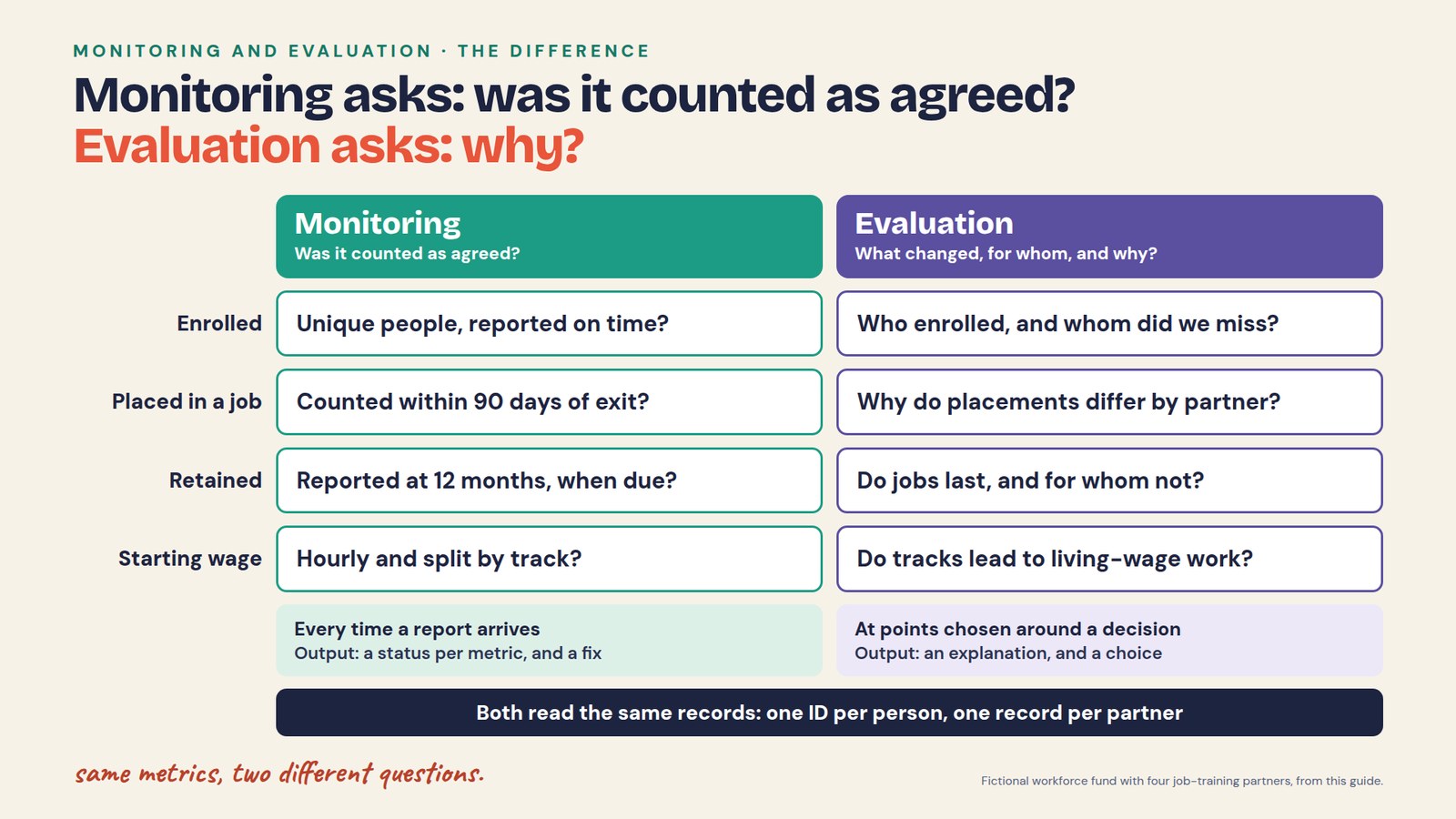
Monitoring and evaluation (M&E) is a systematic approach to tracking program progress and assessing outcomes. Monitoring is continuous — it tracks whether activities are being implemented, outputs are being delivered, and early indicators are moving in the right direction. Evaluation is periodic — it assesses whether the program achieved its intended outcomes and why.
Together, monitoring and evaluation answer four questions every program must address: Are we doing what we planned? Is what we're doing making a difference? For whom? And what should we change?
Here's what breaks: organizations design beautiful M&E frameworks with perfectly aligned indicators, theories of change, and results matrices. Then implementation begins. Data sits in separate spreadsheets. Survey tools don't talk to program databases. Qualitative feedback from interviews remains trapped in documents no one has time to code.
The disconnect is structural. M&E frameworks answer "what should we measure" while ignoring "how will we actually collect, connect, and analyze this data." Teams end up with sophisticated monitoring plans fed by broken data collection workflows that make real-time learning impossible.
The result? By the time insights arrive, programs have already moved forward. Decisions get made without data. Monitoring and evaluation becomes a compliance exercise instead of a learning tool.
Unmesh Sheth, Founder & CEO of Sopact, explains why monitoring and evaluation must be built on clean data architecture — not bolted on after the fact with disconnected tools.
THE REAL PROBLEM
The M&E tools landscape is crowded. Organizations piece together monitoring and evaluation from generic survey tools, spreadsheets, CRMs, and BI dashboards. Each component works individually. Together, they create a permanent cleanup tax.
Failure 1: Duplicate records multiply. Tools don't assign unique identifiers. The same participant appears as "Maria Garcia" in one dataset, "M. Garcia" in another, and "Maria G" in a third. Analysts spend weeks manually matching records, never certain they've caught every duplicate.
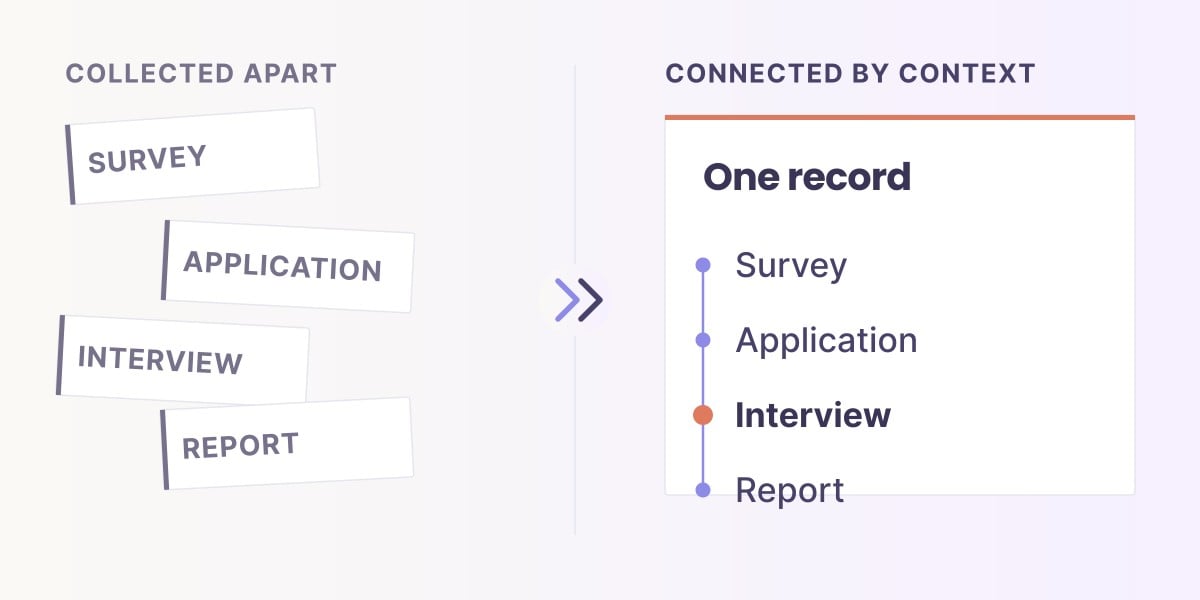
Failure 2: Data fragments across disconnected tools. Intake surveys live in Google Forms. Progress tracking sits in Excel. Feedback comes through SurveyMonkey. Outcome data arrives via email. Connecting these sources requires exporting, standardizing, and merging — work that takes weeks and must restart whenever new data arrives.
Failure 3: Qualitative insights die in spreadsheets. Open-ended responses contain the richest information about program impact, but analyzing hundreds of text responses requires manual coding that takes weeks or becomes impossible at scale. Teams know their data contains insights, but extracting them costs more time than anyone has.
The shift isn't about better dashboards or prettier charts. It's architectural. Organizations need M&E systems where data is born clean, stays connected through persistent identifiers, and gets analyzed — both quantitative metrics and qualitative narratives — while programs are still running.
THE M&E TOOLS LANDSCAPE
Let's be direct about what's available and where each tool shines — because choosing the wrong architecture locks you into years of workarounds.
KoboToolbox is excellent for what it does — mobile data collection in challenging environments with offline capability. It's open-source, free for humanitarian organizations, and trusted by 700,000+ users globally. For one-off surveys, field research, and basic data collection, it's a strong choice.
SurveyCTO offers secure, scalable data collection with complex survey logic, data encryption, and real-time monitoring. It's the go-to for research organizations and large-scale data collection projects where security and complex form design matter.
ActivityInfo goes beyond basic data collection — it's a complete database system designed for ongoing M&E management with customizable reporting, flexible data models, and multi-project management. It's well-suited for organizations managing multiple projects across locations.
TolaData specializes in indicator tracking and donor reporting with native integrations to KoboToolbox and other collection tools. Its strength is connecting data collection to results frameworks and generating donor-aligned reports.
These are all legitimate tools. We're not dismissing them. But here's the honest truth about what they don't solve:
No AI-native qualitative analysis. When your M&E framework requires understanding why outcomes changed — not just whether they changed — you need to analyze interview transcripts, open-ended survey responses, and field notes at scale. None of these tools do that. You're left exporting to NVivo, Atlas.ti, or MAXQDA (desktop tools designed for academic researchers, not M&E practitioners running live programs) or — more realistically — never analyzing your qualitative data at all.
No integrated qual + quant pipeline. The whole promise of monitoring and evaluation is connecting quantitative indicators to qualitative context. "Confidence scores increased 40%" is useful. "Confidence scores increased 40%, driven primarily by peer mentoring — which participants described as 'the first time someone believed I could do this'" is transformative. Achieving that integration with current tools requires manual data exports, separate analysis platforms, and weeks of synthesis work.
No persistent stakeholder identity. KoboToolbox, SurveyCTO, and most collection tools treat each form submission as an independent event. There's no built-in mechanism to say "this person who completed the intake survey is the same person completing the follow-up 6 months later." You build that linkage manually — through matching names, phone numbers, or custom IDs you manage yourself.
No multi-language intelligence. International development organizations routinely collect data in Portuguese, Spanish, French, Swahili, or Arabic — then need reports in English for donors. Current M&E tools handle multi-language forms (you can write questions in multiple languages), but none offer multi-language analysis and reporting where AI processes responses in the original language and generates insights in the donor's language simultaneously.
SOPACT DIFFERENCE
Sopact Sense isn't competing with KoboToolbox on offline mobile data collection — Sopact has that too. It's not competing with TolaData on indicator tracking — Sopact handles that natively. The difference is architectural: Sopact Sense is the only platform that integrates data collection, AI-powered qualitative analysis, quantitative indicators, persistent participant identity, and multi-language intelligence into a single system.
Built-in CRM manages unique IDs automatically. Every participant gets a permanent identifier at first contact that follows them across all surveys, all touchpoints, all follow-ups. Duplicates become structurally impossible. When someone completes their 6-month follow-up, the system links it to intake data, mid-program surveys, and exit feedback automatically.
No manual matching. No name-based deduplication. No export-merge-clean cycles.
Intelligent Cell extracts themes, sentiment, and metrics from open-ended responses and 100-page reports in minutes. What used to take weeks of manual coding happens automatically while maintaining consistency across all responses.
Upload interview transcripts. Apply custom evaluation rubrics. Get coded themes, sentiment analysis, and pattern detection — across 500 responses — in the time it takes to get coffee. Human analysts then validate patterns and investigate edge cases rather than doing repetitive reading.
This is where Sopact Sense stands alone in the M&E tools landscape. Collect data in any language. Analyze responses in their original language. Generate reports in a different language — simultaneously.
Real example: A girls' coding program collects participant feedback in Portuguese. Sopact Sense analyzes the Portuguese responses natively — extracting themes, measuring sentiment, identifying improvement areas — and generates a complete impact report in Portuguese. The same data, same analysis, produces a parallel report in English for international donors. Side by side:
🇧🇷 Portuguese Impact Report →🇬🇧 English Impact Report →
No translation layer. No manual re-analysis. The AI processes original-language nuance rather than translating first and analyzing second — which loses context, idiom, and cultural meaning. Multi-language prompts allow M&E teams to configure analysis criteria in any language. Multi-language reporting ensures every stakeholder — from field teams to headquarters to donor boards — gets insights in their working language.
Why this matters for global M&E: When you collect data in 4 languages across 12 countries, the traditional approach is: collect → export → translate → clean → analyze → report. Each step introduces errors and delays. Sopact's approach: collect → analyze → report — in every language, simultaneously.
Sopact Sense includes offline-capable mobile data collection for field environments with limited connectivity. Forms sync automatically when connection returns. This is table-stakes functionality — KoboToolbox and SurveyCTO offer it too — but Sopact includes it as part of the integrated architecture rather than requiring a separate tool and data pipeline.
Stakeholders receive unique links tied to their participant ID where they can review information, make corrections, and provide updates. Data quality improves continuously without consuming staff bandwidth. When a participant notices their employment status is outdated, they update it directly — no field visit required.
Because every data point connects through persistent unique IDs, organizations see complete participant journeys — from intake through program activities, mid-point assessments, exit surveys, and 6/12/24-month follow-ups. Questions that used to take weeks of manual data matching get answered instantly:
"Did women participants who reported low confidence at intake show improvement by exit?""Which program sites produce stronger employment outcomes?""How does this cohort compare to the last three?"
PRACTICAL APPLICATION
Select your framework — results framework, logframe, theory of change, or logic model. Define indicators at each level. Sopact Sense supports all frameworks by connecting every indicator to real-time evidence.
Configure surveys with built-in unique IDs. Set up intake, mid-point, and exit instruments. Enable multi-language forms for international programs. Activate offline mode for field collection. Every response links to the right participant automatically.
As data arrives, analysis happens in real time. Quantitative indicators update automatically. AI agents process qualitative responses — extracting themes, applying rubrics, detecting patterns. No waiting. No batch processing. No quarterly scramble.
Pull reports aligned to your M&E framework structure. Filter by demographics, site, cohort, time period. Generate in the language your stakeholders need — field teams get local-language reports, headquarters gets English or French, donors get formatted compliance exports.
Insights drive decisions while programs run. When mid-program data shows certain participants struggling, interventions happen immediately. When assumptions break down, the M&E system flags it in real time. Annual reports become summaries of what you already know — not the first time anyone looks at the data.
M&E TOOLS DEEP DIVE
The most important decision isn't which survey tool to use. It's whether to build your M&E system from connected pieces (where data flows between specialized tools) or integrated architecture (where collection, analysis, and reporting share a single foundation).
Stack: KoboToolbox (collection) + TolaData (indicator tracking) + NVivo (qualitative analysis) + Power BI (dashboards)
Pros: Each tool is best-in-class for its specific function. Open-source options keep costs low. Large user communities provide support.
Cons: Data doesn't flow automatically. Each export-import cycle introduces errors. Qualitative analysis happens in a separate universe from quantitative tracking. Multi-language analysis requires manual translation. No persistent participant identity across tools. Staff spend 80% of time managing the pipeline, 20% analyzing.
Best for: Organizations with dedicated M&E technical staff who can manage integrations, and programs where qualitative analysis isn't a priority.
Platform: Sopact Sense (collection + CRM + AI analysis + reporting)
Pros: Single participant ID across all touchpoints. AI-powered qualitative analysis at quantitative scale. Multi-language collection, analysis, and reporting. Real-time insights without data wrangling. 90% reduction in reporting time.
Cons: Less flexibility for highly custom data models (ActivityInfo excels here). Newer platform with smaller community than KoboToolbox. Higher cost than free open-source options.
Best for: Organizations that need qualitative + quantitative integration, operate in multiple languages, want real-time insights, or lack dedicated data engineering staff.
If your M&E needs are primarily quantitative indicator tracking with periodic manual evaluation, the pieced-together approach works. KoboToolbox + TolaData is a solid combination. ActivityInfo handles complex multi-project setups well.
If your M&E framework requires understanding why outcomes change (not just whether), involves qualitative data at scale, spans multiple languages, or needs real-time learning — the integrated approach saves thousands of hours and produces fundamentally better evidence.
Answers to the most searched questions about M&E tools, frameworks, and best practices.
NOTE: Write as plain H3 + paragraph in Webflow rich text. JSON-LD schema separate.
Monitoring and evaluation (M&E) is a systematic approach to tracking program progress and assessing outcomes. Monitoring is continuous — it collects and analyzes data during implementation to track whether activities are being delivered, outputs are being produced, and early indicators are moving in the right direction. Evaluation is periodic — it assesses whether the program achieved its intended outcomes and determines what worked, for whom, and why. Together, M&E transforms program data into evidence that drives decisions, demonstrates accountability, and enables continuous learning.
Monitoring and evaluation tools are software platforms and methodologies used to collect, manage, analyze, and report program data. Common M&E tools include data collection platforms (KoboToolbox, SurveyCTO), indicator management systems (TolaData, ActivityInfo), qualitative analysis software (NVivo, Atlas.ti), and integrated platforms (Sopact Sense) that combine collection, analysis, and reporting in a single system. The best M&E tools eliminate the "80% cleanup tax" by keeping data clean from collection, linking participant records through unique IDs, and enabling AI-powered analysis of both quantitative metrics and qualitative narratives.
An M&E framework is a structured plan that defines what to monitor and evaluate, which indicators to track, how data will be collected, and how findings will be used for decision-making. Common frameworks include results frameworks, logical frameworks (logframes), theories of change, and logic models. A strong M&E framework specifies indicators at each level (activities, outputs, outcomes, impact), data collection methods, responsible parties, frequency, and feedback mechanisms. The framework answers "what should we measure" — but its effectiveness depends entirely on whether the underlying data systems can actually deliver clean, connected evidence.
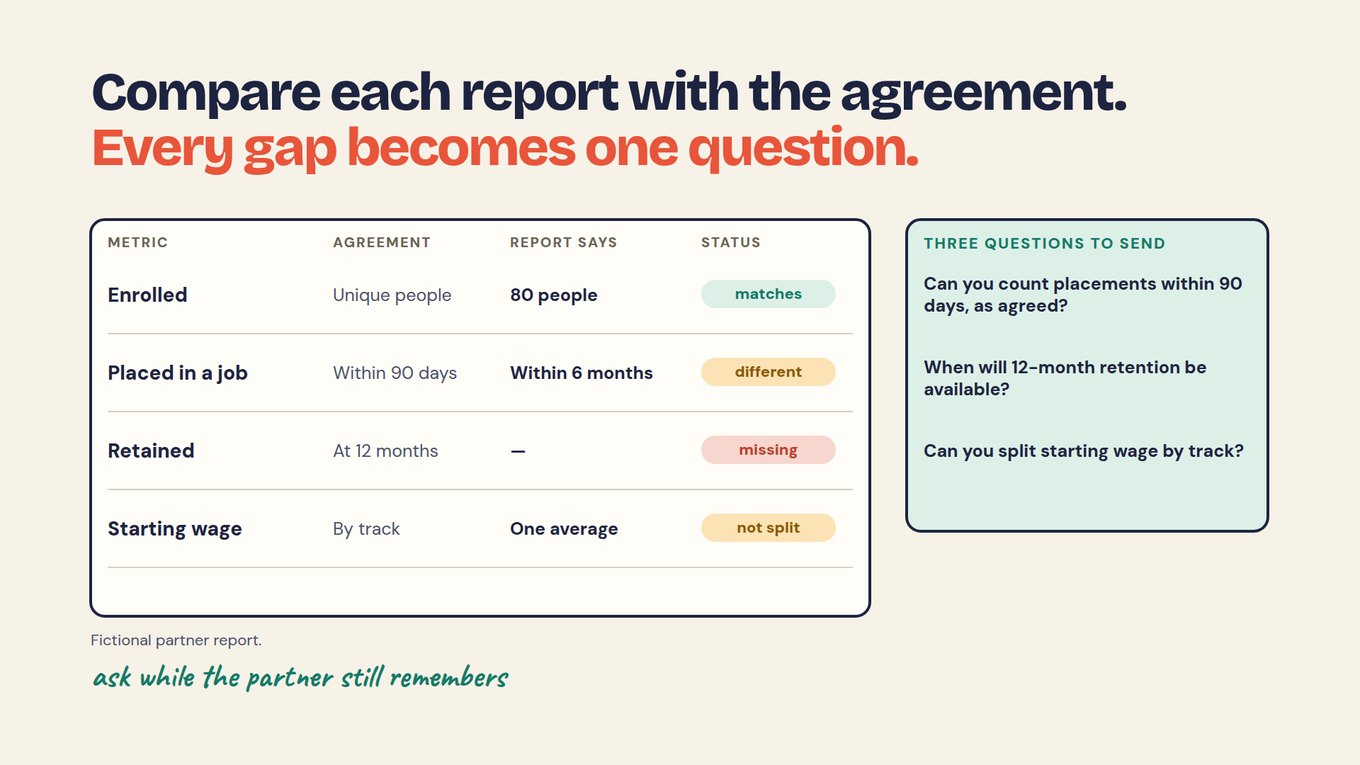
An M&E plan operationalizes the framework by specifying exactly how monitoring and evaluation activities will be implemented. It includes indicator definitions with targets and baselines, data collection instruments and schedules, roles and responsibilities, data management procedures, analysis methods, reporting templates, and feedback loops. The plan bridges the gap between "what we want to know" and "how we'll actually collect and analyze the evidence." Organizations fail when their M&E plan requires data connections that their tools can't deliver — promising longitudinal tracking with tools that treat each survey as an independent event.
The best M&E tools depend on your specific needs. For mobile data collection in challenging environments, KoboToolbox (free, open-source) and SurveyCTO (secure, scalable) are strong options. For indicator tracking and donor reporting, TolaData and ActivityInfo offer robust capabilities. For integrated M&E with AI-powered qualitative analysis, multi-language support, and persistent participant identity, Sopact Sense is the only platform that combines collection, analysis, and reporting in a single architecture. The most important criterion isn't features — it's whether the tool eliminates the 80% data cleanup tax that delays every analysis cycle.
AI transforms M&E in three ways. First, it enables qualitative analysis at quantitative scale — processing hundreds of interview transcripts or open-ended survey responses in minutes with consistent coding that human teams can't achieve across large datasets. Second, it identifies patterns humans miss — correlating variables across demographics, sites, and time periods to reveal which program elements drive outcomes. Third, it enables multi-language intelligence — analyzing responses in their original language and generating reports in any language simultaneously, eliminating the translate-then-analyze pipeline that delays international M&E by weeks. Sopact's Intelligent Cell applies custom evaluation rubrics automatically, creating audit trails that show exactly which evidence supports each finding.
Monitoring is continuous and operational — it tracks program implementation in real time by collecting data on activities, outputs, and early indicators. It answers "Are we on track?" Evaluation is periodic and analytical — it assesses program effectiveness at defined intervals by examining whether outcomes were achieved and why. It answers "Did it work?" Monitoring provides the ongoing data feed; evaluation provides the deeper analysis. Both require clean, connected data to be useful. The best M&E systems blur the line between them by enabling continuous learning — not just continuous data collection.
A workforce development program might use a results framework with four levels: Activities (deliver 30 training workshops), Outputs (200 youth complete certification), Outcomes (60% gain employment within 6 months), and Impact (reduced youth unemployment in target community). The M&E framework specifies indicators at each level, data collection methods (attendance records, skills assessments, employment verification surveys, qualitative interviews), collection frequency, and how findings feed back into program decisions. The framework becomes powerful when connected to a data system that tracks individual participants from intake through long-term follow-up under persistent unique IDs.
M&E methods include quantitative approaches (surveys, administrative data analysis, statistical testing, indicator tracking), qualitative approaches (interviews, focus groups, case studies, observation, document review), and mixed-methods approaches that combine both. The most effective M&E uses mixed methods — quantitative data shows what changed, qualitative data explains why and how. The challenge isn't methodology — it's implementation. Most organizations know they should integrate qualitative and quantitative evidence but lack tools that make that integration practical at scale. AI-powered platforms like Sopact Sense eliminate this barrier by analyzing both data types in a single pipeline.
Start with your program theory — what change do you expect and why? Define measurable indicators at each level of your results chain (activities, outputs, outcomes, impact). For each indicator, specify: data source, collection method, frequency, responsible person, and target value. Design data collection instruments with built-in participant IDs from day one — retrofitting unique identifiers later is exponentially harder. Plan for both quantitative metrics and qualitative evidence. Specify how findings will feed back into program decisions (not just donor reports). Budget for M&E at 5-10% of program costs. And critically: choose tools that connect your collection to your analysis to your reporting — not tools that require weeks of manual data wrangling between each step.
The purpose of monitoring and evaluation is to generate evidence that improves programs, demonstrates accountability, and enables learning. Monitoring provides real-time information to manage implementation effectively — catching problems early, tracking progress against targets, and ensuring resources are used efficiently. Evaluation assesses whether programs achieve their intended outcomes and generates knowledge about what works, for whom, and under what conditions. Together, M&E transforms anecdotal impressions into systematic evidence. The highest purpose of M&E isn't compliance reporting — it's enabling organizations to continuously learn and improve while programs are still running.
Use this call-to-action block anywhere on your page. It’s lightweight, accessible, and matches your existing p-box style.
From Annual Reports to Weekly Learning: Building a Framework That Actually Improves Results
Most organizations are trapped in traditional M&E: design a logframe for months, collect dozens of indicators, wrestle with fragmented spreadsheets, then wait quarters for insights that arrive too late to matter. By the time you see what worked, the program has already moved on.
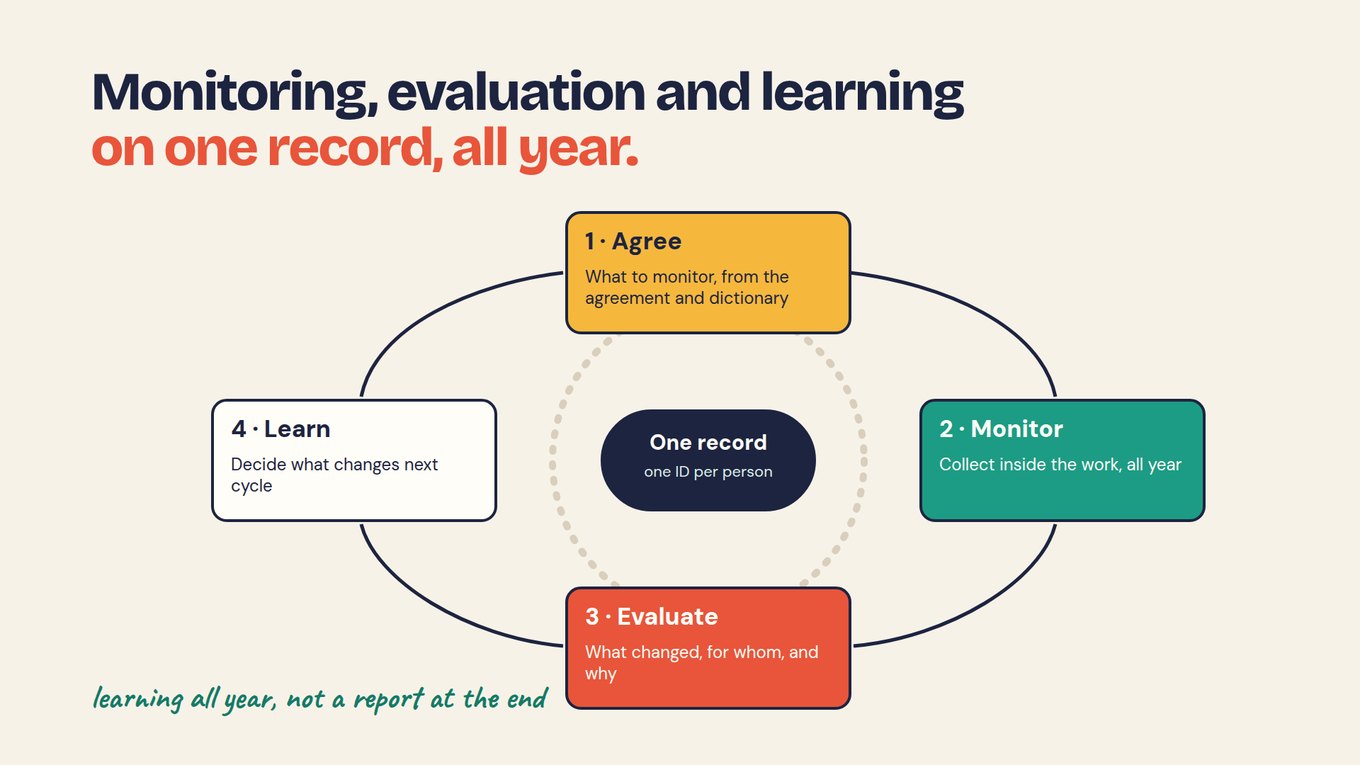
The shift to continuous learning changes everything. Instead of measuring for reports, you measure to improve—capturing evidence as it happens, analyzing patterns in real-time, and adjusting supports while participants are still in your program. This is Monitoring, Evaluation and Learning (MEL): a living system where data collection, analysis, and decision-making happen in the same cycle.
MEL is the connected process of tracking progress, testing effectiveness, and translating insight into better decisions—continuously, not annually.
The difference from traditional M&E? Speed and integration. Your baseline, formative feedback, and outcome data live together—connected by unique participant IDs—so you can disaggregate for equity, understand mechanisms of change, and make evidence-based decisions next week, not next quarter.
The annual evaluation cycle: Baseline → 6-month silence → Endline → 3-month analysis delay → Report arrives after program ends → Insights can't be applied.
The continuous learning cycle: Clean data from day one → Real-time analysis as responses arrive → Weekly/monthly learning sprints → Immediate program adjustments → Participants benefit from insights while still enrolled.
Traditional M&E treats data as a compliance burden. Continuous learning treats data as your fastest feedback loop for improvement.
Start with the decisions your team must make in the next 60-90 days.
Clarity about decisions keeps your framework tight, actionable, and useful.
Blend standard metrics (for comparability and external reporting) with a focused set of custom learning metrics (for causation, equity, and program improvement).
Standard examples:
Custom learning metrics:
The balance matters: enough standards for credibility, enough customs for learning.
This is where Sopact Sense transforms traditional M&E.
Contact object approach:
Form design principles:
The result: When data is born clean and stays connected, analysis becomes routine instead of a months-long struggle.
Continuous learning requires analysis built into your workflow, not bolted on afterward.
What to analyze:
How Sopact Sense helps:
Apply minimum cell-size rules (n≥5) to avoid small-number distortion when disaggregating.
Transform MEL from an annual chore into a monthly or biweekly habit.
Learning sprint agenda (60-90 minutes):
Example sprint outcomes:
These aren't report findings—they're decisions in motion.
Traditional M&E planning takes 3-6 months of consultant workshops and logframe debates. Sopact Sense gets you operational in days.
✅ Clarity on what to build
✅ Intelligent Suite configuration
✅ Implementation-ready specifications
✅ Speed to value
The Implementation Framework (See below)walks you through 12 strategic questions about your program, data needs, and learning goals. Based on your answers, it generates:
Result: You go from "we need better M&E" to "here's exactly what to build in Sopact Sense" in 15-20 minutes.
You don't need a perfect theory of change to begin. You need:
The Implementation Framework gives you the blueprint. Sopact Sense gives you the platform. Your team brings the questions that matter.
Stop waiting quarters for insights. Start learning in real-time.
Many organizations today face mounting pressure to demonstrate accountability, transparency, and measurable progress on complex social standards such as equity, inclusion, and sustainability. A consortium-led framework (similar to corporate racial equity or supply chain sustainability standards) has emerged, engaging diverse stakeholders—corporate leaders, compliance teams, sustainability officers, and community representatives. While the framework outlines clear standards and expectations, the real challenge lies in operationalizing it: companies must conduct self-assessments, generate action plans, track progress, and report results across fragmented data systems. Manual processes, siloed surveys, and ad-hoc dashboards often result in inefficiency, bias, and inconsistent reporting.
Sopact can automate this workflow end-to-end. By centralizing assessments, anonymizing sensitive data, and using AI-driven modules like Intelligent Cell and Grid, Sopact converts open-text, survey, and document inputs into structured benchmarks that align with the framework. In a supply chain example, suppliers, buyers, and auditors each play a role: suppliers upload compliance documents, buyers assess performance against standards, and auditors review progress. Sopact’s automation ensures unique IDs across actors, integrates qualitative and quantitative inputs, and generates dynamic dashboards with department-level and executive views. This enables organizations to move from fragmented reporting to a unified, adaptive feedback loop—reducing manual effort, strengthening accountability, and scaling compliance with confidence.
Build tailored surveys that map directly to your supply chain framework. Each partner is assigned a unique ID to ensure consistent tracking across assessments, eliminate duplication, and maintain a clear audit trail.
The real value of a framework lies in turning principles into measurable action. Whether it’s supply chain standards, equity benchmarks, or your own custom framework—bring your framework and we automate it. The following interactive assessments show how organizations can translate standards into automated evaluations, generate evidence-backed KPIs, and surface actionable insights—all within a unified platform.
[.c-button-green][.c-button-icon-content]Bring Your Framework[.c-button-icon][.c-button-icon][.c-button-icon-content][.c-button-green]
Traditional analysis of open-text feedback is slow and error-prone. The Intelligent Cell changes that by turning qualitative data—comments, narratives, case notes, documents—into structured, coded, and scored outputs.
This workflow makes it possible to move from raw narratives to real-time, mixed-method evidence in minutes.
The result is a self-driven M&E cycle: data stays clean at the source, analysis happens instantly, and both quantitative results and qualitative stories show up together in a single evidence stream.
This flow keeps your Intelligent Cell → Row → Grid model clear, practical, and visually linked to the demo video.
Access a comprehensive AI-generated report that brings together qualitative and quantitative data into one view. The system highlights key patterns, risks, and opportunities—turning scattered inputs into evidence-based insights. This allows decision-makers to quickly identify gaps, measure progress, and prioritize next actions with confidence.
For example, above prompt will generate redflag if case number is not specified
In the following example, you’ll see how a mission-driven organization uses Sopact Sense to run a unified feedback loop: assign a unique ID to each participant, collect data via surveys and interviews, and capture stage-specific assessments (enrollment, pre, post, and parent notes). All submissions update in real time, while Intelligent Cell™ performs qualitative analysis to surface themes, risks, and opportunities without manual coding.
[.c-button-green][.c-button-icon-content]Launch Evaluation Report[.c-button-icon][.c-button-icon][.c-button-icon-content][.c-button-green]
If your Theory of Change for a youth employment program predicts that technical training will lead to job placements, you don’t need to wait until the end of the year to confirm. With AI-enabled M&E, midline surveys and open-ended responses can be analyzed instantly, revealing whether participants are job-ready — and if not, why — so you can adjust training content immediately.


Download: Monitoring & Evaluation Template + Example
End-to-end workforce training workbook: clean-at-source capture, mixed-method assessments, ready-made indicators, derived metrics, and stakeholder reporting views.
Centralize data, align qual + quant under unique IDs, and compress analysis from months to minutes.