play icon for videos

Impact Measurement: The New Architecture for 2026

Frameworks don't fail. Data architecture does. Learn how Sopact Sense collects context from day one so reports and learning emerge automatically

US
Pioneering the best AI-native application & portfolio intelligence platform
Updated
May 11, 2026
360 feedback training evaluation
Use Case

Impact measurement for multi-program nonprofits, longitudinally.

Logic model, theory of change, SROI — built into the participant record, not a separate document.

Your nonprofit runs five programs across three sites. Each program has its own logic model. Your funders ask the same outcome questions every year, and every Q4 you reassemble the answer from four spreadsheets, a survey export, and a Word document. Sopact runs the data collection layer that fills your framework — mixed-method, on one persistent participant record per program, across years. The annual report writes itself.

By Unmesh Sheth, Founder, Sopact · 14 years building impact data infrastructure for foundations, multi-program nonprofits, and federal grantees

The methodology layer

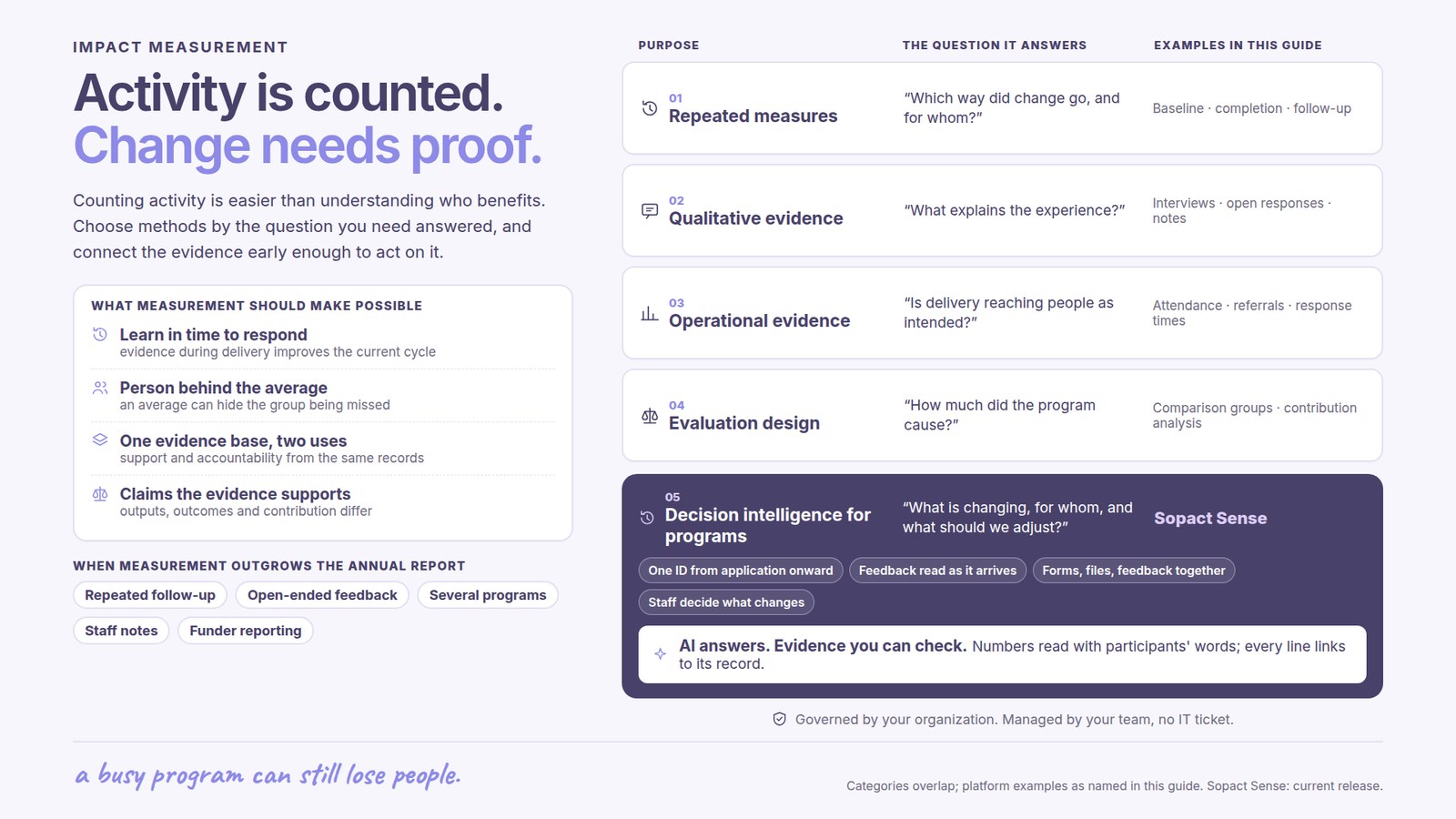
Frameworks tell you what to measure. Sopact runs the layer that fills them.

Logic model, theory of change, SROI, IMP — every framework assumes you already have longitudinal, mixed-method data on a persistent participant record. Most nonprofits don't. Sopact is the data collection layer that makes the framework operate.

Methodology

What the framework tells you

Logic model

Inputs → activities → outputs → outcomes mapped to your program.

Theory of change

Causal chain from immediate change to long-term impact.

SROI

Monetized social return per dollar invested.

IMP 5 dimensions

What, Who, How Much, Contribution, Risk — portfolio-level framing.

Data needed

What the framework assumes you collect

Output + outcome indicators

Counts, attendance, and outcome metrics per participant.

Pre/post + intermediate

Baseline and follow-up at each link in the causal chain.

Pre/post + counterfactual

Plus monetized proxies and an estimate of what would have happened anyway.

Stakeholder & counterfactual

Who is affected, by how much, and would they have been affected without you.

Sopact runs

The data collection layer

Persistent record

One participant ID across pre, mid, post, and follow-up. Outputs and outcomes on the same thread.

Longitudinal pulse

Conversational follow-up at every link in the causal chain. Mixed quant + qual on the same record.

Real data, not estimates

SROI calculations run from actual participant follow-up, not from study averages.

Portfolio rollup

Five programs, eight indicators, one chart — filterable by program, cohort, year.

Frameworks are downstream of data. Sopact owns both layers.

Impact measurement · workflow

Impact Measurement: From Multi-Program Intake to Fundable Outcome Narrative

One client ID issued at first contact. Every form, document, and assessment across six programs threads to the same record, so a journey from a first food card to a launched business sits in one row. Funder reports move from headcounts to outcomes, in minutes instead of months.

Step 01 · Plan the measurement

Every program starts with the same artifact: a measurement plan that names the outcomes to track, the persistent client ID, and the multilingual intake forms across each program. Defined before the first form goes out, so every cycle inherits the same architecture.

Step 02 · Generate the model

The plan becomes a Theory of Change in one pass: inputs to activities to outputs to outcomes to long-term impact. Same shape across all programs, so a client's journey from a first food card through case management to a launched business threads through one record.

Step 03 · Track every client

Stabilization intakes, case plans, financial assessments, event attendance, business milestones, and volunteer hours all arrive as forms and PDFs. Sopact links every submission to the same client ID, so cross-program journeys sit in one row instead of four disconnected systems.

Step 04 · Read the report

The funder-ready report rolls all six programs against the outcomes plan, and every metric traces back to a program activity and a stakeholder voice quote. The toggle flips between outputs (headcounts) and outcomes (economic well-being shifts).

Step 05 · Catch what's missing

Same data, different lens. Sopact scans for clients dropping off between programs, missing follow-ups at 30, 60, and 90 days, and qualitative signals not yet captured before the grant report deadline.

Prompt

Draft the measurement plan for Phase 1 · Stabilization Services. Six programs, three sites, multilingual intake in four languages. One client ID issued at first contact, used by every form and assessment from a first food card through to business launch.

Working folder

/ community-services-phase-1
program_inventory.md
client_id_architecture.md
multilingual_intake_spec.json
outcomes_plan_v2.csv
Phase 1 · Stabilization Services Onboarding
Q3 2025 · six programs · three sites · multilingual intake · client ID issued at first contact

Program context

Community services operation runs across three sites and serves newcomer families, seniors, and small business owners. Six programs in scope, four intake languages (Arabic, Urdu, Tamil, English), and a binding need to move funder reporting from headcounts to outcomes. The previous architecture lived across four disconnected tools: an intake portal, a shared drive, a document store, and a separate forms tool. Phase 1 starts with Stabilization Services on a unified record, before scaling to the remaining five programs.

Six programs in scope

  • Stabilization Services. Emergency food, gas, eviction, rental, and utility aid, with stability check-ins at 30, 60, and 90 days
  • Intensive Case Management. Formal case plans with milestone tracking and a 6-month outcome assessment
  • Financial Capability and Digital Literacy. Pre-class and post-class knowledge scoring, plus banking milestones
  • Events and Community Workshops. Attendance, languages reached, and conversion from event to enrolled program
  • Small Business Development. Readiness rubric, milestones, businesses launched, jobs created
  • Volunteer Management. Hours, engagements, and impact reports for grant compliance, replacing the legacy forms

Identity architecture

One client ID issued at first contact. The same ID carries every form, document, and assessment from a first food card through case management to a launched business. Role-based access for staff at each site. Multilingual self-correction links so clients can review and update their own record without re-keying. The 80% cleanup tax that consumed analyst time across four tools moves to zero on the unified record.

Prompt

From the measurement plan, draft the Theory of Change: Inputs, Activities, Outputs, Outcomes, Impact. Same five-column shape across all six programs, so cross-program journeys roll up cleanly. Tag the north-star outcome at the bottom.

Source

Phase 1 measurement plan · 6 programs · 3 sites · client ID architecture · funder priorities and grant outcome targets imported from the proposal narratives.

Theory of Change · Community Services Phase 1
Generated
Inputs
Program staff across three sites
Multilingual intake in Arabic, Urdu, Tamil, English
Persistent client ID issued at first contact
Federal and private grant funding cycles
Activities
Stabilization Services: emergency food, gas, eviction, rental aid
Intensive Case Management: 6-month case plans
Financial Capability and Digital Literacy classes
Small Business Development coaching, plus events and volunteer engagement
Outputs
Stabilization aid disbursed, recipients tracked by client ID
Case plans active, sessions logged on the same record
Pre-class and post-class knowledge scores recorded
Volunteer hours, event attendance, language reach captured
Outcomes
Housing stability sustained at 30, 60, and 90 days
Case milestones met by 6-month assessment
Financial knowledge delta, pre to post
Businesses launched and jobs created in community
Impact
Long-term housing stability for newcomer families
Economic mobility: income and wage progression
Family well-being and intergenerational outcomes
Community-level employment lift across three sites
North-star outcome. Percentage of stabilization clients sustaining housing at 90 days, pre-to-post knowledge delta in the financial capability cohort, and number of businesses launched with community jobs created. Phase 1 targets: 70% · +1.5 points · 12 launches and 28 jobs.
community_services_phase_1_q3.numbers
View
Zoom
Insert
Table
Chart
Text
Shape
Media
Share
Format
Client journeys
Stabilization
Case management
Financial capability
Business + volunteer
Data dictionary
Stabilization Services · Q3 2025
Phase 1 · 312 clients served · 30, 60, 90 day check-ins · linked by client_id
Recent intakes by stability checkpoint
Client · site · checkpointStatus
C-1042 · Site A · 30-dayStable
C-1067 · Site B · 60-dayStable
C-1089 · Site A · 30-dayPending
C-1103 · Site C · 90-dayStable
C-1118 · Site B · 60-dayPending
C-1134 · Site A · 30-dayStable
C-1151 · Site C · 90-dayAt risk
C-1168 · Site B · 30-dayStable
Stability outcome by checkpoint
CheckpointHoused and stable
30-day check-in87%
60-day check-in78%
90-day check-in71%
Cross-program enrollment from stabilization
Next programQ3 2025
Enrolled in Case Management38%
Enrolled in Financial Capability24%
Enrolled in Small Business Development9%
Stabilization only, no further program49%
Sheet name
Stabilization
Background

Prompt

Build the funder-ready outcomes report from the six programs. Show stability, knowledge gain, and business launch evidence, with a toggle between outputs (headcounts) and outcomes (economic well-being shifts). Every metric traces back to client_id.

Attachments

stabilization.csv
312 clients
case_plans.json
47 plans
financial_class.csv
128 records
business_milestones.csv
31 founders
json · csv · linked by client_id
Phase 1 · Outcomes report Q3 2025
Six programs · three sites · multilingual · funder-ready live link
Outputs Outcomes
Stable at 90 days
71%
▲ +12 pts vs Q2
Knowledge gain
+1.8
▲ pre-to-post on 5 scale
Businesses launched
4
▲ +3 vs prior quarter
Cross-program journeys by quarter
60%30%0%
Q4'24
Q1'25
Q2'25
Q3'25
Active program enrollment
Stabilization 35%
Case mgmt 24%
Financial 22%
Business + Vol 19%

Prompt

Scan Phase 1 across the six programs and three sites. Surface follow-up drop-offs, cross-program funnel breaks, multilingual form gaps, and missing assessments before the grant report deadline locks the narrative.

Working folder

/ community-services-phase-1
community_services_phase_1_q3.numbers
prior_quarter_benchmarks.json
multilingual_form_audit.csv
anomaly_log.md
Anomaly & Gap Report
Q3 2025 · Phase 1 Stabilization Services · 5 flags · scanned 11 days before grant report

Outliers detected

Follow-up drop · Site B
30-day check-ins at Site B running 12 percentage points below Q2 levels. Likely cause: staff reassignment during cohort intake. Personalized resends triggered on the original client record, follow-up window extended 7 days for the affected cohort only.
Cross-program funnel break · Financial to Business
14 financial capability graduates have not been offered the small business development pathway despite eligibility on the rubric. Pattern surfaced by row-level analysis across the same client_id. Worth a referral push from case managers before the quarter closes.
Multilingual gap · Tamil intake
38% of Tamil-language stabilization intakes missing the open-ended primary need field. Likely cause: form wording not landing in translation. Form revision flagged for the next localization cycle, with a back-fill prompt sent to clients via the multilingual self-correction link.

Missing data

6-month assessments · 8 case plans pending
8 of 47 case management plans have not yet completed the 6-month outcome assessment. Window closes in 11 days against the grant report deadline. Personalized resends to clients and case managers triggered, with the at-risk subset flagged for staff outreach.
Volunteer hours · 23% blank in Q3
23% of Q3 volunteer engagements logged without hours captured. Likely cause: the legacy form did not require the field. The migrated form on the unified record makes hours required at submit. Backfill scheduled for Q3 close, with affected volunteers contacted via the same client_id.

What the platform does

What does impact measurement actually involve for a multi-program nonprofit?

01

Methodology layer — logic model, theory of change, SROI.

Pre-built templates for the methodologies nonprofits actually use. Logic model on the participant record, not in a separate document. Theory-of-change indicators tracked longitudinally. SROI calculations run from real participant data, not from study estimates.

02

Longitudinal data collection on a persistent record.

Pre-program, mid-program, post-program, one-year follow-up, alumni cohort — all on the same participant thread. Conversational reminders pull response rates well above the survey-tool baseline (industry: ~18–22% per M+R Benchmarks).

03

Multi-program aggregation.

Five programs, eight outcome indicators, one chart. Filter by program, cohort, year, demographic. The annual report runs from the thread on demand. No Q4 reassembly project across spreadsheets.

04

Mixed-method analysis — quantitative + qualitative.

Open-text participant narratives read against the framework alongside numeric indicators. Deterministic mixed analysis with citation trails back to source data. Every claim defensible to a board, a funder, an auditor.

Why this product

Why impact measurement needs a data layer, not another framework.

  1. 01

    The persistence-gap.

    A nonprofit can run any single program's data collection fine. The gap shows up at the multi-program, multi-year roll-up — when the executive director has to answer how all five programs are doing against the same outcome framework. The cost of the persistence-gap is the next grant renewal.

  2. 02

    The Q4 reassembly problem.

    Every fall, your team reassembles the annual report from four spreadsheets, a survey export, a Word document, and a Drive folder of program notes. Three to four weeks of staff time. Numbers re-keyed by hand. By the time the report is ready, the data is six months old. The report has to live on the thread, not get rebuilt every year.

  3. 03

    The mixed-method problem.

    Most platforms treat numbers and narratives as different products. Numbers go in a dashboard; narratives go in a quote bank. The framework wants both on the same record — output counts alongside participant stories that explain what the outputs meant. Sopact runs the qualitative analysis against the framework, with citation trails back to the participant's own words.

The annual report is not a discipline problem. It's an architecture problem. Build the layer that writes the report, and the report stops being a project.

Who runs impact measurement on Sopact

Three multi-program nonprofits, three different outcome frameworks.

Multi-program civil rights · nonviolence education

The King Center

Atlanta · mission-aligned outcome indicators across distinct programs.

Multi-program tracking against the King Center's nonviolence education framework, with mission-aligned indicators rolled up to one persistent participant record across program lines. Annual reporting runs from the thread instead of from a Q4 reassembly across program teams.

Read the case study. sopact.com/customer/king-center

Arts education · national-scale audience programs

The Kennedy Center

Washington DC · arts education and accessibility programs.

Program-by-program outcome tracking across distinct audience segments. Mixed-method data — attendance and quantitative reach alongside qualitative participant narratives — on the same outcome framework. Post-program follow-up runs against the same record as initial engagement.

Read the case study. sopact.com/customer/kennedy-center

Youth mentoring · multi-year cohort

Boys to Men Tucson

Tucson · multi-year youth mentoring cohorts.

Theory-of-change indicators tracked across pre-program, mid-program, post-program, and one-year follow-up. Participant-level persistent record carries from intake through alumni outcome. The cohort report runs from the thread, not from a stitched survey export.

Read the case study. sopact.com/customer/boys-to-men-tucson

The participant lifecycle thread

How does impact measurement and management work in practice?

One participant. One persistent ID. Five stages, from program intake through alumni follow-up. Every stage writes to the same record. Every framework reads from the same record.

  1. Stage 01 · Intake

    Participant intake

    Smart form aligned to the program's logic model. Demographics, baseline indicators, consent. Identity locks to a participant ID (e.g., P-1843).

  2. Stage 02 · Pre-program

    Baseline + theory of change

    Baseline measurement on the same indicators the framework will track later. Theory-of-change link captured: which inputs are expected to drive which intermediate outcomes.

  3. Stage 03 · Mid-program

    Mid-program pulse

    Conversational check-in mid-way through the program. Drift surfaces against the participant's own baseline, not against a cohort average. Qualitative narrative captured alongside numeric indicators.

  4. Stage 04 · Post-program

    Post-program + outcomes

    Exit measurement on the framework's outcome indicators. Mixed-method: quantitative pre/post delta and qualitative participant story, both on the same record.

  5. Stage 05 · Follow-up

    Longitudinal follow-up

    One-year, two-year, five-year alumni pulse. Long-term outcomes against the theory of change. Rolls up to multi-program portfolio view on demand.

Methodology comparison

Logic model, theory of change, SROI, or mixed-method — which methodology fits your program?

Four impact-measurement methodologies compared across what each tells you, who it fits, what data depth it demands, where it falls short, and how Sopact supports it as a data layer beneath the framework.
Question Logic model Theory of change SROI Mixed-method longitudinal
Sopact-native
What it tells you Inputs → activities → outputs → outcomes mapped to your program Causal chain from immediate change to long-term impact Monetized social return per dollar invested All of the above, on one persistent participant record over time
Best for Single-program reporting, funder grant applications Multi-stakeholder programs, theory-heavy interventions Cost-benefit reporting to funders, government contracts Multi-program nonprofits aggregating across years and cohorts
Data depth needed Outputs + outcome indicators Pre/post + intermediate indicators along the causal chain Pre/post + monetized proxies + counterfactual Pre/mid/post + longitudinal follow-up + mixed quant-qual narrative
Limitation Static; doesn't show why outcomes happened Theoretical; data often retrofitted to fit the chain Monetization assumptions contested across funders Requires longitudinal data collection infrastructure
How Sopact supports it Template on the participant record Causal indicators tracked over time on the same record SROI calc from real participant data, not study estimates Native — this is the layer Sopact runs

Looking to compare specific impact measurement software tools? See our dedicated comparison: Impact Measurement Software — tool-by-tool comparison.

Where to start

Which bottleneck are you solving first?

Bottleneck 01

"Q4 is a three-week reassembly project across four spreadsheets."

Start with the persistent participant record. Move intake, mid-program, and follow-up onto the same ID. The annual report runs from the thread, not from a CSV merge. Q4 stops being a project.

Bottleneck 02

"My follow-up survey response rate is below 20% and our funders are asking."

Start with the longitudinal pulse layer. Conversational reminders against the persistent record. Same participant, same channel, multi-year. Industry baseline ~18–22% per M+R Benchmarks; the persistent record is what closes the gap.

Bottleneck 03

"Five programs, five logic models, no shared outcome view."

Start with the multi-program aggregation layer. One framework rolls up across program teams. Filter by program, cohort, year. The executive summary stops being a board-prep sprint.

Common questions

Impact measurement, answered.

What is impact measurement?

Impact measurement is the practice of collecting and analyzing data to show what a program or investment changed for the people it served. It pairs a framework (logic model, theory of change, SROI) with longitudinal data on a persistent participant record. Output counts alone are not impact measurement; outcomes tracked over time, against a stated theory of change, with attribution to the program, are.

What is impact measurement and management (IMM)?

Impact measurement and management (IMM) extends impact measurement into action. Measurement is the data layer; management is what your team does with the data — redesigning a program, reallocating resources, deciding which cohorts to expand. IMM treats the data as operational, not retrospective. The annual report is a side effect, not the goal.

What is a logic model in impact measurement?

A logic model maps your program's inputs (resources), activities (what you do), outputs (what gets produced), and outcomes (what changes for participants). It is the simplest of the impact-measurement frameworks and the most common starting point. The logic model lives on each participant's record in Sopact — inputs and outputs captured at intake, outcomes tracked through follow-up.

What is theory of change, and how is it different from a logic model?

Theory of change adds the causal "why" layer to a logic model. Where a logic model lists outputs and outcomes, a theory of change articulates the causal chain — which intermediate change leads to which long-term outcome, and what assumptions hold for the chain to operate. ToC is the right framework when stakeholders disagree about how change happens, not just what changed.

What is SROI (Social Return on Investment)?

SROI is a framework for monetizing social outcomes — expressing the value of a program in dollar terms per dollar invested. SROI demands pre/post measurement, monetized proxies for non-financial outcomes, and a counterfactual estimate. It is common in funder reporting and government contracting. Sopact runs SROI from real participant follow-up data, not from study averages, which is where most SROI reports lose credibility.

What is an impact measurement framework, and which one should we use?

An impact measurement framework is a structured way to define and track outcomes. Common choices: logic model for single-program reporting, theory of change for multi-stakeholder programs, SROI for funder cost-benefit reporting, IMP five dimensions for portfolio-level framing. Most multi-program nonprofits run more than one. The framework choice matters less than having a persistent data layer underneath it.

What is an impact measurement system, and how is it different from survey software?

An impact measurement system runs your framework, your data collection, and your reporting as one connected layer. Survey software runs one survey at a time and exports CSV. The difference shows up in two places: identity (one participant record vs. one row per survey) and longitudinal tracking (continuous vs. annual snapshots). A real system makes the annual report a query, not a project.

Can your analytics platform measure program impact longitudinally?

Yes. Sopact is built around longitudinal measurement on a persistent participant record. Pre-program, mid-program, post-program, one-year, and multi-year follow-up all link to the same participant ID and the same theory of change. Conversational reminders against the persistent record close the response-rate gap that kills annual email surveys (industry baseline ~18–22% per M+R Benchmarks).

How does AI fit into impact measurement?

AI in impact measurement does two things: read qualitative narratives at scale and align them to your framework. Open-text participant stories get analyzed against your outcome indicators, with citation trails back to the participant's own words. The analysis is deterministic, not black-box — every claim defensible to a board, a funder, or an auditor.

How is impact measurement different from monitoring and evaluation (M&E)?

M&E historically separates monitoring (ongoing program tracking, internal) from evaluation (periodic outcome studies, often external). Impact measurement collapses the two onto a single data layer. Monitoring data and evaluation data live on the same participant record, so the next evaluation reads the same thread the program team uses weekly. Saves cost, raises credibility.

Is there impact measurement software for multi-program nonprofits?

Yes. Sopact is built specifically for nonprofits running multiple programs against multiple frameworks. One participant identity model carries across programs. Each program runs its own logic model or theory of change. The executive view rolls up across all programs, filterable by program, cohort, year, demographic. For tool-by-tool software comparison, see Impact Measurement Software.

What is the difference between impact measurement and impact reporting?

Impact measurement is the data collection and analysis layer. Impact reporting is the output — the annual report, the funder summary, the board deck. Reporting tools without a measurement layer underneath produce reports off whatever data happens to exist. Reporting on top of a real measurement system means the report is a query against the thread, not a quarterly reassembly project.

How long does implementation take for a multi-program nonprofit?

Three to six weeks is typical, depending on program count and existing data. Week 1: logic model templates loaded for each program. Weeks 2–3: historical data imported, participant identity unified across programs. Weeks 4–6: first cohort live, first follow-up wave scheduled. The annual report becomes a query in month two, not a project in Q4.

Bring one program. Sixty minutes is enough.

See your impact measurement running from the thread.

Discovery call · 60 minutes · with the founder & CEO. Bring one program's logic model and last year's outcome report. We'll walk through how the same data could live on a persistent participant record — and what the next annual report looks like when it's a query, not a project.