When should you consider an UpMetrics alternative?
Consider an UpMetrics alternative when your team’s collection, analysis or reporting workflow no longer fits how you operate—not simply because another platform advertises AI. Compare the effort to gather recurring evidence, maintain definitions, review findings and answer new questions across your programs or portfolio.
This guide is for foundations, funds and program teams evaluating UpMetrics, the impact reporting platform at upmetrics.com. It does not cover the similarly named business-planning product.
UpMetrics supports a broader workflow than dashboards alone. Its current platform documentation describes data collection, collaborative reporting, integration, qualitative analysis and visualization. Sopact should be evaluated through a demonstrated difference in how your team runs the work, rather than a claim that the other platform cannot collect or analyze data.
Start with the recurring job you want to improve
A reporting problem may begin well before a chart is built. A grantee submits a number without a clear reporting period. Another reports attendance where the fund expects unique people. An analyst interprets a written explanation in a separate document. A board question then sends staff back through the same files.
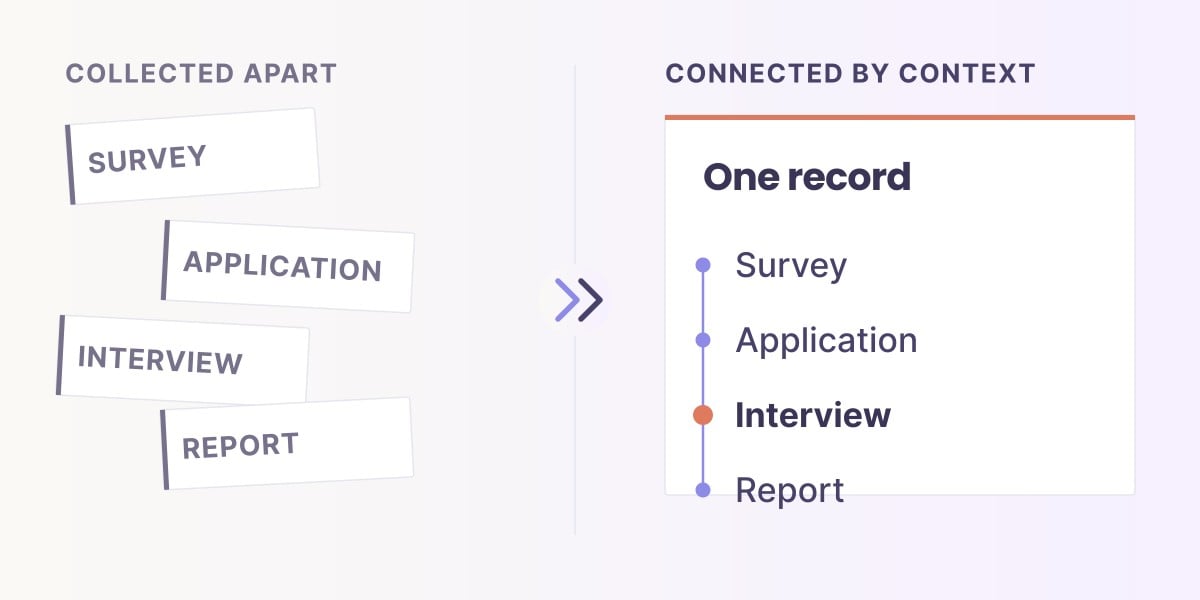
Changing the dashboard will not necessarily solve those problems. The redesign needs to connect the collection request, the contributing organization, the reporting period, the definition and the source evidence. It also needs a person responsible for clarification and approval.
Sopact’s approach brings collection and analysis into a workflow the operating team can maintain. The team defines shared fields and analytical rules, connects structured and written evidence, and reviews findings against their sources. The value to test is whether this removes repeated assembly work while making corrections and decisions easier to inspect.
That is an operating hypothesis to prove in your environment. A label such as AI-native does not guarantee accurate data, compatible measures or a well-governed report.
What UpMetrics already covers
UpMetrics describes configurable metrics, reporting questions, submitter collaboration, approvals and data integration. Its platform page also describes qualitative coding and categories alongside dashboards, including a qualitative analysis release dated August 2026. These features make a blanket “numbers only” comparison inappropriate.
Its help center separately documents collection and qualitative stories. Use those descriptions to establish the baseline for a demonstration, then inspect your actual configuration and requirements. Public documentation cannot establish how well either product will handle your particular data or team structure.
UpMetrics’ own case studies are candid about where portfolio reporting gets hard. Its Kauffman Foundation case study describes “tedious – and sometimes incomplete or error-prone – reporting efforts” built on spreadsheets and data silos. Its Foglia Family Foundation case study lists “clarity around what kind of data they needed to capture” among the challenges, and describes two years of “capacity-building professional services” for the foundation’s grantees. UpMetrics also runs funder-sponsored cohorts, at “around $5,000 per grantee, per year,” that train grantees in data collection and analysis. Take the pattern into any demonstration: a metric often arrives without the context that explains it, and building grantee data capacity tends to fall to the funder.
Sources: UpMetrics platform, Introduction to Collect, qualitative stories and collections, the Kauffman Foundation and Foglia Family Foundation case studies, and UpMetrics cohorts.
A portfolio question that reveals the real work
Consider a fictional fund supporting twelve community organizations. Each organization reports on its activities and outcomes twice a year. The fund wants to understand who was reached, what participants experienced and where partners need support.
One organization reports 300 people reached; another reports 450 attendance entries. A third reports 70% improvement among survey respondents but does not include the response count. The narratives describe transport barriers, staff turnover and changes in participation.
The fund cannot responsibly add the first two figures or compare the percentage without clarification. It needs a small common reporting core, room for local context and a review process for incompatible or incomplete returns.
A useful platform should help the portfolio lead inspect each contribution, request clarification and preserve the approved basis for a report. It should make the analyst’s work easier without pretending that a fluent explanation resolves missing evidence.
Compare the same complete workflow in both platforms
Ask both vendors to work through the same authorized sample. The following questions are evaluation criteria, not unsupported feature scores.
| Work to test | Demonstration request | Evidence of a good fit |
|---|---|---|
| Recurring collection | Send a reporting request, receive an incomplete return and handle clarification. | The contributor, period, source and approval status remain clear. |
| Shared definitions | Combine compatible measures while keeping a locally defined measure separate. | The report explains what is included and why some data cannot be aggregated. |
| Qualitative analysis | Apply reviewed categories to written responses and inspect the supporting passages. | Staff can challenge a classification, handle exceptions and retain context. |
| Changes | Revise a definition and identify which earlier findings require review. | The team can distinguish previous approved results from revised analysis. |
| Source inspection | Open a portfolio finding and inspect the underlying records and calculation. | The result is explainable beyond a chart or generated sentence. |
| Ownership and access | Have the program lead make an ordinary change and test another role’s view. | Responsibilities are clear and sensitive information stays appropriately restricted. |
For Sopact, demonstrate the connected collection-and-analysis workflow rather than relying on a promise that “every number has proof.” For UpMetrics, demonstrate the configured reporting and analysis process rather than assuming its public feature list answers every operational question.
Qualitative features are not the same as a scalable analysis workflow
The important distinction is how much of the analytical cycle the team can run reliably—not whether a platform has a field called qualitative data. Storing a story, organizing it under a category and showing it beside a chart can be useful. A recurring operation may need substantially more: apply reviewed definitions across thousands of responses, revise those definitions as new evidence arrives, connect the resulting findings to quantitative measures and inspect the source behind an answer.
UpMetrics documents qualitative coding and categorization. That establishes a capability, but it does not establish equivalence with the complete workflow described below. Ask each vendor to demonstrate every step; do not infer either parity or absence from a feature label.
| Analytical job | A limited workflow leaves staff doing this | The Sopact workflow to test |
|---|---|---|
| Apply a codebook across the dataset | Read a manageable subset or apply categories record by record. | Apply team-defined analysis across the configured eligible records, with coverage and exceptions visible for human review. |
| Improve a definition | Revisit earlier responses manually, or leave old and new classifications mixed together. | Re-run the analysis on the affected records with the revised definition, then review the findings that changed. |
| Ask across comments and numbers | Export categories, match them to ratings or outcomes and rebuild the analysis. | Analyze connected response, participant and period context together, using valid identifiers and relationships. |
| Inspect a finding | Search for a memorable quote after the aggregate is produced. | Inspect the source records supporting the result, including exceptions and conflicting accounts. |
| Repeat the work next cycle | Reconstruct instructions and analysis steps around another set of files. | Run the same analysis on incoming data, with defined review responsibilities. |
This table contrasts levels of workflow completeness; it is not a claim that every UpMetrics deployment uses the limited approach. The distinction becomes credible when demonstrated on your own data.
The major saving is the repeated work you no longer rebuild
Imagine a fictional portfolio with 4,000 open-ended responses. At three minutes per response, one manual coding pass would require 200 hours. Revisiting half the responses after a definition changes would add another 100 hours. That is 300 hours before joining classifications to ratings or preparing a report.
These are explicit planning assumptions, not measured Sopact results. AI-assisted analysis still requires definition design, configuration, exception handling and quality review. Measure those activities during the pilot. The potential saving comes from reducing repeated application, recoding and reconciliation—not removing the judgment that makes the analysis defensible.
Make agentic analysis accountable
For Sopact, test a repeatable sequence: apply the approved definitions, identify incomplete or ambiguous evidence, connect valid quantitative measures, prepare findings and let an authorized reviewer inspect the sources. A useful agentic workflow carries those rules and record relationships forward rather than asking staff to reconstruct them in a new chat for each report.
Keep the analysis scope, the definition in use and the review status explicit. Automation can process a larger eligible dataset without making every classification correct. Sampling for quality review still matters even when the analysis covers all eligible responses.
Keep quantitative and qualitative evidence connected where the relationship is valid. A comment about one program should not explain another program’s score simply because both were submitted by the same organization. Preserve the program, period and question context.
WATCH THE EXPLANATION
Watch: why qualitative analysis stays small—and how to scale it
This Sopact explanation focuses on applying and revising a team-owned codebook, then connecting the findings to the numbers. Use it to test the depth of an analysis workflow, not to assume a competitor lacks every part of it.
In your pilot: revise one definition and measure the staff effort needed to update the affected analysis, verify it and reconnect the result to the quantitative evidence.
Connect the record without erasing uncertainty
Use stable organization and program identifiers, with separate reporting periods and submissions. A fund may support the same organization through multiple awards. Those awards can share an organizational profile without collapsing their results into one indistinguishable record.
Maintain a data dictionary for the core measures: definition, unit, eligible population, period, source and aggregation rule. Allow program-specific additions where they serve a real purpose. When two measures cannot be compared, make that limit visible.
Source links improve traceability, but they do not prove the source is correct. A grantee’s self-reported result, a participant response and an independently verified outcome carry different evidential weight. Your report should preserve that distinction.
Decide who may revise definitions, approve findings and release external reporting. A connected system is valuable only if the organization can explain how an answer was produced and who accepted responsibility for using it.
Build the ownership case around repeated work
List the tasks your team repeats each reporting cycle: preparing requests, following up, reconciling organization names, interpreting narrative, checking totals, formatting reports and responding to new questions. Include the people who contribute data, not only the analysts receiving it.
Then run the pilot and record the same tasks. If a new workflow reduces report assembly but increases contributor burden or creates a permanent technical dependency, that tradeoff belongs in the decision.
A useful self-managed workflow lets responsible staff make ordinary collection and analysis changes. A self-governed workflow keeps definitions, access and review accountable. Neither means there is no implementation work. Ask who will maintain integrations, resolve failed transfers and onboard a new program owner.
Keep existing systems where they serve a clear role. Your grant administration or finance system may remain the authority for awards and payments, while a reporting workflow uses permitted data from it. Test the transfer and correction process rather than assuming an integration will preserve context automatically.
Pilot one fund or program before making a migration decision
Choose one reporting question and a representative sample of current and historical records. Include incomplete responses, inconsistent measures and a returning organization. Avoid selecting only the cleanest data.
- Document the starting point: record the source systems, identifiers, definitions and approved report you need to reproduce.
- Run collection and review: submit a return, request clarification and inspect the approved version.
- Analyze: combine compatible measures, examine written evidence and account for missing data.
- Correct: change one source value or definition and verify the affected result without silently overwriting prior approval.
- Reconcile and export: compare counts, relationships and reports; confirm what can be taken out in a usable form.
Keep the current reporting process available until the pilot is accepted. Historical data may lack source responses or consistent definitions. Importing those records does not recreate evidence that was never retained; document those gaps instead.
When staying with UpMetrics may be the right decision
If your team already collects, reviews and reports reliably in UpMetrics, a defined configuration improvement may be more valuable than a platform change. If the main issue is unclear measures or inconsistent program practice, resolve that design problem before expecting a migration to fix it.
Include Sopact when your team wants to test a different way to own recurring collection, qualitative analysis and source inspection. Choose it only when the pilot demonstrates a meaningful improvement in your complete workflow.
Turn the comparison into a useful report
Finish the pilot with an output your board or program team would actually use. State what changed, whose data is included, what remains uncertain and what action follows. Use the impact report guide for structure and the report examples to examine possible formats.
Frequently asked questions
Is UpMetrics only a dashboard platform?
No. Its current documentation describes collection, collaborative reporting and qualitative analysis as well as visualization. Evaluate the complete configured workflow.
Can historical records be moved to another platform?
Assess the available exports, attachments, identifiers, permissions and source evidence first. Test a sample and reconcile it. Do not assume that every historical relationship or approved report can be recreated automatically.
Does AI remove the need for an impact analyst?
No. AI can assist with repeated analysis and evidence preparation. People still define meaningful measures, examine limitations, review interpretations and approve claims.