New webinar on 3rd March 2026 | 9:00 am PT
In this webinar, discover how Sopact Sense revolutionizes data collection and analysis.
Build a results framework that connects project objectives to measurable outcomes. Master results-based monitoring and evaluation with AI-powered evidence systems.
Build a results framework that connects every project objective — from activities and outputs to outcomes and impact — to measurable indicators and real-time evidence. Learn how organizations are moving beyond static results matrices to AI-powered results-based monitoring and evaluation systems that prove what changed, for whom, and why.
FOUNDATION
If a funder asks "Show me the results," can you trace a clear line from what you invested to what actually changed? A results framework is your answer — a structured planning and management tool that maps the causal chain from project activities through outputs, outcomes, and impact, with performance indicators at every level that prove whether your intervention is working.
A results framework is a graphic representation of a project or program strategy grounded in cause-and-effect logic. It organizes your intervention into hierarchical levels — typically Activities/Inputs, Outputs, Outcomes (sometimes called Intermediate Results), and Impact/Goal — and assigns measurable indicators to each level. The framework was introduced by USAID in the mid-1990s as a results-based approach to program management and has since been adopted across international development, government, foundations, and social sector organizations worldwide.
Unlike a simple activity plan, the results framework forces you to articulate what changes as a result of your work — not just what you do. It shifts the focus from implementation tracking ("Did we deliver the training?") to results tracking ("Did the training change behavior?").
Some practitioners call this a "results chain," "results matrix," "strategic results framework," or embed it within "results-based management" (RBM) systems. The core idea is the same: making explicit the causal logic between your interventions and their intended results, then measuring whether that logic holds.
Unmesh Sheth, Founder & CEO of Sopact, explains why results frameworks must connect to living data systems — not remain planning documents that sit in proposal binders while real data collection happens in disconnected spreadsheets.
The shift toward results-based monitoring and evaluation isn't optional anymore. Donors, boards, and beneficiaries are demanding evidence of impact — not just proof of activity. The World Bank, USAID, DFID (now FCDO), the EU, and UN agencies all require results frameworks as part of project design. Corporate CSR programs, foundations, and impact investors increasingly adopt results-based approaches to demonstrate that resources translate into meaningful change.
But here's the gap most organizations face: they design beautiful results frameworks during project planning, then implement using disconnected tools that can't actually track results across the causal chain. The framework that was supposed to guide monitoring and evaluation becomes a compliance artifact — a static diagram that nobody updates, tests, or learns from.
BUILDING BLOCKS
Every results framework is built on a results chain — a series of cause-and-effect relationships that connect what you invest to what changes. Understanding each level — and the critical distinctions between them — is the foundation for building a framework that drives decisions rather than gathering dust.
1. Inputs/Resources — What you invest: funding, staff, expertise, technology, partnerships. These are the preconditions for implementation. Example: $250K budget, 5 staff, Sopact Sense platform, 12 community partner organizations
2. Activities — What you do with those inputs: training sessions, data collection, service delivery, capacity building, advocacy campaigns. Example: Conduct 30 skills training workshops, establish 10 savings groups, deliver mentorship to 200 youth
3. Outputs — The direct, countable products of activities: deliverables, completions, items distributed. Outputs confirm implementation happened. Example: 200 youth completed training, 10 savings groups established, 500 mentorship hours delivered
4. Outcomes — The changes that occur because of outputs: behavioral shifts, skill acquisition, condition improvements, systemic changes. This is where the real value of a results framework becomes clear — outcomes prove what changed, not just what was delivered. Example: 75% of graduates demonstrate job-ready skills, 60% increase in household savings, improved self-efficacy scores
5. Impact/Goal — The long-term, sustainable change your project contributes to: systemic transformation, population-level improvements, lasting shifts in conditions. Example: Reduced youth unemployment in target communities, sustainable economic empowerment
This distinction separates compliance reporting from impact evidence:
Output: "We trained 200 youth" — a delivery metric confirming you did what you planned.Outcome: "145 gained employment-ready skills and 88 secured jobs within 6 months" — evidence of actual change.
Most organizations track outputs religiously — participant counts, sessions delivered, materials distributed — because these are easy to count. Outcomes require more sophisticated measurement: baseline-to-endline comparisons, participant-level tracking over time, qualitative evidence of behavior change. A strong results framework demands evidence for both.
Every level of your results framework needs performance indicators — specific, measurable signals that confirm whether results at that level were achieved. Good indicators follow the SMART criteria: Specific, Measurable, Achievable, Relevant, and Time-bound.
Weak indicator: "Improved livelihoods"Strong indicator: "60% of participating households report 25% increase in monthly income within 18 months, verified by household surveys"
The indicator isn't useful unless you also define how you'll collect evidence for it. A results framework without a data collection plan is a set of promises you can't keep.
Every causal link in your results chain depends on assumptions — external conditions that must hold true for results at one level to lead to results at the next. "If we train youth (activity) and employers value the training (assumption), then youth gain employment (outcome)."
Strong results frameworks make assumptions explicit and monitor them continuously. When assumptions fail — and some always do — the framework needs to adapt rather than discovering the problem in a final evaluation report.
THE PROBLEM
The results framework concept is powerful. The execution, however, routinely breaks down at the point where framework meets data.
Teams invest significant effort designing results frameworks for donor proposals — objectives aligned, indicators defined, results chain articulated. The donor approves. Then implementation begins, and data collection happens in completely disconnected systems. Activity tracking lives in Excel. Surveys run through Google Forms. Interview transcripts sit in shared drives. Financial data lives in accounting software. No system connects these sources to the results framework structure.
When reporting time comes, teams spend weeks retrofitting messy data back into the results framework — manually merging spreadsheets, recalculating indicators, and searching for evidence they should have been collecting all along.
The fundamental problem isn't the framework — it's that traditional tools never connected it to a data pipeline. Each data source operates independently, with no shared participant identifiers, inconsistent formats, and incompatible structures. Teams spend 80% of their M&E time cleaning, merging, and reconciling data — and only 20% actually analyzing results.
Results framework outcomes often require more than quantitative metrics. "Improved self-efficacy" or "strengthened community resilience" demands interview data, open-ended survey responses, and narrative evidence that captures how and why change happened. But most organizations lack the capacity for systematic qualitative analysis.
The result: frameworks that track quantitative outputs ("200 trained") but can't explain outcomes ("Did behavior actually change? For whom? Under what conditions?"). The richest evidence sits unanalyzed in field notebooks, audio files, and survey text fields.
Traditional results-based M&E happens at fixed intervals — quarterly reports, mid-term reviews, final evaluations. By then, it's too late to course-correct. Assumptions failed months ago. Activities that weren't producing outcomes continued consuming resources. The shift organizations need: from "Did we achieve results?" (asked once) to "Are we achieving results, and what should we adjust?" (asked continuously).
FRAMEWORK
Most results frameworks fail because they're designed as compliance tools rather than management instruments. Here's the practitioner-tested process for building a framework that stays connected to evidence throughout the project cycle.
Start with the long-term change your project contributes to. What improves in people's lives? What systemic conditions shift? This becomes your impact statement — the north star that every other level of your results framework must connect to.
Example Impact: "Youth in underserved communities achieve sustainable economic self-sufficiency through employment and entrepreneurship."
Why backwards? Starting with activities traps you in describing what you do. Starting with impact forces every level of your results chain to justify its existence.
What intermediate changes must occur for participants to reach that impact? Map these as short-term, medium-term, and long-term outcomes, each with specific indicators:
Short-term: Participants gain technical skills and professional confidence (measured by assessment scores and self-efficacy scales)Medium-term: Participants secure employment or launch businesses within 6 months (measured by employment verification surveys)Long-term: Sustained career growth and income stability over 2+ years (measured by longitudinal follow-up surveys)
Sopact approach: Intelligent Column correlates baseline-to-endline changes across outcome dimensions, identifying which short-term outcomes predict long-term success — so you focus resources on what actually matters.
Set measurable output targets that confirm activities happened as planned. Then — critically — design the data collection system that captures outputs linked to participant IDs from day one.
This is where most results frameworks break down in practice. Teams define beautiful indicators but collect data in disconnected systems. When reporting time comes, they spend 80% of their effort cleaning data rather than analyzing results.
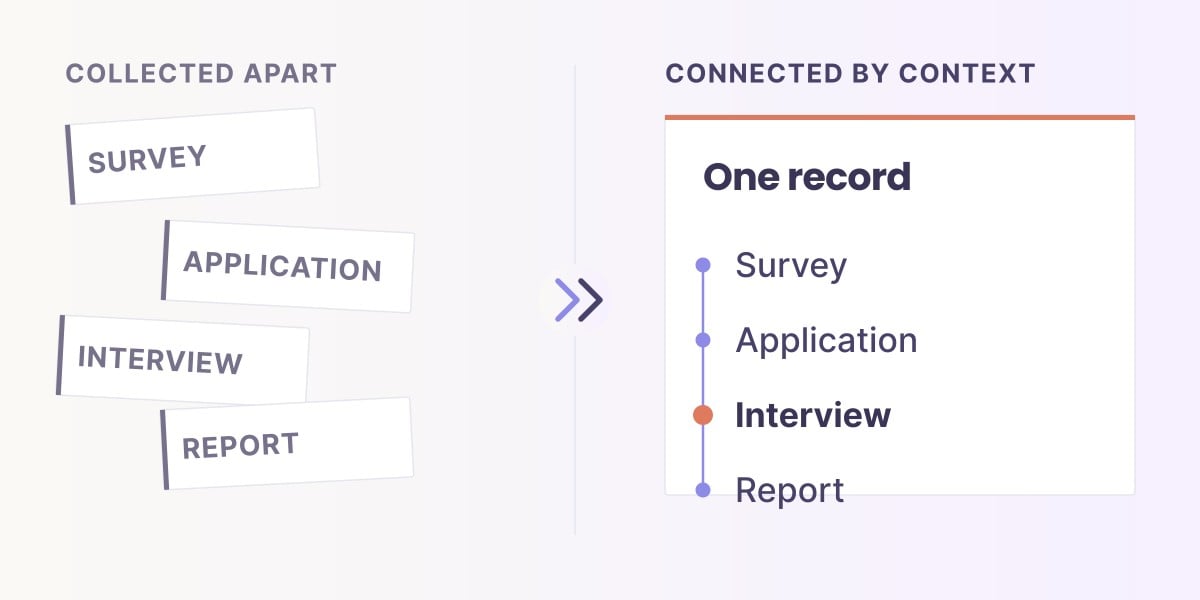
Sopact approach: Clean-at-source data collection with persistent unique participant IDs. Every form response, assessment score, and interview transcript connects through a single identifier. Unique reference links ensure zero duplication — each participant gets one record, one continuous journey through your results framework.
Design specific activities that logically produce your defined outputs and outcomes. For each indicator, specify exactly how evidence will be collected: who collects it, how often, in what format, at what cost.
If your results framework promises outcome data but your budget can't fund the necessary surveys, interviews, or follow-up assessments, the indicator is meaningless. Practical means of verification are as important as the indicators themselves.
List every external condition that must hold true for your results chain to work. Then design monitoring systems that check assumptions in real time — not just at mid-term review.
Sopact approach: Intelligent Cell extracts qualitative evidence from open-ended responses and interviews, revealing when assumptions break down. When a participant writes "The job market collapsed after the factory closed," that's your assumption being tested — and you learn about it now, not at the final evaluation.
IMPLEMENTATION
The gap between designing a results framework and using it for decisions is where most organizations fail. Here's what separates a compliance artifact from a strategic management tool.
A living results framework connects each level of the results chain to evidence captured at the source. This requires three architectural decisions:
1. Persistent Participant IDs — Every beneficiary gets a unique identifier at first contact. Baseline data, activity participation, output delivery, outcome measurement — all linked to that single ID across the entire project cycle.
2. Clean-at-Source Collection — Design data collection instruments that produce analysis-ready data from the moment it's captured. No more collecting messy data in one system and spending weeks cleaning it for another. Sopact Sense eliminates the "80% cleanup problem."
3. AI-Native Analysis — Qualitative evidence (interviews, open-ended responses, focus group transcripts) gets analyzed alongside quantitative indicators. No more choosing between numbers and stories — your results framework comes alive with both.
Intelligent Cell — Processes individual data points. Extracts themes from open-ended responses, scores interview transcripts against rubrics, flags when participant experiences contradict your results chain assumptions. Maps to: Output and outcome measurement at the data point level.
Intelligent Row — Summarizes each participant's complete journey through your program. Pull up any ID and see their full pathway — from intake through activities, outputs, to outcome measurement. Maps to: Individual-level results tracking across the full chain.
Intelligent Column — Identifies patterns across cohorts. Which outputs correlate with outcome achievement? Where do participants with different backgrounds diverge? Maps to: Results chain testing at scale — proving (or disproving) your causal logic.
Intelligent Grid — Generates reports that map directly to your results framework structure. Shows funders and boards exactly how activities translated to outputs, outputs to outcomes, and outcomes to impact. Maps to: Donor reporting and results-based accountability.
RESULTS-BASED M&E
Results-based monitoring and evaluation (RBM&E) represents a fundamental shift from traditional M&E. While traditional approaches focus on tracking implementation — "Did we do what we planned?" — results-based approaches focus on tracking change — "Did what we did actually make a difference?"
Traditional M&E tracks inputs and activities: budgets spent, workshops delivered, participants counted. Results-based M&E tracks outcomes and impact: behaviors changed, conditions improved, systems transformed. The distinction isn't just semantic — it changes what you measure, how you measure it, and what you do with the findings.
A results-based approach requires: (1) clearly defined results at each level of the chain, (2) measurable indicators for each result, (3) baseline data against which to measure progress, (4) systematic data collection tied to indicators, and (5) feedback loops that connect findings to decision-making.
Many organizations now use "MEL" (Monitoring, Evaluation, and Learning) frameworks that embed learning into the results-based approach. The addition of "Learning" signals a critical shift: results data isn't just for accountability reporting — it's for improving programs in real time.
A strong MEL framework built on a results framework:
Monitors outputs and early outcome indicators continuously — catching problems while there's still time to adjustEvaluates the strength of causal links in the results chain — testing whether outputs actually produced outcomesLearns from both successes and failures — adapting activities, revising assumptions, and improving the theory behind the results chain
Sopact Sense supports the full MEL cycle by connecting every data point to the results framework structure, enabling real-time monitoring, automated outcome analysis, and continuous learning without the manual data wrangling that kills most M&E systems.
International Development: Required by USAID, World Bank, EU, DFID/FCDO, and UN agencies. The results framework serves as both a planning tool and a contractual accountability mechanism.
Foundations & Grantmakers: Use results frameworks to assess grantee performance, compare across portfolios, and demonstrate impact to boards and stakeholders.
Corporate CSR & ESG: Adopt results-based approaches to prove that social investments create measurable change — moving beyond activity reporting to outcome evidence.
Government Programs: Apply results frameworks to link policy investments to measurable improvements in citizen outcomes — from education and health to employment and safety.
FRAMEWORK COMPARISON
Understanding how the results framework relates to other common M&E frameworks helps you choose the right tool for each context — and understand when to use them together.
A hierarchical diagram showing the causal chain from activities through outputs, outcomes, and impact, with performance indicators at each level. Emphasizes measurable results and results-based management. Used for strategic planning, performance monitoring, and donor accountability.
📊 Shows WHAT results you expect and HOW you'll measure progress toward them
A structured 4×4 grid adding means of verification and assumptions to the results chain. More detailed than a results framework at the indicator level, with explicit evidence sources and risk factors for every objective.
📋 Shows WHAT you'll deliver, HOW you'll prove it, and WHAT must hold true
Goes deeper by explaining why and how change happens in complex systems. Surfaces preconditions, contextual factors, and the reasoning behind causal links. Less structured than results framework or logframe, more exploratory.
🧭 Shows WHY change happens and under what conditions
A horizontal flowchart showing inputs → activities → outputs → outcomes → impact. Simpler than a results framework (fewer indicator requirements), focused on program visualization and communication.
🔗 Shows HOW resources translate to results in a sequential flow
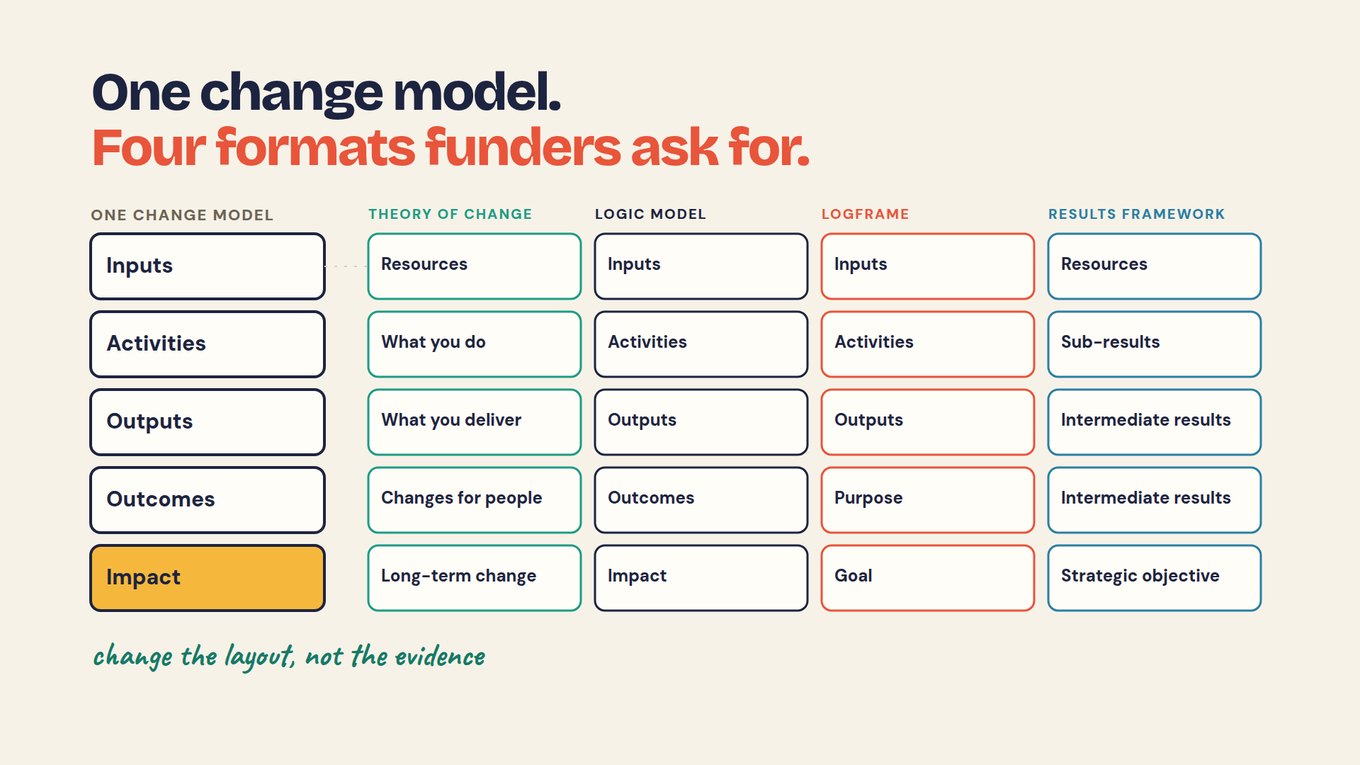
The most effective organizations don't choose one framework — they layer them:
Theory of Change provides the strategic rationale (why your approach should work)Results Framework provides the measurement architecture (what you'll track and how)Logframe provides the detailed accountability matrix (indicators, evidence sources, assumptions at each level)Logic Model provides the communication tool (simple visual for teams and stakeholders)
Sopact Sense supports all four frameworks by connecting every indicator, assumption, and data point to real-time evidence — transforming static planning documents into living management tools.
Get answers to the most common questions about building, implementing, and using results frameworks for monitoring, evaluation, and learning.
NOTE: Write these as plain H3 + paragraph text in Webflow rich text editor. The JSON-LD schema goes separately in Webflow page settings → Custom Code (Head).
A results framework is a structured planning and management tool that maps the causal chain from project activities through outputs, outcomes, and impact, with measurable performance indicators at every level. It answers "How does your intervention create change and how will you prove it?" by connecting what you invest to what actually changes. Introduced by USAID in the mid-1990s, results frameworks are now required by most major donors and used across international development, government, foundations, and social sector organizations for strategic planning, monitoring, and accountability.
A results framework is a hierarchical diagram showing the causal chain from activities to impact with performance indicators at each level — it emphasizes strategic results and performance monitoring. A logframe is a more detailed 4×4 matrix that adds means of verification (specific evidence sources) and assumptions (external conditions) for every objective. Think of the results framework as the strategic overview and the logframe as the detailed accountability matrix. Many organizations use a results framework for strategic planning and a logframe for operational M&E and donor reporting.
Results-based monitoring and evaluation (RBM&E) is a systematic approach that focuses on tracking outcomes and impact rather than just inputs and activities. While traditional M&E asks "Did we do what we planned?", results-based M&E asks "Did what we did make a difference?" It requires clearly defined results at each level of the chain, measurable indicators, baseline data, systematic data collection, and feedback loops connecting findings to decisions. Major development agencies including the World Bank, USAID, and UN agencies have adopted results-based approaches as their standard M&E methodology.
A results chain is the series of cause-and-effect relationships that form the backbone of a results framework. It connects inputs and activities (what you invest and do) to outputs (what you produce), outcomes (what changes for participants), and impact (long-term systemic change). Each link in the chain represents a causal hypothesis: "If we deliver this output, and assumptions hold, then this outcome will follow." The results chain makes your program's theory of change explicit and testable at every level.
Start with the long-term impact you want to achieve and work backwards. Define the outcomes required to reach that impact, the outputs needed to produce those outcomes, and the activities that will deliver those outputs. For each level, define specific measurable indicators and practical data collection methods. Surface every assumption your results chain depends on. Finally, design data architecture that connects evidence across all levels using persistent participant IDs — so you can actually test whether your causal logic holds in practice.
A MEL (Monitoring, Evaluation, and Learning) framework extends traditional M&E by explicitly incorporating learning into the process. While monitoring tracks progress against indicators and evaluation assesses program effectiveness, the learning component ensures that findings from both feed back into program design and adaptation. A MEL framework built on a results framework monitors outputs continuously, evaluates causal links between levels, and learns from both successes and failures to improve the program while it's still running.
A results framework is a measurement-focused tool that defines what results you expect and how you'll track progress toward them with specific indicators. A theory of change is a strategy-focused tool that explains why and how change happens, surfacing the assumptions, preconditions, and contextual factors behind your causal logic. The results framework tells you what to measure; the theory of change tells you why measuring it matters. The most effective organizations use both — theory of change for strategic depth and results framework for measurement precision.
Performance indicators are specific, measurable signals that confirm whether a result at each level of the framework has been achieved. Good indicators follow SMART criteria: Specific (clearly defined), Measurable (quantifiable or observable), Achievable (realistic targets), Relevant (directly connected to the result), and Time-bound (with a defined measurement period). For example, "60% of participating households report 25% increase in monthly income within 18 months" is a strong indicator, while "improved livelihoods" is too vague to measure.
A results framework provides the structure for donor reporting by defining exactly what to report at each project level. It maps indicators to evidence sources, establishes targets against which to measure progress, and creates a shared language between implementers, evaluators, and funders. When your results framework is connected to a living data system, donor reports can be generated automatically from clean, linked data rather than manually assembled from fragmented spreadsheets — reducing reporting time by up to 90%.
Results-based management (RBM) is a management strategy that uses the results framework as its operational backbone. Rather than managing by activities (tracking what you do), RBM manages by results (tracking what changes). All organizational functions — planning, budgeting, implementation, monitoring, evaluation, and reporting — are oriented toward achieving and demonstrating defined results. The results framework provides the structure; RBM provides the management discipline to use it continuously rather than filing it after project approval.