




Sopact is a technology based social enterprise committed to helping organizations measure impact by directly involving their stakeholders.
Useful links
Copyright 2015-2025 © sopact. All rights reserved.


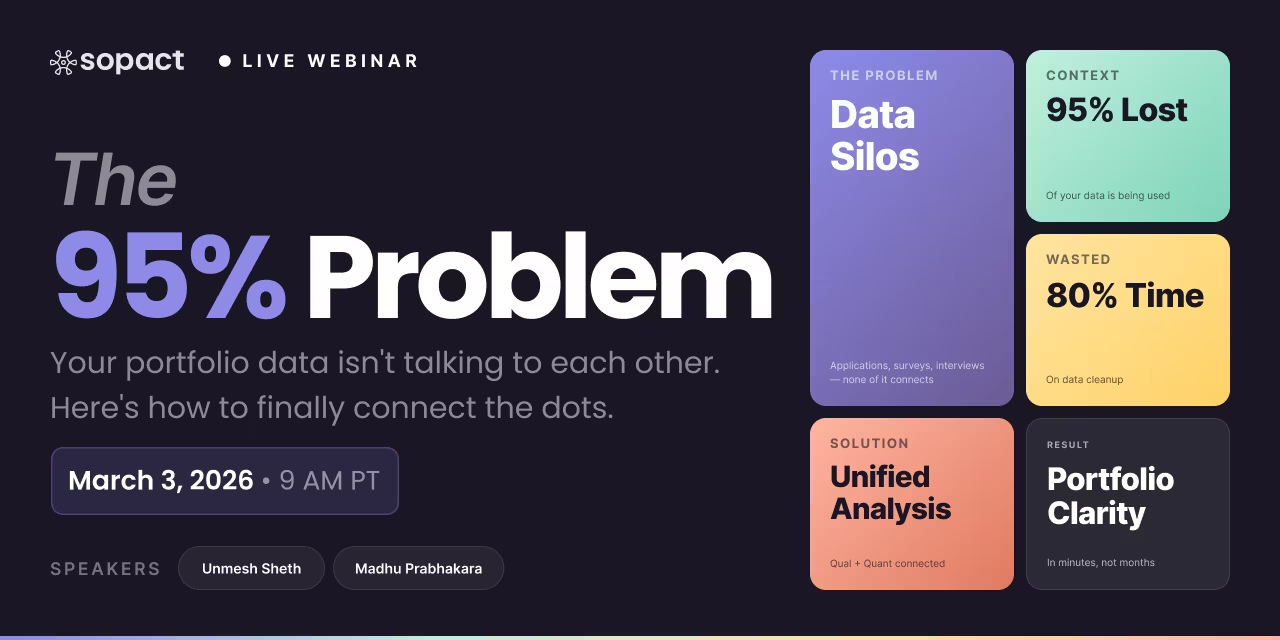
New webinar on 3rd March 2026 | 9:00 am PT
In this webinar, discover how Sopact Sense revolutionizes data collection and analysis.
Measure patient outcomes in weeks, not quarters. Learn how healthcare organizations use AI-powered data collection, clean feedback systems, and real-time.
Transform how your healthcare organization collects, analyzes, and acts on patient outcomes data. This guide shows you how to move from fragmented, quarterly reporting cycles to continuous, AI-powered care quality intelligence that connects every patient touchpoint to measurable improvement.
If a funder, regulator, or board member asks "How do you know your care is actually improving patient lives?" — can your team give a clear, evidence-backed answer in minutes? Healthcare outcomes measurement is the systematic process of collecting, analyzing, and reporting data about the results of healthcare interventions on patients' health status, experience, and quality of life.
Unlike traditional process metrics ("We treated 500 patients"), outcomes measurement answers the harder question: "Did those patients get better? How do we know? And what evidence do we have?" It connects clinical inputs, care delivery activities, and patient experience data into a causal chain that proves whether your care model works.
Despite billions invested in EHR systems and patient satisfaction surveys, most healthcare organizations still cannot answer basic outcomes questions in real time. The problem isn't a lack of data — it's that patient feedback lives in disconnected silos: CAHPS surveys in one platform, clinical outcome measures in another, discharge feedback in spreadsheets, and qualitative patient narratives in filing cabinets nobody opens.
The result? Quality improvement teams spend 80% of their time cleaning and reconciling data, and by the time insights reach decision-makers, the care delivery moment has passed. Patients have already been discharged. Complaints have already escalated. Opportunities for early intervention have already been missed.
Healthcare outcomes measurement fails when organizations treat each feedback channel as a standalone data source rather than part of a connected evidence system. Consider a typical community health center:
Patient satisfaction surveys (CAHPS, Press Ganey) arrive quarterly in spreadsheet exports. Clinical outcome measures (PHQ-9, HbA1c tracking) live inside the EHR. Discharge feedback forms use a separate survey tool. Patient interviews and focus groups produce transcripts that sit in shared drives. Community health worker notes exist in yet another system.
Each source contains genuine signal about care quality. But without a unified collection and analysis platform, nobody can connect a declining CAHPS score to the specific qualitative feedback that explains why patients are dissatisfied — or identify which clinical programs are producing the best outcomes and why.
Modern, AI-powered healthcare outcomes measurement solves this fragmentation at the source. Instead of collecting data in five disconnected tools and spending months reconciling it, organizations build unified feedback systems that maintain patient identity (with full HIPAA compliance), connect quantitative scores to qualitative narratives, and deliver real-time analysis the moment responses arrive.
With Sopact Sense, healthcare teams can design surveys that collect both structured metrics (Likert scales, NPS, clinical scores) and open-ended patient narratives in a single instrument — then analyze everything together using AI that identifies themes, sentiment patterns, and outcome correlations automatically. No manual coding. No months-long analysis cycles. No insight decay.
PROMs capture the patient's own assessment of their health status, functional ability, and quality of life. Examples include PHQ-9 for depression, PROMIS scales for general health, and condition-specific measures like the Oxford Hip Score. The challenge isn't collecting PROMs — it's connecting them longitudinally across visits and correlating them with care delivery data to understand what's actually driving improvement.
PREMs assess the patient's experience of care delivery — communication, wait times, care coordination, shared decision-making. CAHPS surveys are the gold standard in the US, but most organizations analyze them in isolation from clinical outcomes, missing the connection between experience and health improvement.
These include readmission rates, infection rates, mortality rates, and condition-specific clinical indicators. When connected to patient-reported data, clinical measures reveal not just what happened clinically but how patients experienced the care that produced those outcomes.
The most mature healthcare organizations build composite scores that blend PROMs, PREMs, and clinical outcomes into unified quality dashboards. This requires clean, connected data from the start — exactly what traditional fragmented tools cannot deliver.
Start with survey instruments that collect both quantitative metrics and qualitative feedback in one flow. Use conditional logic to route patients through relevant outcome measures based on their condition, care setting, and touchpoint (intake, mid-treatment, discharge, follow-up). Sopact Sense maintains participant identity across all touchpoints — so longitudinal tracking works automatically without manual matching.
Connect CAHPS/satisfaction surveys, clinical outcome forms, discharge feedback, patient interviews, and community health worker observations into a single data ecosystem. Every response links back to the participant, the program, and the care episode — creating a 360-degree view of each patient's outcomes journey.
Use AI-powered thematic analysis to process open-ended patient narratives at scale. Sopact Sense identifies recurring themes, sentiment patterns, and emerging concerns across thousands of responses in minutes — surfacing insights that would take manual coders weeks to discover.
Connect outcomes data to real-time dashboards that quality improvement teams can act on weekly, not quarterly. Set up automated alerts when satisfaction scores drop, when specific themes spike in patient narratives, or when clinical outcome trends diverge from targets.
Traditional healthcare survey platforms collect data. Sopact Sense connects collection, analysis, and action into one continuous system. Patient identity is maintained from the first survey through the final outcome report. Quantitative scores and qualitative narratives are analyzed together — not in separate tools. Longitudinal tracking works automatically across visits, programs, and care settings. And every insight is audit-ready, with clear data lineage from raw response to dashboard metric.
The result: healthcare teams spend 80% less time on data cleanup and 80% more time on care improvement. Quality reports that took quarters now take days. Patient narratives that sat unread now drive real-time clinical decisions.
Map your patient data ecosystem — from collection to continuous care quality insight
Use this template to design a connected healthcare outcomes measurement system. Map each patient touchpoint, define the metrics that matter, and build feedback loops that turn raw patient data into actionable care quality intelligence.
Identify the clinical outcomes, patient experience metrics, and quality indicators that align with your organization's care model. Map the causal chain: What inputs (staff, protocols, resources) drive which activities (screenings, interventions, follow-ups), producing which outputs (visits completed, assessments administered), leading to which outcomes (symptom improvement, satisfaction, functional ability)?
Build survey instruments that capture both structured metrics (PHQ-9, CAHPS scores, NPS) and open-ended patient narratives in a single flow. Use conditional logic to route patients through relevant measures based on their care setting, condition, and touchpoint. Ensure every response links to the participant and care episode automatically.
Connect satisfaction surveys, clinical outcome forms, discharge feedback, patient interviews, and staff observations into one data ecosystem. Sopact Sense maintains participant identity across all touchpoints — enabling true longitudinal outcome tracking without manual record matching.
Deploy thematic analysis on open-ended patient narratives to surface emerging concerns, satisfaction drivers, and care quality patterns. Correlate qualitative themes with quantitative outcome scores to understand not just what changed but why.
Connect outcome data to real-time dashboards. Set automated alerts for score drops, theme spikes, or outcome divergence. Quality improvement teams act on weekly intelligence — not quarterly reports that arrive after the care moment has passed.
PHQ-9, GAD-7, PROMIS scales, condition-specific measures. Track patient self-assessment of health status, functional ability, and quality of life across visits.
CAHPS scores, communication quality, care coordination, shared decision-making. Connect experience data to clinical outcomes for complete care quality picture.
Readmission rates, infection rates, treatment adherence, condition-specific clinical indicators. Link to patient-reported data for causation analysis.
Blended PROMs + PREMs + clinical outcomes into unified quality scores. Requires clean, connected data from collection through insight.
Open-ended feedback themes, sentiment analysis, emerging concern detection. The richest signal for understanding the why behind outcome scores.
Response rates, completion rates, time-to-insight, data quality scores. Measure the health of your measurement system itself.
In this section, you'll find real-world, sector-adapted examples of how healthcare organizations apply connected outcomes measurement systems to transform patient feedback into continuous care quality improvement. These examples show how different care settings — from community health centers to behavioral health programs — move beyond fragmented quarterly reports to real-time, AI-powered outcome intelligence.
A federally qualified health center (FQHC) serving 12,000 patients annually across 3 sites needed to connect CAHPS satisfaction data, PHQ-9 depression screening scores, and patient interview narratives into a unified quality improvement system.
CAHPS surveys arrived quarterly as spreadsheet exports. PHQ-9 scores lived inside the EHR. Patient interviews were transcribed but never systematically analyzed. Quality improvement meetings relied on anecdotal reports because nobody could connect the data.
By the time quarterly CAHPS results were cleaned and analyzed, the care delivery moments were 3-6 months old. Complaints had already escalated. Staff turnover had already changed the care team. The data was accurate but useless for real-time improvement.
Designed a single survey instrument combining CAHPS-derived satisfaction questions, PHQ-9 screening, and open-ended experience narratives. Patients complete it at intake, mid-treatment, and discharge — with conditional logic routing them through relevant measures based on their primary condition.
Open-ended patient comments analyzed in real time using Sopact Sense thematic analysis. Within weeks, the system identified that communication during medication changes was the top driver of dissatisfaction — a finding that would have taken manual coders months to surface.
Data cleanup time reduced by 82%. Quality improvement cycles shortened from quarterly to bi-weekly. Patient satisfaction scores increased 14% within two quarters as care teams acted on real-time narrative insights. PHQ-9 tracking became continuous rather than episodic.
A regional behavioral health provider operating intensive outpatient programs (IOP) across 5 counties needed to track patient recovery outcomes over 12 months — connecting intake assessments, weekly check-ins, and discharge outcomes into a single evidence chain.
Patients completed intake PHQ-9 and GAD-7 assessments, but follow-up scores were captured inconsistently across clinicians and sites. 40% of longitudinal data was incomplete or unmatched — making it impossible to demonstrate treatment effectiveness to funders.
Weekly group therapy sessions generated rich recovery narratives, but clinicians had no way to systematically capture or analyze them. Funder reports relied solely on quantitative scores, missing the human stories that demonstrated real transformation.
Built a connected survey system with automated follow-up sequences at intake, 30, 60, 90, 180, and 365 days. Sopact Sense maintained participant identity across all touchpoints — matching every response to the right patient and care episode without manual intervention.
Added structured open-ended prompts at each follow-up asking what had changed most in daily life since starting treatment. AI thematic analysis processed thousands of responses to identify recovery patterns, barriers, and breakthrough moments — correlated with PHQ-9 and GAD-7 score trajectories.
Longitudinal completion rates increased from 58% to 91%. The program demonstrated a 34% average PHQ-9 improvement at 6 months with qualitative evidence showing specific life changes (employment, relationships, housing stability). Funder renewal rate increased to 100% based on the depth and credibility of outcome evidence.