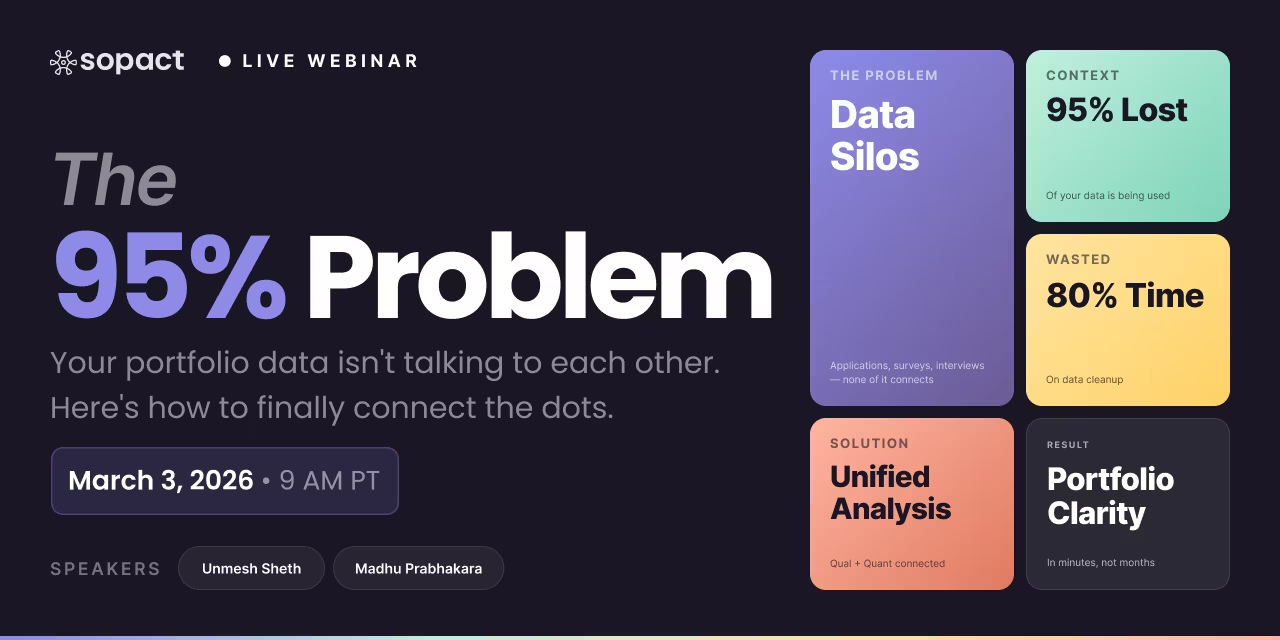
New webinar on 3rd March 2026 | 9:00 am PT
In this webinar, discover how Sopact Sense revolutionizes data collection and analysis.
Updated March 2026
OpenWater is the best-known application management platform in the awards and grants space. Four consecutive Inc5000 rankings. 60+ integrations. 10-minute average support response. For associations running annual awards programs and academic conferences managing abstract submissions, it has earned its reputation.
But "best application management platform" and "best application intelligence platform" are two different things — and in 2026, the gap between them is widening fast.
This guide compares OpenWater honestly against Sopact Sense across pitch competitions, incubators, grants, scholarships, and awards programs. Including where OpenWater genuinely wins, where the AI gap is architectural, and which organizations should switch — and which shouldn't.
OpenWater's strengths are real. So are its limitations — and they share a common root: the platform was designed to manage the workflow of human review, not to replace any part of it with intelligence.
No AI review — manual judging only. Every application, award nomination, abstract, and pitch deck that enters OpenWater must be read and scored by a human judge. OpenWater manages that process well — assignment, routing, blinded review, weighted scoring. But the AI features announced in early 2026 are early-stage and limited to basic scoring assistance, not qualitative essay or document analysis.
UI complexity draws consistent complaints. "Lots of clicks to navigate" appears in user reviews across G2, Capterra, and Trustpilot. For associations with small staff and volunteer-driven programs, a high-click interface multiplies the administrative burden at every cycle.
No outcome tracking. OpenWater's architecture stops at the award decision. What happened to the cohort you funded? Which pitch competition winners actually raised their next round? Which grant recipients achieved the outcomes they projected? These questions require data architecture that connects the application to what happened afterward — and OpenWater doesn't provide it.
Association and higher ed focus limits social good fit. OpenWater was built for associations managing member awards and academic conferences managing abstract submissions. Its positioning, integrations, and workflow assumptions reflect those buyers. Nonprofits, impact funds, and social good accelerators operating outside the association world often find the platform's assumptions don't match their programs.
Part of ASI — innovation pace reflects conglomerate reality. ASI (Association Systems Inc) is a large software conglomerate serving the association management space. OpenWater benefits from that stability — and moves at that pace. For organizations evaluating platforms in a rapidly changing AI landscape, this matters.
You run pitch competitions or accelerators — not association awards. OpenWater's integrations and workflows are built around iMIS, Salesforce AMS, and association management systems. If you're running a social impact accelerator, a startup pitch competition, or a workforce development cohort selection — the platform's core assumptions are mismatched to your context.
Review cycles are consuming more staff time than the program itself. When a two-person accelerator team is spending four weeks manually reviewing 300 pitch applications, the bottleneck isn't workflow management — it's that 300 applications need a human to read them. OpenWater makes that reading process more organized. It doesn't make it faster in any fundamental sense.
You need to prove what happened after selection. Funders, boards, and partners increasingly ask outcome questions: which cohort companies raised follow-on funding? Which fellows completed their programs? Which grantees hit their projected milestones? OpenWater stops at the decision. If your program needs to connect selection to outcomes, you need a different architecture.
Reviewer consistency is a governance issue. As programs face scrutiny around equitable selection — particularly in pitch competitions, fellowships, and community grants — the inability to audit whether judges applied criteria consistently is becoming a liability. OpenWater provides scoring aggregation but no statistical bias detection.
Sopact approaches application management from the opposite direction. Instead of optimizing how quickly humans review, it uses AI to read everything first — then surfaces what needs human judgment.
When 300 pitch applications arrive, Sopact's Intelligent Cell reads every deck summary, executive summary, and narrative response against your exact judging criteria — "demonstrates market understanding," "shows team execution capability," "presents realistic financial projections" — using natural language understanding, not keyword matching.
Each application receives a detailed AI assessment with specific evidence citations from the applicant's own submission. Judges see the AI's reasoning alongside the original text. For a three-person accelerator team, this means reviewing a ranked shortlist of 40 finalists rather than reading all 300 individually. The best applications rise to the top based on criteria — not based on who happened to get read first.
Sopact flags when judge scoring patterns diverge statistically — one judge scoring 22% above the panel mean, late-session fatigue patterns, systematic scoring differences by geography or founder demographic. Every program cycle produces an audit trail that boards and funders can review.
Every applicant receives a persistent unique ID at first interaction. That ID connects their application data to cohort check-ins, milestone surveys, and alumni outcome tracking — automatically, without manual reconciliation. When your funder asks which portfolio companies from Cohort 3 raised a Series A, the answer is already in the system.
Sopact does not offer the 60+ AMS integrations that OpenWater provides. For associations where iMIS or Salesforce AMS integration is a core requirement, OpenWater's integration library is a genuine differentiator that Sopact does not match.
Sopact is also not optimized for academic abstract management — conference submission workflows, proceedings management, and reviewer assignment at scale for academic conferences are outside Sopact's core design.
With OpenWater: Staff configures judging workflow, assigns 12 judges, 20 applications each. Judges read every application individually over three weeks. Scoring aggregated in OpenWater dashboard. Final decisions made in committee. Cohort outcomes tracked in a separate spreadsheet that's incomplete by Year 2.
With Sopact: AI reads all 250 applications overnight against accelerator rubric criteria — team dynamics, market potential, social impact thesis, execution track record. Staff reviews ranked shortlist of 50. Judges focus on top 50 and 20 borderline cases. Bias audit confirms consistent scoring across judge panels. Cohort outcomes link forward to application data through persistent IDs.
Time saved: Selection cycle from 3 weeks to 4 days. Outcome reporting from "doesn't exist" to automatic.
With OpenWater: This is OpenWater's strongest use case — mature workflow, iMIS integration, awards-specific configuration, strong support. For an association awards program with 100–200 nominations and a volunteer judge panel, OpenWater handles the logistics well.
With Sopact: AI pre-scores all nominations against award criteria, surfaces top candidates with evidence citations. Judges validate the shortlist rather than reading everything. Works well — but the iMIS integration gap may matter if the association's membership data and award history need to connect.
Best fit: OpenWater for association awards with deep AMS integration needs. Sopact where AI screening and bias documentation are the primary priorities.
With OpenWater: Application intake and reviewer workflow function well. No AI analysis of grant narratives. Program officers read all 400 narrative proposals manually. No longitudinal connection between grant selection and grantee outcomes.
With Sopact: All 400 grant narratives scored against rubric overnight. Program officer team reviews shortlist of 80. Bias audit included. Grantee outcomes connect to original application data. Board reporting generated from the same system that managed selection.
Time saved: Review cycle from 6 weeks to 1 week. Cross-grantee analysis from "never done" to automatic.
OpenWater is the right choice when:
Sopact is the stronger choice when:
OpenWater is an application and review management platform serving associations, higher education, and foundations. Part of ASI (Association Systems Inc), it handles awards programs, abstract submissions, grant management, and scholarship applications — with 60+ integrations spanning iMIS, Salesforce, MemberClicks, and other association management systems. Four consecutive Inc5000 rankings reflect genuine operational maturity and market presence in the association and awards management space.
The best alternative depends on your primary need. For programs that require AI-powered review of applications — reading and scoring pitch narratives, grant essays, and personal statements against rubric criteria — Sopact Sense is the strongest alternative. For large associations with deep iMIS integration requirements, OpenWater remains the strongest option. Other alternatives include Submittable (broad application management across use cases), Foundant (community foundation grantmaking), SmarterSelect (affordable, fast setup), and Evalato (strong for awards and accelerators, 40 languages).
OpenWater announced early-stage AI scoring assistance in 2026. However, this is limited to basic scoring support — it does not perform qualitative NLP analysis of essays, pitch narratives, or grant proposals. Full document and essay analysis — reading what applicants actually wrote and scoring it against rubric criteria — is not available in OpenWater. Every application must still be read and evaluated by a human judge.
The core difference is captured in one line: OpenWater manages the process. Sopact understands the applications. OpenWater optimizes how quickly human judges review submissions — assignment, routing, blinded panels, weighted scoring. Sopact uses AI to read every submission first — essays, pitch decks, grant narratives — scores them against your exact judging criteria with evidence citations from the applicant's own writing, then surfaces the shortlist for human judgment. The bottleneck OpenWater optimizes around is the bottleneck Sopact eliminates.
Yes — and this is OpenWater's strongest differentiator. OpenWater offers 60+ integrations including iMIS, Salesforce, MemberClicks, and other AMS systems. For associations where membership data and award history need to connect through existing AMS infrastructure, this integration library is deep and mature. Sopact does not offer equivalent AMS integrations and exports data in standard formats. Organizations where iMIS or Salesforce AMS integration is a core requirement should evaluate this gap carefully.
Yes. Every applicant receives a persistent unique ID at first interaction. That ID automatically connects their application to cohort check-ins, milestone surveys, and alumni outcome tracking — without manual reconciliation. For accelerators, this means connecting which pitch competition applicants from Cohort 3 raised follow-on funding, completed their program, or hit the milestones they projected. OpenWater stops at the award or acceptance decision; it does not connect selection data to what happened afterward.
OpenWater handles pitch competition workflows — multi-round judging, weighted scoring, blinded panels. However, it was designed primarily for association awards and academic abstract management; its workflow assumptions and integration ecosystem reflect those buyers. Social impact accelerators and startup pitch competitions outside the association world often find OpenWater's configuration overhead doesn't match their context. Sopact provides AI pre-screening of pitches alongside workflow management without the AMS integration dependency.
Sopact deploys in 1–2 days for standard programs. Application forms are configured in plain language; AI scoring criteria are written in the same language as your existing judging rubric. No professional services required. OpenWater typically requires several weeks for setup and configuration, particularly for complex judging workflows.
OpenWater pricing starts around $5,100–$6,900 per year for entry-level configurations, with custom pricing for enterprise deployments. Sopact offers published flat-tier pricing with unlimited users and unlimited forms at every tier — no per-seat cost increases. Full AI analysis is included at every Sopact pricing tier, not gated behind a premium add-on.
Sopact handles awards workflows including multi-round judging, reviewer portals, and rubric scoring — with AI pre-screening that reduces the reading burden on volunteer judge panels. However, if your association requires native iMIS or Salesforce AMS integration, OpenWater's 60+ integration library is a genuine differentiator that Sopact does not replicate. For associations where award management is primarily a workflow and integration problem, OpenWater may be the better fit. For associations where judge consistency, bias documentation, and outcome tracking are growing priorities, Sopact adds capabilities OpenWater doesn't provide.
No. Academic conference abstract management — submission workflows, proceedings management, reviewer assignment at scale for peer review — is outside Sopact's core design. OpenWater is the stronger choice for this specific use case.