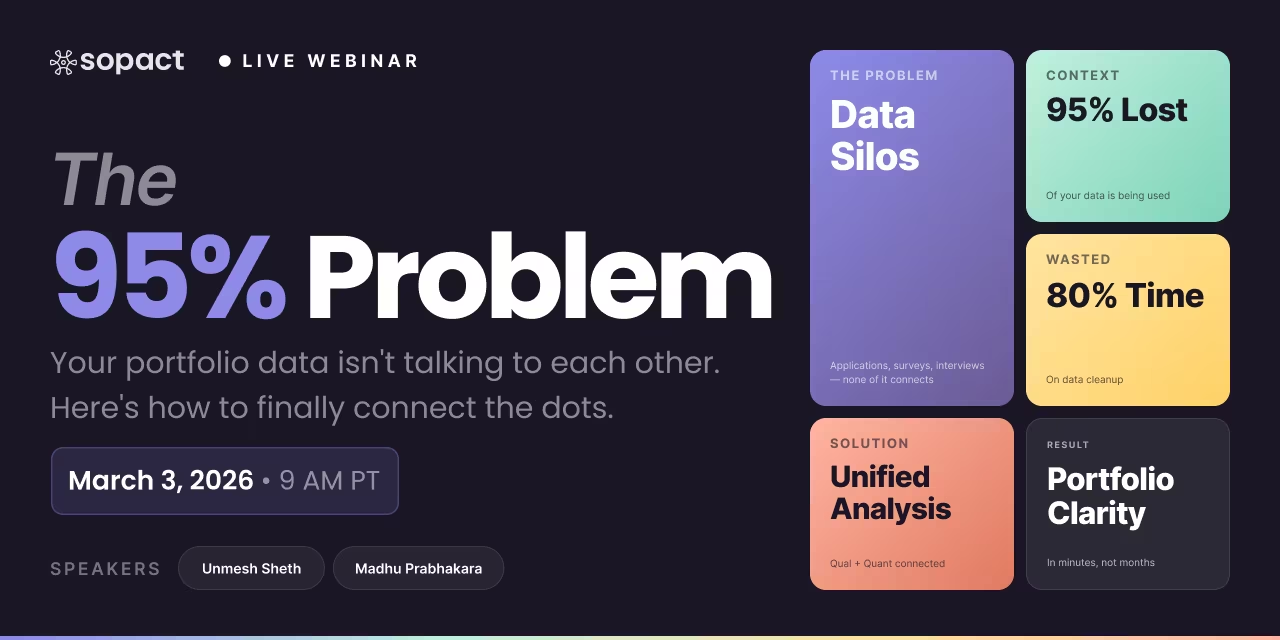
New webinar on 3rd March 2026 | 9:00 am PT
In this webinar, discover how Sopact Sense revolutionizes data collection and analysis.
The traditional review process has 7 failure points. AI fixes 5 of them. Learn how AI-native review replaces manual scoring with intelligent pre-screening, bias detection, and agentic workflows.
The traditional review process has seven failure points. AI fixes five of them.
Every organization that runs a grant program, scholarship, or fellowship knows the pain: hundreds of applications arrive, a handful of reviewers are available, and the timeline is always too short. The review process that follows — manual reading, subjective scoring, committee deliberation — has not fundamentally changed since grant-making began. What has changed is the volume, the complexity, and the expectation of fairness.
Submittable, SurveyMonkey Apply, and similar platforms digitized this process. They replaced paper with PDFs, spreadsheets with scoring portals, and postal mail with email notifications. These were meaningful improvements — in 2015. But they were improvements to a fundamentally manual workflow. The platforms were built before AI existed, and their architecture reflects that: they assume humans read every word, score every application, and catch every inconsistency.
That assumption is now a weakness, not a strength.
When your program receives 500 applications and assigns 8 reviewers, each reviewer reads approximately 60 proposals. At 30 minutes per proposal — and 30 minutes is conservative for a 20-page narrative with a budget attachment — each reviewer commits 30 hours. The review period stretches to 8-12 weeks. Reviewer fatigue degrades scoring quality after the first 15-20 applications. The proposals reviewed on Monday morning receive more thoughtful evaluation than the proposals reviewed on Friday afternoon of week three.
Sopact Sense takes a fundamentally different approach to application review — not by adding AI features to a pre-AI platform, but by building review intelligence into the data architecture from the ground up. Sopact Sense replaces traditional application workflow tools with AI-native, agentic workflows that manage applications end-to-end and connect them to longitudinal outcomes in a single loop. The result is a process where AI does the reading, humans do the thinking, and the system learns from every cycle.
📌 HERO VIDEO PLACEMENT — Embed YouTube video here: https://www.youtube.com/watch?v=pXHuBzE3-BQ&list=PLUZhQX79v60VKfnFppQ2ew4SmlKJ61B9b&index=1&t=7s
Every credible application review process starts with a rubric. This is not optional. Without anchored criteria, reviewers default to gut instinct, and gut instinct is where bias lives.
Research from Brown University's Sheridan Center for Teaching and Learning identifies the essential elements of effective rubrics: 4-6 criteria for most reviews (more for significant awards), 4 quality levels per criterion (consistency decreases as levels increase), anchor descriptions that define what "excellent" and "inadequate" look like with concrete examples, and exemplar proposals that calibrate reviewer expectations before scoring begins.
The NIH's 2025 simplified review framework reorganized five criteria into three scoring factors — Importance of Research, Rigor and Feasibility, and Expertise and Resources — specifically because the old structure enabled reputational bias. Under the new framework, Expertise and Resources receives a sufficiency assessment rather than a numerical score, removing one vector through which institutional prestige inflated ratings.
In Sopact Sense, rubric building is the first step in configuring your review. You define criteria, set weight distributions, write anchor descriptions, and — critically — the AI uses this rubric as its scoring framework. The rubric is not a template reviewers fill out. It is the instruction set the AI follows when analyzing every application. Instead of static stages and complex rule trees, Sopact uses AI agents to orchestrate the entire application lifecycle.
This is where the architectural difference matters most.
In Submittable: Applications arrive and wait in a queue. Nothing happens until a human opens them. The platform cannot read a proposal. It cannot assess rubric alignment. It cannot tell you which of 500 applications are the strongest candidates before a single reviewer logs in.
In SurveyMonkey Apply: Same. Applications are stored files. The platform tracks who submitted and when. It does not understand what was submitted.
In Sopact Sense: The moment an application is submitted, Intelligent Cell processes the entire content. It reads the project narrative. It parses the budget. It evaluates outcome projections against your rubric criteria. For each criterion, it generates a proposed score and attaches sentence-level citations — the specific passages in the proposal that support the score.
This is not keyword matching. It is not counting how many times "equity" appears in the narrative. The AI reads for meaning: Does the methodology section describe a credible approach? Does the budget align with the proposed activities? Are the stated outcomes measurable and timebound? Does the team description demonstrate relevant experience for this specific project?
The output is a structured pre-assessment for every application:
Example: AI Pre-Assessment Output
Application: Youth Leadership Initiative — Riverside Community CenterOverall AI Score: 82/100
Reviewers receive this pre-assessment before they open the proposal. They are not starting from a blank page. They are starting from an informed position — and their job shifts from data extraction to judgment validation.
In a traditional system, the program officer opens each application, reads enough to determine the subject area, and manually assigns it to an appropriate reviewer. In a 500-application program, this triage alone takes 40-60 hours.
In Sopact Sense, routing is intelligent. The AI has already analyzed every application. It knows the subject area, methodology type, geographic focus, and budget range. It routes applications to reviewers based on expertise match, workload balance, and conflict-of-interest screening — automatically. Legacy platforms coordinate steps; Sopact's AI agents actually run the process — scoring, routing, follow-up, and impact reporting.
Each reviewer's queue includes the AI pre-assessment summary. Instead of reading a 40-page proposal cold, the reviewer reads a 2-page analysis that highlights strengths, flags gaps, and surfaces the key judgment calls that require human expertise.
This is why Sopact's approach requires fewer reviewers. The AI does not replace reviewers — it replaces the mechanical work that consumed 80% of their time. A reviewer who previously spent 30 minutes per application now spends 5-8 minutes, because they are validating an intelligent analysis rather than constructing one from raw text. Eight reviewers can process 500 applications in 2-3 weeks instead of 8-12 weeks.
Submittable's approach to bias: hide the applicant's name. That is better than nothing. It is not enough.
Name-blinding addresses one narrow bias vector (conscious demographic prejudice) and misses the rest: institutional reputation bias (reviewers score proposals from prestigious organizations higher), halo effects (a strong opening section inflates scores for weaker subsequent sections), anchoring (the first application reviewed sets the baseline for all subsequent scores), fatigue drift (scores trend downward as reviewers tire), and in-group favoritism (reviewers give higher scores to proposals using familiar terminology and frameworks).
Sopact's Intelligent Row analyzes scoring patterns across all reviewers and all applications simultaneously. It detects institutional bias, scoring drift, outlier detection, and demographic pattern analysis — not after the review period ends, but while it is happening. This gives program officers the opportunity to intervene before final scores are submitted.
This is not theoretical. The NIH's own research documented that approximately 70% of NIH grants concentrate at just 10% of institutions — a pattern that persists even when proposal quality is equivalent. The 2025 simplified review framework was designed specifically to address this problem. Sopact's bias detection makes the same correction available to every organization running a review process, not just federal agencies.
The committee meeting in a traditional process involves a ranked spreadsheet, reviewer notes (if they wrote any), and discussion driven by whoever speaks loudest. The committee in a Sopact-powered process receives a portfolio analysis: how funded projects distribute across focus areas, geography, demographics, and budget ranges. Where scoring disagreements exist. Where AI pre-scores diverge from human scores (indicating either AI limitations or reviewer bias). What the funded portfolio looks like compared to the applicant pool — and whether that distribution reflects the organization's stated priorities.
Submittable, SurveyMonkey Apply, and similar platforms were built on a specific architectural assumption: the application is a document that humans process. Every feature — form builders, reviewer portals, scoring interfaces, auto-assignment rules — is designed to make human processing more efficient. The AI they might bolt on will operate within these constraints.
Sopact was built on a different assumption: the application is data that AI processes, with humans providing judgment, oversight, and final authority. This distinction sounds subtle. It is structural. Sopact's architecture is AI-native, not AI bolted onto a legacy workflow tool.
When a pre-AI platform adds AI features, the AI operates on top of an architecture designed for humans. It can summarize a document. It can extract keywords. It cannot restructure the review workflow because the workflow is hardcoded into the platform. The reviewer still opens each application. The scoring interface still assumes the reviewer read the full proposal. The bias detection still depends on the reviewer's self-reporting.
When Sopact processes an application, the AI is the primary reader. The reviewer is the validator. The rubric is the AI's instruction set, not just a scoring template. The bias detection operates on data the platform generates automatically (AI pre-scores compared to human scores, scoring patterns across demographic dimensions, drift analysis across time). No human needs to flag a bias concern — the system detects it structurally.
This is why adding AI to Submittable is not the same as building an AI-native review platform. The old platforms digitized a manual process. Sopact automated the intelligence and preserved the human judgment.
A traditional platform's business model depends on scaling reviewers: more applications → more reviewers → higher tier pricing (Submittable charges $399/mo for 5 users, $1,499/mo for 50). The platform profits when you need more human labor.
Sopact's model inverts this. Because AI handles pre-scoring, summarization, and bias detection, the number of reviewers needed drops dramatically. A 500-application program that requires 8-12 reviewers on Submittable requires 3-4 on Sopact — and those reviewers are better informed, less fatigued, and more consistent.
This is not about replacing reviewers. It is about respecting their time. Expert reviewers are expensive and scarce. Making them read 60 full proposals when AI can surface the 15 proposals that genuinely need their deep expertise is a better use of everyone's time.
A complete guide to rubric design is available at Grant Review Rubric Builder. Here is what matters for the AI-powered application review process:
Your rubric must be specific enough for AI to score against. Vague criteria like "demonstrates organizational capacity" give AI nothing to anchor on. Specific criteria like "describes relevant staff qualifications, documents three or more years of program delivery, and identifies a specific evaluation methodology" give AI clear targets.
The Brown University rubric design framework recommends 4-6 criteria with 4 quality levels each. For AI-powered review, we recommend adding one element: citation instructions. For each criterion, describe what evidence the AI should look for in the proposal text. This turns your rubric from a scoring template into an analysis protocol.
A deep analysis of bias in grant review is available at Bias in Grant Review. The key points for the review process:
NIH's research documented systemic patterns: approximately 70% of grants concentrate at 10% of institutions. NSF data from 23 years and over one million proposals shows white PIs funded at rates 8+ percentage points above average, while Black PIs fall 8% below. These are not individual reviewer failures. They are structural patterns that individual awareness cannot fix.
The Hubble Space Telescope program implemented dual anonymous peer review in 2018 and saw increased success rates for first-time PIs, reduced gender bias, and increased institutional diversity among funded proposals. Structured intervention works — but only when the system detects the patterns automatically.
Sopact's bias detection runs continuously during the review period. It does not wait for a post-mortem analysis. It flags concerns in real-time, giving program officers the opportunity to intervene before final scores are submitted.
In January 2025, NIH implemented its most significant review reform in decades. The simplified framework reorganized five regulatory criteria into three scoring factors:
Factor 1 — Importance of Research: Combines the former Significance and Innovation criteria. Scored 1-9. Asks whether the research addresses an important problem and whether the approach offers meaningful advantages over existing strategies.
Factor 2 — Rigor and Feasibility: Maps to the former Approach criterion. Scored 1-9. Evaluates whether the research plan is well-designed, with appropriate methods, adequate sample sizes, and clear milestones.
Factor 3 — Expertise and Resources: Combines the former Investigator and Environment criteria. Not scored numerically. Receives only a sufficiency assessment — "sufficient" or "insufficient" — specifically to reduce the influence of institutional prestige and investigator reputation on overall scores.
This third change is the critical one. Under the old framework, a proposal from a Harvard researcher at a well-equipped lab could receive inflated Investigator and Environment scores simply because of institutional brand — even if the specific project did not require those resources. The new framework asks only: are the qualifications and resources adequate for this specific project? Yes or no.
For organizations designing their own review processes, the NIH framework offers a blueprint: separate merit assessment (what is the quality of this proposal?) from credentialing assessment (is this team qualified to execute it?). Score the merit. Assess the credentials as pass/fail. Do not let institutional prestige inflate merit scores.
Sopact's AI aligns naturally with this approach. Intelligent Cell evaluates proposal content — methodology, outcomes, budget alignment — independently of who submitted it. It does not know or care whether the applicant represents a major university or a community organization. It scores the proposal on its merits, with citations. This is exactly what the NIH reform intended: separating the science from the scientist.
Traditional platforms end at the review decision. Sopact extends into post-review operations through native integrations with Claude and OpenAI that enable agentic — meaning autonomous, rule-driven — workflows. Teams describe goals and policies in natural language, and AI agents handle routing and coordination, so workflows adapt without major reconfiguration.
Daily Digest Reviews: Configure a rule: every morning at 8am, generate a summary of new applications received in the last 24 hours. The AI reviews each submission against your rubric and sends a digest to the program officer: "14 new applications. 3 score above 80 and are ready for reviewer assignment. 2 are incomplete (missing budget attachment). 9 are in the standard review queue."
Score-Threshold Routing: Applications scoring above 85 on AI pre-assessment automatically advance to the final review panel. Applications scoring below 50 receive an automated response with specific feedback and an invitation to revise. Applications in the middle range route to individual reviewers. This eliminates manual triage entirely.
Acceptance and Rejection Communication: Connect Sopact to your email platform — Mailchimp, SendGrid, HubSpot, Constant Contact, or any provider with an API. When a review decision is finalized, the system sends personalized communications. Award letters include next-step instructions and onboarding materials. Rejection letters include specific, constructive feedback drawn from the AI pre-assessment — not generic "we received many qualified applications" language.
Post-Award Monitoring: After the award, agentic rules monitor grantee engagement. If a quarterly report is overdue, the system sends reminders. If outcome data shows a project trending below projections, it flags the program officer. If a grantee's qualitative feedback indicates challenges, the AI surfaces the themes and recommends follow-up.
None of these workflows exist in Submittable or SurveyMonkey Apply. They do not exist because those platforms were not built with AI integration in mind. Adding them would require rebuilding the platform's core architecture — the integration layer, the data model, the workflow engine. Sopact built these capabilities from day one because Sopact manages applications end-to-end and connects them to longitudinal outcomes in a single loop.
Fair scoring requires three elements working together: structured rubrics with anchored criteria (defining exactly what "excellent" and "inadequate" look like for each criterion), AI pre-scoring that evaluates every application against the same rubric consistently (eliminating reviewer fatigue and inconsistency), and real-time bias detection that flags scoring patterns across demographic, institutional, and temporal dimensions. Submittable recommends hiding applicant names. That addresses one bias vector. Sopact detects actual scoring patterns — institutional bias, fatigue drift, outlier scores — and surfaces them before final decisions are made.
Automated grant review means AI reads and pre-scores applications against your rubric before human reviewers engage. The AI extracts key information (methodology, budget alignment, outcome projections), proposes rubric-aligned scores with citation-level evidence, and generates structured summaries. Reviewers then validate AI assessments rather than scoring from scratch — reducing review time from 30 minutes to 5-8 minutes per application. Submittable charges premium pricing for basic automation features. Sopact includes AI-powered pre-scoring, bias detection, and agentic workflows natively — no add-on fees.
Traditional platforms (Submittable, SurveyMonkey Apply) require more reviewers as application volume grows, because each reviewer must read every assigned proposal in full. A 500-application program typically needs 8-12 reviewers, each committing 25-30 hours over 8-12 weeks. With AI-powered pre-scoring (Sopact Sense), reviewers validate AI analyses rather than starting from scratch — spending 5-8 minutes per application instead of 30. The same program needs 3-4 reviewers over 2-3 weeks. Fewer, better-informed reviewers produce more consistent, less biased outcomes.
No — and it should not. AI excels at data extraction, pattern recognition, rubric alignment analysis, and consistency. Humans excel at contextual judgment, ethical reasoning, strategic prioritization, and recognizing innovation that does not fit established patterns. The most effective review process combines both: AI pre-scores for consistency and coverage, humans review for judgment and nuance, and the system detects when human scoring deviates from expected patterns (indicating either valuable human insight or reviewable bias).
AI-native bias detection analyzes scoring patterns across all reviewers and applications simultaneously. It detects institutional reputation bias (university-affiliated orgs scored higher than community-based), fatigue drift (scores dropping after 15-20 applications), scoring outliers (statistically anomalous scores), and demographic patterns (rural organizations scored lower despite equivalent rubric alignment). This runs continuously during the review period, flagging concerns in real-time rather than waiting for post-hoc analysis.
The NIH 2025 framework reorganized five review criteria into three scoring factors: Importance of Research (scored 1-9), Rigor and Feasibility (scored 1-9), and Expertise and Resources (pass/fail sufficiency assessment only). The critical change is making credentials pass/fail rather than scored, preventing institutional prestige from inflating merit scores. This approach — scoring merit, assessing credentials as sufficient/insufficient — is a blueprint for any organization's review process.
Product Tie-In: Intelligent Cell (pre-scoring with citations), Intelligent Row (bias detection and pattern analysis), Agentic Connectors (Claude, OpenAI integration for automated workflows)