play icon for videos
Use case

Donor Impact Report Examples & Templates | Nonprofit Reporting Guide

Create donor impact reports that drive 80%+ retention. Examples, templates & AI-powered nonprofit reporting that blends outcomes with stakeholder voices.

TABLE OF CONTENT

Author: Unmesh Sheth

Last Updated:

March 11, 2026

Founder & CEO of Sopact with 35 years of experience in data systems and AI

Donor Impact Report Examples & Best Practices: The 2026 Nonprofit Guide

Your team spends 80% of reporting time cleaning fragmented data. By the time the annual donor impact report reaches supporters, the narrative feels like revisionist history — and your renewal rate proves it. This guide shows you a faster, more authentic path.

Definition: A donor impact report connects specific contributions to tangible program outcomes — showing donors their role in real change rather than simply acknowledging receipt of funds. Effective donor impact reports combine quantitative evidence, qualitative stakeholder voices, and financial transparency into relationship-building assets that drive 70–85% retention rates compared to 40–50% for generic acknowledgments.

What Is a Donor Impact Report?

A donor impact report is a structured communication that positions contributors as protagonists driving transformation — linking their investment to measurable improvements in the lives of people and communities served. Unlike general annual reports covering organizational operations, donor impact reports answer a single donor question: What did my gift actually accomplish?

Three elements distinguish high-performing donor impact reports from compliance documents:

Quantitative evidence proves the scale of change — completion rates, employment outcomes, health improvements, housing stability.

Qualitative stakeholder voices prove the significance of that change — participant narratives, transformation stories, community perspectives that numbers alone can never convey.

Financial transparency demonstrates responsible stewardship — clear breakdowns of where dollars went, honest explanations of any variances, signals that you treat donor funds as a sacred trust.

When all three connect through clean, linked data, the report becomes a retention tool. When even one element is missing or weak, donors sense it — and renewal rates reflect that.

Why Donor Reporting Determines Retention — Not Just Gratitude

The relationship between reporting quality and donor retention is direct and measurable. Organizations sending personalized impact reports showing contribution-to-outcome pathways consistently achieve 70–85% retention rates. Organizations sending generic thank-you letters with aggregate statistics hover around 40–50%.

Major donors are particularly sensitive. A contributor at the $10,000+ level expects granular insight: not "we served 500 families" but "your $10,000 enabled 23 first-generation students to complete their first semester, with 91% maintaining full-time enrollment." Generic reports signal either that you don't track impact at that level, or that you don't value the relationship enough to personalize. Either perception undermines renewal.

Donor reporting — the broader practice of communicating impact to financial supporters — has shifted dramatically. Funders and individual donors now expect continuous visibility into program progress, not annual snapshots assembled months after the fact. Organizations earning the highest retention treat donor reports as living conversations about shared impact, not static documents summarizing past activities.

The 80% Problem: Why Your Current Reporting System Is Broken

Here's what actually happens in most nonprofits: Development teams scramble in March to compile data from last October. Program staff dig through survey exports, email threads, and half-completed spreadsheets. Someone discovers the pre-program records don't match the post-program data. By the time the report reaches donors, the cohort has moved on, staff have forgotten context, and the narrative feels assembled rather than lived.

The problem isn't effort — your team works incredibly hard on these reports. The problem is that traditional data collection creates the mess that reporting tries to clean up. When participant data flows through disconnected surveys and separate spreadsheets, when qualitative feedback lives in email inboxes, you're not building toward reporting. You're building toward data cleanup.

Organizations spend 80% of reporting time preparing data — hunting duplicates, matching pre/post records, reconciling conflicts. The actual insight work, the storytelling, the donor connection? That gets squeezed into whatever time remains.

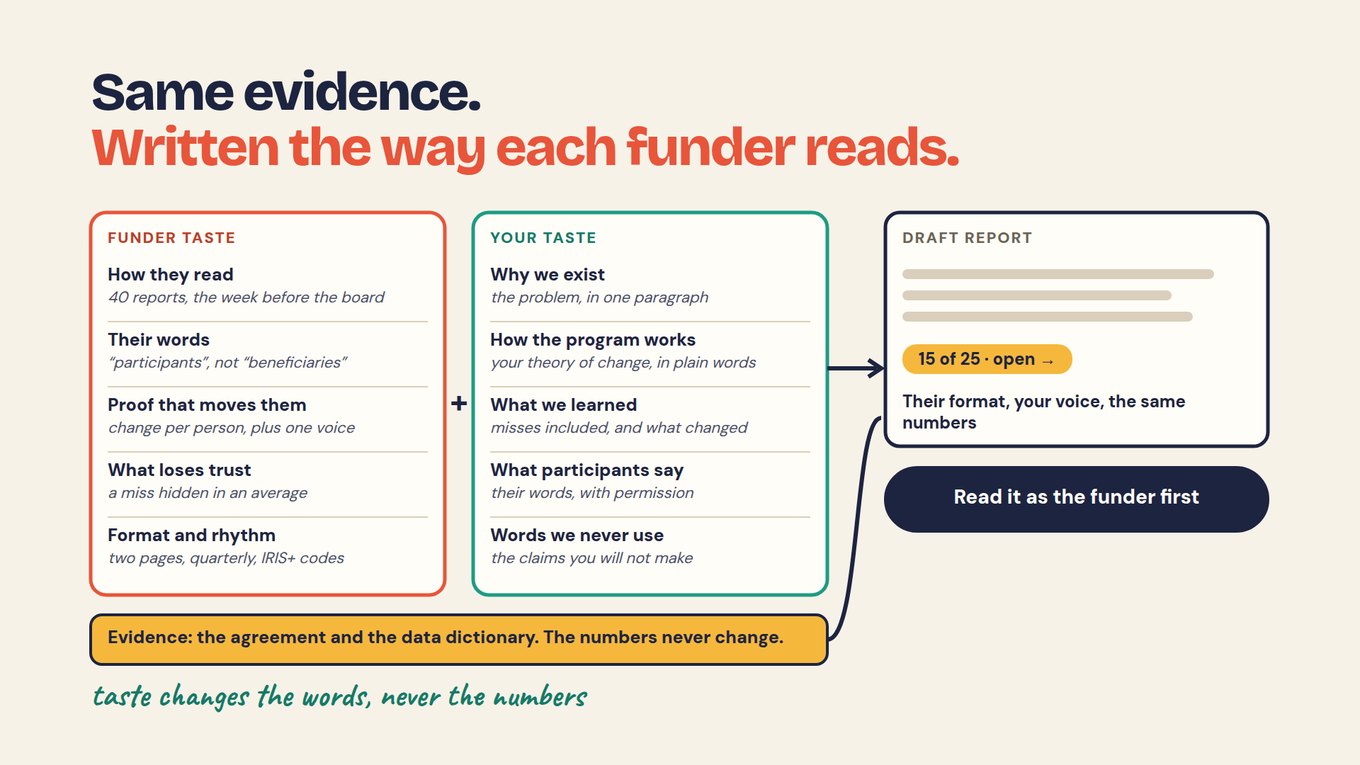
What changes this? Starting with data systems designed for continuous learning instead of annual reporting. When participant data stays connected from intake through completion — when qualitative feedback links directly to quantitative outcomes — reporting shifts from reconstruction to insight. You're not building a narrative months after the fact. You're sharing what's already visible because your data stayed clean and contextual throughout. That's the architecture behind nonprofit program intelligence.

▶ Watch Now

From Fragmented Data to Donor-Ready Reports in Minutes

See how AI-native impact reporting eliminates the 80% data-cleanup problem for nonprofits

6 Best Practices in Donor Impact Report Design

Professional design isn't decoration — it's decision architecture. These six practices separate reports that inspire continued giving from those that collect digital dust.

1. Lead With Donor Impact, Not Organizational Activity

Your executive summary should open with donor-funded outcomes, not operational updates. Replace "We served 500 families" with "Your support enabled 500 families to secure stable housing." Position donors as protagonists.

This works because donors scan for their role in transformation. Leading with organizational metrics forces them to translate activities into personal relevance — cognitive work most won't undertake when skimming.

2. Balance Numbers With Narrative Context

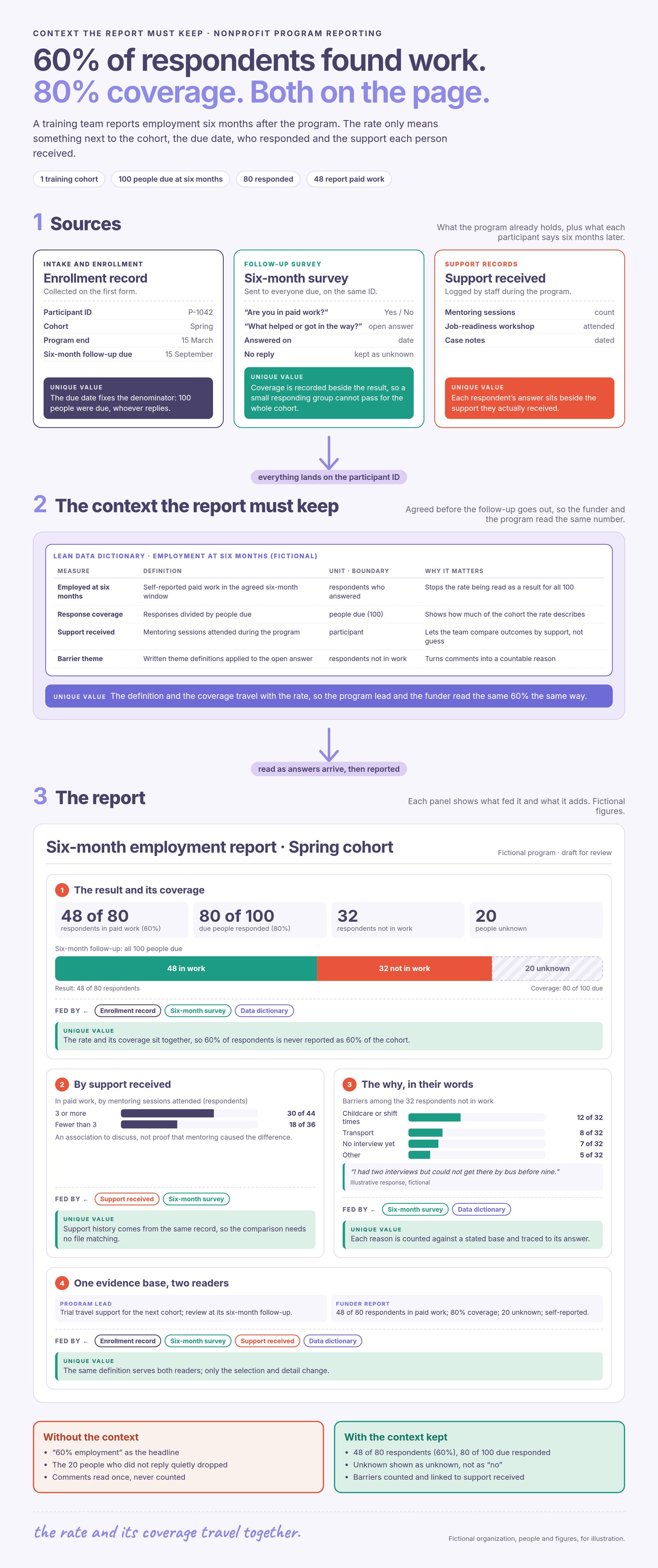
Quantitative data proves scale; qualitative stories prove significance. Show "87% of participants reported increased confidence" alongside one participant's specific journey. Data without context is noise; narrative without data is anecdotal.

The best impact measurement approaches integrate both automatically rather than requiring manual assembly — pairing every metric with the participant voices that explain why the number shifted.

3. Use Visual Hierarchy to Guide Attention

High-contrast data points, bold section headers, and generous white space create scannable reports. Place your most compelling outcome — the single "big win" — above the fold. Donors spend 20–40 seconds on initial scan. Clear hierarchy ensures they absorb your core message even without reading deeply.

4. Segment Reporting by Donor Investment Level

Major donors deserve personalized reports connecting their specific contribution to targeted outcomes. Mid-level donors receive cohort-based impact. General supporters get high-level aggregated results. One-size-fits-all reporting satisfies no one.

A $50,000 donor expects granular insight into how their funds moved specific metrics. A $250 donor wants to feel part of collective progress. Mismatched detail levels signal you don't understand their investment psychology.

5. Include Transparent Financial Breakdowns

Show exactly where dollars went — program costs, overhead, administration — using simple pie charts, not dense spreadsheets. If 82% went to direct services, lead with that. Honest explanations of variances build more trust than vague financial summaries.

6. End With Specific Next Steps

Reports that end with "thank you" feel transactional. Reports inviting continued partnership signal you view donors as long-term mission investors. Include specific calls to action: join monthly giving, schedule a site visit, introduce a corporate partner. Make continued engagement frictionless.

6 Best Practices in Donor Impact Report Design

The patterns that separate 80%+ retention reports from those that get archived unread

Practice 01

Lead With Donor Impact, Not Activity

Open with outcomes donors funded — position contributors as protagonists driving change from the very first sentence.

✓ "Your support enabled 500 families to secure stable housing"

Practice 02

Balance Numbers With Narrative

Quantitative data proves scale; qualitative stories prove significance. Donors need both to understand magnitude and meaning.

✓ 87% completion rate + one named participant journey

Practice 03

Visual Hierarchy Guides Attention

Bold outcome numbers, clear section headers, and ample white space ensure your core message lands in a 20–40 second scan.

✓ "Big win" metric in largest type, above the fold

Practice 04

Segment by Investment Level

Personalized for major donors, cohort-based for mid-level, aggregated for general supporters. One-size-fits-all satisfies no one.

✓ $50K donor ≠ $250 donor reporting needs

Practice 05

Transparent Financial Breakdown

Simple pie chart over dense spreadsheets. Even unfavorable ratios, explained honestly, build more trust than vague financial summaries.

✓ "82% direct services · 12% evaluation · 6% admin"

Practice 06

End With Specific Next Steps

Forward momentum, not just "thank you." Invite continued partnership: renew, visit, refer, join monthly giving. Make engagement frictionless.

✓ Reports ending with clear asks outperform by 28%

All 6 practices require clean, connected data — the foundation that makes reporting possible without 80% cleanup time

Donor Impact Report Examples That Drive Results

High-performing reports share identifiable patterns: they open with gratitude, quantify outcomes clearly, humanize data through named individuals, and end with forward momentum. These examples — drawn from real programs across sectors — reveal what separates reports donors read from those they archive unread.

See the full survey report examples library for live interactive reports you can study and adapt.

Example 1: Workforce Development Program (Digital PDF)

A regional nonprofit serving 18–24 year-olds transitioning from unemployment to skilled trades. Distributed digitally to 340 contributors.

What makes this work: An opening impact snapshot — single-page infographic showing 87% completion rate, $18.50/hr average wage, 94% six-month retention — demonstrates ROI immediately. Segmented storytelling features three participant journeys representing different entry points (high school graduate, formerly incarcerated, single parent). A transparent challenge section acknowledges that mental health support costs ran 23% over budget and explains how the gap was addressed — a move that increased major donor trust rather than undermining it.

Outcome: Donor renewal rate increased from 62% to 81% after introducing this format, primarily because major donors finally understood the causal connection between funding and employment outcomes.

Explore workforce training report examples →

Example 2: Scholarship Fund Program (Web + Video)

University scholarship program for first-generation students. Interactive website with embedded video accessed by 1,200+ visitors.

What makes this work: A video-first approach features scholarship recipients discussing specific barriers removed and opportunities gained — faces and voices building connection that data alone cannot. A live data dashboard shows real-time cohort progress: enrollment status, GPA distribution, graduation timeline. Comparative context — scholarship recipients' 93% retention versus the institutional average of 67% — proves program effectiveness without requiring donors to make that calculation themselves.

Outcome: A/B testing revealed "your gift removed barriers" outperformed "your gift provided opportunity" by 34% in time-on-page and 28% in donation clickthrough.

Explore scholarship program report examples →

Example 3: Youth Program Impact Report

Youth development program serving low-income families. Comprehensive report integrating survey data, interview transcripts, and observational notes.

What makes this work: A mixed-method approach provides multi-dimensional impact evidence rather than service volume. The report tracks participant outcomes — skill development, confidence measures, behavioral changes — not just headcount. Cost-per-impact transparency provides clear breakdowns showing funding allocation versus comparable programs. Direct quotes from youth and families create the human evidence that board members, funders, and donors remember.

Outcome: Comprehensive reporting format increased stakeholder confidence and led to expanded funding partnerships by demonstrating a systematic approach to evidence collection.

View youth program report example →

Example 4: Community Impact Report — Boys to Men Tucson

HIM Initiative serves BIPOC youth through mentorship circles. Community-focused report demonstrating systemic impact across schools, families, and neighborhoods.

What makes this work: The report connects individual youth outcomes to broader community transformation — 40% reduction in behavioral incidents, 60% increase in participant confidence — shifting focus from "what we did for participants" to "how participants transformed their communities." Multi-stakeholder narrative integrates perspectives from youth, mentors, school administrators, and parents. SDG alignment connects local mentorship work to UN Sustainable Development Goals, elevating program significance for systems-change funders.

Outcome: Community impact framing attracted school district partnerships that traditional individual-outcome reports couldn't access.

View community impact report →

What Separates Great Donor Reports From Generic Ones

Five elements — applied across workforce, scholarship, youth, and community examples

Element
Weak Approach
Strong Approach
Opening
"Thank you for your support this year…"
"Your $10K removed barriers for 23 students — here's what happened next…"
Data
"We served 500 families"
"72% remained housed at 12-month follow-up vs. 41% in comparable programs"
Stories
"Many participants reported positive experiences"
Named participant, specific transformation, direct quote with attribution
Financials
Dense spreadsheet buried in appendix
Simple pie chart on page 2: "82% direct / 12% eval / 6% admin"
Closing
"We look forward to your continued support"
"60% to goal. Your renewal funds 8 more students. Can we count on you?"
5 patterns present in all high-performing reports — workforce, scholarship, youth, and community programs
📈

Outcomes First

Lead with what donors funded, not what you did

👤

Named Individuals

Stories prove significance beyond statistics

💰

Cost-Per-Impact

$5K = 12 months mentorship for 8 students

📉

Baseline Compare

87% completion vs. 63% prior year

🎯

Specific Next Steps

Renew, visit, refer — not just "thank you"

Nonprofit Impact Report Template: The 6-Section Framework

This template provides the proven structure nonprofits use to transform donor reporting from obligation into opportunity. Adapt each section to your organization's voice while maintaining the core framework that connects contributions to outcomes.

Section 1 — Personalized Gratitude OpeningAcknowledge donors immediately before any organizational content. Include direct acknowledgment of their contribution level, recognition of continued support if applicable, and a brief statement connecting their gift to mission progress. Example: "Your $5,000 scholarship contribution joined 47 other donors to remove financial barriers for an entire cohort of first-generation students."

Section 2 — Executive Summary: Your Impact at a GlanceDeliver the "big win" in 60 seconds. Include 3–5 high-level outcome metrics, one standout achievement that exceeded expectations, comparison to baseline or prior period, and a visual infographic summarizing key numbers.

Section 3 — Program Narrative: Challenge → Intervention → TransformationTell the story of what donors funded. Context (what problem existed and who faced barriers) → Limitation (why traditional approaches fell short) → Transformation (what your program provided) → Result (measurable improvements with comparative data and at least one named individual story).

Section 4 — Financial Transparency: Where Dollars WentUse a simple pie chart or bar graph. Show percentage allocated to direct program costs versus overhead. Provide brief explanation of any significant variance. State audit status.

Section 5 — Stakeholder Voices: Direct TestimonialsLet beneficiaries speak directly to donors. Include 2–3 direct quotes, photos with consent, qualitative themes extracted from feedback surveys, and video testimonials where format allows.

Section 6 — Looking Forward: Next Steps and Continued PartnershipInvite ongoing engagement. Include upcoming expansions, remaining challenges, specific calls to action (renew, visit, refer), and direct contact for deeper partnership conversations.

✦ Sopact Nonprofit Programs

Stop Rebuilding Reports From Scratch Every Year

Sopact's nonprofit program intelligence connects clean data collection to personalized donor reports — outcomes, financials, and participant voices assembled in minutes, not months.

80% of reporting time eliminated through clean-at-source data
70–85% donor retention with personalized impact reports
4 min to generate a full donor-ready report with AI analysis
Already using spreadsheets for reporting? Sopact replaces the 40–80 hour annual cleanup cycle with continuous, clean data — so your next donor report is always ready.

Automating Donor Reporting Without Losing Authenticity

The tension in automated reporting is real: speed and personalization feel contradictory. Organizations fear that automation produces generic, soulless documents that damage relationships rather than strengthen them. This fear is valid — when automation is applied to bad data, you get bad reports faster.

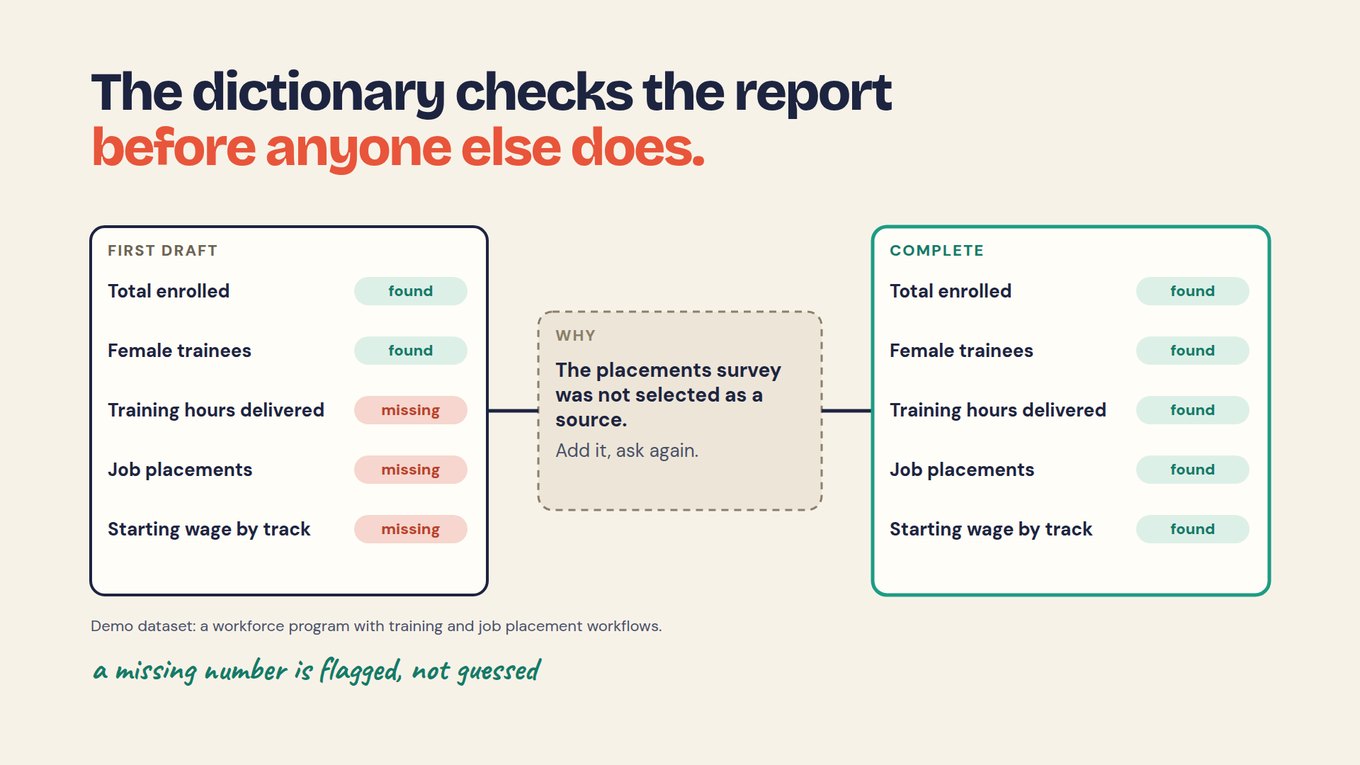
But automation applied to clean, continuously collected data produces something different: personalized, evidence-rich reports generated in minutes that are more authentic than manually assembled alternatives, because they draw from complete datasets rather than whatever fragments staff could locate under deadline pressure.

Sopact's approach operates across four analysis layers:

Intelligent Cell processes individual participant responses — extracting themes, sentiment, and confidence measures from open-ended feedback. What a participant writes about their experience becomes structured qualitative data in minutes, not months.

Intelligent Row creates participant-level profiles combining all responses, assessments, and interactions into coherent narratives. Reports generate participant stories pre-ranked by story strength — selected by evidence, not by which story the development officer happened to remember.

Intelligent Column aggregates across participants — calculating outcome metrics, identifying patterns, and answering the question donors and program staff most want answered: Why did metrics improve?

Intelligent Grid assembles everything into donor-ready reports. Staff type plain-language prompts and receive formatted output in minutes — ready for distribution or customization.

This is why AI-powered analysis replaces manual qualitative coding tools and produces more honest, more comprehensive, and ultimately more compelling donor reports. Every voice counted. Every pattern surfaced. Every story connected to measurable outcomes. Learn more about how nonprofit program intelligence works.

Donor Stewardship Reports: Impact Reporting as Relationship Management

Donor stewardship reports sit at the intersection of impact reporting and relationship management. While donor impact reports focus on proving outcomes, stewardship reports deepen the donor relationship — acknowledging their journey with your organization, showing how their feedback has shaped programs, and inviting continued partnership.

A strong stewardship report follows this structure: giving history acknowledgment (one paragraph), impact summary connecting contributions to outcomes (one to two paragraphs), one to two participant stories linked to their funding area, a forward look with specific upcoming opportunities, and a personal invitation to deepen engagement. Keep it to two pages maximum for individual donors — stewardship reports that feel like full annual reports lose the personal touch that makes them effective.

For foundation funders, stewardship blends with compliance — but the best reports go beyond required elements to demonstrate learning and adaptation. Foundation impact reports showing how evaluation findings improved programs (not just that data was collected) differentiate organizations as learning partners rather than mere grantees.

Donor Impact Report: Frequently Asked Questions

How often should nonprofits send donor impact reports?

Most nonprofits benefit from annual comprehensive reports to all donors, with quarterly updates for major contributors giving $10,000 or more. High-activity organizations running multiple campaigns should consider quarterly reporting broadly. The key is matching frequency to your program cycle and donor expectations — quarterly reports work when you have meaningful new outcomes to share every 90 days.

What's the difference between a donor impact report and an annual report?

Donor impact reports focus specifically on demonstrating how contributions created outcomes, positioning donors as protagonists driving change. Annual reports provide comprehensive organizational overviews including governance, strategy, and stakeholder messages beyond just donor-funded results. Many high-performing nonprofits now blend these formats, creating annual impact reports that emphasize donor-driven outcomes while including organizational context.

How do you measure the effectiveness of a donor impact report?

Track donor renewal rates comparing pre- and post-report periods, open and engagement rates for digital formats, and average gift increases among report recipients versus non-recipients. For digital reports, monitor time-on-page, scroll depth, video completion rates, and social sharing. Strong reports typically show 40–60% open rates, three to five minutes average engagement time, and lead to 15–30% increases in donor retention compared to organizations not reporting consistently.

What if our data shows programs underperformed or didn't meet goals?

Transparency builds trust more reliably than selective reporting. Acknowledge shortfalls directly, explain contributing factors honestly, and detail corrective actions taken. Donors respect organizations that learn from challenges rather than hiding difficulties. Organizations that report honestly during challenging periods often see stronger donor loyalty because transparency signals integrity and adaptive capacity.

How can small nonprofits create professional impact reports without large budgets?

Focus on clean data collection from the start rather than expensive post-production design. Use free tools for visual design, prioritize substance over elaborate formatting, and invest in platforms that keep data clean and centralized — eliminating the 40–80 hours typically spent preparing fragmented information. Sopact Sense addresses exactly this challenge, enabling small teams to produce professional reports in minutes rather than weeks.

What is the best software for nonprofit donor impact reporting?

The best donor reporting software depends on your needs. Traditional CRM tools generate basic acknowledgment reports but don't connect contributions to program outcomes. BI tools produce strong visualizations but require clean data input and technical staff. AI-native platforms like Sopact Sense integrate data collection, qualitative analysis, and report generation — producing donor-ready reports with blended outcomes and stakeholder voices in minutes from continuously clean data.

Should donor impact reports be public or only shared with contributors?

Most organizations publish general impact reports publicly while creating personalized versions for major donors showing their specific contribution's outcomes. Public reports build credibility with prospects researching your organization and demonstrate transparency to regulators and community stakeholders. Personalized reports for donors above certain thresholds should include contribution acknowledgment, specific program details their funding supported, and exclusive insights about upcoming initiatives.

What is donor reporting and why does it matter for nonprofits?

Donor reporting is the systematic practice of communicating program outcomes, financial accountability, and impact evidence to individuals and organizations that provide funding. It matters because it directly drives retention: organizations with strong, consistent donor reporting retain 70–85% of donors annually versus 40–50% for organizations with weak reporting. Strong donor reporting transforms one-time gifts into sustained partnerships that compound impact over time.

Sopact Nonprofit Programs

Create Donor Reports That Build Partnerships, Not Just Check Boxes

See how Sopact turns clean data into personalized donor impact reports in minutes — with outcomes, financials, and participant voices blended automatically.

Solution

Nonprofit Program Intelligence

AI-native data collection, qualitative analysis, and report generation — connected in one platform that eliminates the 80% cleanup problem.

Explore the solution →

Examples

Live Report Library

Real workforce, scholarship, ESG, and community impact reports — interactive, shareable, and updated automatically as data arrives.

View live reports →

Watch

AI Reporting Demo

See the Intelligent Suite generate a donor-ready impact report from a plain-English prompt — outcomes and stories in under 5 minutes.

Watch demo →

Ready to stop spending 80% of reporting time on data cleanup?
Book a 30-minute demo and see how Sopact transforms donor reporting from obligation into competitive advantage.

Get Started →